
Uganda Safari Transportation Guide
Uganda safari transportation affects every stage of a wildlife holiday, from airport pickup to the return journey. This guide explains 4×4 vehicles, roads, domestic flights, park transfers, and the practical choices that help first-time visitors travel comfortably. PrideMark Safaris shares route-planning considerations that can make the difference between a rushed itinerary and a rewarding safari.
How Uganda safari transportation shapes the entire journey
Uganda safari transportation is more than the vehicle that collects you from an airport. It determines how much daylight you spend watching wildlife, how comfortably you arrive at a lodge, and whether a gorilla trekking morning begins calmly. At PrideMark Safaris, we plan the route around actual activities, overnight locations, and sensible departure times rather than treating every park transfer as a simple distance on a map.
First-time visitors often underestimate the difference between driving across a city and travelling between national parks. A road journey may include paved highways, town traffic, winding hills, trading centres, and the final unpaved approach to a lodge. The most useful itinerary therefore shows both the destination and the purpose of the travel day, leaving room for meals, photographs, and unexpected delays.
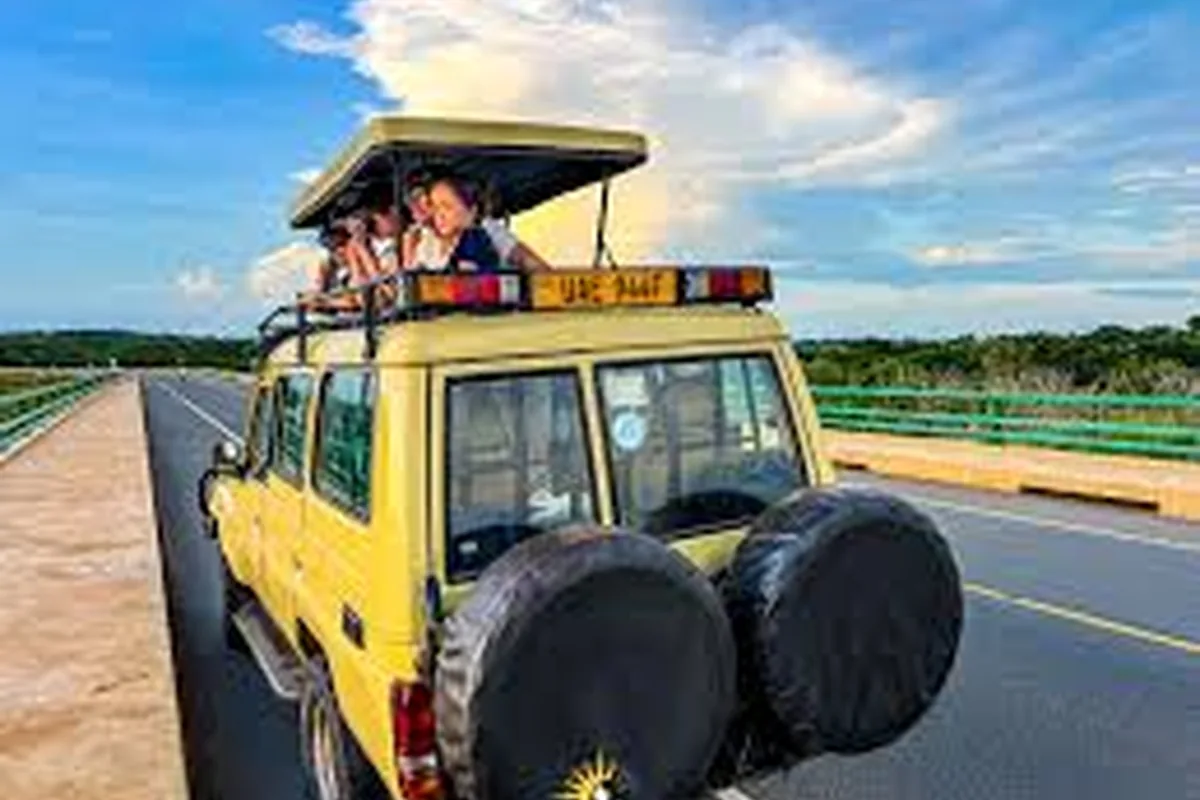
A safari vehicle with a pop-up roof, ideal for comfortable wildlife viewing and photography on a Uganda safari.
1. Choosing the right 4×4 safari vehicle
For Uganda safari transportation, a well-maintained four-wheel-drive vehicle is generally the practical starting point for a multi-park itinerary. Safari Land Cruisers are popular because of their ground clearance, luggage capacity, and suitability for changing road surfaces. A vehicle must still be matched to the group, however; a famous model name does not guarantee comfortable seating, good tyres, or a driver familiar with park conditions.
When PrideMark Safaris prepares a quotation, we recommend checking whether every traveller has an appropriate seat and a usable window for viewing. The roof configuration also matters. A pop-up roof can improve observation during permitted game drives, but it does not replace the need to remain seated and follow the guide’s instructions. The correct choice balances viewing, comfort, safety, and the itinerary’s road demands.
Before confirming Uganda safari transportation, ask how much luggage the vehicle can carry without filling the passenger cabin. Large hard-shell suitcases can become inconvenient when several people share one vehicle. Soft-sided bags are often easier to arrange, particularly when a trip also involves domestic flights. If you are travelling with children or require particular seating support, raise those requirements before the vehicle is assigned.
2. Safari Land Cruiser versus safari van
A safari Land Cruiser and a safari van are not interchangeable merely because both may have a raised viewing roof. The Land Cruiser is commonly selected for routes involving rougher tracks and longer multi-park journeys, while vans may suit certain paved-road transfers or budget-sensitive plans. Availability, actual vehicle condition, and access rules are more important than relying on a generic comparison of vehicle categories.
For Uganda safari transportation involving Bwindi, Queen Elizabeth, and Murchison Falls, PrideMark Safaris generally prioritizes vehicle suitability over a small headline saving. A lower-priced vehicle can be poor value if passengers are cramped or the planned route becomes uncomfortable. Ask for the vehicle type in writing and confirm whether the same vehicle remains with you for the whole trip or changes at a particular transfer.
Neither vehicle category should be described as automatically safe or unsafe. Maintenance, responsible driving, tyres, seat belts, and a knowledgeable driver-guide all contribute to the experience. Travellers should also ask whether the quoted vehicle has air conditioning, charging points, and adequate storage, while understanding that power availability and equipment can vary between individual vehicles.
| Vehicle choice | Potential advantage | What to confirm |
|---|---|---|
| 4×4 Land Cruiser | Useful for demanding multi-park routes | Seats, roof, luggage and condition |
| Safari van | May suit some transfers and budgets | Route suitability and viewing layout |
| Domestic flight plus transfer | Can reduce long driving days | Airstrip, baggage and road pickup |
3. Private transport or shared safari arrangements
Private Uganda safari transportation gives travellers more control over departure times, planned stops, and the rhythm of each day. That flexibility is especially valuable for photographers, families, and guests who want to spend longer at a wildlife sighting when park rules permit. Private transport does not mean unrestricted access: park operating procedures, activity bookings, and guide judgement still determine what is possible.
Shared arrangements can reduce the per-person vehicle contribution when compatible travellers and dates are available. However, a group tour only delivers the expected saving when a real departure exists and the inclusions are comparable. PrideMark Safaris recommends confirming the group size, seating arrangement, departure guarantee, and room-sharing assumptions rather than comparing a hypothetical shared price with a confirmed private quotation.
If one person becomes tired or wants an extra stop, a shared itinerary may have less room to adapt. This is not necessarily a disadvantage; many travellers enjoy the social atmosphere and predictable structure. The key is to choose Uganda safari transportation that matches your expectations, then check whether permits, lodging standards, and planned activities remain the same across both options.
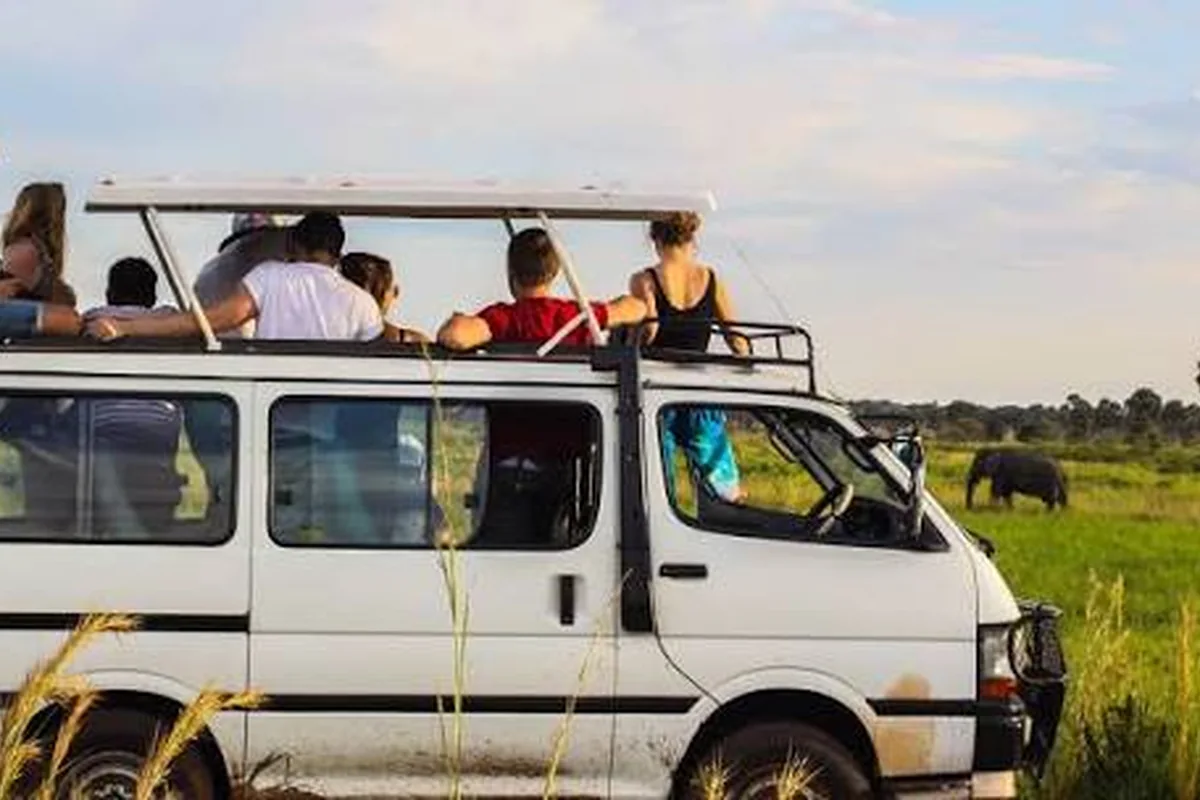
Safari travelers enjoying wildlife viewing from an open-roof vehicle in the African savannah.
4. Understanding road conditions in Uganda
Uganda safari transportation usually combines surfaced highways with sections of gravel, earth, or park tracks. Conditions change with weather, maintenance, construction, and the exact lodge approach. A map application may estimate a journey using ordinary driving assumptions that do not reflect slow wildlife roads or a cautious pace on steep sections. Treat online driving times as a starting reference, not a fixed promise.
The roads around southwestern Uganda can be winding, particularly when approaching highland communities and gorilla trekking sectors. Even where the surface is paved, bends, settlements, and heavy vehicles can reduce average speed. On park tracks, drivers may need to slow for animals, erosion, or wet patches. This is why a sensible itinerary avoids scheduling a long road transfer immediately before an activity with a strict reporting time.
PrideMark Safaris builds breaks into longer Uganda safari transportation days and recommends travelling during daylight where practical. Travellers should expect occasional dust on dry tracks and mud after rain. A vehicle’s four-wheel-drive system improves capability but does not remove weather limitations. When access changes, the responsible response is to adjust the route rather than promise a particular road will always be passable.
5. Why travel times are estimates rather than guarantees
A journey described as several hours can take longer because of traffic leaving Kampala, roadworks, weather, stops, and the final distance to a lodge. Uganda safari transportation should therefore be presented with approximate ranges and a clear note that the actual timing depends on conditions. Precision to the minute may look professional in a brochure, but it can create expectations no operator can reliably meet.
For a first-time safari, the best planning question is not simply how many kilometres separate two parks. Ask what time you will leave, whether lunch is planned en route, and what activity is realistically possible after arrival. A long transfer followed by an ambitious evening programme can make the day feel rushed even when the distance seems reasonable on paper.
When PrideMark Safaris reviews Uganda safari transportation, we also look at the position of the lodge within or outside a protected area. Two lodges marketed for the same park may require different approach roads and gate arrangements. That difference can affect sunrise departures, boat-cruise reporting times, and the next transfer. It is worth discussing before committing to a particular accommodation.
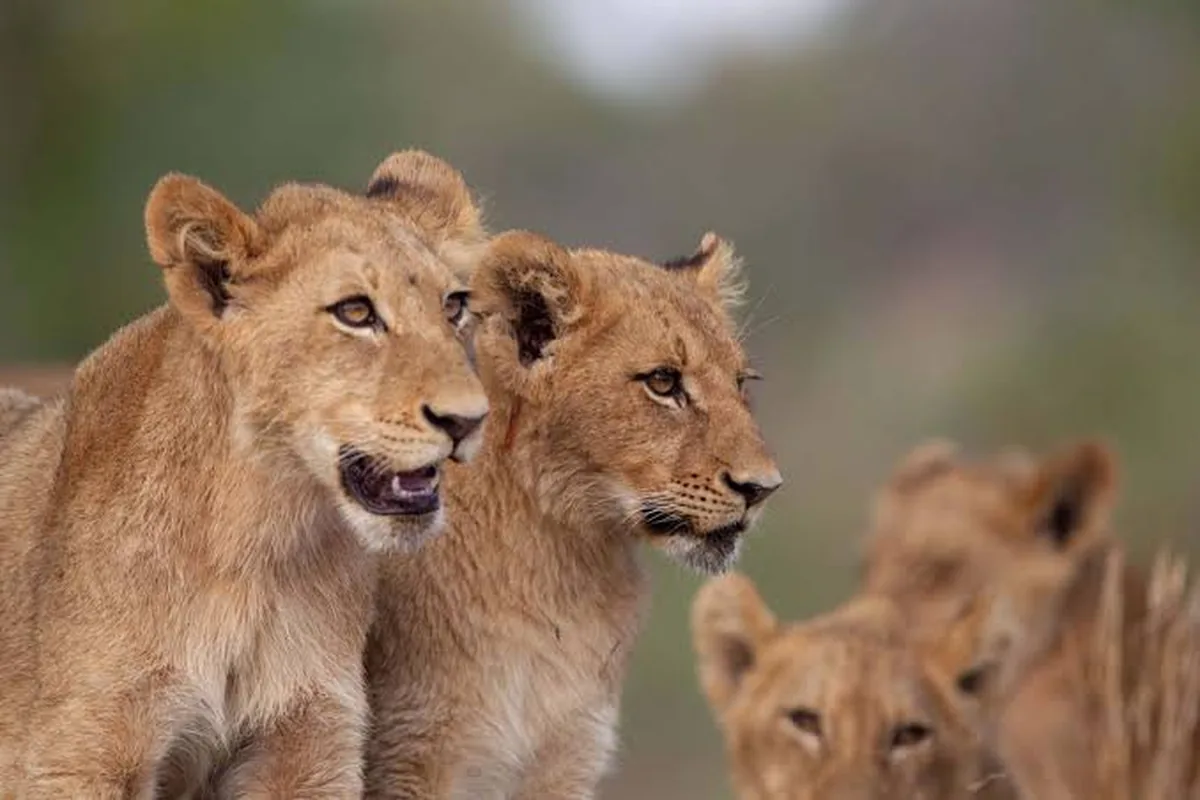
Young African lion cubs resting together, showcasing the remarkable wildlife visitors can encounter on an African safari.
6. Entebbe airport arrival and the first transfer
Entebbe International Airport is the usual international arrival point for Uganda safaris. Uganda safari transportation begins with a realistic airport collection plan that accounts for immigration, baggage, and the time of arrival. Travellers arriving late may be more comfortable sleeping in Entebbe before beginning a long drive. A same-day park transfer can work for some schedules, but it should not be assumed without checking flight details.
PrideMark Safaris asks clients to share the airline, flight number, and expected arrival time so the collection plan matches the booking. It is also useful to confirm the meeting point and the name or contact method of the person receiving you. An airport pickup should be straightforward, particularly after a long international flight, and the first night should allow enough rest for the following day.
For Uganda safari transportation starting from Kampala rather than Entebbe, city traffic can change the ideal departure time. A guide may recommend an early start to avoid spending valuable safari hours in congestion. Guests should also distinguish between Entebbe airport and Kampala city when comparing advertised transfer times; they are different starting points with different traffic patterns.
7. Entebbe to Murchison Falls National Park
Murchison Falls National Park is a popular northern stop on longer Uganda itineraries. Uganda safari transportation to the area is commonly arranged by road, with the precise approach depending on the booked lodge and intended activities. Some itineraries include a stop at Ziwa Rhino Sanctuary, but that visit requires its own timing and activity arrangements rather than being treated as an automatic roadside photo stop.
A well-paced Murchison Falls visit may include a game drive, a Nile boat excursion, and time to appreciate the waterfall from an appropriate viewpoint. Those activities take place in different settings, so transport planning should reflect departure points and park access. PrideMark Safaris prefers to reserve adequate time in the destination rather than squeeze several major activities into an arrival afternoon.
Visitors should confirm whether their lodge is on the north or south side of the park and whether a river crossing affects their programme. Access arrangements can change, so the route needs checking close to travel. Uganda safari transportation works best when the guide understands the lodge location, the booked boat departure, and the intended game-viewing sector before setting off.
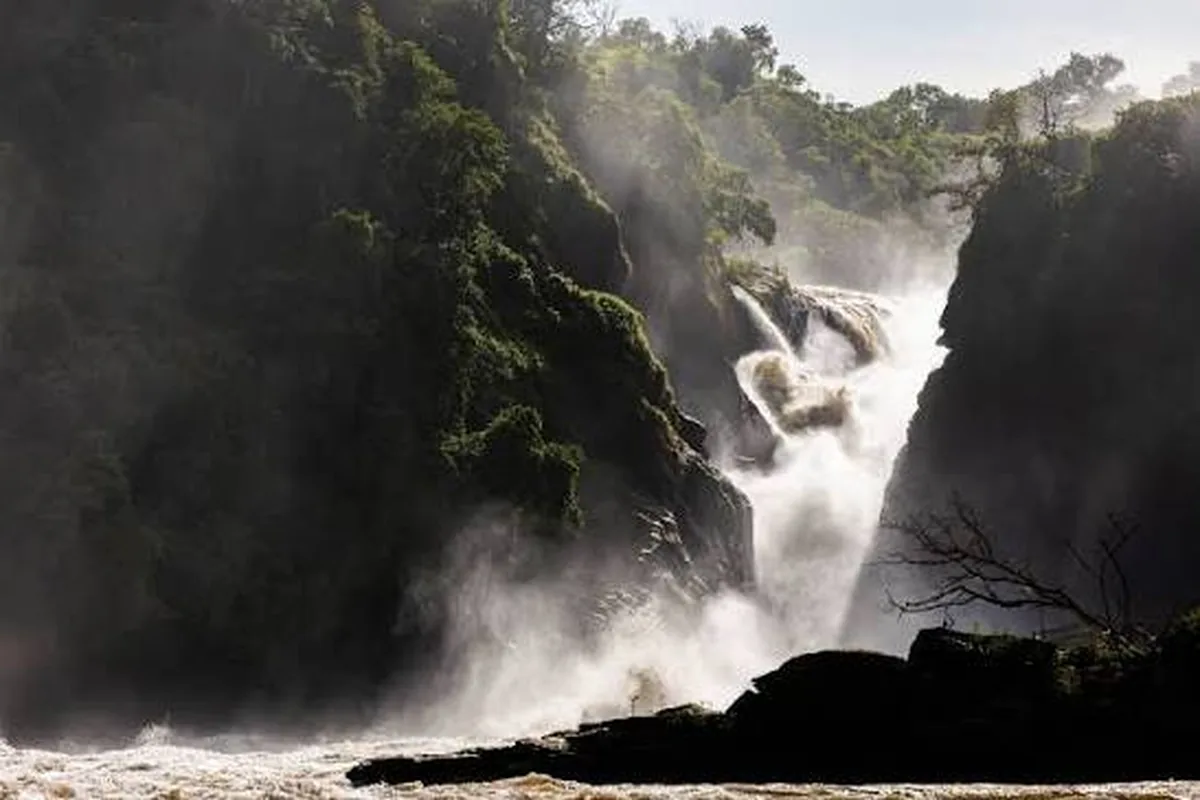
The spectacular Murchison Falls showcases Uganda’s dramatic natural scenery and unforgettable safari experiences.
8. Getting to Kibale Forest and chimpanzee tracking
Kibale National Park is an important destination for chimpanzee tracking. Uganda safari transportation to the forest often forms part of a wider western circuit linking Murchison Falls, Queen Elizabeth, and Bwindi. The drive is not simply a transit task: it may pass farmland, trading centres, tea-growing areas, and changing scenery that help visitors understand the country beyond the park gates.
Chimpanzee tracking is a scheduled activity, and guests should not assume they can arrive at any time and join a walk. Permit availability, reporting instructions, and the location of the activity meeting point need to be checked in advance. PrideMark Safaris normally considers an overnight stay in the area before a morning tracking session to reduce unnecessary pressure on the day.
When reviewing Uganda safari transportation around Kibale, check whether the accommodation is near the main tracking arrangements or requires a longer morning transfer. A lodge advertised as being in the Kibale area can still involve travel to the briefing point. Travellers who also want a community or wetland walk should allow separate time instead of assuming it is included in the tracking permit.
9. Queen Elizabeth National Park and Ishasha
Queen Elizabeth National Park combines savannah game viewing with the Kazinga Channel boat experience. Uganda safari transportation here depends on which sector you intend to visit. The northern game-drive areas, channel departure points, and Ishasha sector are not all in the same place. A route that sounds compact when listed under one park name may require meaningful driving between activities.
Ishasha is associated with tree-climbing lions, although a sighting can never be guaranteed. Travellers moving between Queen Elizabeth and Bwindi may be interested in visiting the sector when the route and road conditions permit. PrideMark Safaris recommends presenting this as a wildlife-search opportunity, not as a scheduled encounter, because animals choose where to rest and move.
Boat-cruise times and park entry arrangements should be confirmed separately from the vehicle transfer. Uganda safari transportation must allow enough time to reach the departure point before boarding. If the day also includes a game drive, the guide should choose a realistic order based on the booked session, lodge position, and available daylight rather than promising every possible activity.

A tree-climbing lioness rests on a large branch, showcasing one of Uganda’s remarkable wildlife safari experiences.
10. Reaching Bwindi Impenetrable National Park
Bwindi Impenetrable National Park is a major reason visitors choose Uganda, but its gorilla trekking sectors require careful planning. Uganda safari transportation to Bwindi should identify the actual booked trekking sector, not just the park name. Buhoma, Ruhija, Rushaga, and Nkuringo involve different approach routes and accommodation choices, so a lodge convenient for one sector may be unsuitable for another.
Gorilla trekking permits are issued for particular arrangements, and sector allocation is essential when building the itinerary. PrideMark Safaris recommends securing or verifying the trekking details before finalizing the lodge and transfer route. A hotel described as close to Bwindi is not enough information. The relevant question is how the guest will reach the correct briefing location at the required time.
Highland roads around Bwindi may be steep, narrow, or affected by rain. Uganda safari transportation plans should therefore leave a margin rather than treating a late-night arrival as routine. Guests can enjoy the forest setting more fully when they arrive with time to settle in, prepare their walking gear, and review the next morning’s instructions with their guide.
11. Bwindi trekking sectors and lodge location
Choosing a Bwindi lodge solely by photographs or price can create avoidable transfer problems. Uganda safari transportation depends on the relationship between the room you book and the trekking sector on your permit. A cheaper lodge may become poor value if it requires an impractical early drive over difficult roads. Sector suitability should be established before accommodation is presented as confirmed.
Buhoma and Ruhija are often discussed in relation to approaches from the north, while Rushaga and Nkuringo are important southern-sector options. That broad distinction does not replace route-specific planning. PrideMark Safaris considers the previous park, the following destination, and the confirmed trekking arrangements together so that a convenient location on one day does not create an unnecessary detour the next.
Visitors with mobility concerns should discuss them before selecting Uganda safari transportation and accommodation. The drive to a briefing point is only one part of the challenge; forest terrain and trekking duration vary. A comfortable vehicle cannot make a gorilla trek physically easy, but careful logistics can reduce avoidable fatigue before the walk begins.
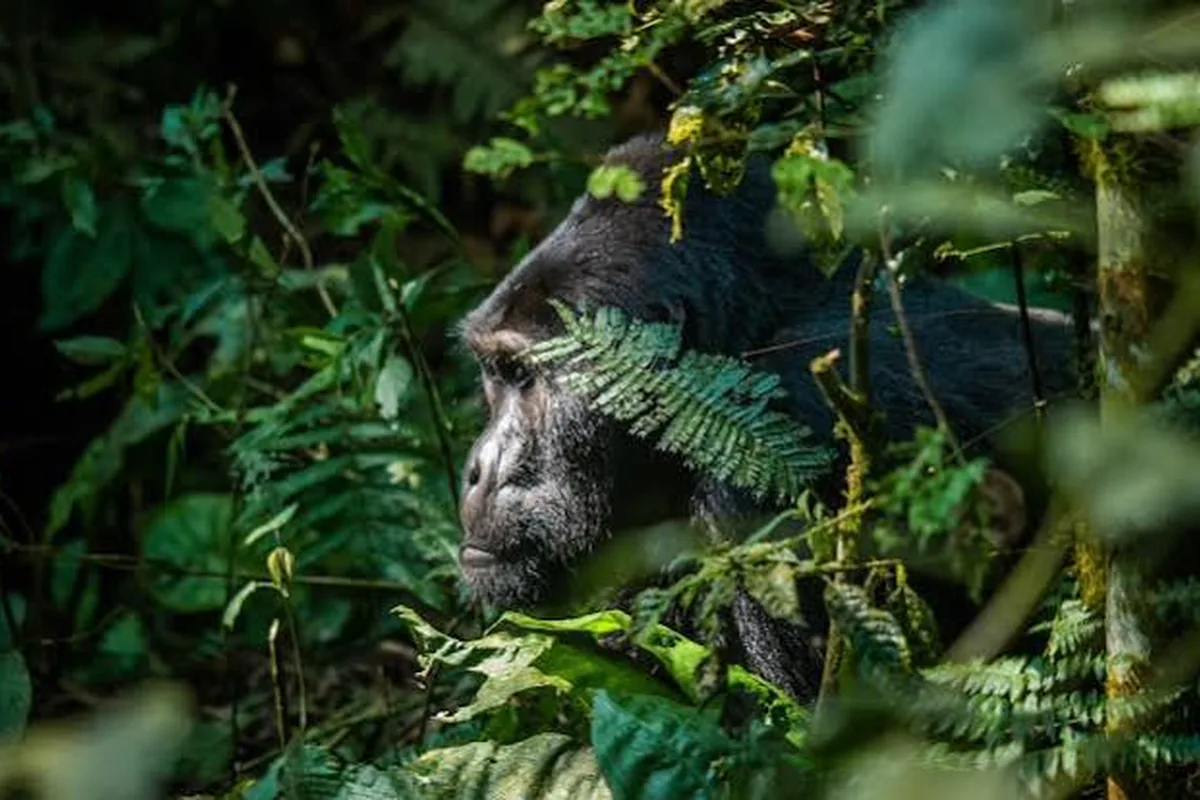
A chimpanzee rests among lush tropical forest vegetation, highlighting the fascinating primate encounters that make Uganda’s safari experiences distinctive.
12. Lake Mburo as a useful final wildlife stop
Lake Mburo National Park can fit naturally into certain road itineraries between southwestern Uganda and the Entebbe area. Uganda safari transportation planning may use the park as a wildlife stop that breaks a longer return journey, depending on the overall route. It should not be inserted automatically, however, because a worthwhile visit requires time for the activities travellers actually want.
Lake Mburo is known for landscapes and wildlife experiences that differ from Uganda’s forest destinations. Some activities may be guided on foot or by boat, subject to the relevant arrangements. PrideMark Safaris encourages visitors to choose the activity that complements the rest of the safari rather than repeating an experience simply because it appears in a standard itinerary.
For Uganda safari transportation, the timing of the final park stop matters especially when an international flight follows. We prefer not to rely on a lengthy same-day drive to meet a tightly scheduled departure. Road delays are possible, and an additional night near Entebbe may offer a calmer end to the trip for travellers with an early or important flight.
13. Domestic flights: when flying makes sense
Domestic flights can reduce time spent on long road transfers, particularly for travellers with limited holiday days or a preference for fewer hours in a vehicle. Uganda safari transportation by air is not always a direct door-to-door substitute for driving. Flights operate between specific airstrips, and a road transfer is still needed between the airstrip, lodge, and activity briefing point.
Flight schedules, routing, seat availability, luggage allowances, and operating conditions must be checked with the carrier. Some services are scheduled, while others may involve charter arrangements or intermediate stops. PrideMark Safaris recommends quoting the actual flight option available for the travel dates rather than assuming every park can be reached on demand at a fixed fare.
For Uganda safari transportation that includes a domestic flight, travellers should ask whether the quoted price covers airport transfers, airstrip pickups, baggage handling, and the vehicle used for local activities. A fly-in itinerary may still need a dedicated safari vehicle at the destination. Comparing only the airfare with the road vehicle cost can therefore produce a misleading impression of the total.

An AeroLink aircraft at an airstrip, illustrating domestic flights used for fly-in safaris in Uganda.
14. Flying to Bwindi: Kisoro and Kihihi
Kihihi and Kisoro are the airstrips commonly considered for access to different parts of the Bwindi region. Uganda safari transportation after landing still involves a road journey, and the appropriate airstrip depends on the confirmed trekking sector and lodge. Choosing the wrong arrival point can undermine much of the time saved by flying, so the airstrip should follow the itinerary rather than lead it.
Kihihi is often considered for northern Bwindi approaches, while Kisoro is frequently relevant for southern-sector itineraries. These are planning patterns, not universal rules. PrideMark Safaris checks the actual route and transfer arrangements because road conditions and lodge locations vary. Travellers should also ask whether their flight routing includes stops and whether weather could affect operations.
If a gorilla trek is the main purpose of the journey, it is sensible to allow a buffer between the flight arrival and the activity date. Uganda safari transportation by air can be convenient, but flight disruption is still possible. Booking a trek for immediately after an uncertain connection introduces a risk that is usually avoidable with better overnight planning.
15. Road safari versus fly-in safari
Road-based Uganda safari transportation gives visitors a closer view of changing landscapes and local life between parks. It can also make multi-stop itineraries more straightforward when destinations lie along a practical circuit. The trade-off is time: long drives may reduce the number of hours available for game viewing or relaxation, especially when travellers try to include too many regions.
Fly-in Uganda safari transportation can be appealing for shorter premium trips or travellers who find long journeys tiring. However, a flight does not eliminate all road transfers and may not align neatly with a multi-park sequence. A well-designed fly-in safari should explain which legs are flown, where local vehicles take over, and what happens if the published service changes.
PrideMark Safaris recommends comparing complete day-by-day plans rather than judging the options from a single price difference. One itinerary may offer more nights inside wildlife areas, while another offers more stops but less time at each. The best choice is the one that protects your priority experiences and gives you a realistic, enjoyable travel rhythm.
16. Domestic flight baggage and practical preparation
Baggage restrictions on smaller aircraft may be different from those on an international airline. Uganda safari transportation involving a flight should therefore be planned around the carrier’s current allowance, bag dimensions, and any applicable weight rules. Soft-sided luggage is often easier to accommodate, but the exact requirement must be confirmed for the booked service rather than assumed from another traveller’s experience.
Keep essential medication, documents, and valuables in a suitable personal bag within the carrier’s rules. Travellers bringing camera equipment should disclose bulky or heavy items before ticketing. PrideMark Safaris encourages guests to share luggage expectations early, because an itinerary that looks workable on paper can require adjustments if the group has more bags than the aircraft or transfer vehicle can accept.
Weather and operational decisions may affect small-aircraft services, and safety instructions from the carrier take priority over the original schedule. Uganda safari transportation plans benefit from some flexibility on flight days. If an international departure is at stake, a carefully chosen overnight buffer may be worth more than squeezing in one additional activity.

An AeroLink aircraft preparing for passengers at a remote airstrip, illustrating domestic air transfers for Uganda wildlife safaris.
17. Safari transfers and activity reporting times
Uganda safari transportation is closely connected to activity reporting times. Gorilla and chimpanzee trekking, boat excursions, and some guided walks have specific meeting arrangements. A lodge booking does not automatically reserve the activity, and a transport plan should not assume the guide can arrive whenever convenient. The activity confirmation needs to drive the departure time.
For morning trekking, PrideMark Safaris recommends preparing clothing, water, and essential documents the evening before. The guide can then confirm the planned departure based on the actual briefing location. This reduces confusion when several trekking sectors or activity meeting points exist within a broad destination area, and it helps travellers start an important day without unnecessary rushing.
Park gates and protected-area procedures may influence Uganda safari transportation, including where vehicles can travel and when particular roads are used. Travellers should follow the instructions of the guide and relevant authorities. If an activity is delayed or changed, the revised plan should be communicated clearly rather than quietly removing an inclusion from the day.
18. What a safari transport quotation should include
A clear Uganda safari transportation quotation should say whether the vehicle is private or shared, identify the expected vehicle category, and explain the role of the driver-guide. Fuel, guide allowances, and ordinary transfer costs should be listed consistently with the itinerary. If a flight is included, the quotation should distinguish the air ticket from airstrip transfers and destination-based game-drive arrangements.
PrideMark Safaris also recommends checking what is excluded. Park entry, boat excursions, permits, meals during transfers, and optional activities may appear in different parts of a safari quotation. A low transport line item does not necessarily mean the overall trip is cheaper if essential items have been moved into separate charges. Compare the complete trip, not one component.
Ask what happens if you request a different route, an additional destination, or a substantial change in daily driving. Uganda safari transportation costs can change with extra mileage, additional vehicle days, different lodge locations, or domestic flights. Transparent explanations help clients decide which adjustments are worth paying for and prevent misunderstandings after arrival.
| Cost item | Check in quotation | Why it matters |
|---|---|---|
| Vehicle | Private or shared; vehicle category | Comfort and per-person cost |
| Fuel and guide | Included or billed separately | Affects the real total |
| Flights | Ticket, luggage, airstrip pickup | Airfare alone is not door-to-door |
| Activities | Permits, park fees, boat excursions | Often separate from transport |
19. Understanding the cost of private safari vehicles
The per-person cost of Uganda safari transportation is influenced by how many travellers share the vehicle, the number of days it is needed, and the route it covers. A vehicle carrying one guest may cost much more per person than the same vehicle serving four travellers. This does not mean a larger group always has the better experience; comfort and viewing space still matter.
Fuel requirements, driver-guide time, accommodation logistics, and vehicle positioning can affect the final quotation. PrideMark Safaris avoids presenting a universal daily transport price as though it applies to every Uganda itinerary. A short transfer around Entebbe and a long circuit through several national parks involve different demands, even when the same category of vehicle is used.
When comparing Uganda safari transportation quotes, request the same number of travellers, dates, destinations, and inclusions. A cheaper offer may omit fuel, change the vehicle category, or assume different accommodation. If a quote looks unusually low, ask specific questions rather than assuming either that it is a bargain or that it is unreliable.
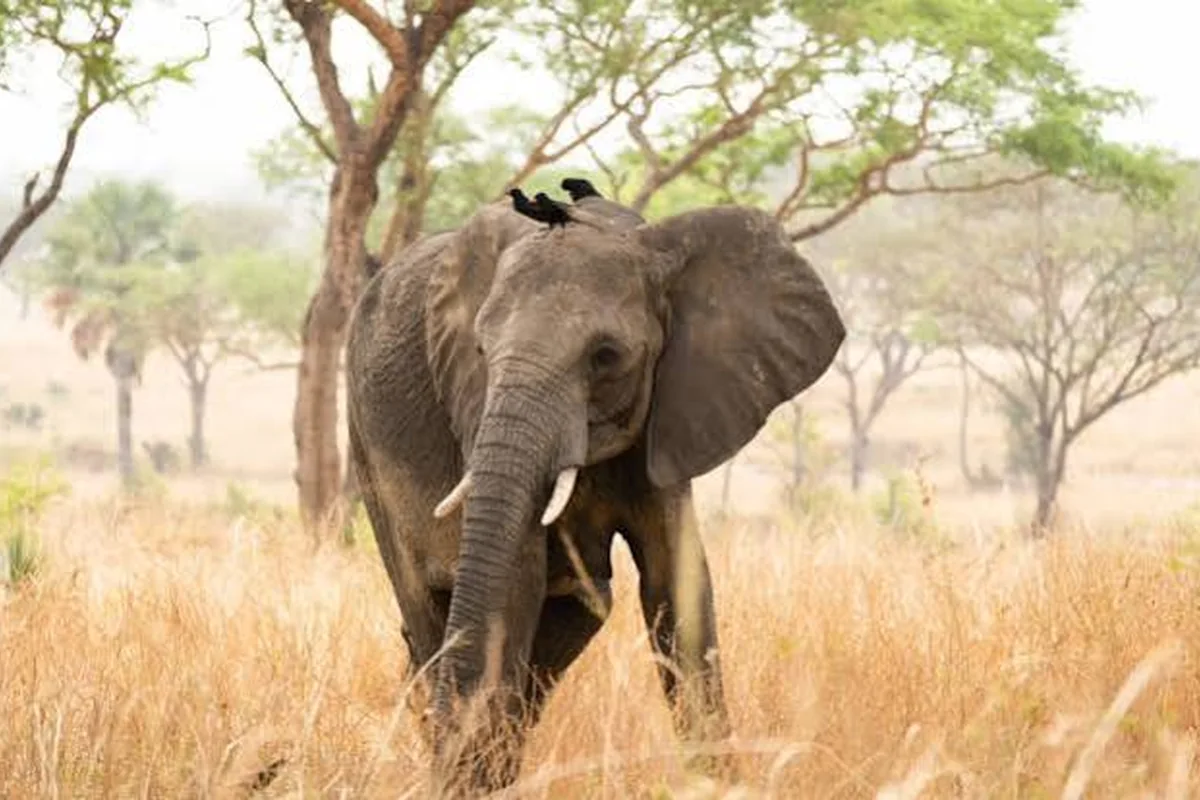
An African elephant walking through golden savannah grassland, with birds perched on its back.
20. Travel comfort on longer road days
Comfortable Uganda safari transportation starts before the vehicle leaves the lodge. Keep drinking water accessible, wear clothing suited to changing temperatures, and arrange small essentials so they do not need to be unpacked at every stop. Travellers who experience motion sickness may prefer particular seats and should discuss their needs with a qualified clinician before travel rather than relying on a guide for medical advice.
PrideMark Safaris encourages regular, sensible breaks on longer journeys, particularly for families and older guests. Breaks can be coordinated with safe stopping places and planned meals. The guide should avoid unnecessary speeding to recover lost time. Reaching the lodge slightly later but safely is preferable to treating an optimistic itinerary estimate as a deadline.
For Uganda safari transportation on dusty tracks, keep cameras protected when not in use and follow the guide’s advice about opening windows or the roof. During wildlife viewing, sudden movement and noise can disturb animals. Comfort and responsible behaviour are compatible: guests can enjoy excellent sightings while respecting park rules and the wellbeing of wildlife.
21. Travelling with children and family groups
Families should discuss ages, seating, and the daily pace when booking Uganda safari transportation. A vehicle that comfortably carries several adults may feel crowded once child seats, snacks, and luggage are added. Not every activity is appropriate for every age group, so the itinerary should be checked against the rules for trekking and other guided experiences before the family commits to the route.
PrideMark Safaris recommends balancing long drives with shorter activity days where possible. Children may enjoy a boat excursion or a relaxed game drive more than an exhausting series of transfers. Families should confirm whether appropriate child restraints can be provided and how the vehicle seating plan will work. Those arrangements are best made before arrival, not negotiated at the airport.
For Uganda safari transportation with children, the route should also account for meal times, rest stops, and the location of the next overnight stay. A good family itinerary is not simply an adult itinerary with smaller passengers. It protects the experiences everyone wants while keeping the day realistic for the youngest traveller.

Children and adults enjoying an educational nature walk and exploring their natural surroundings.
22. Transport planning for seniors and limited mobility
Uganda safari transportation can be adapted for many travellers who prefer a gentler pace, but individual needs should be discussed before a booking is confirmed. Step height, seating support, the length of drives, and the distance between parking areas and accommodation rooms can all affect comfort. A vehicle described as luxury may still be difficult to enter without assistance.
PrideMark Safaris encourages guests to describe practical requirements rather than relying on broad labels such as senior-friendly. For example, needing a low step, frequent breaks, or help with luggage gives the planning team something specific to address. Gorilla trekking presents separate terrain and access considerations that cannot be solved by selecting a comfortable road vehicle alone.
Where Uganda safari transportation includes flights, airport and airstrip assistance should be requested with the relevant provider in advance. Accessibility can differ substantially between locations. The most responsible plan is one based on confirmed arrangements, with clear alternatives if a particular transfer or activity is unsuitable.
23. Rainy weather and seasonal route adjustments
Rain can change the experience of Uganda safari transportation even when the itinerary remains the same. Some unpaved roads become slippery, visibility may fall, and a driver may need more time to cover a familiar route. Wet conditions can also affect the best choice of footwear and how luggage is packed. These possibilities should be explained without suggesting that travel becomes impossible whenever rain falls.
PrideMark Safaris recommends flexibility in daily timing during periods of unsettled weather. The guide may alter the order of stops or choose a more suitable road while preserving booked activities where feasible. Travellers should understand that the safest route is not always the shortest route displayed on a phone. Local conditions matter more than a fixed digital estimate.
Dry periods can make some tracks dusty, so Uganda safari transportation has practical considerations in every season. Wildlife viewing also depends on habitat, water availability, and animal movement, not simply whether roads are dry. A balanced safari plan takes seasonal patterns into account without making guarantees about weather or sightings.
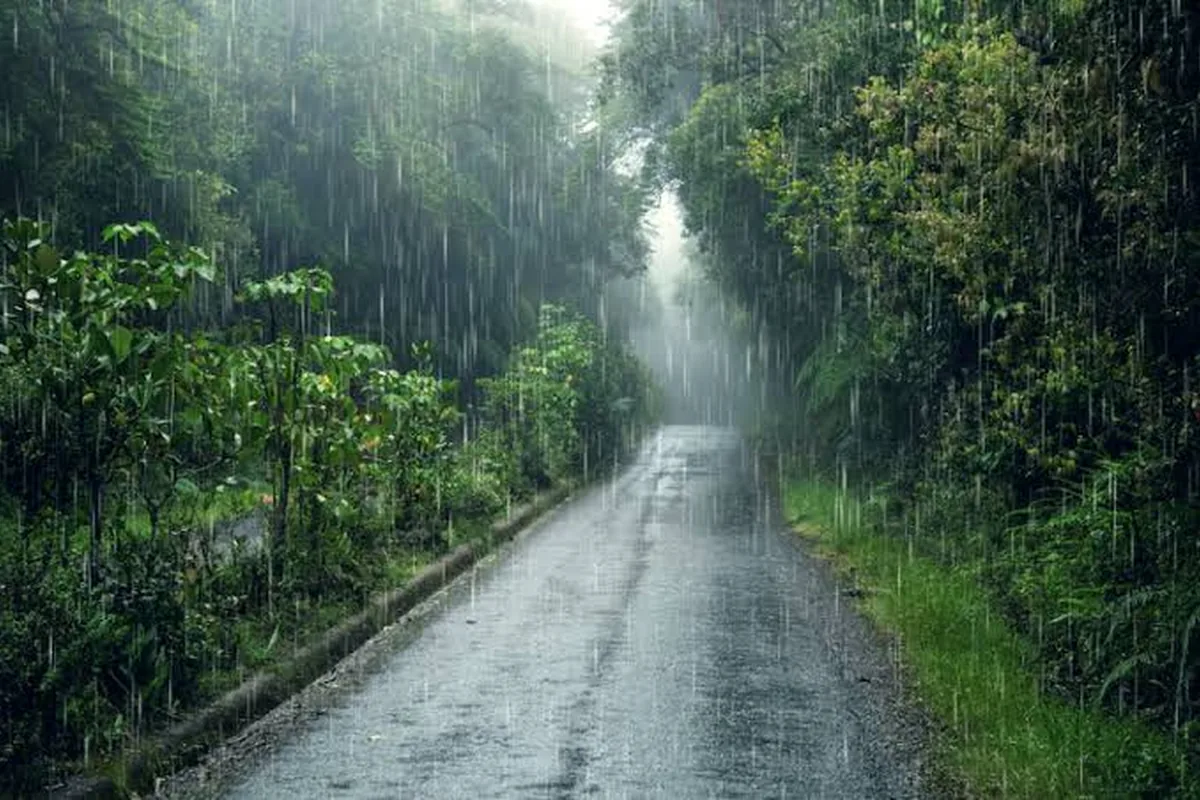
A forest road during heavy rainfall, illustrating the wet conditions travelers may experience during the rainy season.
24. Safety and responsible driving on safari
Safe Uganda safari transportation depends on responsible driving, a suitable vehicle, and respect for local rules. Seat belts should be used when the vehicle is moving, and passengers should follow instructions about when it is safe to stand for viewing. A pop-up roof is a viewing feature, not permission to lean dangerously outside the vehicle or approach wildlife.
PrideMark Safaris encourages guests to tell the guide if they feel uncomfortable with the pace or need a break. Responsible driving also means avoiding unnecessary night travel on unfamiliar rural routes where practical. Park animals have priority in their habitat, and vehicles should not block their movement or pressure them into a photograph.
For Uganda safari transportation, visitors should keep personal valuables secure and use common-sense precautions at stops. A guide can help identify appropriate places to pause, but travellers remain responsible for their documents and belongings. Safety information should be practical and proportionate, not based on exaggerated claims about the country or unrealistic promises that nothing can go wrong.
26. Cross-border journeys involving Rwanda
Some Uganda itineraries begin or end in Kigali, particularly when travellers want access to southwestern Uganda. Uganda safari transportation on a cross-border route requires more than estimating the road distance. Immigration procedures, visa eligibility, vehicle documents, and border operating arrangements should be checked for the actual nationality and travel dates of the guests.
PrideMark Safaris recommends confirming whether a quotation includes the private cross-border transfer and whether visas are excluded. These are separate items. Travellers should also know which border crossing is planned, because Cyanika and Katuna serve different route patterns. The most suitable crossing depends on the starting point, destination, road conditions, and relevant entry requirements.
Cross-border Uganda safari transportation may involve waiting time that cannot be guaranteed in advance. It is therefore unwise to place a tightly timed flight or trekking briefing immediately after an uncertain border transfer. Official immigration information should be checked close to departure rather than relying on an old blog post or an assumption that rules never change.
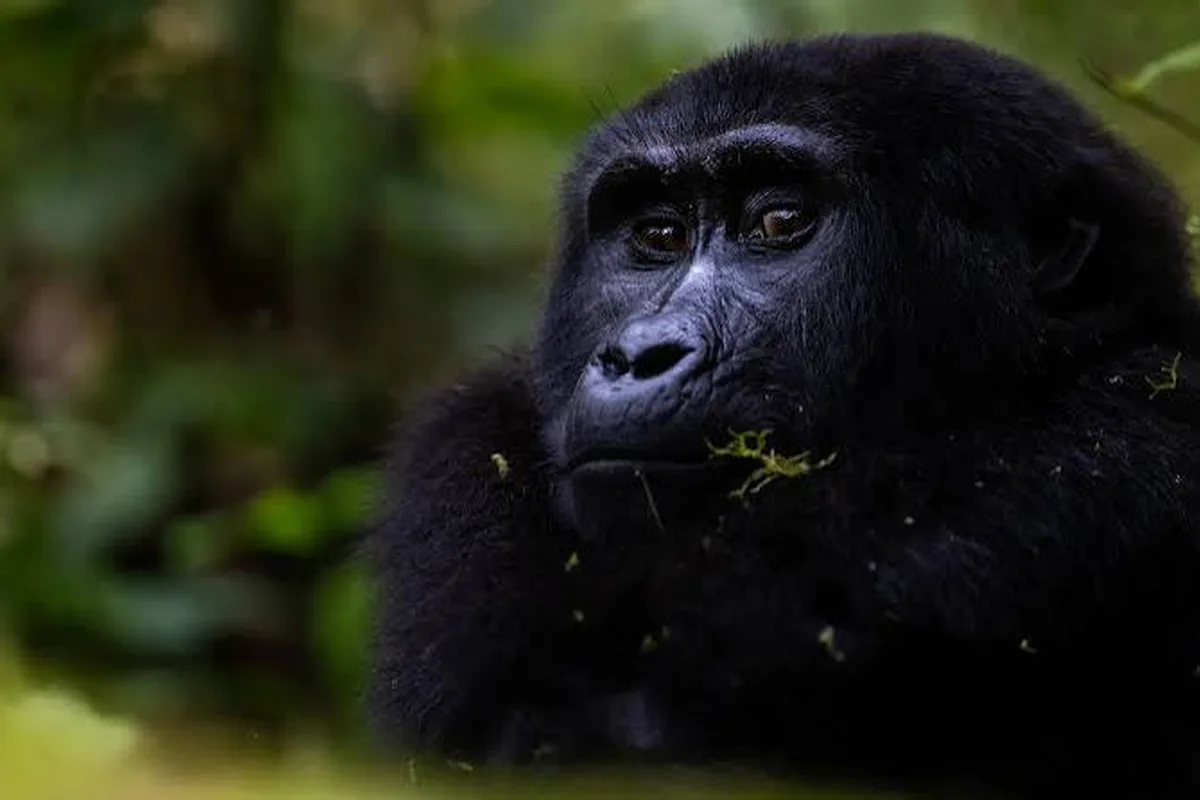
A mountain gorilla resting in its natural forest habitat, illustrating the remarkable wildlife encounters possible during gorilla trekking in Uganda.
27. A practical western Uganda safari route
A common planning approach is to connect Entebbe with Murchison Falls, Kibale, Queen Elizabeth, Bwindi, and a return toward Entebbe, sometimes including Lake Mburo. Uganda safari transportation on this circuit can be efficient when the number of nights reflects the activities chosen. It becomes less enjoyable if each park receives only a rushed arrival and departure.
PrideMark Safaris usually begins route design with the experiences travellers consider essential. Gorilla trekking and chimpanzee tracking have booking requirements, while boat excursions and game drives need realistic timing. The overnight sequence is then arranged to reduce unnecessary backtracking. This process is more reliable than starting with a fixed list of parks and trying to fit everything into an arbitrary number of days.
For Uganda safari transportation, the best circuit may change with flight arrival times, permit availability, lodge location, and whether the client wants a slower pace. A route map should be understood as a planning illustration until the details are confirmed. Two trips visiting the same parks can differ significantly in daily driving and comfort.
| Destination | Typical planning focus | Transport consideration |
|---|---|---|
| Murchison Falls | Game drives and Nile excursions | Lodge side and activity meeting point |
| Kibale | Chimpanzee tracking | Briefing time and lodge distance |
| Queen Elizabeth | Game drives and Kazinga Channel | Sector and boat departure point |
| Bwindi | Gorilla trekking | Correct permit sector and access road |
| Lake Mburo | Optional final wildlife stop | Time before international departure |
29. Questions to ask before confirming transport
Before paying for Uganda safari transportation, ask for the planned vehicle category, whether it is private or shared, and what happens if a replacement vehicle becomes necessary. Confirm fuel, driver-guide services, luggage capacity, and airport collection. If domestic flights are involved, ask for the airline, airstrip, baggage rules, and arrangements for local transfers after landing.
PrideMark Safaris also recommends checking the trekking sector, lodge location, park access arrangements, and activity reporting times. These details are connected. A beautifully presented itinerary can still contain an impractical transfer if a lodge is far from the confirmed gorilla briefing point or a boat departure is scheduled too soon after a long drive.
Ask how the operator handles reasonable changes caused by road conditions or flight disruptions. Uganda safari transportation is an operational service, not only a line in a brochure. Clear communication, transparent inclusions, and a workable contingency plan are more useful than promises that every journey will follow an exact minute-by-minute timetable.
30. Planning with PrideMark Safaris
At PrideMark Safaris, we approach Uganda safari transportation by connecting the practical details to the traveller’s priorities. We discuss arrival and departure flights, group size, preferred accommodation, trekking interests, and the amount of time guests want to spend in each destination. From there, we can propose a road-based, fly-in, or combined arrangement suited to the requested itinerary.
We encourage visitors to review the route carefully before confirming permits and lodges. Uganda safari transportation should reflect actual booking details, especially in Bwindi and Kibale, where activity locations matter. Our aim is to explain the options clearly so clients understand why a particular route or overnight stop has been recommended rather than simply accepting an unexplained transfer schedule.
If you are preparing your first Uganda safari, share your dates, number of travellers, arrival airport, and must-see wildlife. PrideMark Safaris can then discuss a suitable itinerary and provide a quotation showing the relevant transport arrangements and inclusions. The right plan gives you enough time to appreciate Uganda’s landscapes and wildlife without turning the journey into a race.
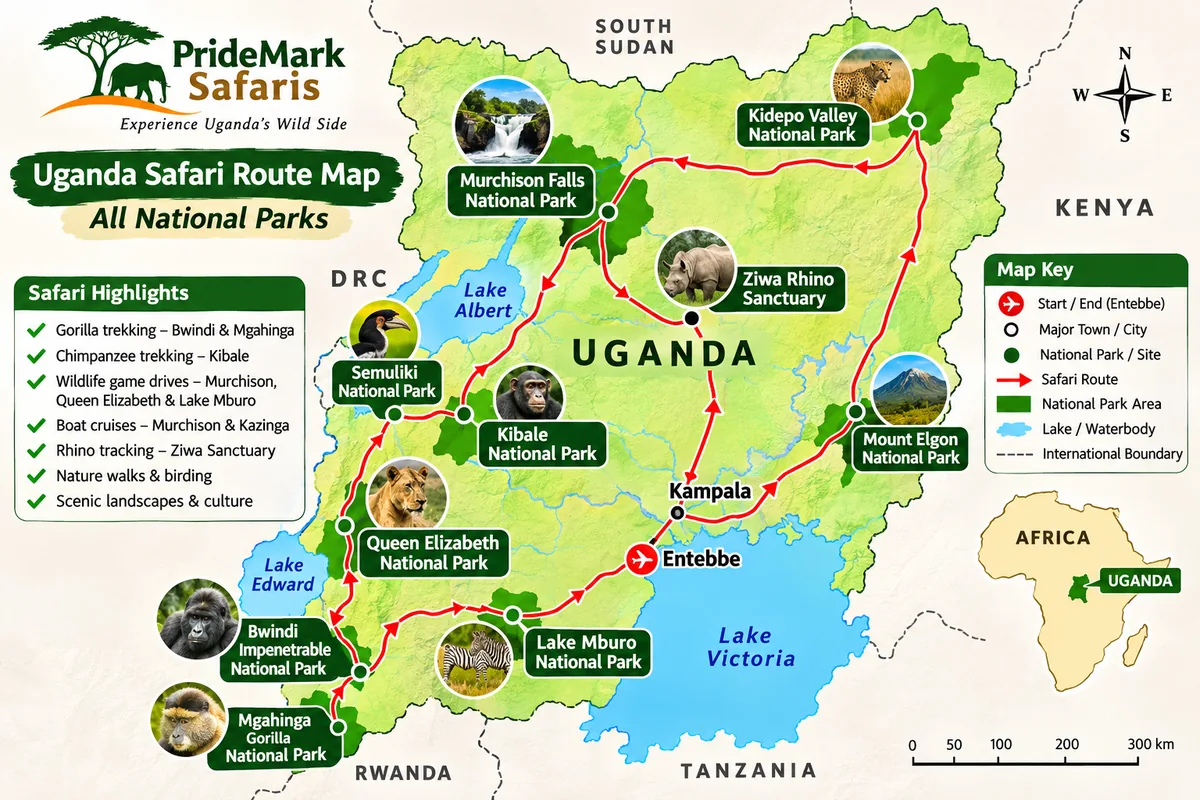
Illustrated Uganda safari route map highlighting national parks, wildlife destinations, and major safari attractions across Uganda.
Frequently asked questions about Uganda safari transportation
Is a 4×4 necessary for every Uganda safari?
A 4×4 is a sensible choice for many multi-park routes, especially where unpaved tracks and changing weather are involved. The actual requirement depends on the itinerary, road conditions, and park access. Ask which vehicle will be provided rather than assuming every transfer uses the same type.
Can I fly directly to Bwindi?
Flights can serve airstrips used for access to the Bwindi region, but they do not land at the gorilla trekking briefing point. The correct airstrip and onward road transfer depend on your booked sector and lodge. Confirm the flight schedule and transfer arrangements before purchasing.
Is driving from Entebbe to Bwindi possible in one day?
A road transfer may be arranged in one long day, depending on the destination sector, starting time, and conditions. It can be tiring, and the itinerary should leave enough rest before trekking. A flight or intermediate overnight stop may suit travellers who prefer less driving.
Are safari vehicles private?
Not automatically. Some quotations provide a private vehicle, while others assume a shared group departure. Check the wording, maximum passengers, luggage arrangements, and whether the vehicle remains with you for the full itinerary.
Do safari transport prices include fuel?
Some quotations include fuel, guide services, and vehicle costs together, while others separate them. Ask for written inclusions and exclusions. Park fees, permits, flights, and optional activities should be checked independently rather than assumed to be covered.
Can I travel between Uganda and Rwanda by road?
Cross-border road itineraries are possible subject to the relevant immigration and vehicle requirements. Confirm the planned border crossing, visa arrangements, and timing for your nationality and dates. Allow flexibility rather than scheduling a tight connection immediately after the crossing.
How early should we leave for gorilla trekking?
The departure time depends on the assigned trekking sector, lodge position, and official briefing instructions. Your guide should confirm it the previous evening. Staying near the correct sector is generally more useful than relying on a generic departure time published online.
Is a fly-in safari always better than a road safari?
No. Flying can save time on selected routes, but road journeys offer landscape experiences and may suit a multi-park circuit. A fly-in trip still requires transfers and may have baggage limits. Compare complete itineraries and confirmed services, not just the travel mode.
Can children join a safari road trip?
Families can arrange road safaris, but seating, suitable restraints, travel duration, and activity age restrictions require planning. The best itinerary balances wildlife experiences with breaks and realistic driving days. Share children’s ages before the route and vehicle are confirmed.
What should I do if a road is affected by rain?
Follow the guide’s safety instructions and allow the route to be adjusted when necessary. Four-wheel drive improves capability but cannot guarantee access on every road. A responsible operator should explain material changes and prioritize safe travel over an inflexible schedule.
Useful official resources and safari planning links
For current park information, consult the Uganda Wildlife Authority. For travel information, see Explore Uganda. Flight schedules and luggage rules should be checked with the operating carrier, while entry requirements should be verified through the appropriate official immigration authority before travel.
Explore Uganda safari packages, or contact PrideMark Safaris to discuss a route, trekking sector, vehicle choice, and realistic transfer plan. Your quotation should identify the confirmed inclusions rather than relying on assumptions about permits, park fees, or flights.