

Why Do Safari Vehicles Have Open Sides or Top? Is It Safe? What Travelers Should Know
Quick answer:
Yes, professional safari vehicles with open sides or pop-up roofs can be very safe when they are properly operated and travelers follow their guide’s instructions. The open design is not simply for appearance. It is specifically intended to improve wildlife viewing, photography, visibility and ventilation while passengers remain inside the vehicle. In Uganda, customized 4×4 safari vehicles with pop-up roofs are commonly used for game drives because they provide an elevated viewing position without requiring travelers to leave the vehicle. Safari vehicle safety is crucial.
If you are planning your first African safari, one of the first things you may notice is that safari vehicles look very different from ordinary cars. Instead of a completely enclosed roof, many have a section that lifts upward. Others have large open-sided viewing areas or canvas-covered sections that can be opened during wildlife encounters. For someone who has never experienced a game drive before, this naturally raises an important question: why do safari vehicles have open sides or tops, and is it actually safe?
The answer is closely connected to the way wildlife is observed. A safari vehicle is not simply transportation between a lodge and a national park. It is also a viewing platform. The vehicle is designed to take travelers into wildlife areas while providing enough height, visibility and protection for them to observe animals from inside. In Uganda, safari operators commonly use customized 4×4 vehicles, including Land Cruiser-based vehicles and safari vans, with pop-up roofs designed for game viewing. Some Ugandan safari vehicle suppliers specifically describe these vehicles as being modified for elevated wildlife viewing and photography.
The most important thing to understand is that an open safari roof does not mean that passengers are simply exposed to wild animals. In a proper pop-up-roof vehicle, travelers stand inside the passenger compartment and look through the raised roof opening. They do not climb onto the roof or leave the vehicle. The vehicle, the trained driver-guide, wildlife regulations and responsible passenger behavior all work together to create a controlled wildlife-viewing experience.
Why Do Safari Vehicles Have Open Sides or Pop-Up Roofs?
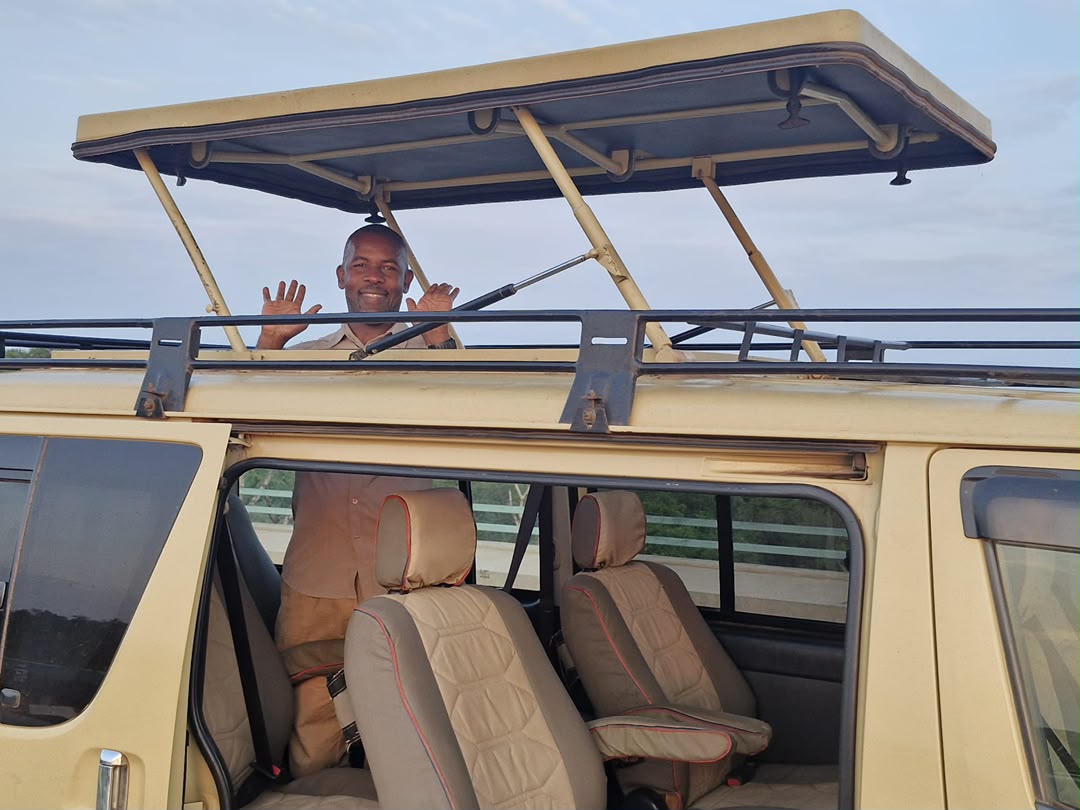
Open roof van for a good safari experience
The main reason is visibility. Wildlife does not always appear conveniently beside the road. An elephant may be partly hidden behind bushes, a lion may lie low in grass, or a herd of antelope may be several hundred metres away. A conventional closed vehicle can restrict what passengers see through its windows and roof. A raised safari roof gives passengers a higher viewpoint and allows them to look over vegetation.
The design is also extremely useful for photography. When travelers photograph through ordinary glass, reflections and window frames can interfere with the image. A pop-up roof allows a photographer to raise a camera above the vehicle and find a much clearer line of sight. This is one reason safari photographers often prefer a vehicle designed specifically for wildlife viewing.
There is also an experiential reason. A safari is about more than simply ticking animals off a list. Travelers come to hear birds, feel the breeze, observe the landscape and experience the atmosphere of the wilderness. A raised roof creates a much stronger sense of connection with the surroundings while still keeping passengers within the vehicle.
In Uganda, different operators use different vehicle configurations. Some have Land Cruiser-based vehicles with pop-up roofs, while others use customized safari vans. Seating capacity, roof design, air conditioning, luggage space and window arrangements can vary considerably. Therefore, travelers should ask their safari company what type of vehicle will be used rather than assuming that every safari vehicle is identical.
What Is a Pop-Up Roof Safari Vehicle?
A pop-up roof safari vehicle is normally a customized 4×4 or safari van with a section of the roof that can be lifted during game drives. The opening creates an elevated viewing position where passengers can stand inside the vehicle. When the roof is closed, the vehicle functions more like a conventional enclosed vehicle for transfers and changing weather conditions.
This design gives travelers a useful combination of comfort and wildlife visibility. During a long road journey, the vehicle can remain enclosed and air-conditioned where applicable. Once the group enters a suitable wildlife-viewing area, the guide can raise the roof so passengers can enjoy a much wider view.
Some Uganda safari vehicles are also configured so that passengers have individual window seats. This is particularly useful for small private groups because everyone gets a reasonable opportunity to photograph and observe wildlife instead of competing for a single window.

Is an Open-Top Safari Vehicle Safe?
Yes, when properly operated, an open-top safari vehicle can be a safe way to experience wildlife. However, it is important to be precise about what “safe” means. No wildlife encounter can ever be described as completely risk-free. Travelers are entering a natural environment containing large and unpredictable animals. The safety of the experience therefore depends on professional vehicle operation, appropriate distance, responsible wildlife viewing and passenger behavior.
The driver-guide plays a particularly important role. A professional guide understands the roads, knows how animals commonly behave and can recognize changes in an animal’s body language that visitors may not notice. The guide decides how close the vehicle should approach, when to remain stationary and when it is better to move away.
Uganda Wildlife Authority guidance for Murchison Falls National Park, for example, emphasizes wildlife and visitor safety through measures including speed limits, restrictions on unnecessary stopping and prohibitions on hooting and feeding animals. The guidance states that the park’s speed limit is 40 km/h and explains that these measures are intended to protect both people and wildlife.
The golden safari safety rule:
Never assume that an animal is harmless because it appears calm. Stay inside the vehicle, keep movements controlled, remain quiet when appropriate and follow your driver-guide’s instructions immediately.
Why Don’t Wild Animals Usually Attack Safari Vehicles?
Many first-time safari travelers are surprised when they see an elephant, lion or buffalo standing relatively close to a vehicle without immediately reacting to the people inside. This happens partly because wildlife in frequently visited safari areas can become accustomed to seeing vehicles. To the animal, the vehicle may simply be another large object moving through its environment.
This does not mean that wild animals are domesticated or that they cannot become aggressive. A vehicle should never be treated as an invisible protective bubble that makes careless behavior acceptable. Animals can react when they feel threatened, surprised or cornered.
For this reason, guides avoid unnecessary disturbance. They do not want passengers shouting, waving objects, feeding animals or trying to force a reaction for a photograph. Responsible safari tourism is about observing natural behavior rather than manipulating it.

Can You Stand Through a Safari Vehicle Roof?
Yes, if the vehicle is specifically designed with a pop-up roof, standing through the roof opening is one of the main purposes of the design. Travelers can stand inside the passenger compartment and raise their upper bodies above the normal roofline to obtain a wider view.
However, there is an important distinction between standing through a purpose-built roof opening and climbing onto the exterior of the vehicle. Travelers should never sit on the roof, climb onto the vehicle or lean dangerously outside it. The roof is designed to create a controlled viewing position, not to turn the vehicle into an open platform where passengers can move freely.
Your guide may also ask everyone to sit down or lower themselves during certain wildlife encounters. When that happens, follow the instruction immediately. The guide may have noticed a change in an animal’s behavior that passengers have not yet recognized.
Open-Sided Safari Vehicles vs Pop-Up Roof Vehicles
The terms “open safari vehicle,” “open-top safari vehicle,” “open-sided safari vehicle” and “pop-up roof safari vehicle” are sometimes used interchangeably. However, the actual vehicle designs can be different. Some vehicles have a hinged roof section that opens upward, while others have large removable or roll-up window sections. Some specialist game-drive vehicles are much more open than the safari vehicles commonly used for long-distance Uganda itineraries.
| Vehicle Type | Typical Design | Main Advantage | Best For |
|---|---|---|---|
| Pop-up roof Land Cruiser | 4×4 with a raised roof section | Excellent elevated wildlife viewing | Private safaris, photography and small groups |
| Safari van | Customized van with pop-up roof | Good visibility and larger passenger capacity | Families and larger groups |
| Open-sided safari vehicle | Large open viewing areas, sometimes with canvas protection | Excellent airflow and immersion | Dedicated game drives |
| Closed 4×4 | Conventional enclosed cabin | Greater protection from weather and dust | Road transfers and travelers wanting more enclosure |
What Are the Advantages of a Pop-Up Roof Safari Vehicle?
Better Visibility
The elevated viewing position makes it easier to see animals beyond grass, shrubs and other vegetation.
Better Photography
The raised roof reduces obstructions and allows photographers to position cameras more freely.
More Immersion
Travelers can hear birds, feel the breeze and experience the landscape more naturally while remaining inside the vehicle.
Better Wildlife Visibility
The elevated position is especially useful in open savannah environments. Instead of looking horizontally through a window, passengers can raise themselves above the vehicle’s roofline and scan a much larger section of the landscape. This is particularly useful when searching for lions, antelope, giraffes and other animals that may be partially hidden.
Better Wildlife Photography
Photography is one of the biggest reasons travelers request a pop-up roof. Without glass between the camera and the subject, photographers can avoid many reflections and obstructions. The extra height also provides more opportunities for clear shots when vegetation is present.
A More Immersive Safari
A safari is an experience of the entire environment, not just the animals. With the roof raised, travelers can hear birds and insects more clearly and experience the changing atmosphere of the park. Early morning drives can feel completely different from midday drives, and the open viewing position makes those changes easier to appreciate.

What Are the Risks of an Open Safari Vehicle?
An open safari vehicle is not completely without risk. Travelers should understand this before booking. Wildlife is unpredictable, roads can be rough, weather can change quickly and passengers may occasionally be close to powerful animals.
The greatest avoidable risks usually come from poor behavior rather than the existence of the open roof itself. Shouting at animals, waving objects, feeding wildlife, making sudden movements or attempting to leave the vehicle can create unnecessary situations.
Another consideration is the weather. Uganda can experience strong sunshine and sudden rainfall. Travelers should therefore carry sunscreen, drinking water, sunglasses and a lightweight waterproof jacket. Dust can also be significant on dry-season game drives, so cameras and other electronic equipment should be protected.
Important:
Never leave a safari vehicle because an animal appears far away or uninterested. Always ask your guide before getting out. In wildlife areas, distance can be difficult to judge and animal behavior can change quickly.
Safari Vehicle Safety Rules Every Traveler Should Know
A safe safari begins before the vehicle enters the park. Listen carefully to the guide’s briefing and ask questions if you do not understand the roof system, seating arrangements or rules about standing.
Once inside the park, keep your voice low when animals are nearby. Never feed wildlife. Do not throw food or objects. Avoid shouting or attempting to attract an animal’s attention. Keep your hands and body within the intended passenger area and never climb onto the roof.
Uganda Wildlife Authority guidance specifically prohibits activities such as feeding wildlife and hooting because they disturb animals and can create dangerous situations. The same guidance also emphasizes speed control and restrictions on unnecessary stopping within Murchison Falls National Park.
Are Open Safari Vehicles Safe Near Elephants?
Yes, professional guides routinely conduct elephant sightings from safari vehicles. However, elephants are extremely powerful animals and their behavior must always be respected. A relaxed elephant may continue feeding while a vehicle is nearby, but an animal that feels threatened can react very differently.
The guide therefore considers the elephant’s position, body language, the road and the surrounding vehicles before deciding where to stop. Passengers should not pressure the guide to move closer simply because another vehicle has stopped nearby.
Are Open Safari Vehicles Safe Near Lions?
Lions are among the animals travelers most want to see on safari, and they can sometimes be observed resting near roads. Because they are predators, their behavior may be difficult for an inexperienced visitor to interpret. The guide remains responsible for positioning the vehicle appropriately.
Passengers should remain calm and avoid sudden movements. A lion looking directly at the vehicle does not necessarily mean it is preparing to attack, but it is another reason to let the professional guide manage the encounter.

Are Safari Vehicles Safe for Families With Children?
Families can enjoy safari vehicles, but children should be supervised carefully. A child seeing an elephant or lion for the first time may become excited and want to stand, shout or move closer to the edge of the vehicle.
Parents should explain the basic safari rules before entering the park. Children should know that wild animals must not be called, fed, touched or approached. They should also understand that the guide’s instructions must be followed immediately.
Families should tell their safari company about the ages of children before the trip. This allows the operator to recommend an appropriate vehicle, seating arrangement and itinerary.
Why Safari Vehicles Are Usually 4x4s
Safari vehicles need to do much more than provide a good view. Uganda’s national parks contain dirt roads, uneven tracks, mud, rocks and changing road conditions. A vehicle must therefore be capable of handling difficult terrain while carrying passengers comfortably.
Four-wheel-drive safari vehicles are popular because they combine ground clearance, traction and durability with the specialized modifications required for wildlife viewing. Ugandan safari vehicle providers commonly describe pop-up-roof Land Cruisers as 4×4 vehicles modified specifically for game viewing.

What Should You Ask Your Safari Company About the Vehicle?
Before booking a Uganda safari, ask specific questions about transportation. Instead of simply asking whether a safari vehicle is provided, ask whether it has a pop-up roof, how many passengers it carries, whether everyone has a window seat, whether it has air conditioning and whether the same vehicle will be used for long transfers and game drives.
Photography-focused travelers should also ask about luggage and camera space. A vehicle can technically carry the correct number of passengers but still feel crowded when several people bring large camera bags, binoculars and other equipment.
Group size is also important. A private safari for two or four people may have a very different vehicle experience from a group of eight or ten. If comfort is important to you, discuss the seating arrangement before confirming the safari.
Quick Facts About Bwindi Impenetrable National Park
Bwindi Impenetrable National Park is included here because many travelers combine Uganda’s savannah game drives with a gorilla trekking experience in southwestern Uganda. However, Bwindi is very different from the open savannah parks where pop-up-roof vehicles are primarily used for game viewing. Bwindi is a mountainous rainforest environment where the main wildlife experience involves guided trekking rather than conventional vehicle-based game drives.
| Fact | What Travelers Should Know |
|---|---|
| Location | Southwestern Uganda |
| Known For | Mountain gorilla trekking, forest biodiversity and birdlife |
| Landscape | Dense montane rainforest with steep and rugged terrain |
| Main Wildlife Experience | Guided gorilla trekking and other forest activities |
| Vehicle Role | Vehicles are important for reaching sectors, lodges and trekking trailheads |
| Major Sectors | Buhoma, Ruhija, Rushaga and Nkuringo |
| Travel Consideration | Road access and terrain vary considerably between sectors |
Bwindi is divided into several tourism sectors, including Buhoma, Ruhija, Rushaga and Nkuringo. The terrain and access routes vary between them, which is why travelers should confirm their gorilla trekking sector before choosing accommodation and transportation. UNESCO also identifies Bwindi as a World Heritage property in southwestern Uganda.
Map: Bwindi Impenetrable National Park
Bwindi is located in southwestern Uganda near the borders of Rwanda and the Democratic Republic of Congo. Because the park contains several trekking sectors, the exact location of your lodge can have a significant effect on the amount of driving required before your gorilla trekking activity.
What Should You Wear in an Open Safari Vehicle?
Clothing can have a surprisingly large effect on your safari experience. Because the roof can be raised, passengers receive more direct sunlight than they would inside an ordinary vehicle. Sunglasses, sunscreen and a hat are therefore useful, especially during longer game drives.
Early morning game drives can be cool, so a light jacket or fleece is useful. During the day, breathable clothing is usually more comfortable. Neutral or earthy tones are commonly recommended for wildlife activities because they blend naturally into the environment.
Travelers should also remember that safari roads can become dusty during dry periods. Cameras, phones and other electronic equipment should be protected when traveling behind another vehicle or along particularly dusty tracks.

Are Open Safari Vehicles Better Than Closed Vehicles?
Neither vehicle type is automatically better for every traveler. A pop-up roof vehicle is often the better choice when wildlife viewing and photography are the main priorities. A closed vehicle may be more appealing to travelers who prioritize protection from rain, dust, wind or cooler temperatures.
For many Uganda game drives, however, a well-maintained 4×4 with a pop-up roof provides an excellent compromise. The vehicle can remain enclosed during road transfers and open the roof when conditions are suitable for wildlife viewing.
What Happens When It Rains During a Game Drive?
Rain does not automatically mean that a safari has to end. Uganda has a tropical climate, and weather can change quickly. Depending on the vehicle design, the roof can be lowered when additional protection is required.
Travelers should nevertheless carry a lightweight waterproof jacket. Rain can also affect park roads, making them slippery or muddy. This is another reason why experienced drivers and capable 4×4 vehicles are important during a Uganda safari.
Can Safari Vehicles Be Used for Long Transfers?
Yes. Many Uganda safari itineraries use the same vehicle for both road transfers and game drives. This is convenient because travelers do not have to change vehicles between destinations. However, the comfort of the journey depends on the vehicle’s seating configuration, passenger capacity, suspension, air conditioning and luggage space.
If your itinerary includes several long driving days, tell your safari company that comfort is a priority. A vehicle that is excellent for a short game drive may feel very different after several hours on the road. This is particularly important for families, older travelers and photographers carrying substantial equipment.
How to Choose a Safe Safari Vehicle in Uganda
Choosing the right safari vehicle begins with choosing an experienced safari operator. Ask about the vehicle’s condition, the driver’s experience, passenger capacity, seat configuration and whether the vehicle is equipped for the roads included in your itinerary.
It is also useful to ask whether every passenger will have a window seat. Some operators specifically customize their vehicles so passengers have good access to the windows and roof opening. Vehicle suppliers in Uganda commonly advertise configurations designed around wildlife viewing and individual passenger visibility.
If you are traveling for wildlife photography, tell the operator before booking. Photographers may require more space for cameras, lenses and tripods than ordinary travelers. A private vehicle can also provide greater flexibility because the guide does not have to balance the photography preferences of several unrelated passengers.

Open Roof Safari Safety: The Bottom Line
So, why do safari vehicles have open sides or tops, and is it safe? The answer is that the design exists primarily to improve wildlife observation. The raised roof gives travelers a higher viewpoint, makes photography easier and creates a more immersive safari experience while keeping passengers inside the vehicle.
The open roof is therefore not a gimmick. It is a practical feature developed around the needs of wildlife viewing. Professional safari vehicles combine this design with strong 4×4 capability, appropriate seating and experienced driver-guides.
At the same time, travelers should never treat an open safari vehicle as permission to interact with wildlife. Animals remain wild. The safest approach is to stay inside the vehicle, remain calm, avoid attracting animals and follow the guide’s instructions.
If you are planning a Uganda safari with PrideMark Safaris, ask about the vehicle before your trip. The right vehicle can make long transfers more comfortable, improve your wildlife-viewing opportunities and give you a much better experience when an unforgettable animal sighting happens.
Frequently Asked Questions About Safari Vehicles
Are open-top safari vehicles safe?
Yes. Professional open-top and pop-up-roof safari vehicles are designed for wildlife viewing. Safety depends on the vehicle, experienced driver-guide, park regulations and responsible passenger behavior.
Why do safari vehicles have open roofs?
Safari vehicles have open or pop-up roofs mainly to improve wildlife visibility, provide a higher viewing position and make photography easier while passengers remain inside the vehicle.
Can I stand through the safari vehicle roof?
Yes, if the vehicle has a purpose-built pop-up roof. Travelers can stand inside the passenger compartment through the roof opening. However, passengers should never climb onto the exterior roof or leave the vehicle without permission.
Can lions jump into safari vehicles?
Professional safari vehicles are designed to keep passengers within the vehicle’s passenger compartment. However, wildlife is unpredictable, so passengers should never lean out, attract animals or attempt to interact with them.
Are safari vehicles safe near elephants?
Professional guides routinely manage elephant sightings from safari vehicles. However, elephants are powerful wild animals, so guides carefully consider distance, behavior and surroundings during every encounter.
What is the best safari vehicle for Uganda?
For many Uganda wildlife safaris, a well-maintained 4×4 safari vehicle with a pop-up roof is an excellent choice. The ideal vehicle depends on group size, itinerary, road conditions, comfort requirements and photography needs.
Are open safari vehicles good for photography?
Yes. A pop-up roof can provide a higher and less obstructed viewing position, making it easier to photograph wildlife without shooting through closed glass.
Are safari vehicles safe for children?
Families can enjoy safari vehicles, but children should be supervised closely. They should remain inside the vehicle, avoid shouting at animals and follow the guide’s instructions throughout the game drive.
Do safari vehicles have air conditioning?
Many customized Uganda safari vehicles have air conditioning, but specifications differ between operators and vehicle types. Travelers who consider air conditioning important should confirm it before booking.
Should I choose a Land Cruiser or safari van?
Both can work well. A Land Cruiser is often preferred by private groups and travelers looking for a strong 4×4 platform, while safari vans can offer useful capacity for families and larger groups. The best choice depends on the itinerary and group size.
Planning a Uganda Safari?
The vehicle you use can make a major difference to your wildlife experience. Whether you are planning a Uganda wildlife safari, gorilla trekking trip, chimpanzee adventure or a multi-park itinerary, it is worth choosing transportation that matches your group, comfort needs and interests.
PrideMark Safaris can help you plan a Uganda safari with the right route, accommodation and safari transportation for your trip.
Plan Your Uganda Safari with PrideMark Safaris →