
Uganda Chimpanzee Trekking Guide
This Uganda chimpanzee trekking guide from PrideMark Safaris explains how to choose a forest, understand permits, prepare for trekking day, and combine chimpanzee encounters with Uganda’s other remarkable wildlife experiences. We focus on practical decisions and realistic expectations so that your safari feels rewarding from the first briefing to the final drive.
Quick comparison: chimpanzee experiences in Uganda
| Experience | Viewing time | Best suited to |
|---|---|---|
| Standard chimpanzee tracking | Up to 1 hour after encounter | First-time visitors and compact itineraries |
| Chimpanzee habituation | Up to 4 hours after encounter | Longer behavioural observation |
1. Why Uganda is a special place for chimpanzee trekking
Uganda offers a distinctive chance to listen for wild chimpanzees in a living tropical forest rather than observing them in captivity. Their calls can travel through the canopy before the animals themselves come into view. A visit is as much about the forest sounds, shifting light, and patient tracking as it is about photographs. Visitors should approach the experience with curiosity and realistic expectations, because chimpanzees choose where to move and when to appear.
Our Uganda chimpanzee trekking guide begins with a simple principle: the best safari is planned around the animals rather than the other way around. Forest wildlife cannot be scheduled like a museum visit. Guides interpret calls, feeding signs, and movement while keeping visitors together. The rewards may include a family grooming, an individual resting on a branch, or a dramatic chorus of vocalisations echoing through the trees.
For travellers building a broader itinerary, chimpanzees pair beautifully with mountain gorillas and savannah wildlife. The experience is physically and visually different from a game drive. With PrideMark Safaris, guests can connect Kibale with Queen Elizabeth National Park, Bwindi, or Murchison Falls without treating each stop as an isolated excursion. Thoughtful route planning allows time for rest, changing weather, and unexpected discoveries.
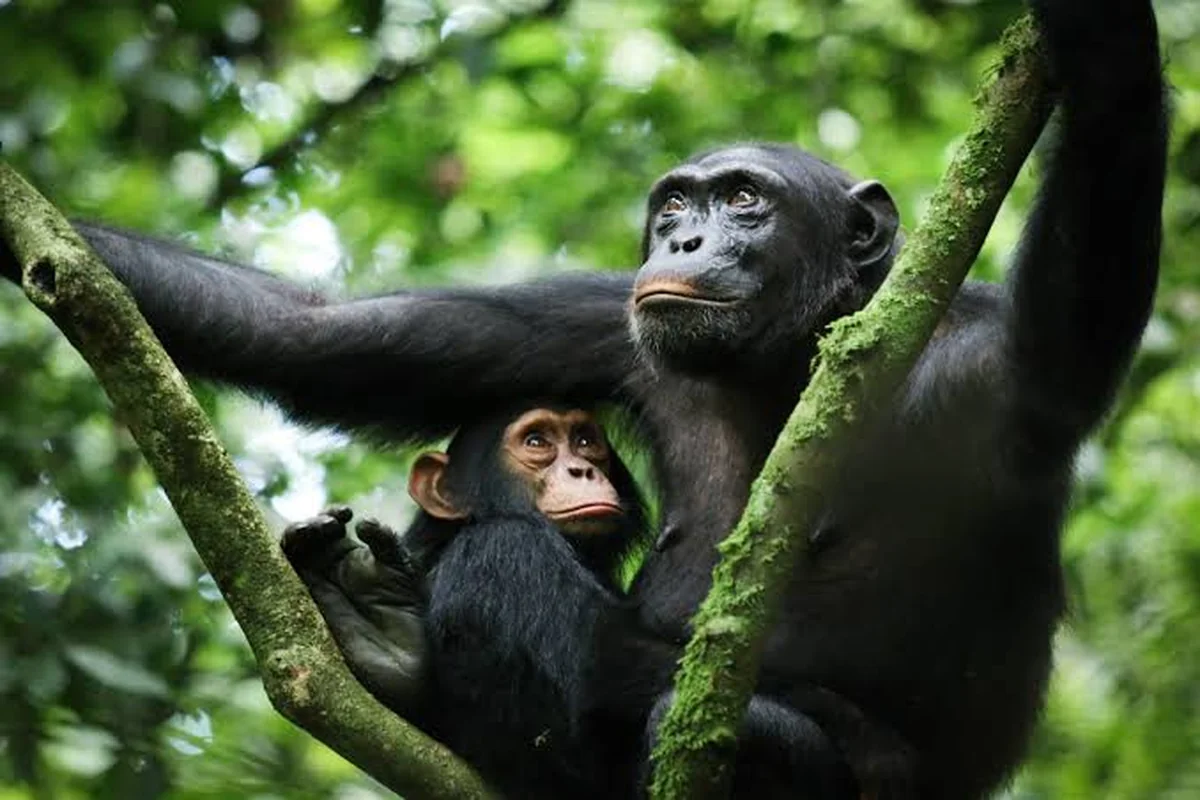
An adult chimpanzee shelters a young chimpanzee among the branches of a tropical forest tree, highlighting the close family bonds of these remarkable primates.
2. Kibale National Park: the principal chimpanzee destination
Kibale National Park in western Uganda is the country’s best-known destination for guided chimpanzee tracking. Its forest is home to multiple primate species, and visitors may hear birds and monkeys while searching for chimpanzees. Tracking commonly begins with a ranger briefing and continues on foot. The distance and pace depend on where the animals are feeding, so no responsible operator can promise an identical experience on every departure.
Kanyanchu is a key designated starting point under Uganda Wildlife Authority guidelines, while other authorised sectors can be used according to official arrangements. It is important not to confuse a lodge’s location, a nearby trail, and an approved tracking entry point. PrideMark Safaris helps guests confirm the correct meeting point before travel and selects accommodation that supports an early arrival for the ranger briefing.
Kibale also offers the possibility of pairing the main tracking activity with Bigodi Wetland, a community-linked nature experience outside the national park. Forest birds, other primates, and village landscapes provide a complementary afternoon rather than a repeat of the morning trek. A balanced itinerary should not force a long road transfer immediately after an exhausting forest walk, particularly for guests who value unhurried wildlife photography.
Learn more about the destination: Kibale Forest National Park and what chimpanzee tracking in Kibale feels like.
3. Other places to see chimpanzees in Uganda
Kibale is not the only place associated with chimpanzees in Uganda. Kyambura Gorge in Queen Elizabeth National Park offers a very different landscape: a forested gorge set within a wider savannah conservation area. It can suit travellers who want to combine a primate excursion with game drives and the Kazinga Channel boat cruise. Sightings and walking conditions vary, and the experience should not be represented as identical to Kibale.
Kalinzu Forest is another destination discussed in Uganda chimpanzee safari planning. It is managed differently from UWA national parks, so visitors should check the applicable booking authority, current fees, guiding arrangements, and what is included. A cheaper-looking permit is not automatically a cheaper overall safari once accommodation, transfers, park activities, and vehicle costs are considered.
For an informed choice, PrideMark Safaris considers the traveller’s route, budget, physical comfort, and other priorities. Someone already visiting Queen Elizabeth may value a nearby forest experience, whereas a dedicated primate enthusiast may prefer extra time around Kibale. We avoid suggesting that every destination has the same likelihood of encounters or the same operating procedures.
Related planning article: Where to See Chimpanzees in Uganda.
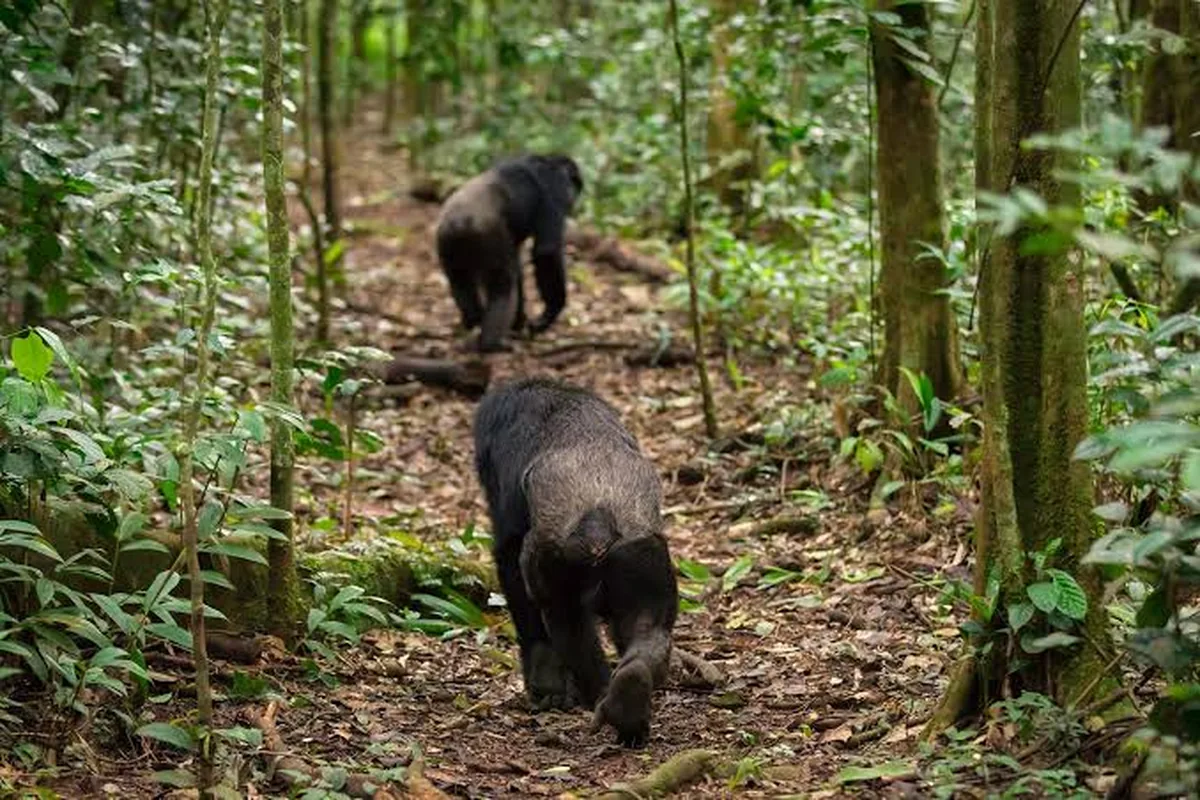
Two chimpanzees move along a forest trail, illustrating the natural behaviour and forest environment visitors may encounter during chimpanzee trekking in Uganda.
4. Chimpanzee trekking permit prices and what they include
Permit prices are an essential part of planning, but the correct figure depends on the tariff period, residency category, and destination. Uganda Wildlife Authority’s published 2027–2028 conservation tariff lists Kibale chimpanzee tracking at US$250 for foreign non-residents and US$200 for foreign residents. The same tariff lists Kibale chimpanzee habituation at US$400 for foreign non-residents. These figures should be checked again before payment.
The published 2027–2028 UWA tariff states that Kibale chimpanzee tracking and habituation fees include the guide and park entrance fees. This is important when comparing quotations because an operator should not casually add an identical park entry charge twice for the same covered activity. Separate experiences, additional days, accommodation, transport, and privately arranged services may still carry their own costs.
PrideMark Safaris recommends checking the precise date of travel and confirming the permit category before making a non-refundable commitment. A permit is not the entire safari price. Your overall quotation may also include an English-speaking driver-guide, vehicle and fuel, accommodation, meals, other park activities, and transfers. We explain these components separately so travellers can compare proposals on a like-for-like basis.
Official tariff reference: Uganda Wildlife Authority Conservation Tariff 2027–2028. Prices are not universal across all dates, visitor categories, or forest destinations.
5. Trekking versus chimpanzee habituation
Ordinary chimpanzee tracking is designed around finding a habituated chimpanzee community and spending a regulated period observing it. Uganda Wildlife Authority guidelines set a maximum of one hour of viewing after the encounter for standard chimpanzee tracking. The time spent searching and returning is additional. The forest walk itself may therefore be considerably longer than the one-hour viewing period.
Chimpanzee habituation offers a longer opportunity to observe chimpanzees as they go about their daily activities. UWA’s published guidelines allow a maximum of four hours of viewing for the habituation experience. This should not be confused with a guaranteed four-hour close-up photo session: animals may move, climb, rest, or remain partly obscured by vegetation, and participants must follow ranger instructions.
Choose standard tracking if you want a memorable primate encounter within a more compact safari schedule. Consider habituation if extended observation and behavioural photography are central to your journey and you are comfortable with a longer forest outing. PrideMark Safaris can help compare the actual schedule, available permits, and suitability of each experience rather than recommending the more expensive option by default.
Official activity rules: UWA tracking and habituation guidelines.
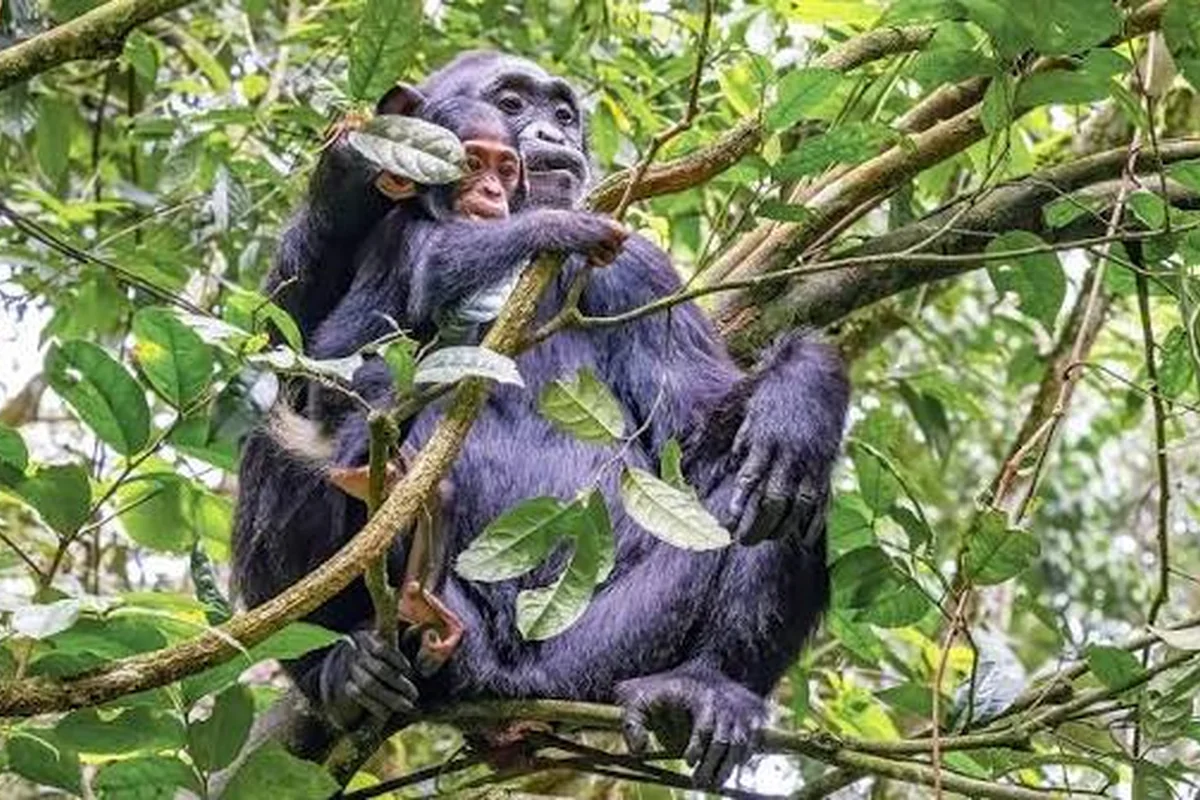
An adult chimpanzee holds a young chimpanzee among forest branches, illustrating the close bonds between chimpanzee mothers and their offspring.
6. What happens on trekking day
A typical tracking day begins with an early breakfast, a transfer to the designated briefing point, and a safety introduction from the ranger team. Visitors are organised according to the day’s arrangements and then enter the forest with authorised guides. Walking can involve roots, wet leaves, narrow tracks, and uneven ground. The briefing is the right moment to mention mobility concerns or ask about the expected pace.
Chimpanzees are mobile and may be heard before they are seen. Your guide may stop to listen, study signs, or adjust the direction of the group. When chimpanzees are located, visitors should remain calm and avoid sudden movements or loud conversations. Photography is possible when conditions allow, but the experience should never be reduced to a race for a close-up picture.
After the encounter, the group walks back to the authorised return point. The total time is not fixed, so PrideMark Safaris recommends leaving the afternoon reasonably flexible. Guests may appreciate lunch and a rest before a wetland walk or another activity. Packing a little water, wearing suitable shoes, and following the ranger’s instructions will generally improve comfort more than bringing excessive equipment.
7. Best time of year for chimpanzee trekking
Chimpanzee tracking operates throughout the year, but conditions differ between wetter and drier periods. Dry-season travel may offer firmer walking surfaces on some trails, while rainfall can make forest paths slippery and muddy. Neither season guarantees a sighting or a particular trekking duration. A flexible traveller should think about the wider safari route, not just the weather on one forest morning.
Uganda Wildlife Authority notes that rainy periods can sometimes be favourable for chimpanzee tracking even though walking is muddier. Feeding patterns and chimpanzee movements change, and an easy trail does not always mean an easy search. Travellers should be cautious about sweeping claims that one month is universally the best or that chimpanzees remain in the same area all year.
When PrideMark Safaris prepares a route, we balance forest activities with the seasons at Queen Elizabeth, Bwindi, Murchison Falls, or Lake Mburo. A guest seeking the simplest walking conditions may prioritise a drier period; a photographer may value green forest light and quieter trails. We still recommend waterproof protection and footwear with reliable grip in every season.
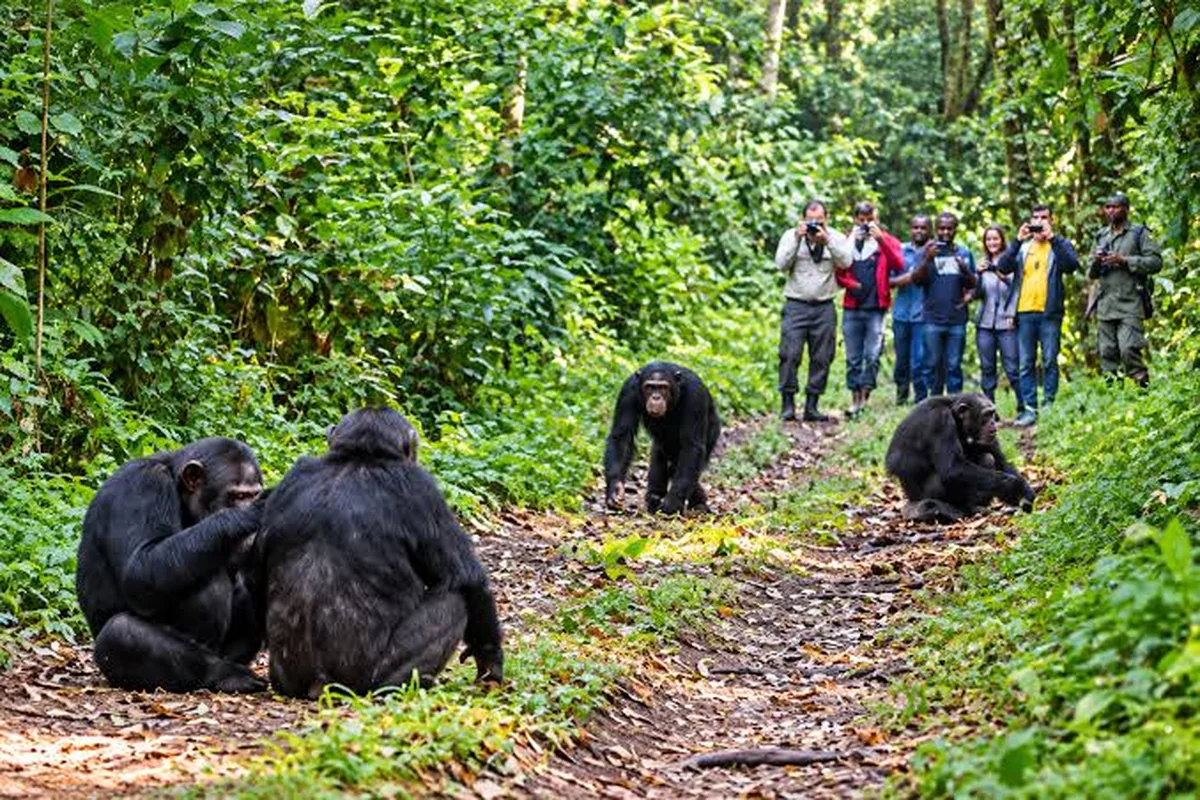
Visitors photograph and observe a group of chimpanzees along a tropical forest trail during a guided primate encounter.
8. Fitness, difficulty and accessibility
Chimpanzee trekking is a forest activity rather than a paved sightseeing walk. Participants may cross uneven terrain, step over roots, climb short slopes, and stand for periods while observing animals. Some outings are relatively straightforward, while others demand more stamina because the chimpanzees move quickly or are farther from the briefing point. The difficulty should never be promised in advance as uniformly easy.
Travellers with knee problems, limited mobility, or concerns about endurance should discuss these issues before permits are purchased. A medical professional can advise on individual fitness limitations, while the park authority determines what is feasible and safe within its operating rules. PrideMark Safaris can help communicate practical needs to the relevant guides, but cannot guarantee a particular chimpanzee location or walking distance.
For seniors and first-time trekkers, preparation can be simple and effective: regular walks, comfortable broken-in footwear, and sensible pacing. Travellers should carry only necessary items and ask about available assistance where applicable. If a long forest walk is unsuitable, a different safari activity may be a better choice than pushing through discomfort merely to complete an itinerary.
9. What to wear and pack
Choose long trousers, a lightweight long-sleeved top, sturdy walking shoes or boots, and socks that protect against rubbing. Neutral colours work well in forest environments, but comfort and weather protection matter more than purchasing a special outfit. A light rain jacket is useful even in a generally dry month, and a hat may help during transfers or in open sections near the forest.
Carry drinking water, any essential personal medication, a small waterproof bag, and a camera or binoculars if desired. Keep valuables secure and avoid unnecessary heavy equipment. Flash photography should not be used around chimpanzees. Rangers may issue additional guidance about distances, behaviour, and hygiene; their instructions always take priority over general packing advice found online.
PrideMark Safaris advises guests to prepare the evening before trekking rather than rush through packing in the morning. Check your permit details, confirm your meeting time, charge camera batteries, and arrange breakfast with the lodge. A simple, organised backpack helps you concentrate on the sounds and movements of the forest instead of searching for equipment.
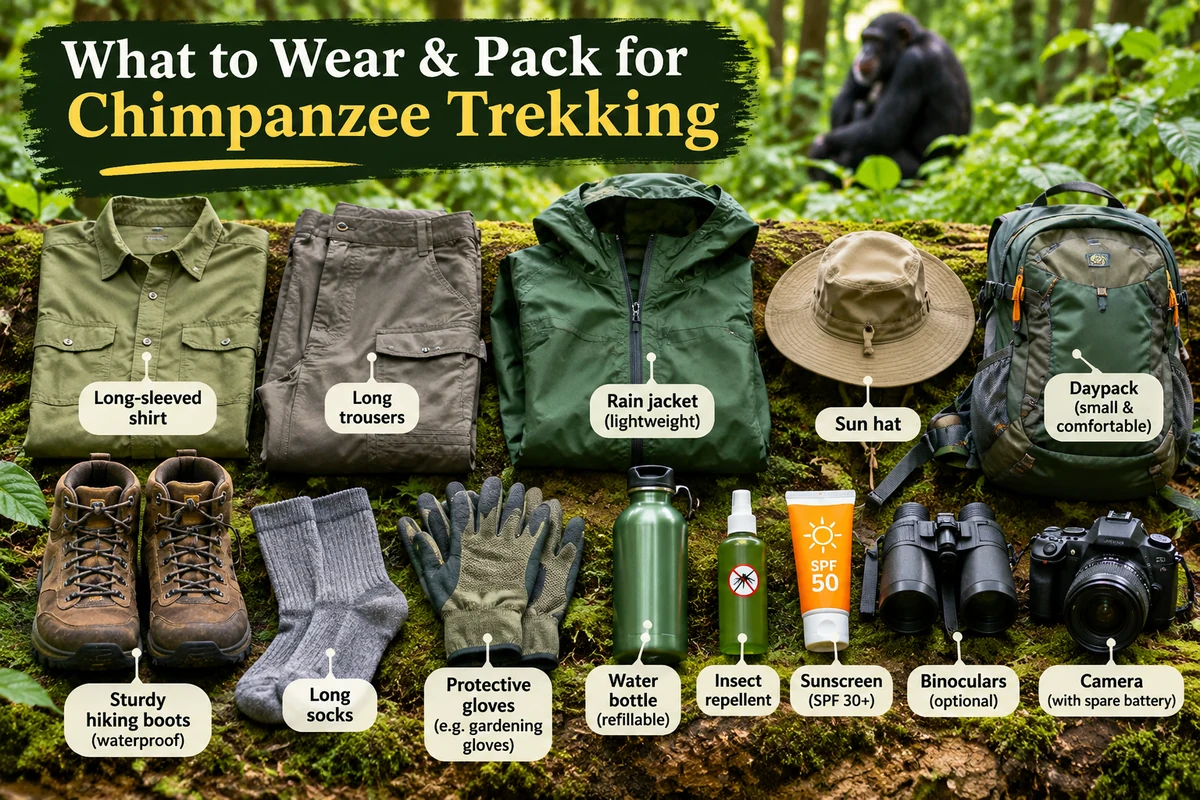
Essential clothing and equipment for chimpanzee trekking in Uganda, including waterproof hiking boots, long-sleeved clothing, a rain jacket, gloves, drinking water and a comfortable daypack.
10. Safety, health and responsible wildlife viewing
Chimpanzees are powerful wild animals, not pets or performers. Visitors should keep the required distance, avoid touching or feeding animals, and follow the ranger’s direction immediately. Stay with the group and do not approach chimpanzees independently for a photograph. A respectful encounter protects visitors while reducing unnecessary disturbance to animals in a sensitive forest ecosystem.
Human respiratory illnesses can pose risks to great apes. Anyone feeling unwell before trekking should tell the guide or operator rather than conceal symptoms. Official requirements may include specific rules about hygiene, minimum ages, distances, and permitted behaviour. These should be confirmed with Uganda Wildlife Authority shortly before the activity because operational guidance can change.
Responsible tourism extends beyond the encounter itself. PrideMark Safaris encourages guests to avoid litter, respect community spaces, and choose authorised experiences. The forest is a habitat with its own rhythms, not a controlled stage. The best photographs and memories often come from patient observation rather than crowding an animal or trying to provoke a reaction.
11. Photography tips for the forest
Forest photography presents challenges: light changes quickly, leaves obstruct clear views, and chimpanzees may move between branches without warning. A camera with reliable autofocus and good low-light performance is useful, but it is not essential for enjoying the experience. Visitors using phones can still capture meaningful moments when they stay calm and work within the guide’s positioning instructions.
Avoid flash, intrusive movements, and attempts to push ahead of the group. Think about a wider story rather than only portraits: hands gripping branches, a silhouette against the canopy, or a group listening for distant calls can communicate the experience. Always keep enough attention on your footing, especially when moving with a camera raised.
If photography is the main goal, discuss that priority with PrideMark Safaris when planning the itinerary. Habituation may provide longer observation time, but it does not guarantee clear angles, close proximity, or consistent light. A spare battery, protected lens cloth, and realistic expectations are more useful than assuming expensive equipment will overcome every forest condition.
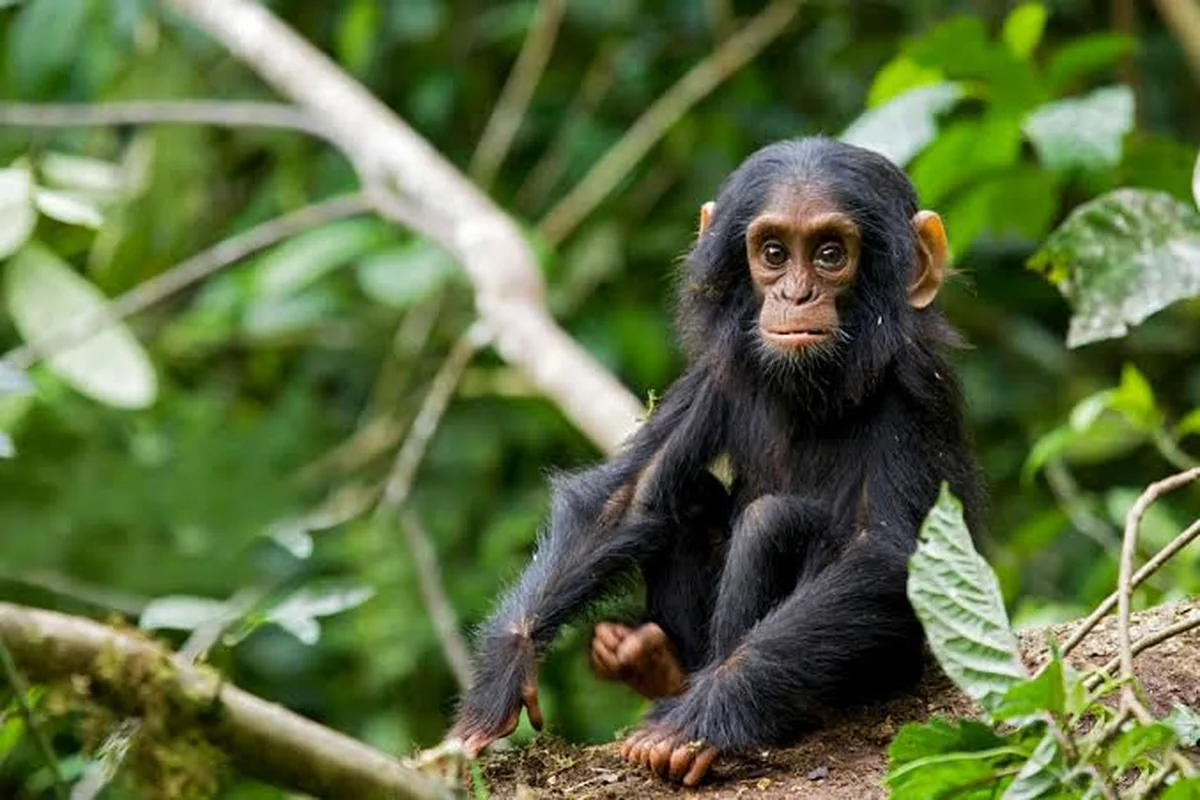
A young chimpanzee rests on a fallen tree in a lush tropical forest, highlighting the remarkable primate encounters visitors may experience during chimpanzee trekking in Uganda.
12. Where to stay around Kibale
Accommodation near Kibale ranges from simpler guesthouses to comfortable mid-range lodges and higher-end forest retreats. The best option depends on budget, desired comfort, and the actual briefing location. A lodge that looks close on a map may still involve a longer drive on rural roads, so it is important to confirm transfer time rather than relying only on straight-line distance.
Guests often benefit from spending at least one night near the park before their tracking activity. This reduces the risk of a tiring early-morning transfer from a distant destination. An additional night can make room for Bigodi Wetland, a relaxed afternoon, or a more comfortable connection to Queen Elizabeth National Park. The right pacing depends on the rest of the safari.
PrideMark Safaris selects accommodation based on the client’s preferences and the confirmed route. We look at room category, meal arrangements, access, and the needs of families or older travellers. We also distinguish between accommodation included in a quotation and optional upgrades so that the final cost remains transparent.
13. Getting to Kibale from Entebbe, Kampala and other parks
Kibale is reached by road from Uganda’s main arrival areas and can be integrated into a western Uganda safari circuit. Road time depends on the departure point, route, roadworks, weather, and stops. A journey that looks short in kilometres may take longer than expected, particularly when travelling through towns or on roads affected by rain.
For many itineraries, a logical progression is Entebbe or Kampala to Kibale, then onward to Queen Elizabeth National Park and Bwindi. Other travellers may arrive via Murchison Falls or connect from Lake Mburo. The ideal order depends on international flights, permit availability, and how many days guests want to spend at each destination.
PrideMark Safaris uses private safari transport for tailor-made trips and plans driving days around comfort and activity timing. We avoid promising an exact arrival hour before the itinerary and route have been confirmed. Guests should leave reasonable flexibility on days involving both a long transfer and a scheduled wildlife activity.
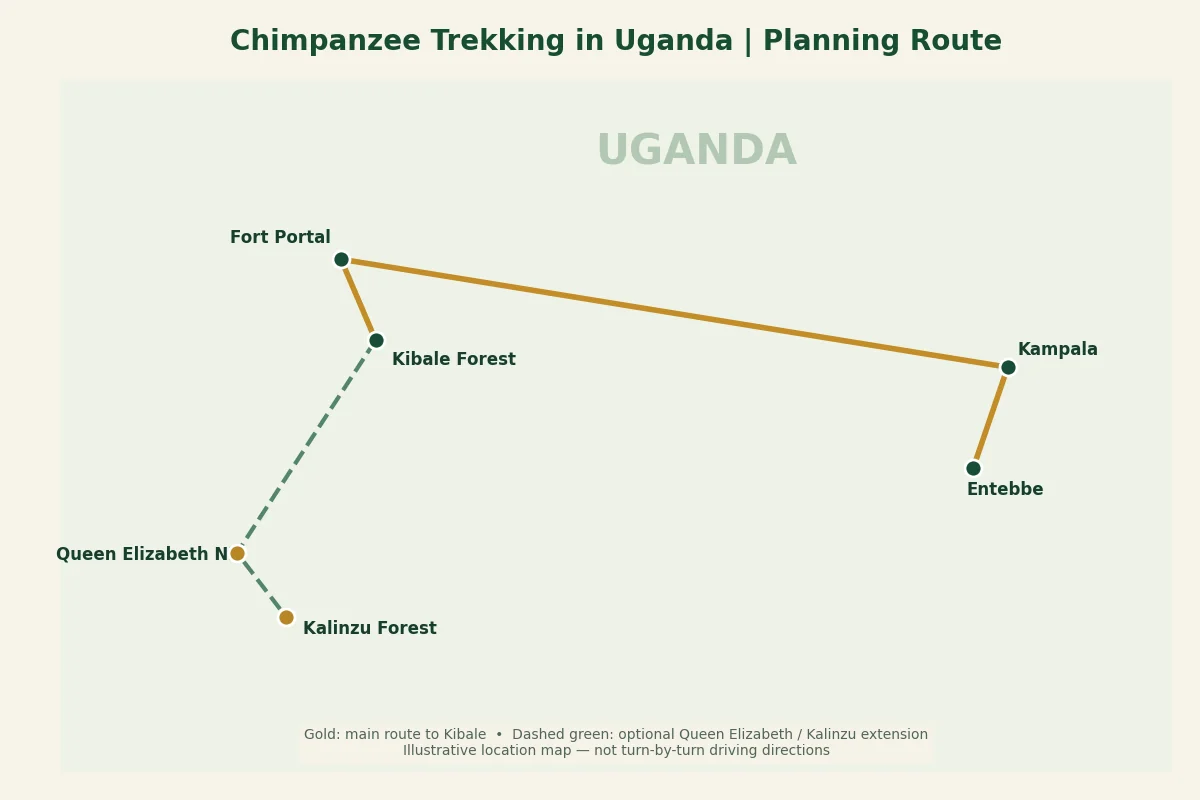
Illustrative route map showing the journey from Entebbe through Kampala and Fort Portal to Kibale Forest, with an optional extension to Queen Elizabeth National Park and Kalinzu Forest.
14. Combining chimpanzees with gorillas and classic wildlife
Chimpanzee trekking and gorilla trekking complement one another because they reveal different aspects of great-ape behaviour and habitat. Chimpanzees are often energetic and vocal in the canopy, while gorilla encounters may involve observing a family resting, feeding, or moving through dense vegetation. Neither is a substitute for the other, and the two activities have separate permits and rules.
A popular safari combination links Kibale with Queen Elizabeth National Park, where guests may enjoy game drives and a Kazinga Channel boat cruise, before continuing to Bwindi for gorilla trekking. With more time, Murchison Falls, Ziwa Rhino Sanctuary, or Lake Bunyonyi can add variety. The itinerary should allow for road distances rather than trying to visit every destination in a few days.
PrideMark Safaris offers routes that combine primates and wildlife, including a seven-day Uganda primates and game safari and longer Uganda circuits. We recommend choosing the number of days based on the experience you want, not simply fitting as many park names as possible onto a schedule. Rest days and unhurried transfers often make the trip more rewarding.
Explore our 7-Day Uganda Primates & Game Safari, 11-Day Best of Uganda Safari, or browse all Uganda safari packages.
15. Budgeting for a chimpanzee safari
An accurate chimpanzee safari budget should separate the permit from the wider trip. Accommodation, vehicle and fuel, guide services, meals, other park fees, and optional activities all affect the total. Travellers comparing operators should confirm whether quoted prices are per person or per group and whether they assume a particular number of guests sharing a vehicle.
Budget, mid-range, and luxury are useful descriptions, but they do not always mean the same thing across companies. Ask about the actual lodge, room type, meal plan, transport standard, and activity inclusions. A lower headline price may exclude the chimpanzee permit or important transfers, while a higher price may include services that would otherwise be paid separately.
With PrideMark Safaris, the most useful starting point is your preferred travel month, number of travellers, arrival and departure airports, and desired activities. From there, we can prepare a tailored quotation and explain which costs are fixed by park authorities and which depend on accommodation or transport choices.
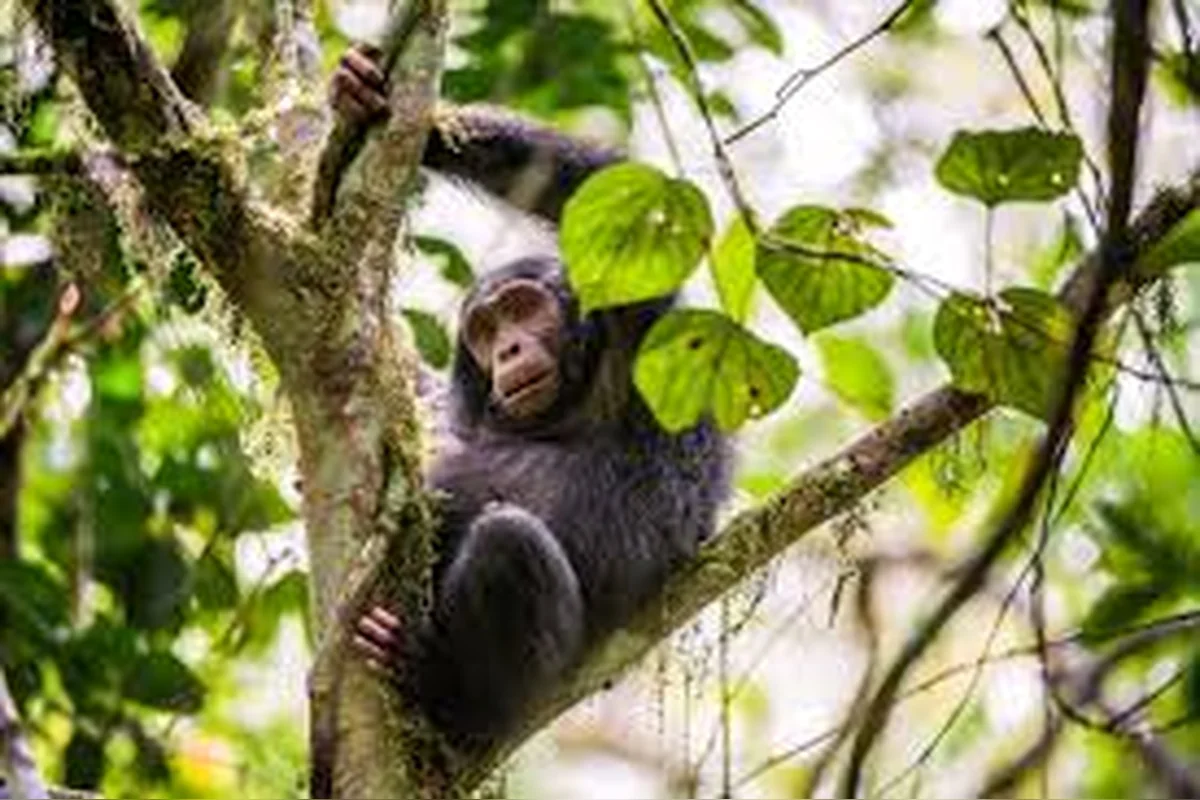
A young chimpanzee climbs among the branches of a tropical forest tree, demonstrating the agility and natural climbing behaviour of these fascinating primates.
16. Planning your first chimpanzee safari with PrideMark Safaris
First-time visitors should decide whether chimpanzees are the main purpose of their holiday or one part of a larger Uganda safari. This determines how many nights to allow around Kibale and whether standard tracking or habituation makes sense. It also helps prevent an itinerary that feels rushed after long drives or multiple early-morning activities.
Before booking, confirm the travel dates, passport and residency category, permit availability, accommodation, and any health or mobility needs. PrideMark Safaris can help organise these details into a practical sequence. We also encourage travellers to read the relevant official UWA guidance so that viewing limits, ranger instructions, and permit rules are clear before arrival.
A well-designed Uganda chimpanzee trekking guide should help you make confident choices, not pressure you into the longest or most expensive itinerary. If you prefer a short visit, a three-day chimpanzee trip may be enough. If you want primates, savannah wildlife, and time to enjoy the landscape, a longer private safari is often more satisfying.
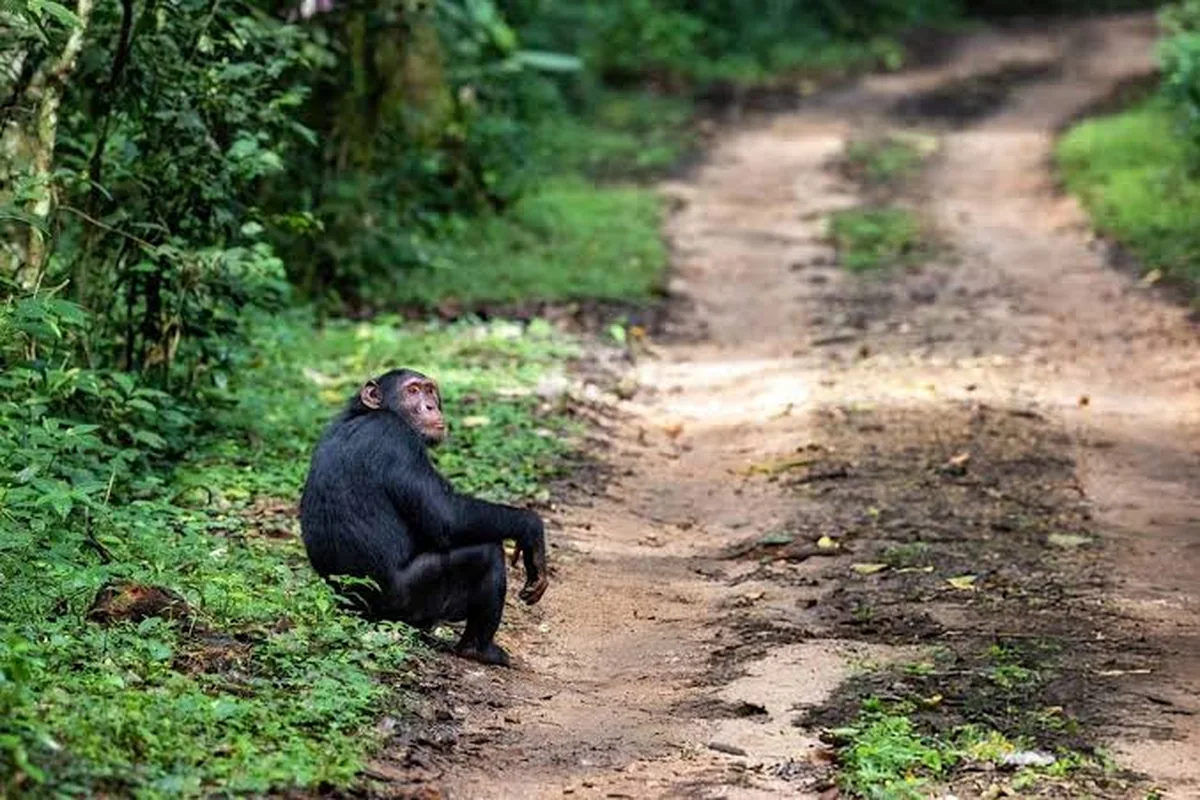
A wild chimpanzee rests beside a forest trail, offering a glimpse into the natural environment visitors may explore during chimpanzee trekking in Uganda.
Uganda chimpanzee trekking FAQs
How long do visitors spend with chimpanzees?
Standard tracking permits allow a maximum of one hour of viewing once chimpanzees are encountered. The walk to find them and the return can take additional time. UWA guidelines allow up to four hours of viewing on the chimpanzee habituation experience.
Is chimpanzee trekking guaranteed?
No. Chimpanzees are wild animals and move freely. Experienced guides improve the chances of locating them, but responsible operators do not promise a sighting or a fixed walking distance.
What is the 2027–2028 Kibale permit price?
The published UWA tariff lists US$250 for foreign non-resident standard chimpanzee tracking and US$400 for foreign non-resident habituation. Verify the tariff and category for your travel date.
Can I combine chimpanzees and gorillas?
Yes. Kibale and Bwindi can be linked on a western Uganda itinerary, often with Queen Elizabeth National Park between them. Each primate activity requires its own arrangements.
Is Kibale suitable for beginners?
Many first-time visitors enjoy Kibale, but conditions are variable. Discuss fitness, walking ability, and any mobility concerns with your operator and the park authorities before committing.
What should I wear?
Long trousers, comfortable walking shoes, a light rain jacket, and practical layers are a good foundation. Carry water and follow any additional guidance given at the ranger briefing.
Can I use flash photography?
Do not use flash around chimpanzees. Follow the ranger’s photography and distance instructions and never move closer to obtain a picture.
Is Kibale the same as Kalinzu?
No. They are different forest destinations with different booking arrangements and travel logistics. Compare the specific activity, authority, permit price, and route before deciding.
Should I book in advance?
Advance arrangements are advisable, particularly when travel dates are fixed. Permit availability and operational arrangements should be confirmed before finalising non-refundable travel plans.
Can I visit Bigodi Wetland after tracking?
Often yes, depending on the trekking finish time, energy levels, and the rest of your itinerary. Leave enough flexibility for a comfortable lunch and transfer.
Is the rainy season unsuitable?
Not necessarily. Tracking runs year-round, and UWA notes potential advantages in wetter periods. Trails may be muddy, so suitable footwear and flexible expectations matter.
How can PrideMark Safaris help?
PrideMark Safaris can plan routes, coordinate permits and lodges, and prepare an itemised safari quotation based on your dates, interests, and budget.
Plan your chimpanzee safari with PrideMark Safaris
Tell us your travel dates, number of travellers, preferred accommodation standard, and whether you want standard tracking or habituation. We can help create a personalised route connecting Kibale with Uganda’s other unforgettable destinations.
Contact PrideMark Safaris for a tailored itinerary and quotation.