
A Uganda safari can be made more comfortable for motion-sensitive travellers with private transport, slower routes, regular rest stops and carefully planned transfers.
Uganda Safari With Motion Sickness is completely possible when the itinerary is designed around your comfort rather than simply trying to visit as many national parks as possible. Uganda has beautiful landscapes, mountain roads, remote wildlife areas and unpaved park tracks, so travellers who become carsick should consider driving time before confirming their route.
The answer is not necessarily to avoid safari travel. Instead, choose a private vehicle, stay longer in fewer destinations, allow sensible rest stops and avoid stacking several demanding road journeys together. Travellers can explore PrideMark Safaris’ Uganda and Rwanda Safari Ideas to compare shorter and longer itineraries before deciding which route feels manageable.
Motion sickness also affects travellers differently. One person may struggle mainly on winding mountain roads while another feels uncomfortable on rough game-drive tracks, boats or small aircraft. Knowing your personal triggers can help PrideMark Safaris design a more comfortable journey.
Can You Enjoy a Uganda Safari With Motion Sickness?
Yes. Getting carsick does not mean Uganda is the wrong destination for you.
The most important factor is how the trip is structured. A traveller who is comfortable with a few hours of road travel but becomes unwell after an entire day in a vehicle needs a different itinerary from someone who can tolerate long drives but dislikes winding mountain roads.
PrideMark’s guide on how many days you need for a Uganda safari explains why travel time should be considered when deciding how many destinations to include.
For travellers with motion sickness, this becomes even more important. Adding an extra safari day can sometimes improve the trip more than adding another national park.
1. Tell PrideMark Safaris About Motion Sickness Before Booking
The best time to mention motion sickness is while the itinerary is being designed.
Do not wait until the guide begins the first long transfer.
If PrideMark knows that winding roads, long drives or rough tracks make you uncomfortable, the team can consider this when recommending destinations and travel times.
A seven-day itinerary, for example, could focus on two or three well-connected destinations instead of forcing four or five national parks into the same holiday.
Travellers can review PrideMark’s Safari Ideas to understand how different trip lengths combine Uganda’s primates, wildlife and landscapes.
Explain What Type of Travel Affects You Most
Motion sickness is not identical for everyone.
Some travellers mainly struggle on winding roads.
Others become uncomfortable when seated at the back of a vehicle.
Some tolerate road transfers well but feel sick on boats.
Others are more affected by small aircraft.
Explain which situations normally cause problems for you. That information is more useful than simply saying, “I get motion sickness.”
2. Choose a Private Safari Vehicle
A private safari vehicle is one of the most useful choices for travellers who are sensitive to movement.
You are travelling with your own driver-guide rather than following the fixed rhythm of a large shared group.
This makes communication easier.
If you begin to feel uncomfortable, you can tell the guide.
If you need fresh air, a toilet stop or a few minutes outside the vehicle, the situation can often be handled more naturally.
PrideMark Safaris specialises in tailor-made travel rather than requiring every traveller to follow one identical schedule. You can learn more about the company and its travel approach on the About PrideMark Safaris page.
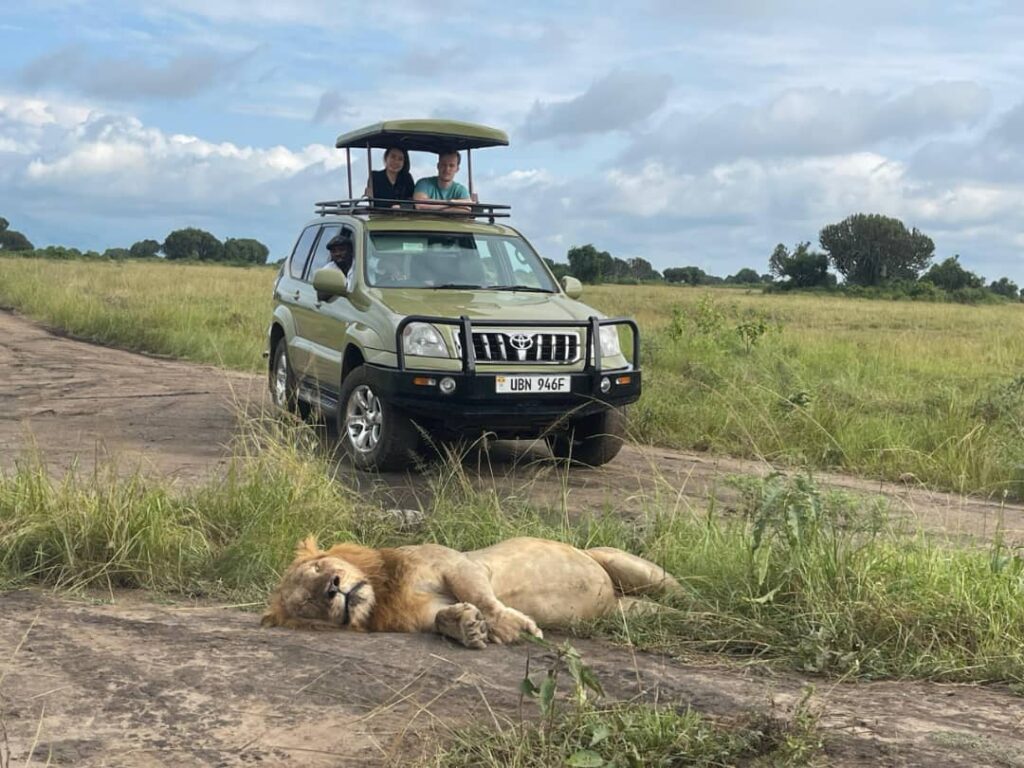
A private safari vehicle gives travellers more control over seating, rest stops and the daily travel pace.
Where Should You Sit in a Safari Vehicle?
Some motion-sensitive travellers feel more comfortable closer to the front of the vehicle because they can see the road ahead.
Others prefer a window where they can get more airflow and maintain a clear view outside.
The exact preference varies.
If you already know where you normally feel best in a car, tell your guide.
Avoid automatically choosing the very back seat simply because it appears to have more space if you know that rear seating makes you feel worse.
Keep Your Eyes on the Road and Landscape
Reading messages, editing photographs or staring at a phone during a winding transfer can make some people feel worse.
Looking ahead at the road or watching the landscape may feel more comfortable.
A Uganda road safari also passes through towns, farmland, lakes, hills and rural communities, so there is plenty to observe outside the vehicle.
Use long transfers as part of the travel experience rather than spending the entire journey looking down at a screen.
3. Avoid Changing Safari Lodges Every Night
Moving to a different destination every day means more time on the road.
For motion-sensitive travellers, this can quickly become exhausting.
Two-night and three-night stays provide more breathing room.
Instead of arriving at a lodge late in the afternoon, sleeping and immediately packing again, travellers can spend a full day enjoying the destination.
This also creates flexibility for shorter game drives, afternoon activities and rest periods.
PrideMark’s How Many Days Do You Need for a Uganda Safari? guide is useful when deciding whether your available holiday time is enough for the destinations you want to combine.
Stay Longer in Fewer Places
Safari quality should not be measured by the number of national parks listed on an itinerary.
Spending two or three nights in Queen Elizabeth National Park may provide more enjoyment than rushing through it in one afternoon just so another park can be added the following morning.
Travellers with motion sickness benefit particularly from this approach because fewer hotel changes usually mean fewer long road transfers.
4. Consider Lake Mburo as a Gentler First Safari Stop
Lake Mburo National Park can work well near the beginning or end of a western Uganda itinerary.
It is a compact savannah park and provides a useful introduction to Uganda’s wildlife without immediately committing travellers to one of the country’s longest transfers.
PrideMark has a dedicated Lake Mburo National Park guide covering the destination, wildlife and safari possibilities.
Travellers can also compare current Uganda routes through PrideMark’s Safari Ideas.

Lake Mburo can provide a gentler introduction to Uganda safari travel before longer journeys into western Uganda.
Why Lake Mburo Can Feel Easier
A smaller park can feel less intimidating for someone experiencing safari roads for the first time.
Instead of beginning the holiday with an extremely long road journey, Lake Mburo can act as a transitional stop before continuing deeper into western Uganda.
It also gives you an opportunity to understand how your body responds to safari-vehicle movement before reaching more remote destinations.
Do Not Add Lake Mburo Only to Collect Another Park
Lake Mburo is useful when it improves the route.
It should not be inserted unnecessarily if doing so creates another hotel change or additional driving that does not help the itinerary.
Every stop should serve a purpose.
For motion-sensitive travellers, geographic logic matters more than collecting destination names.
5. Plan Queen Elizabeth National Park With Rest Time
Queen Elizabeth National Park can work very well for travellers who dislike continuous driving because the stay can combine vehicle-based wildlife viewing with other experiences.
PrideMark’s Queen Elizabeth National Park guide provides more information about the park’s wildlife and major safari experiences.
A well-paced stay might include one game drive, time at the lodge and a separate boat experience rather than keeping travellers inside the vehicle from sunrise until sunset.
The official Uganda Wildlife Authority Queen Elizabeth National Park page can also be used for current park information.

Planning rest time between game drives and other activities can make Queen Elizabeth National Park more comfortable for travellers prone to motion sickness.
Shorter Game Drives Can Still Be Excellent
You do not have to spend six consecutive hours on rough park tracks to have a rewarding wildlife experience.
A shorter, carefully timed game drive may be better for a traveller who begins to feel unwell after prolonged vehicle movement.
Tell your guide how you are feeling.
The objective is to enjoy lions, elephants, antelopes, buffaloes and the landscape—not to prove that you can remain in a vehicle longer than is comfortable.
Give Yourself Time at the Lodge
Safari lodges are part of the experience.
A midday rest between activities can make the day much easier.
Have lunch, relax, enjoy the scenery and return for a later activity when you feel refreshed.
This is one reason two-night stays are so useful.
They create time that does not have to be spent moving.
6. Prepare for the Winding Roads Around Bwindi
Bwindi Impenetrable National Park is one of Uganda’s most famous destinations, but travellers with strong motion sickness should think carefully about the road journey.
Routes around southwestern Uganda can include winding and mountainous sections.
The exact driving experience depends on the trekking sector, lodge location and direction of travel.
This makes accommodation location particularly important.
The official Uganda Wildlife Authority Bwindi information explains that gorilla trekking operates from different sectors of the forest.
Choosing accommodation close to the correct trekking area can help avoid unnecessary additional driving.
Gorilla Trekking Itself Is on Foot
For motion-sensitive travellers, it is important to separate getting to Bwindi from gorilla trekking itself.
Once trekking begins, you are walking through the forest with ranger guides rather than travelling in a vehicle.
This means someone who strongly dislikes winding roads can still enjoy the actual gorilla experience.
PrideMark’s guide on going gorilla trekking alone in Uganda explains how the regulated trekking experience works.
Arrive in Bwindi Before the Trekking Day
Avoid designing an itinerary where a very long transfer ends late in the evening and gorilla trekking begins early the next morning.
A motion-sensitive traveller may arrive tired, nauseous and dehydrated before one of the most important activities of the safari.
Where the itinerary allows, arrive with enough time to settle into the lodge.
Rest.
Eat properly.
Prepare your trekking equipment.
Then begin the gorilla experience feeling much better.
Consider a Slower Day After Gorilla Trekking
After trekking, you do not necessarily need another major transfer immediately.
An additional night around Bwindi or a slower onward journey can create valuable recovery time.
This is particularly useful when the trek itself has been physically demanding.
The safari should not become a sequence of long drives interrupted only by activities.
7. Use Rest Stops Before You Feel Very Sick
Do not wait until nausea becomes severe before speaking to the guide.
If you know that stopping periodically helps you, discuss it before departure.
A short break can allow you to stretch, use a bathroom, drink water and get fresh air.
Road journeys in Uganda often pass through towns and trading centres where planned stops may be possible.
Your guide can help identify sensible locations.
There Is Nothing Embarrassing About Asking to Stop
Safari guides travel with guests of different ages, fitness levels and comfort needs.
They are used to toilet breaks, photography stops and travellers who need time outside the vehicle.
Communicate.
Sitting silently because you do not want to inconvenience the guide often makes the situation worse.
Build Rest Stops Into the Itinerary Naturally
Some breaks can also become enjoyable travel experiences.
Lunch stops, viewpoints, coffee breaks and scenic stops can divide longer journeys into more manageable sections.
This makes the trip feel less like one uninterrupted transfer.
8. Think Carefully About Boat Safaris
Some travellers who become carsick feel perfectly fine on boats.
Others experience motion sickness on both land and water.
Know which group you belong to before adding several boat activities.
Queen Elizabeth National Park offers a popular boat experience, while other Uganda safari routes can also include boat trips.
If boat movement affects you badly, tell PrideMark when the trip is being planned.
You do not have to remove every boat activity automatically, but it should be considered.
Travellers who experience motion sickness should consider how they normally respond to boat movement before adding several water-based safari activities.
Boat Conditions Are Different From Ocean Travel
A safari boat on an inland waterway is not the same as crossing rough open ocean.
However, individuals react differently.
Someone who becomes severely seasick should not assume they will automatically feel comfortable simply because the water looks calm.
If motion sickness is significant, speak to a qualified healthcare professional before travel about appropriate prevention strategies.
Sit Where You Feel Most Comfortable
If you choose a boat safari, ask the guide or crew where movement may feel more comfortable.
Remain seated when appropriate and keep fresh air around you.
Watching the horizon or landscape may help some travellers.
Individual responses vary, so use the techniques that already work for you.
9. Consider Domestic Flights for Some Routes
Domestic flights can reduce the number of hours spent travelling by road.
For some travellers, that makes a huge difference.
A long road transfer to southwestern Uganda may be replaced with a scheduled flight followed by a shorter vehicle transfer.
However, this option should be considered carefully rather than automatically.
Small aircraft may also experience movement or turbulence.
A traveller who becomes severely airsick may prefer the road even if it takes longer.
Domestic flights can reduce long road journeys on selected Uganda safari routes, although travellers should still consider how they respond to small aircraft.
Flying Does Not Remove Every Road Transfer
Reaching an airstrip does not mean the safari lodge is beside the runway.
Vehicle transfers are still required.
This is particularly relevant around gorilla areas.
Compare the complete journey from hotel to lodge rather than comparing only road hours with flight duration.
Domestic Flights Can Increase Safari Cost
Flights normally add cost compared with an entirely road-based itinerary.
The decision should therefore consider budget as well as comfort.
For some travellers, paying more to reduce a particularly difficult road transfer is worthwhile.
For others, a slower road itinerary with additional overnight stops is better value.
10. Eat Sensibly Before Long Safari Drives
Food can influence how comfortable you feel in a moving vehicle.
Very heavy meals immediately before winding roads may not suit some travellers.
Travelling for hours without eating may also make other people feel worse.
Use what you already know about your own body.
Do not experiment with an unusually heavy breakfast just before one of the longest driving days.
Allow Time After Breakfast
Rushing from the breakfast table directly into a vehicle may feel uncomfortable for some travellers.
A well-designed itinerary should allow enough time to eat calmly before departure when the day’s schedule permits.
This is another reason not to overload every morning.
Keep Water Accessible
Hydration matters during safari travel.
Keep drinking water somewhere easy to reach rather than packed at the bottom of the vehicle.
Take reasonable amounts throughout the day.
If drinking too much immediately before winding sections makes you uncomfortable, manage your intake sensibly while still staying hydrated.
Carry Simple Snacks
Long transfers can become easier when travellers have access to familiar snacks.
Choose foods that travel well and that you already know agree with you.
Avoid waiting until you are extremely hungry.
If you have dietary restrictions, tell PrideMark in advance so meal and stop planning can be considered throughout the safari.
11. Speak to a Healthcare Professional Before Travel
PrideMark Safaris can help design the itinerary.
It cannot diagnose or medically treat motion sickness.
Travellers who experience severe or frequent motion sickness should speak with a doctor, pharmacist or qualified travel-health professional before travelling.
They can advise on prevention or medication based on your health history and other medicines you may be taking.
This is particularly important because some motion-sickness medicines may cause drowsiness or other side effects.
Do Not Experiment With Medication During the Safari
If a qualified healthcare professional recommends medication, understand how it affects you before relying on it during an important safari activity.
Feeling extremely drowsy during gorilla trekking or a wildlife drive is not ideal.
Follow professional instructions rather than taking unfamiliar medication based on another traveller’s recommendation.
What Is the Best Uganda Safari Route for Motion Sickness?
The best route is usually one that avoids unnecessary backtracking.
For many travellers, concentrating on western Uganda makes sense.
A route might combine Lake Mburo, Queen Elizabeth and Bwindi.
Another might combine Kibale and Queen Elizabeth.
A primate-focused journey might use Kibale and Bwindi with enough nights between the longer transfers.
The best combination depends on which experiences matter most to you.
A 5-Day Uganda Safari With Motion Sickness
Five days is relatively short, so avoid trying to cover too much.
A combination such as Lake Mburo and Queen Elizabeth can provide wildlife experiences without forcing travellers across several distant regions.
Another five-day route could focus heavily on one major destination rather than using half the holiday for transfers.
The strongest short safari is focused.
A 7-Day Uganda Safari With Motion Sickness
Seven days provide more room for a slower western circuit.
One possible route could be Entebbe, Kibale, Queen Elizabeth and Lake Mburo.
Travellers who prioritise gorillas might instead choose Queen Elizabeth and Bwindi, spending additional nights in each area.
PrideMark offers several options through its Uganda Safari Ideas that can be adapted according to available time and comfort.
A 10-Day Uganda Safari With Motion Sickness
Ten days should not automatically mean adding more destinations.
Use the extra days to slow down.
Spend two or three nights around Kibale.
Stay longer in Queen Elizabeth.
Allow enough time around Bwindi before and after gorilla trekking.
Longer trips can actually feel easier when the additional days reduce pressure rather than expand the route.
Can Kibale Work for Motion-Sensitive Travellers?
Yes.
Kibale can combine logically with Queen Elizabeth National Park, which helps reduce unnecessary long-distance backtracking.
Chimpanzee tracking itself takes place on foot.
The main motion-sickness consideration is therefore the road journey to and from the forest.
A two-night stay can be much more comfortable than arriving one evening and leaving immediately after tracking.
For general chimpanzee itineraries, travellers can browse PrideMark’s Safari Ideas.
Official Kibale information is also available from the Uganda Wildlife Authority.
Can Queen Elizabeth Work for Motion-Sensitive Travellers?
Yes, particularly when the stay is not overloaded.
A mixture of game drives, lodge time and boat-based wildlife viewing can break up the amount of time spent continuously on road tracks.
Two nights normally create more flexibility than attempting to pass through the park in a single day.
Read PrideMark’s Queen Elizabeth National Park guide before deciding how the park fits into your route.
Can Bwindi Work for Motion-Sensitive Travellers?
Yes.
The important part is planning the approach carefully.
Choose the correct lodge for the trekking sector, avoid unnecessary transfers and arrive with enough time to recover.
Gorilla trekking itself is a walking activity, so road sickness does not automatically prevent someone from experiencing the forest.
Bwindi can still work well for travellers with motion sickness when the route is planned carefully and accommodation is close to the correct trekking sector.
Is Lake Mburo Good for Travellers With Motion Sickness?
It can be an excellent addition when it helps divide a longer route.
The park can provide wildlife viewing while acting as a logical stop between central Uganda and destinations farther southwest.
PrideMark’s Lake Mburo National Park guide provides more information about the destination.
Should You Include Murchison Falls?
Murchison Falls can be a wonderful destination, but think carefully about the complete itinerary.
Combining Murchison with several western Uganda parks can produce substantial road travel.
If Murchison is a priority, it may be better to design the safari around northern and central destinations rather than treating it as one more park to squeeze into an already full western circuit.
Murchison Falls can still fit into a motion-sensitive Uganda safari when the route is planned carefully and long road transfers are not overloaded.
What About Kidepo Valley?
Kidepo is remote and deserves enough time.
Travellers with severe motion sickness should be particularly careful about adding it to a short road itinerary.
A fly-in option may be worth investigating depending on schedule and budget.
If travelling by road, allow enough time rather than trying to reach Kidepo and immediately move elsewhere.
What Should You Pack for a Uganda Safari With Motion Sickness?
Keep comfort items easy to access rather than locked inside your main suitcase.
Water, tissues, a small emergency bag, simple snacks and any medication recommended by your healthcare professional should remain close at hand.
Comfortable clothing can also help on long travel days.
You do not need a huge collection of special equipment.
Preparation is mostly about accessibility.
Avoid Reading During Winding Transfers
Even travellers who rarely become carsick can sometimes feel uncomfortable when reading for long periods in a moving vehicle.
If you know this affects you, avoid trying to work, read long documents or spend the entire journey on your phone.
Watch the road and landscape instead.
Can the Guide Drive More Slowly?
You can always tell your guide when you feel uncomfortable.
Safe speed still depends on road conditions, traffic and other practical factors.
The useful part is communication.
The guide can consider the situation and stop where practical.
Do not expect the guide to know how you feel without telling them.
What If You Start Feeling Sick During a Game Drive?
Tell the guide early.
Depending on your location, it may be possible to stop at a safe place or shorten the drive.
Remain inside the vehicle unless the guide says it is safe to get out.
Wildlife areas are not places to open the door and walk away from the vehicle independently.
Should Motion-Sensitive Travellers Avoid Sunrise Drives?
Not necessarily.
The time of day may have less effect than the length and condition of the drive.
A shorter morning game drive may be comfortable while an all-day drive is not.
Instead of automatically removing morning activities, focus on duration and road conditions.
Why Slow Safari Travel Works Better
Slow travel reduces the amount of packing, checking out and driving.
It also gives travellers time to recover after difficult transfers.
This is particularly valuable around primate destinations where the main activities are already physically demanding.
PrideMark’s How Many Days Do You Need for a Uganda Safari? guide is useful for understanding why trip length should match the experiences you want rather than simply the number of places on your wish list.
Why Book With PrideMark Safaris When You Get Motion Sick?
Safari route design matters.
PrideMark Safaris creates tailor-made Uganda and Rwanda journeys rather than expecting every traveller to follow one rigid programme.
Tell the team that motion sickness is an important consideration.
The route can then be designed around fewer unnecessary transfers, longer stays and private transport where appropriate.
Travellers can review PrideMark Safari Ideas, learn more about the company on the About Us page or explore destinations such as Lake Mburo National Park and Queen Elizabeth National Park before deciding which route suits them.
The objective is not to avoid Uganda’s roads completely.
It is to make sure those roads do not dominate your holiday.
Frequently Asked Questions About a Uganda Safari With Motion Sickness
Can I Go on a Uganda Safari if I Get Carsick?
Yes. Private transport, sensible routing, rest stops and fewer long transfer days can make the journey much easier.
What Is the Best Seat in a Safari Vehicle?
Some travellers prefer sitting closer to the front where they can see the road ahead. Choose the position that normally works best for you.
Are Uganda Safari Roads Bumpy?
Conditions vary. Some main roads are paved, while park tracks and remote roads can be uneven or unpaved.
Can I Ask the Guide to Stop?
Yes. Tell your guide when you need a practical rest stop.
Is Lake Mburo a Good First Stop?
It can work very well because it is a compact park and can fit logically into southwestern Uganda itineraries.
Is Queen Elizabeth Suitable if I Get Motion Sick?
Yes. A well-paced stay can combine shorter game drives with lodge time and other activities.
Can I Still Go Gorilla Trekking?
Yes. Gorilla trekking itself is on foot. The main planning consideration is the road journey to the correct Bwindi sector.
Are Domestic Flights Better Than Driving?
They can substantially reduce road time, but travellers who become airsick should consider how they respond to small aircraft.
Should I Take Motion-Sickness Medicine?
Ask a doctor, pharmacist or qualified travel-health professional. A safari company cannot prescribe medication.
Is a Private Safari Better?
Usually, because it provides greater flexibility with rest stops and daily pacing.
Should I Choose a Longer Safari?
A longer safari can be more comfortable if the additional days are used to reduce driving rather than add more destinations.
Plan a Comfortable Uganda Safari With PrideMark
A Uganda Safari With Motion Sickness can still include mountain gorillas, chimpanzees, lions, elephants, boat safaris and beautiful landscapes.
Tell PrideMark about your motion sensitivity before the itinerary is designed.
Choose fewer destinations.
Stay longer.
Use private transport.
Build in rest stops.
Select accommodation that makes geographical sense.
And seek professional medical advice if your symptoms are significant.
Your safari does not need to be rushed to be memorable.
Sometimes the strongest Uganda itinerary is the one that gives you enough time to enjoy each destination without spending every day preparing for another long road journey.
Explore PrideMark Safari Ideas and start building a Uganda journey around your comfort as well as your wildlife priorities.