Can You Go Gorilla Trekking With Parkinson’s Disease in Uganda? 9 Amazing Tips

Can You Go Gorilla Trekking With Multiple Sclerosis in Uganda? 9 Amazing Tips
November 9, 2026
Can You Go Gorilla Trekking Without a Permit in Uganda? 9 Essential Facts
November 10, 2026
Gorilla trekking with parkinson’s disease is a question worth exploring carefully because Parkinson’s affects different travelers in very different ways. Uganda offers remarkable mountain gorilla encounters, but reaching a gorilla family may involve steep forest trails, mud, roots and unpredictable walking distances. A thoughtful plan begins with individual ability rather than a blanket yes-or-no answer.
This guide from PrideMark Safaris explains the decisions that matter most: mobility, balance, medication schedules, weather, ranger support and emergency planning. Learn about our team on the About Us page, and explore the 3-day Uganda gorilla trekking safari as one possible itinerary to discuss, not a promise of an easy walk.
For anyone considering gorilla trekking with Parkinson’s disease, the goal should be an informed choice that protects health and respects park rules. The information below is educational, not personal medical clearance. A neurologist and rehabilitation professional familiar with the traveler’s condition should help assess whether this remote forest activity is appropriate.
Can You Go Gorilla Trekking With Parkinson’s Disease?
Suitability is individual, not determined by a diagnosis alone. Some people with stable symptoms, dependable walking ability and an appropriate support plan may be able to participate, while others face an unacceptable fall or medical risk. Rangers determine the actual route and gorilla location on the day, so a short, level walk cannot be promised.
A realistic decision considers walking endurance, ability to recover from a stumble, medication response, freezing episodes, cognitive changes and the support available in remote terrain. Discuss these details with your neurologist and rehabilitation team, then share functional requirements privately with the safari organizer before making nonrefundable arrangements. When planning gorilla trekking with Parkinson’s disease, this distinction deserves a specific discussion rather than a general assumption.
Ask about permit conditions, ranger guidance and the possibility of additional assistance, but treat every option as subject to availability and park approval. A travel companion should understand the person’s usual mobility pattern and be ready to help communicate if symptoms change unexpectedly.
Practical planning. Make a simple one-page profile listing walking pace, recent falls, usual medication times, mobility aids and the symptoms that signal a need to stop. Share only the details necessary to organize assistance, and keep sensitive medical information with the traveler or trusted companion. For gorilla trekking with Parkinson’s disease, the practical implication is to prepare for conditions that may be more difficult than the traveler expects. For background on related mobility concerns, our article search for gorilla trekking with multiple sclerosis may help readers compare different preparation issues.
What to ask before booking. Ask who can coordinate porter support, how long the transfer takes, what happens if the traveler cannot continue and whether the lodge has steps or steep pathways. Request written clarification of costs and limitations rather than assuming that a premium package includes specialized assistance. Before confirming gorilla trekking with Parkinson’s disease, discuss this point with both the medical team and the people organizing the itinerary. You can ask PrideMark Safaris how this fits a 3-day flying luxury gorilla safari and whether additional arrangements can be explored.
For tailored questions about gorilla trekking with Parkinson’s disease, contact PrideMark Safaris and describe the traveler’s functional needs before selecting a package. The 3-day Uganda gorilla trekking safari is one itinerary worth reviewing, but the operator must confirm what support can actually be arranged. Our About Us page provides additional company background.
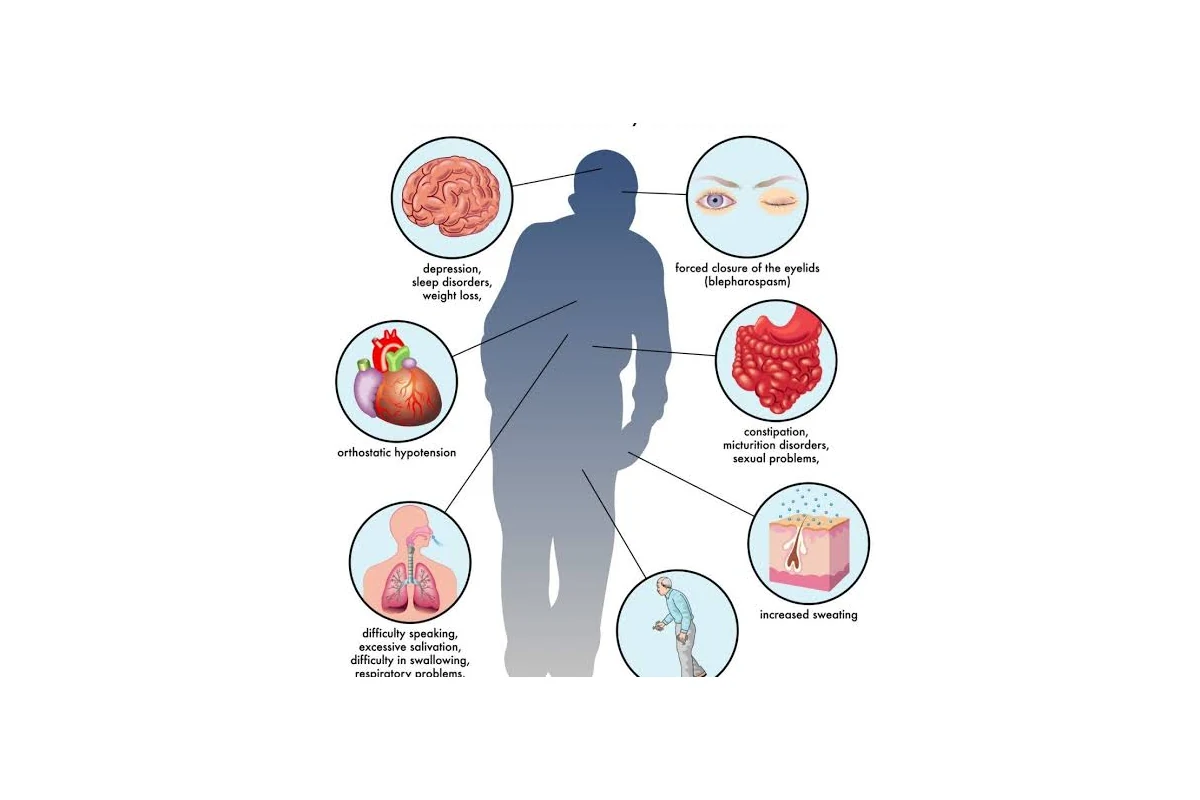
Medical illustration highlighting several symptoms associated with Parkinson’s disease, including sleep disturbances, constipation, low blood pressure and difficulty swallowing.
How Parkinson’s Symptoms Can Affect a Gorilla Trek
Parkinson’s disease can affect movement speed, muscle rigidity, posture, coordination and automatic balance reactions. Symptoms vary widely and may fluctuate through the day. A person who walks comfortably on a paved surface may still struggle with exposed roots, deep mud, narrow tracks and sudden changes of direction.
Tremor alone does not predict trekking ability. Freezing of gait, shuffling steps, postural instability, dizziness when standing and impaired turning can be more important on a steep trail. Nonmotor symptoms such as sleep disruption, constipation, anxiety and fatigue can also influence comfort and stamina. When planning gorilla trekking with Parkinson’s disease, this distinction deserves a specific discussion rather than a general assumption.
Evaluate practical tasks rather than relying only on a diagnosis or disease stage: can the traveler step over obstacles, descend a slope safely, stand after sitting, follow ranger instructions and walk for a prolonged period with limited facilities? These questions help turn general concerns into a usable planning discussion.
Practical planning. Make a simple one-page profile listing walking pace, recent falls, usual medication times, mobility aids and the symptoms that signal a need to stop. Share only the details necessary to organize assistance, and keep sensitive medical information with the traveler or trusted companion. Before confirming gorilla trekking with Parkinson’s disease, discuss this point with both the medical team and the people organizing the itinerary. For background on related mobility concerns, our article search for gorilla trekking with fibromyalgia may help readers compare different preparation issues.
What to ask before booking. Ask who can coordinate porter support, how long the transfer takes, what happens if the traveler cannot continue and whether the lodge has steps or steep pathways. Request written clarification of costs and limitations rather than assuming that a premium package includes specialized assistance. Planning gorilla trekking with Parkinson’s disease becomes more realistic when this concern is addressed before travel rather than on the trail. You can ask PrideMark Safaris how this fits a 5-day gorilla and game safari and whether additional arrangements can be explored.
| Practical issue | Why it matters | Planning response |
|---|---|---|
| Balance and turning | Roots and narrow tracks can trigger instability | Review falls and gait with a clinician |
| Medication schedule | Early departures can disrupt established routines | Carry written instructions and spare supplies |
| Porter support | A porter can carry a bag and offer practical help | Confirm availability and limits in advance |
| Trekking duration | Gorilla locations and routes are unpredictable | Plan for a possible early return |
| Lodge access | Steps and steep paths may increase fatigue | Ask about room access and transfer distances |
For tailored questions about gorilla trekking with Parkinson’s disease, contact PrideMark Safaris and describe the traveler’s functional needs before selecting a package. The 3-day flying luxury gorilla safari is one itinerary worth reviewing, but the operator must confirm what support can actually be arranged. Our About Us page provides additional company background.
Balance, Freezing of Gait and Fall Prevention
Slippery leaf litter, tangled roots and downhill stretches create particular hazards when balance reactions are slow. Freezing of gait may occur at narrow passages, obstacles or moments of stress. A companion should know the traveler’s established cueing techniques, but unfamiliar techniques should not be improvised on the trail.
Practice safe turning, obstacle negotiation and downhill walking with a qualified physical therapist before travel. A well-fitted walking aid may improve confidence for some people, yet poles are not appropriate for everyone. The goal is dependable movement, not simply completing longer walks during training. When planning gorilla trekking with Parkinson’s disease, this distinction deserves a specific discussion rather than a general assumption.
If falls have become frequent or the traveler cannot recover balance without another person catching them, the risks deserve especially careful review. Park staff can help assess practical options, but neither a porter nor a ranger can guarantee prevention of injury.
Practical planning. Make a simple one-page profile listing walking pace, recent falls, usual medication times, mobility aids and the symptoms that signal a need to stop. Share only the details necessary to organize assistance, and keep sensitive medical information with the traveler or trusted companion. Planning gorilla trekking with Parkinson’s disease becomes more realistic when this concern is addressed before travel rather than on the trail. For background on related mobility concerns, our article search for gorilla trekking with a knee replacement may help readers compare different preparation issues.
What to ask before booking. Ask who can coordinate porter support, how long the transfer takes, what happens if the traveler cannot continue and whether the lodge has steps or steep pathways. Request written clarification of costs and limitations rather than assuming that a premium package includes specialized assistance. For gorilla trekking with Parkinson’s disease, the practical implication is to prepare for conditions that may be more difficult than the traveler expects. You can ask PrideMark Safaris how this fits a 3-day Uganda gorilla trekking safari and whether additional arrangements can be explored.
For tailored questions about gorilla trekking with Parkinson’s disease, contact PrideMark Safaris and describe the traveler’s functional needs before selecting a package. The 5-day gorilla and game safari is one itinerary worth reviewing, but the operator must confirm what support can actually be arranged. Our About Us page provides additional company background.
Steep Trails, Mud, Weather and Fatigue
Uganda’s gorilla habitats include steep, uneven and sometimes muddy forest terrain. Rain can make exposed soil and roots slippery, and a gorilla family may move before trackers locate it. Trek duration and elevation changes cannot be reliably selected in advance, even during a comparatively dry period.
Fatigue may worsen walking quality, concentration and balance. Build rest into the wider itinerary, avoid demanding activities immediately before trekking day and plan for slow, steady movement. Heat, rain and cool mountain conditions may each affect comfort, so adaptable clothing and accessible drinking water are useful. When planning gorilla trekking with Parkinson’s disease, this distinction deserves a specific discussion rather than a general assumption.
Good preparation includes realistic turnaround criteria. If a person becomes unsafe on uneven ground, pushing onward for the sighting is not a sensible objective. Discuss stopping, returning and seeking assistance before the trek begins, rather than making those decisions under pressure.
Practical planning. Make a simple one-page profile listing walking pace, recent falls, usual medication times, mobility aids and the symptoms that signal a need to stop. Share only the details necessary to organize assistance, and keep sensitive medical information with the traveler or trusted companion. For gorilla trekking with Parkinson’s disease, the practical implication is to prepare for conditions that may be more difficult than the traveler expects. For background on related mobility concerns, our article search for gorilla trekking with epilepsy may help readers compare different preparation issues.
What to ask before booking. Ask who can coordinate porter support, how long the transfer takes, what happens if the traveler cannot continue and whether the lodge has steps or steep pathways. Request written clarification of costs and limitations rather than assuming that a premium package includes specialized assistance. Before confirming gorilla trekking with Parkinson’s disease, discuss this point with both the medical team and the people organizing the itinerary. You can ask PrideMark Safaris how this fits a 3-day flying luxury gorilla safari and whether additional arrangements can be explored.
For tailored questions about gorilla trekking with Parkinson’s disease, contact PrideMark Safaris and describe the traveler’s functional needs before selecting a package. The 3-day Uganda gorilla trekking safari is one itinerary worth reviewing, but the operator must confirm what support can actually be arranged. Our About Us page provides additional company background.
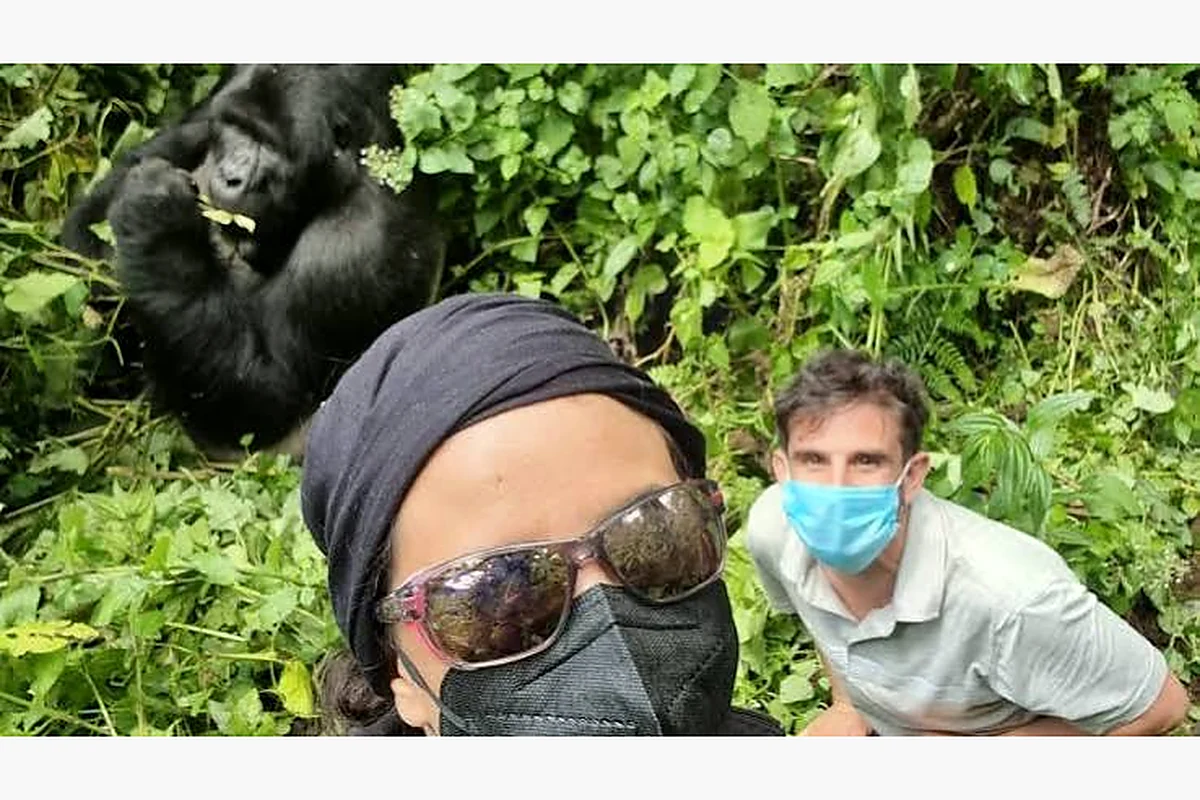
Two visitors wearing face masks take a photograph with a mountain gorilla visible behind them in lush forest vegetation.
Neurologist Advice, Medication Timing and Travel Preparation
Parkinson’s medication timing can be essential for maintaining mobility. Long transfers, early departures and changes in meals may disrupt a routine. Before traveling, ask the prescribing clinician how to manage the schedule across flights, time zones and a trekking morning without independently changing doses.
Carry medicines in original labeled packaging, keep a written medication list and bring an appropriate reserve in hand luggage. Check entry rules for controlled medicines and ask the clinician about dehydration, nausea, orthostatic hypotension, swallowing difficulty and interactions with drugs used for travel sickness. When planning gorilla trekking with Parkinson’s disease, this distinction deserves a specific discussion rather than a general assumption.
A medical consultation should consider recent falls, episodes of fainting, wearing-off periods, hallucinations, swallowing issues and any cardiovascular conditions. If symptoms are changing rapidly, postpone a demanding trek until the situation has been evaluated and stabilized.
Practical planning. Make a simple one-page profile listing walking pace, recent falls, usual medication times, mobility aids and the symptoms that signal a need to stop. Share only the details necessary to organize assistance, and keep sensitive medical information with the traveler or trusted companion. Before confirming gorilla trekking with Parkinson’s disease, discuss this point with both the medical team and the people organizing the itinerary. For background on related mobility concerns, our article search for gorilla trekking with COPD may help readers compare different preparation issues.
What to ask before booking. Ask who can coordinate porter support, how long the transfer takes, what happens if the traveler cannot continue and whether the lodge has steps or steep pathways. Request written clarification of costs and limitations rather than assuming that a premium package includes specialized assistance. Planning gorilla trekking with Parkinson’s disease becomes more realistic when this concern is addressed before travel rather than on the trail. You can ask PrideMark Safaris how this fits a 5-day gorilla and game safari and whether additional arrangements can be explored.
| Travel decision | Potential challenge | What to confirm |
|---|---|---|
| Balance and turning | Roots and narrow tracks can trigger instability | Review falls and gait with a clinician |
| Medication schedule | Early departures can disrupt established routines | Carry written instructions and spare supplies |
| Porter support | A porter can carry a bag and offer practical help | Confirm availability and limits in advance |
| Trekking duration | Gorilla locations and routes are unpredictable | Plan for a possible early return |
| Lodge access | Steps and steep paths may increase fatigue | Ask about room access and transfer distances |
For tailored questions about gorilla trekking with Parkinson’s disease, contact PrideMark Safaris and describe the traveler’s functional needs before selecting a package. The 3-day flying luxury gorilla safari is one itinerary worth reviewing, but the operator must confirm what support can actually be arranged. Our About Us page provides additional company background.
Bwindi or Mgahinga: Choosing the Right Setting
Bwindi Impenetrable National Park and Mgahinga Gorilla National Park both protect mountain gorillas, but neither offers a universally easy trekking route. Trail conditions depend on the specific sector, weather, gorilla movements and the day’s tracking assignment. Descriptions of one park as always flatter or shorter are misleading.
Transport time, accommodation location and the morning meeting point may matter as much as the walk itself. A lodge close to the briefing point can reduce early travel stress, while a flying itinerary may shorten some road journeys. However, flights do not remove the physical demands of the forest. When planning gorilla trekking with Parkinson’s disease, this distinction deserves a specific discussion rather than a general assumption.
Discuss the traveler’s balance, walking speed and assistance requirements with the operator well in advance. Ask what information can be passed to park staff, which support arrangements require advance notice and which choices remain outside the operator’s control.
Practical planning. Make a simple one-page profile listing walking pace, recent falls, usual medication times, mobility aids and the symptoms that signal a need to stop. Share only the details necessary to organize assistance, and keep sensitive medical information with the traveler or trusted companion. Planning gorilla trekking with Parkinson’s disease becomes more realistic when this concern is addressed before travel rather than on the trail. For background on related mobility concerns, our article search for gorilla trekking with osteoporosis may help readers compare different preparation issues.
What to ask before booking. Ask who can coordinate porter support, how long the transfer takes, what happens if the traveler cannot continue and whether the lodge has steps or steep pathways. Request written clarification of costs and limitations rather than assuming that a premium package includes specialized assistance. For gorilla trekking with Parkinson’s disease, the practical implication is to prepare for conditions that may be more difficult than the traveler expects. You can ask PrideMark Safaris how this fits a 3-day Uganda gorilla trekking safari and whether additional arrangements can be explored.
For tailored questions about gorilla trekking with Parkinson’s disease, contact PrideMark Safaris and describe the traveler’s functional needs before selecting a package. The 5-day gorilla and game safari is one itinerary worth reviewing, but the operator must confirm what support can actually be arranged. Our About Us page provides additional company background.
Porters, Walking Sticks and Additional Mobility Assistance
A local porter may help carry a daypack and offer practical support on difficult ground. Walking sticks or poles can be useful when appropriate for the individual, but the traveler should practice with the same type of aid beforehand. Assistance must not be confused with a medically supervised rehabilitation service.
Specialized carrying arrangements may sometimes be discussed with local providers, but availability, staffing, route suitability, pricing and park authorization must be confirmed directly. They are not an automatic entitlement or a guarantee of access to every gorilla family or trail. When planning gorilla trekking with Parkinson’s disease, this distinction deserves a specific discussion rather than a general assumption.
Explain whether the traveler can stand independently, transfer safely, tolerate prolonged sitting and manage a sudden change in terrain. Clear information protects the traveler and helps avoid unrealistic promises. Guides and porters should also be told how to respond if the traveler needs to stop.
Practical planning. Make a simple one-page profile listing walking pace, recent falls, usual medication times, mobility aids and the symptoms that signal a need to stop. Share only the details necessary to organize assistance, and keep sensitive medical information with the traveler or trusted companion. For gorilla trekking with Parkinson’s disease, the practical implication is to prepare for conditions that may be more difficult than the traveler expects. For background on related mobility concerns, our article search for gorilla trekking with knee problems may help readers compare different preparation issues.
What to ask before booking. Ask who can coordinate porter support, how long the transfer takes, what happens if the traveler cannot continue and whether the lodge has steps or steep pathways. Request written clarification of costs and limitations rather than assuming that a premium package includes specialized assistance. Before confirming gorilla trekking with Parkinson’s disease, discuss this point with both the medical team and the people organizing the itinerary. You can ask PrideMark Safaris how this fits a 3-day flying luxury gorilla safari and whether additional arrangements can be explored.
| Support option | Possible benefit | Important limitation |
|---|---|---|
| Balance and turning | Roots and narrow tracks can trigger instability | Review falls and gait with a clinician |
| Medication schedule | Early departures can disrupt established routines | Carry written instructions and spare supplies |
| Porter support | A porter can carry a bag and offer practical help | Confirm availability and limits in advance |
| Trekking duration | Gorilla locations and routes are unpredictable | Plan for a possible early return |
| Lodge access | Steps and steep paths may increase fatigue | Ask about room access and transfer distances |
For tailored questions about gorilla trekking with Parkinson’s disease, contact PrideMark Safaris and describe the traveler’s functional needs before selecting a package. The 3-day Uganda gorilla trekking safari is one itinerary worth reviewing, but the operator must confirm what support can actually be arranged. Our About Us page provides additional company background.
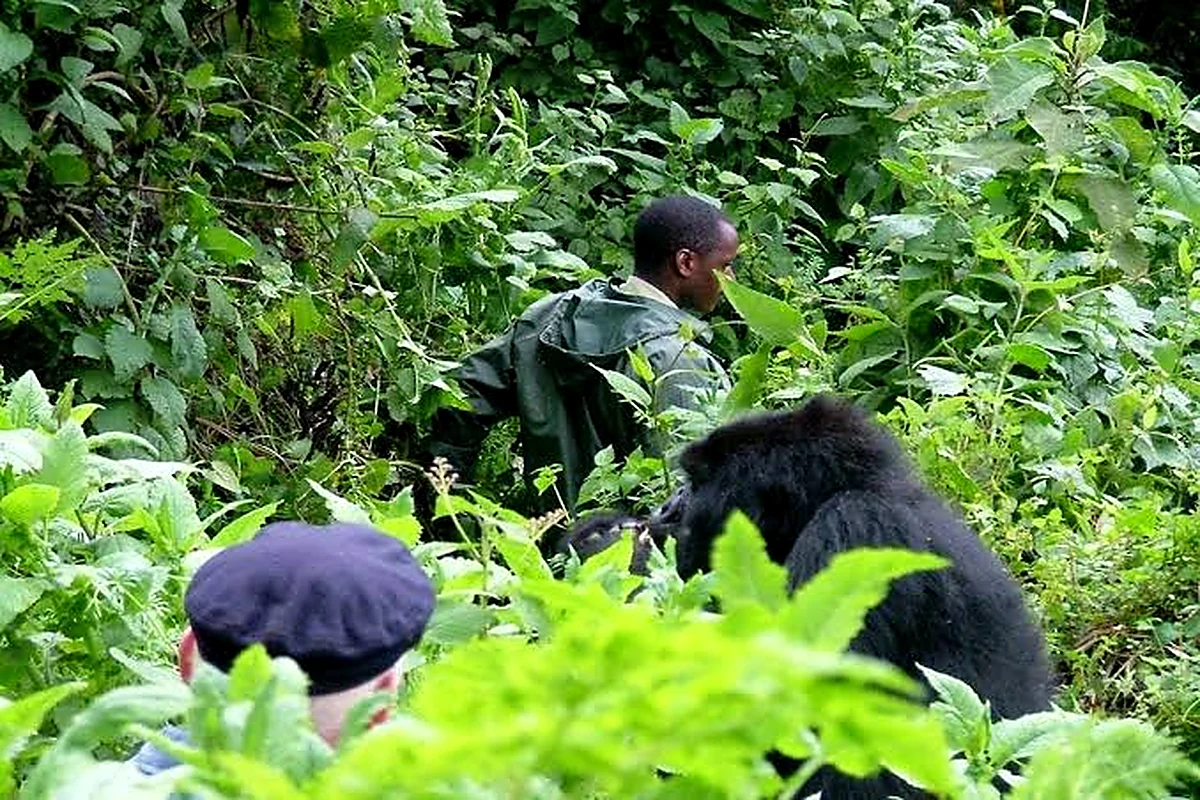
A mountain gorilla rests among lush forest vegetation while a park ranger and visitor observe nearby.
Warning Signs, Emergencies and When Not to Trek
Severe dizziness, fainting, chest pain, unusual breathlessness, new confusion or a sudden marked deterioration in walking ability should not be dismissed as ordinary trekking fatigue. Stop activity and seek appropriate medical assessment. New neurological symptoms require urgent attention, particularly if they differ from the person’s usual Parkinson’s pattern.
A traveler who has had repeated recent falls, poorly controlled freezing, severe orthostatic hypotension or substantial cognitive difficulties may need to reconsider trekking. Decisions should reflect clinical advice and the practical reality of being far from rapid medical care, not pressure to use a purchased permit. When planning gorilla trekking with Parkinson’s disease, this distinction deserves a specific discussion rather than a general assumption.
Agree on a communication plan, emergency contact details and the role of a companion before departure. Travel insurance should be checked for medical conditions, evacuation provisions and exclusions. Emergency transport in remote areas may take time even when arrangements are in place.
Practical planning. Make a simple one-page profile listing walking pace, recent falls, usual medication times, mobility aids and the symptoms that signal a need to stop. Share only the details necessary to organize assistance, and keep sensitive medical information with the traveler or trusted companion. Before confirming gorilla trekking with Parkinson’s disease, discuss this point with both the medical team and the people organizing the itinerary. For background on related mobility concerns, our article search for gorilla trekking with walking sticks may help readers compare different preparation issues.
What to ask before booking. Ask who can coordinate porter support, how long the transfer takes, what happens if the traveler cannot continue and whether the lodge has steps or steep pathways. Request written clarification of costs and limitations rather than assuming that a premium package includes specialized assistance. Planning gorilla trekking with Parkinson’s disease becomes more realistic when this concern is addressed before travel rather than on the trail. You can ask PrideMark Safaris how this fits a 5-day gorilla and game safari and whether additional arrangements can be explored.
For tailored questions about gorilla trekking with Parkinson’s disease, contact PrideMark Safaris and describe the traveler’s functional needs before selecting a package. The 3-day flying luxury gorilla safari is one itinerary worth reviewing, but the operator must confirm what support can actually be arranged. Our About Us page provides additional company background.
Planning a Suitable Uganda Gorilla Safari
The best itinerary is not necessarily the one with the most activities. It allows rest, sensible transfers, a suitable lodge and time to discuss mobility needs before trekking day. Package descriptions are starting points for a conversation rather than assurances that a particular visitor will be able to complete the forest walk.
Consider whether a short itinerary would feel rushed or whether a longer journey with recovery days would be more comfortable. Road conditions, domestic flights, luggage handling and accommodation access should be discussed alongside trekking logistics. The travel companion’s needs also deserve attention. When planning gorilla trekking with Parkinson’s disease, this distinction deserves a specific discussion rather than a general assumption.
A responsible operator should explain what can be requested, what requires confirmation and what cannot be guaranteed. The final choice should be based on medical guidance, the traveler’s preferences and a clear understanding of the uncertainties involved in wildlife tracking.
Practical planning. Make a simple one-page profile listing walking pace, recent falls, usual medication times, mobility aids and the symptoms that signal a need to stop. Share only the details necessary to organize assistance, and keep sensitive medical information with the traveler or trusted companion. Planning gorilla trekking with Parkinson’s disease becomes more realistic when this concern is addressed before travel rather than on the trail. For background on related mobility concerns, our article search for gorilla trekking with multiple sclerosis may help readers compare different preparation issues.
What to ask before booking. Ask who can coordinate porter support, how long the transfer takes, what happens if the traveler cannot continue and whether the lodge has steps or steep pathways. Request written clarification of costs and limitations rather than assuming that a premium package includes specialized assistance. For gorilla trekking with Parkinson’s disease, the practical implication is to prepare for conditions that may be more difficult than the traveler expects. You can ask PrideMark Safaris how this fits a 3-day Uganda gorilla trekking safari and whether additional arrangements can be explored.
For tailored questions about gorilla trekking with Parkinson’s disease, contact PrideMark Safaris and describe the traveler’s functional needs before selecting a package. The 5-day gorilla and game safari is one itinerary worth reviewing, but the operator must confirm what support can actually be arranged. Our About Us page provides additional company background.
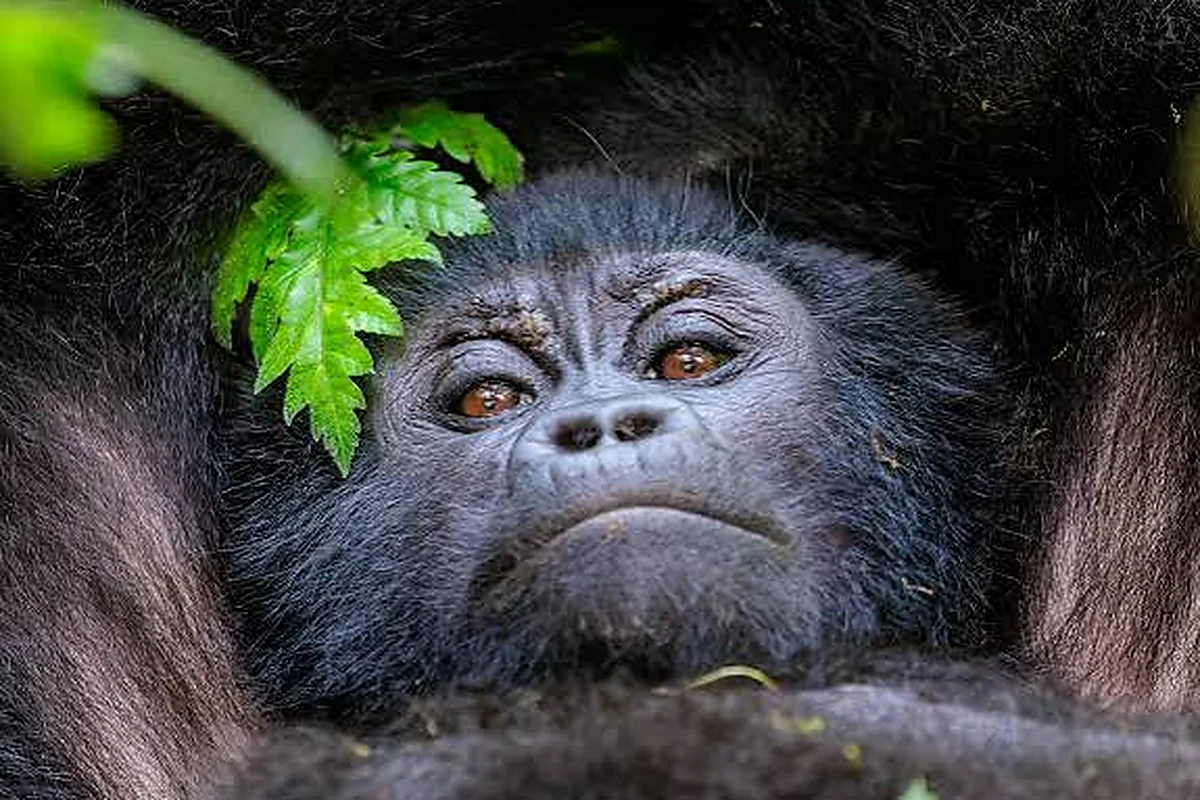
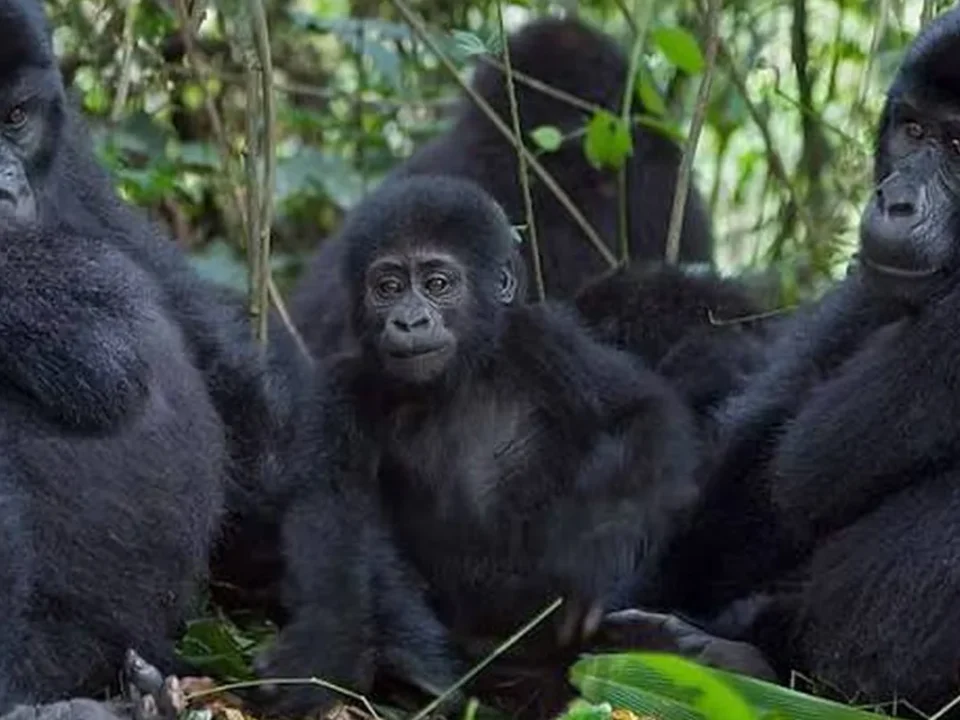
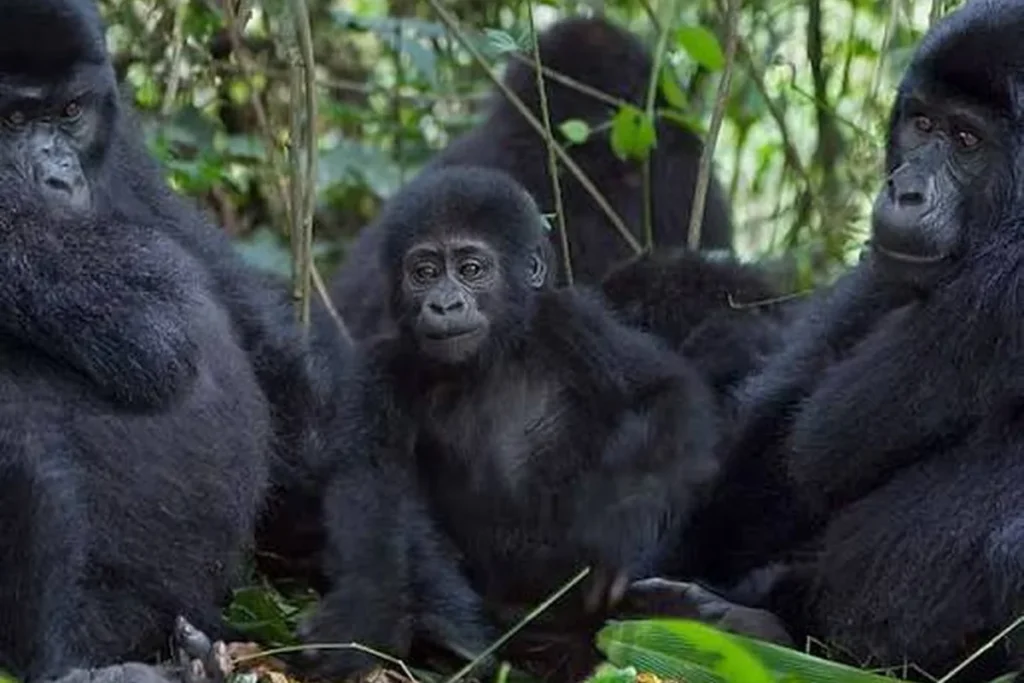
A young mountain gorilla gazes upward while resting against the protective body of an adult gorilla.
Frequently Asked Questions About Gorilla Trekking With Parkinson’s Disease
Can a person with Parkinson’s disease trek to see mountain gorillas?
Possibly, depending on walking ability, balance, symptoms, medical advice and the available assistance. A diagnosis alone does not determine eligibility, and no route can be guaranteed easy. For gorilla trekking with Parkinson’s disease, personalized preparation is more valuable than relying on an average trekking time or a general claim that a park is easy. If you need itinerary details, ask PrideMark Safaris about 3-day Uganda gorilla trekking safari before booking.
Is gorilla trekking safe for someone with Parkinson’s?
Risk varies considerably. Steep mud, roots, long walking times and remote conditions can increase fall risk. A treating clinician and park staff should help assess the practical concerns. For gorilla trekking with Parkinson’s disease, personalized preparation is more valuable than relying on an average trekking time or a general claim that a park is easy. If you need itinerary details, ask PrideMark Safaris about 3-day flying luxury gorilla safari before booking.
Does tremor prevent gorilla trekking?
Not necessarily. Balance problems, freezing of gait, fainting and endurance may matter more than tremor alone. A functional assessment is more informative than focusing on one symptom. For gorilla trekking with Parkinson’s disease, personalized preparation is more valuable than relying on an average trekking time or a general claim that a park is easy. If you need itinerary details, ask PrideMark Safaris about 5-day gorilla and game safari before booking.
What if I experience freezing of gait?
Tell your clinician and guide before the trek. Use only cueing approaches already practiced with a qualified professional, and consider whether narrow or steep trails present unacceptable risk. For gorilla trekking with Parkinson’s disease, personalized preparation is more valuable than relying on an average trekking time or a general claim that a park is easy. If you need itinerary details, ask PrideMark Safaris about 3-day Uganda gorilla trekking safari before booking.
Can I bring Parkinson’s medication on the trek?
Essential prescribed medicines should remain accessible in their original packaging. Ask your prescriber how to handle timing, food and travel-related changes; do not adjust doses independently. For gorilla trekking with Parkinson’s disease, personalized preparation is more valuable than relying on an average trekking time or a general claim that a park is easy. If you need itinerary details, ask PrideMark Safaris about 3-day flying luxury gorilla safari before booking.
Is Bwindi easier than Mgahinga for Parkinson’s disease?
Neither park can guarantee an easy trek. Actual difficulty depends on weather, terrain, sector and where gorillas are located on the day. For gorilla trekking with Parkinson’s disease, personalized preparation is more valuable than relying on an average trekking time or a general claim that a park is easy. If you need itinerary details, ask PrideMark Safaris about 5-day gorilla and game safari before booking.
Can a porter help someone with Parkinson’s?
A porter may carry a bag and provide practical assistance, subject to local arrangements. Porters are not a substitute for medical supervision or a guarantee against falls. For gorilla trekking with Parkinson’s disease, personalized preparation is more valuable than relying on an average trekking time or a general claim that a park is easy. If you need itinerary details, ask PrideMark Safaris about 3-day Uganda gorilla trekking safari before booking.
Are walking sticks allowed for gorilla trekking?
Walking sticks are commonly used, but the safest aid depends on individual needs and ranger guidance. Practice beforehand and confirm current arrangements with the operator. For gorilla trekking with Parkinson’s disease, personalized preparation is more valuable than relying on an average trekking time or a general claim that a park is easy. If you need itinerary details, ask PrideMark Safaris about 3-day flying luxury gorilla safari before booking.
Can I request a shorter gorilla trek?
You can explain your limitations in advance, but the operator cannot promise a short or level route. Park authorities and wildlife movements determine what is feasible. For gorilla trekking with Parkinson’s disease, personalized preparation is more valuable than relying on an average trekking time or a general claim that a park is easy. If you need itinerary details, ask PrideMark Safaris about 5-day gorilla and game safari before booking.
What symptoms mean I should stop trekking?
Fainting, chest pain, severe dizziness, new confusion, unusual breathlessness or a marked decline in mobility warrant stopping and seeking appropriate help. For gorilla trekking with Parkinson’s disease, personalized preparation is more valuable than relying on an average trekking time or a general claim that a park is easy. If you need itinerary details, ask PrideMark Safaris about 3-day Uganda gorilla trekking safari before booking.
Does a luxury flying safari remove trekking difficulty?
No. Flying can reduce some road travel but does not remove steep or muddy trails. Ask about lodge accessibility, transfers and actual forest conditions. For gorilla trekking with Parkinson’s disease, personalized preparation is more valuable than relying on an average trekking time or a general claim that a park is easy. If you need itinerary details, ask PrideMark Safaris about 3-day flying luxury gorilla safari before booking.
How do I plan a gorilla safari with Parkinson’s disease?
Start with a medical review, explain mobility needs to the operator, confirm assistance and permit conditions, choose a flexible itinerary and prepare a realistic contingency plan. For gorilla trekking with Parkinson’s disease, personalized preparation is more valuable than relying on an average trekking time or a general claim that a park is easy. If you need itinerary details, ask PrideMark Safaris about 5-day gorilla and game safari before booking.
Final Thoughts
Gorilla trekking with parkinson’s disease requires careful assessment of mobility, falls, medication timing and the uncertainty of forest trails. Some travelers may find the experience feasible with appropriate support; others may decide that a different safari activity is safer. Both outcomes are valid when they reflect informed choices and sound medical guidance.
Discuss your preferred itinerary with PrideMark Safaris, review the About Us page, and explore the 5-day gorilla and game safari if you want a broader Uganda journey. No itinerary, porter or lodge can guarantee a safe or easy gorilla trek, so confirm arrangements and medical suitability before committing.