Where Are the Big Five in Uganda? A Park-by-Park Guide

Best Time to Visit Uganda: 12-Month Ultimate Safari Secrets!
September 30, 2026
Flying vs Driving on a Uganda Safari: Ultimate Guide
October 1, 2026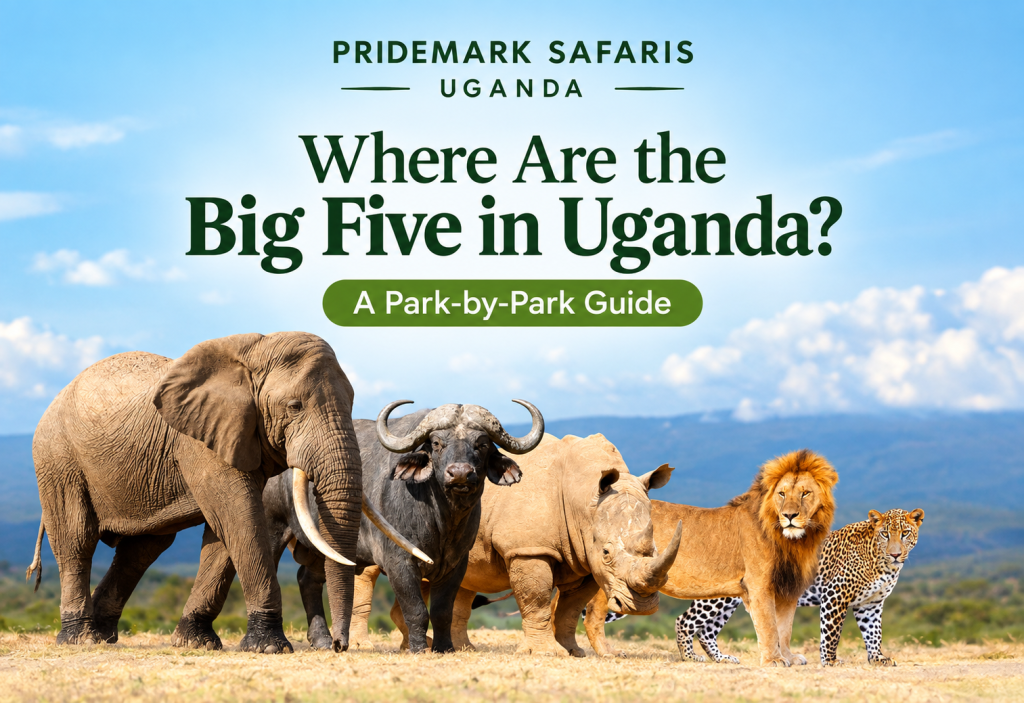
If you dream of watching an elephant emerge from the golden savannah, hearing a lion call across the plains at sunrise, catching a glimpse of a leopard disappearing into the grass, or standing quietly as a huge buffalo herd crosses your safari route, Uganda offers an extraordinary setting for the experience. The Big Five in Uganda are not concentrated in one single destination. Instead, they are spread across several remarkable wildlife landscapes, each with its own character, scenery, wildlife concentrations and style of safari.
Uganda’s great advantage is variety. A safari here can move from the palm-dotted plains of Murchison Falls to the crater-studded landscapes of Queen Elizabeth, the dry wilderness of Kidepo Valley and the intimate savannahs of Lake Mburo. And there is an important twist when it comes to the fifth member of the famous group: rhinos have a fascinating conservation story in Uganda. Ziwa Rhino Sanctuary has played a central role in bringing southern white rhinos back to the country, while 2026 has marked a major new chapter with rhino reintroductions into protected areas, including Kidepo Valley National Park.
So, where are the Big Five in Uganda? The answer requires looking beyond a simple list of parks. It means understanding where each species lives, where sightings are realistically possible, why some animals are much harder to find than others, and how Uganda’s conservation story is changing.


The Big Five in Uganda: What Does the Term Mean?
The expression Big Five traditionally refers to the African lion, leopard, African elephant, African buffalo and rhinoceros. The term has historical roots in big-game hunting, where these animals were considered among the most challenging and dangerous animals to hunt on foot. Today, however, the phrase is widely used in wildlife tourism and photography to describe five iconic African mammals visitors hope to encounter on safari.
Seeing all five is not guaranteed anywhere in Uganda. Wildlife is wild, and animals move according to water, food, vegetation, weather, breeding behaviour and disturbance. A safari guide can increase your chances through knowledge of animal movements and habitats, but no responsible operator should promise that you will see every species.
This is especially important when discussing the Big Five in Uganda because the country’s rhino situation is different from its elephant, buffalo, lion and leopard populations. Uganda’s wildlife authority states that rhinos were eliminated from the country’s wild landscapes during the twentieth century, while the rhino breeding and conservation programme at Ziwa helped rebuild the population.
In other words, a Uganda safari should not be viewed simply as a checklist. The real experience comes from entering different ecosystems and observing animals behaving naturally in their own landscapes.
Big Five in Uganda: Quick Facts
| Big Five Animal | Main Uganda Locations | What to Know |
|---|---|---|
| 🦁 Lion | Murchison Falls, Queen Elizabeth, Kidepo | Strongest opportunities are in Uganda’s major savannah landscapes |
| 🐆 Leopard | Murchison Falls, Queen Elizabeth, Kidepo, Lake Mburo and others | Present but secretive and much harder to spot |
| 🐘 Elephant | Murchison Falls, Queen Elizabeth, Kidepo | Often encountered near water and feeding areas |
| 🦬 Buffalo | Murchison Falls, Queen Elizabeth, Kidepo, Lake Mburo | Common in several savannah ecosystems |
| 🦏 Rhino | Ziwa, Ajai; reintroduction underway at Kidepo | Rhino conservation in Uganda is an active restoration story |
UWA’s 2026 wildlife report identifies Murchison Falls, Queen Elizabeth and Kidepo as the country’s principal lion landscapes, while its leopard assessment records leopards in several protected areas including Queen Elizabeth, Murchison Falls, Lake Mburo and Kidepo.
Uganda’s Big Five Safari Map
A good way to understand where to see the Big Five in Uganda is to picture the country’s safari circuit from north to south.
Murchison Falls lies in northern Uganda and is the country’s largest national park. Queen Elizabeth is further southwest, while Lake Mburo is conveniently positioned closer to Kampala and forms a natural stop between central Uganda and the western safari destinations. Kidepo lies far to the northeast in the dramatic Karamoja region.
Ziwa Rhino Sanctuary sits in Nakasongola and is particularly important because it can be incorporated into a Murchison Falls safari route.


This geographic arrangement is useful when designing an itinerary because trying to see every major wildlife area in one short safari can create unnecessarily long driving days. A thoughtful itinerary groups destinations according to geography.
1. Murchison Falls National Park: A Classic Big Five Safari Landscape
If you are asking where to begin looking for the Big Five in Uganda, Murchison Falls National Park deserves a place near the top of the conversation.
Murchison Falls is Uganda’s largest national park and forms part of a much larger conservation landscape. The Victoria Nile divides the park before forcing its way through the narrow Murchison Falls gorge, creating one of the country’s most spectacular natural scenes. Around the river and across the northern savannah plains, wildlife gathers in remarkable numbers.
The park is particularly impressive because the safari experience combines game drives with the possibility of a boat cruise. Rather than experiencing wildlife only from a vehicle, visitors can travel along the Nile and watch elephants, buffaloes, hippos and crocodiles around the riverbanks.
UWA describes Murchison Falls as supporting a remarkably diverse wildlife community, with elephants, giraffes and buffaloes among the animals frequently associated with the Nile landscape. UWA’s conservation documentation also records lion and leopard among the park’s larger mammals.


Elephants are among the most memorable animals in Murchison Falls. They can be encountered moving across the savannah, feeding in woodland or gathering around water. The Nile adds another dimension to the experience because elephant sightings along the river can create wonderful photographic opportunities.
UWA’s current wildlife information places elephants among Uganda’s major populations and identifies Murchison-Semliki, Kidepo and the Greater Virunga landscape as important elephant areas.
Lions in Murchison Falls
Murchison Falls is one of Uganda’s three principal lion landscapes. The 2026 State of Wildlife Resources report says lions are currently restricted primarily to Queen Elizabeth, Kidepo and Murchison Falls, with the Murchison population described as relatively stable compared with declines recorded in some other landscapes.
Early morning game drives can be particularly rewarding because lions may be active before the heat of the day becomes intense. However, lions may also rest for long periods, especially when temperatures rise.
Leopards in Murchison Falls
Leopards are present, but they are considerably more difficult to find than elephants or buffaloes. Their spotted coats provide superb camouflage, and they frequently avoid open areas when exposed to people or other predators.
UWA’s 2026 leopard assessment includes Murchison Falls among Uganda’s protected areas supporting leopard populations.
Buffaloes in Murchison Falls
Buffaloes can be one of the most spectacular sights in Murchison Falls. Large herds may spread across open grassland, creating a moving wall of dark bodies beneath the African sun. UWA notes that Murchison Falls can support very large buffalo herds.
What makes Murchison Falls special?
The combination of game drives + Nile boat cruise + waterfall scenery + large savannah wildlife makes Murchison Falls an exceptionally complete safari destination.
For travellers researching Big Five safari Uganda, Murchison Falls is also conveniently paired with Ziwa Rhino Sanctuary on many overland itineraries.
2. Queen Elizabeth National Park: Big Game, Lions and the Kazinga Channel
Queen Elizabeth National Park offers a completely different interpretation of the Big Five in Uganda. Instead of the broad northern plains of Murchison, the landscape here is shaped by lakes, savannah, wetlands, forests, crater lakes and the famous Kazinga Channel.
The park is one of Uganda’s most diverse wildlife destinations and is especially famous for lions in the Ishasha sector. The park’s tree-climbing lions have become one of Uganda’s most recognizable wildlife attractions.
UWA lists elephants, buffaloes, lions and leopards among Queen Elizabeth’s wildlife. Its current park information also highlights the Kazinga Channel as a major wildlife-viewing location where elephants and buffaloes can be seen around the water.


Elephants around Queen Elizabeth
The Kazinga Channel is one of the most visually impressive places to watch elephants. Herds may approach the water to drink, bathe or cool themselves.
The combination of water, open shoreline and wildlife makes a boat cruise along the Kazinga Channel particularly useful for wildlife photography. You are not guaranteed a particular animal, but the channel regularly brings different species into the same general area.
The famous tree-climbing lions of Ishasha
The Ishasha sector in the southern part of Queen Elizabeth National Park is particularly famous for its tree-climbing lions. UWA identifies Ishasha as a place where these lions can be found resting in trees, sometimes looking out over the plains below.
The behaviour is unusual enough to become one of the highlights of a western Uganda safari.
The important thing to remember is that the lions do not climb trees simply because visitors arrive. Wildlife does not perform on schedule. On some days you may find lions comfortably positioned on branches; on others, they may be on the ground or hidden from view.
Leopards in Queen Elizabeth
Queen Elizabeth is also important for leopard conservation. The 2026 UWA wildlife report estimates that Queen Elizabeth has one of Uganda’s larger leopard populations, although leopards remain elusive and sightings are never guaranteed.
This makes the park interesting for visitors who want more than the obvious wildlife. A safari guide may spend time reading tracks, checking likely resting areas and carefully scanning trees and thickets.
Buffaloes and the Kazinga Channel
Buffaloes are one of the animals you are most likely to associate with the Kazinga Channel. They may gather along the banks or move between grazing areas and water.
The sight of buffaloes beside hippos, elephants and waterbirds demonstrates why Queen Elizabeth is often described as a medley of ecosystems rather than simply a savannah park.
3. Kidepo Valley National Park: Remote Big Five Wilderness
Kidepo Valley National Park is where the idea of an African wilderness becomes particularly dramatic.
Located in northeastern Uganda’s Karamoja region, Kidepo is separated from many of Uganda’s better-known safari circuits by considerable distance. Its broad valleys, mountains, dry-country vegetation and enormous skies give it a visual identity unlike Murchison Falls or Queen Elizabeth.
UWA describes Kidepo as a remote wilderness destination with more than 77 mammal species and highlights lions, buffaloes and elephants among its major attractions. Historical and current UWA sources also record leopards in the park.


Elephants are among the most impressive animals in Kidepo. The park’s remote setting creates a powerful feeling of wilderness, especially when an elephant herd appears against the mountainous horizon.
UWA’s elephant information identifies Kidepo as one of the landscapes supporting Uganda’s elephant populations.
Kidepo’s buffaloes
Buffaloes are particularly important in Kidepo’s ecosystem. UWA’s 2026 wildlife report identifies Kidepo as the country’s main buffalo stronghold, with Queen Elizabeth, Murchison Falls and Lake Mburo also supporting significant populations.
The Narus Valley can become particularly productive for wildlife during dry periods because water availability concentrates animals around the remaining sources.
Kidepo’s lions
Kidepo is one of Uganda’s three principal lion landscapes. However, the current conservation picture is more complicated than simply saying “Kidepo has many lions.” UWA’s 2026 report records declines in the country’s lion population, with particularly notable concerns in Kidepo and Queen Elizabeth.
This is an important reminder that wildlife tourism articles should not promise guaranteed sightings.
Kidepo and the return of rhinos
This is where the story of the Big Five in Uganda becomes especially exciting.
In March 2026, Uganda Wildlife Authority began reintroducing southern white rhinos into Kidepo Valley National Park after more than four decades without rhinos in the landscape. The first phase involved an initial group of rhinos, with eight planned for the programme. The animals were placed in a secure sanctuary within the park for monitoring and adaptation.
Conservation partners later reported that four rhinos were feeding and moving within the secure Kidepo sanctuary, with further arrivals planned.
This means Kidepo is now at the beginning of a fascinating new chapter. However, travellers should not assume that rhino sightings are currently equivalent to established safari sightings of elephants or buffaloes. The reintroduction is a conservation process, and the animals are being carefully monitored.
That distinction makes your article more accurate and more useful to readers planning a safari.
4. Lake Mburo National Park: The Small Park with a Big Wildlife Personality
Lake Mburo National Park is one of Uganda’s most compact savannah parks, but its smaller size does not mean it lacks character.
In fact, Lake Mburo provides one of the most intimate wildlife experiences in Uganda. The landscape contains savannah, acacia woodland, wetlands, rocky areas and lakes, creating habitat for species that are uncommon or absent from some of Uganda’s larger parks.


Lake Mburo is particularly famous for zebras, impalas and eland, but it also supports buffaloes and leopards. UWA specifically identifies leopards among the park’s wildlife, while noting that sightings are rare.
Does Lake Mburo have elephants?
This is one of the most important distinctions when discussing the Big Five in Uganda.
Lake Mburo is not an elephant destination in the same way that Murchison Falls, Queen Elizabeth or Kidepo are. UWA’s current Lake Mburo information specifically notes that the park lacks elephants.
That absence has ecological consequences. Without elephants shaping the woodland in the same way they do elsewhere, Lake Mburo maintains a distinctive mosaic of vegetation.
Leopards in Lake Mburo
Lake Mburo is one of the places where you can potentially encounter a leopard, although patience is essential. UWA’s 2026 large-carnivore assessment describes Lake Mburo as locally important for leopards, with densities that appear stable or potentially increasing in the available research.
A quiet early-morning drive can therefore be especially rewarding for visitors interested in predators.
Buffaloes in Lake Mburo
Buffaloes are present and can be seen among the park’s grasslands and woodlands. Their presence adds another Big Five species to Lake Mburo’s wildlife profile, even though the park does not offer the full group.
Lake Mburo is therefore better thought of as a Big Five component of a wider Uganda safari, rather than a park where you go expecting all five.
5. Ziwa Rhino Sanctuary: Uganda’s Essential Rhino Stop
If your goal is specifically to see a rhino during a Uganda safari, Ziwa Rhino Sanctuary deserves special attention.
Ziwa is not a national park. It is a dedicated rhino conservation landscape in Nakasongola, and it has played an extraordinary role in Uganda’s rhino recovery.
Uganda Wildlife Authority explains that rhinos were wiped out in Uganda by the early 1980s and that Ziwa was established in 2005 to reintroduce southern white rhinos.


This is why Ziwa is particularly valuable for travellers who want to understand the conservation story behind the Big Five in Uganda.
Instead of simply ticking “rhino” off a list, visitors can see how a species that disappeared from Uganda’s wild landscapes is being gradually restored.
The 2026 Rhino Conservation Story Changes Uganda’s Big Five Picture
For years, the simplest explanation was that Uganda offered excellent opportunities for four members of the Big Five in its national parks, while rhinos were associated primarily with Ziwa Rhino Sanctuary.
That picture is now changing.
In January 2026, four southern white rhinos were moved from Ziwa to Ajai Wildlife Reserve as part of a national programme to restore rhinos to protected areas where they historically occurred.
Then, in March 2026, the reintroduction programme expanded to Kidepo Valley National Park. UWA reported that the first rhinos had returned to Kidepo after 43 years, following their disappearance from the area in the early 1980s.
This is significant because conservation in Uganda is moving beyond maintaining animals in one protected location and toward rebuilding populations across suitable landscapes.
For safari travellers, that means the answer to where are the Big Five in Uganda will continue to evolve over time.
Big Five in Uganda: Park-by-Park Comparison
| Destination | Lion | Leopard | Elephant | Buffalo | Rhino |
|---|---|---|---|---|---|
| Murchison Falls | ✓ | ✓ | ✓ | ✓ | Not currently established |
| Queen Elizabeth | ✓ | ✓ | ✓ | ✓ | Not currently established |
| Kidepo Valley | ✓ | ✓ | ✓ | ✓ | Reintroduction underway |
| Lake Mburo | Limited/occasional | ✓ | ✗ | ✓ | ✗ |
| Ziwa Rhino Sanctuary | ✗ | ✗ | ✗ | ✗ | ✓ |
| Ajai Wildlife Reserve | Not a primary Big Five safari destination | — | — | — | Reintroduction underway |
This table should be displayed responsively so that on mobile devices it becomes horizontally scrollable rather than squeezing the columns together.
Where to See Each of the Big Five in Uganda
Where to see lions in Uganda
For lions, concentrate your safari around Murchison Falls, Queen Elizabeth and Kidepo Valley National Parks. These are the three principal lion landscapes identified in Uganda’s 2026 wildlife assessment.
Queen Elizabeth is particularly famous for the tree-climbing lions of Ishasha, while Murchison Falls offers classic savannah predator viewing and Kidepo provides the dramatic backdrop of the northeastern wilderness.
Lion sightings remain wildlife encounters rather than guarantees.
Where to see leopards in Uganda
Leopards occur in Murchison Falls, Queen Elizabeth, Kidepo Valley and Lake Mburo, among other protected areas. UWA’s 2026 assessment identifies seven national parks as supporting suitable leopard populations, including these four.
However, leopards are among the hardest Big Five animals to see. Their solitary behaviour, camouflage and tendency to remain hidden make a leopard sighting particularly special.


The major elephant safari landscapes include Murchison Falls, Queen Elizabeth and Kidepo. UWA identifies these landscapes as important elephant areas.
For close wildlife encounters, water sources can be especially productive, although elephant movements vary considerably with season and local conditions.
Where to see buffaloes in Uganda
Buffaloes are among the more widely distributed members of the Big Five in Uganda.
Major safari locations include Kidepo Valley, Murchison Falls, Queen Elizabeth and Lake Mburo. UWA’s 2026 wildlife report identifies Kidepo as the main buffalo stronghold and lists Murchison Falls, Queen Elizabeth and Lake Mburo among the other significant areas.
Where to see rhinos in Uganda
For the most established visitor experience, Ziwa Rhino Sanctuary remains central to Uganda’s rhino tourism and conservation story.
However, 2026 has brought major changes. Four rhinos were translocated to Ajai Wildlife Reserve in January, and a further reintroduction programme began at Kidepo in March.
Travellers should therefore check the latest access and viewing arrangements before building an itinerary around rhino sightings in newly established reintroduction sites.
Why You May Not See All Five on One Uganda Safari
One of the biggest mistakes a safari traveller can make is treating wildlife like a museum collection.
An elephant does not know that you have travelled thousands of kilometres to photograph it. A leopard may be sitting behind vegetation only a few metres from the road. A lion may be sleeping in tall grass. Buffaloes may be on the opposite side of a river.
Even when a species is present, it may not be visible.
Weather also changes wildlife behaviour. During dry periods, animals may concentrate around water. During wetter periods, food becomes more widely distributed and animals may spread across a larger area.
This is why experienced guides often focus on reading the ecosystem, rather than simply driving from one location to another.
A good guide looks for tracks, dung, alarm calls, vultures, fresh kills, disturbed vegetation, footprints and the behaviour of prey species. Sometimes a sudden change in the behaviour of Uganda kobs or antelope can provide a clue that a predator is nearby.
That is one reason a safari can be exciting even when the animal you hoped to see has not yet appeared.
The Best Time for a Big Five Safari in Uganda
Uganda can be visited throughout the year, but wildlife-viewing conditions change with the seasons.
During drier periods, vegetation may become thinner and animals can be easier to observe in some savannah areas. Water becomes increasingly important, which can concentrate wildlife around rivers, lakes and remaining water sources.
During wetter periods, the landscape becomes greener and dramatically beautiful. Young animals may be present, migratory birds become more noticeable in some locations, and landscapes can look exceptionally fresh. However, thick vegetation can sometimes make animals harder to spot.
For visitors researching the Big Five in Uganda, the most important point is not simply choosing a month. It is choosing the right combination of parks, activities, accommodation location and safari duration.
A longer safari naturally provides more opportunities for wildlife encounters than a rushed itinerary that spends most of its time driving between destinations.
How Many Days Do You Need to See the Big Five in Uganda?
There is no guaranteed number of days because wildlife sightings are unpredictable. However, a well-designed itinerary can significantly improve your opportunities.
A shorter safari can focus on Murchison Falls, potentially combined with Ziwa Rhino Sanctuary.
A longer western circuit can combine Murchison Falls, Kibale, Queen Elizabeth and Bwindi, allowing travellers to experience wildlife, chimpanzees and gorillas alongside the savannah safari.
For a more expansive wildlife journey, Kidepo Valley can be added, although its remote location means it deserves more time and careful logistical planning.


One practical route begins in Entebbe or Kampala, travels north toward Ziwa Rhino Sanctuary, continues to Murchison Falls, then moves southwest toward Kibale and Queen Elizabeth.
A traveller with additional time can continue toward Bwindi or Lake Mburo depending on interests and departure arrangements.
For visitors who specifically want Kidepo, it is usually better to treat the park as a major component of the itinerary rather than trying to squeeze it into a short western Uganda circuit.
Example route
Entebbe → Ziwa Rhino Sanctuary → Murchison Falls → Kibale → Queen Elizabeth → Bwindi → Lake Mburo → Entebbe
This route can combine:
- Rhino conservation
- Big-game drives
- Nile boat cruise
- Chimpanzee tracking
- Kazinga Channel cruise
- Tree-climbing lion viewing
- Gorilla trekking
- Savannah wildlife
- Cultural experiences
- Scenic landscapes
A separate northern/eastern route can focus on:
Entebbe → Murchison Falls → Kidepo Valley → Entebbe
The exact route should depend on the traveller’s interests, available days, accommodation level and preferred transport.
Big Five Photography Tips for Uganda
The best wildlife photograph is not always the one taken from closest distance.
Elephants can produce beautiful photographs when framed against the savannah or water. Buffaloes are particularly impressive when photographed as a herd rather than as isolated individuals. Lions can create strong portraits during early morning light, especially when they are active.
Leopards require patience. A long lens is valuable because the animal may be partly hidden or positioned at a distance.
For rhinos, ethical photography is particularly important. Avoid encouraging guides or drivers to approach wildlife inappropriately simply to obtain a closer photograph.
A responsible safari puts the welfare of the animal first.
The Big Five Are Only Part of Uganda’s Wildlife Story
Although the phrase Big Five in Uganda attracts attention, Uganda’s wildlife experience is much bigger than five species.
Murchison Falls is known for giraffes, hartebeest, kob, hippos and abundant birdlife. Queen Elizabeth supports hippos, Uganda kobs, chimpanzees and numerous other mammals and birds. Kidepo contains species that give the park a distinctly northern dry-country character, while Lake Mburo is famous for zebra, impala and eland.


You might set out in search of a lion and end up spending twenty minutes watching a herd of elephants. You might be looking for a leopard and instead discover a family of warthogs crossing the track. A boat cruise intended for hippos may turn into an unexpected elephant photography session.
The unpredictability is part of the magic.
Conservation and the Future of the Big Five in Uganda
Uganda’s wildlife story is not simply about tourism. It is also about restoration.
The 2026 State of Wildlife Resources report shows that several wildlife populations have recorded recovery, while others remain under pressure. UWA reported increases in buffaloes, hippos, Uganda kob, waterbucks, zebras, topis and other species between the 2021–2022 and 2023–2025 assessment periods. At the same time, elephant and lion populations remain conservation concerns.
Rhino restoration is one of the clearest examples of what long-term conservation can accomplish. From the establishment of the Ziwa breeding programme to the movement of rhinos into Ajai and Kidepo, Uganda’s approach is gradually rebuilding populations across more than one landscape.
This also demonstrates why responsible tourism matters.
When visitors pay park fees, book guides, stay in local accommodation, use local transport providers and participate in community tourism, tourism can contribute to the wider conservation economy.
Uganda Wildlife Authority manages the country’s national parks and other protected wildlife areas, including Murchison Falls, Queen Elizabeth, Kidepo Valley and Lake Mburo.
For the most current park information, visitors should consult Uganda Wildlife Authority before travelling.
Big Five in Uganda: Frequently Asked Questions
Are the Big Five found in Uganda?
Yes, Uganda supports lions, leopards, elephants, buffaloes and rhinos, although they are not all distributed equally or found in the same places. Lions, leopards, elephants and buffaloes occur in several savannah landscapes, while rhino conservation has historically been centred on Ziwa and is now expanding through reintroduction programmes.
Where is the best place to see the Big Five in Uganda?
There is no single guaranteed location for seeing all five. Murchison Falls and Queen Elizabeth are important destinations for the first four species, while Ziwa is central to rhino tourism. Kidepo is also undergoing rhino reintroduction in 2026.
Can I see rhinos in Uganda?
Yes. Ziwa Rhino Sanctuary has been the country’s principal rhino conservation and viewing destination. In 2026, rhinos were also moved into Ajai Wildlife Reserve and Kidepo Valley National Park as part of Uganda’s wider rhino restoration programme.
Does Queen Elizabeth National Park have the Big Five?
Queen Elizabeth has lions, leopards, elephants and buffaloes. Rhinos are not currently an established safari population there.
Does Murchison Falls have the Big Five?
Murchison Falls supports lions, leopards, elephants and buffaloes. It is one of Uganda’s major savannah wildlife destinations. Rhinos are associated with the wider national conservation story through Ziwa and current reintroduction initiatives elsewhere.
Does Kidepo have the Big Five?
Kidepo has lions, leopards, elephants and buffaloes. In 2026, rhino reintroduction began in the park, marking a major change in its conservation landscape. The rhinos are being carefully managed within a secure sanctuary as they adapt, so visitors should not treat them as an established, guaranteed safari sighting yet.
Does Lake Mburo have elephants?
No. UWA’s current Lake Mburo information specifically notes that the park lacks elephants. It does, however, support buffaloes and leopards and is famous for zebra, impala and eland.
Are leopard sightings common in Uganda?
Leopards are present in several Ugandan protected areas, but they are naturally secretive and difficult to see. UWA describes them as solitary, stealthy and difficult to spot.
How long should I spend on a Big Five safari in Uganda?
A longer safari gives you more opportunities, but there is no guaranteed number of days for seeing all five. A multi-park itinerary generally provides more variety than visiting only one destination.
Why Uganda Is a Special Big Five Destination
The real beauty of the Big Five in Uganda is not simply the animals themselves. It is the landscapes in which they are encountered.
An elephant beside the Nile at Murchison Falls feels completely different from an elephant walking beneath the mountains of Kidepo. A lion resting in an Ishasha fig tree creates a different memory from a lion crossing the open plains of Murchison. A leopard disappearing into Lake Mburo’s woodland demands a completely different kind of patience.
And then there is the rhino story.
At Ziwa, visitors can encounter a species that Uganda lost from its wild landscapes and subsequently began rebuilding through years of conservation work. In 2026, that story moved into another chapter as rhinos began returning to protected landscapes including Ajai and Kidepo.
That makes a Uganda safari more than a wildlife checklist. It becomes a journey through recovery, wilderness, landscapes and conservation.
Final Thoughts: Where Are the Big Five in Uganda?
So, where are the Big Five in Uganda?
The answer is spread across the country.
Murchison Falls National Park offers elephants, buffaloes, lions and leopards amid broad savannah and the powerful Nile.
Queen Elizabeth National Park combines elephants, buffaloes, lions and leopards with lakes, crater landscapes and the famous tree-climbing lions of Ishasha.
Kidepo Valley National Park offers a remote wilderness experience with elephants, buffaloes, lions and leopards, while its 2026 rhino reintroduction programme is beginning a new chapter in the park’s wildlife story.
Lake Mburo National Park provides buffaloes and leopards alongside zebra, impala and eland, although it does not have elephants.
And Ziwa Rhino Sanctuary remains fundamental to Uganda’s rhino conservation and safari story.

For travellers planning a Big Five safari in Uganda, working with a knowledgeable local safari company can help match the route to the animals, landscapes and experiences you most want to see.
PrideMark Safaris can also be positioned here with an internal link to your relevant Uganda safari tours page, followed by your existing rounded green Contact PrideMark Safaris button.