
Why do hippos spend so much time in water. If you have ever watched a hippopotamus disappear beneath the surface of an African river, you may have wondered exactly why do hippos spend so much time in water. At first glance, their enormous bodies seem almost too heavy for an aquatic lifestyle. Yet water is one of the most important parts of a hippo’s daily routine. During the hottest part of the day, these massive mammals gather in rivers, lakes, pools and other suitable wetlands, with much of their bodies hidden beneath the surface while only their eyes, ears and nostrils may remain visible. When evening arrives and temperatures fall, they leave the water and begin their nightly search for grass. This unusual rhythm makes the hippopotamus one of Africa’s most fascinating semi-aquatic mammals.
Understanding why do hippos spend so much time in water means looking beyond the simple idea that hippos “like water.” Their relationship with water is much more important than that. Water is woven into their daily schedule, their body design, their social behavior, their reproduction and even the way they sleep. Their high-set eyes, ears and nostrils allow them to monitor the world while keeping most of their enormous bodies beneath the surface. Their nostrils can close when they dive, while a clear membrane protects their eyes when they are underwater. These adaptations allow the hippo to turn a shallow river or lake into a place where it can rest for hours while still remaining aware of its surroundings.
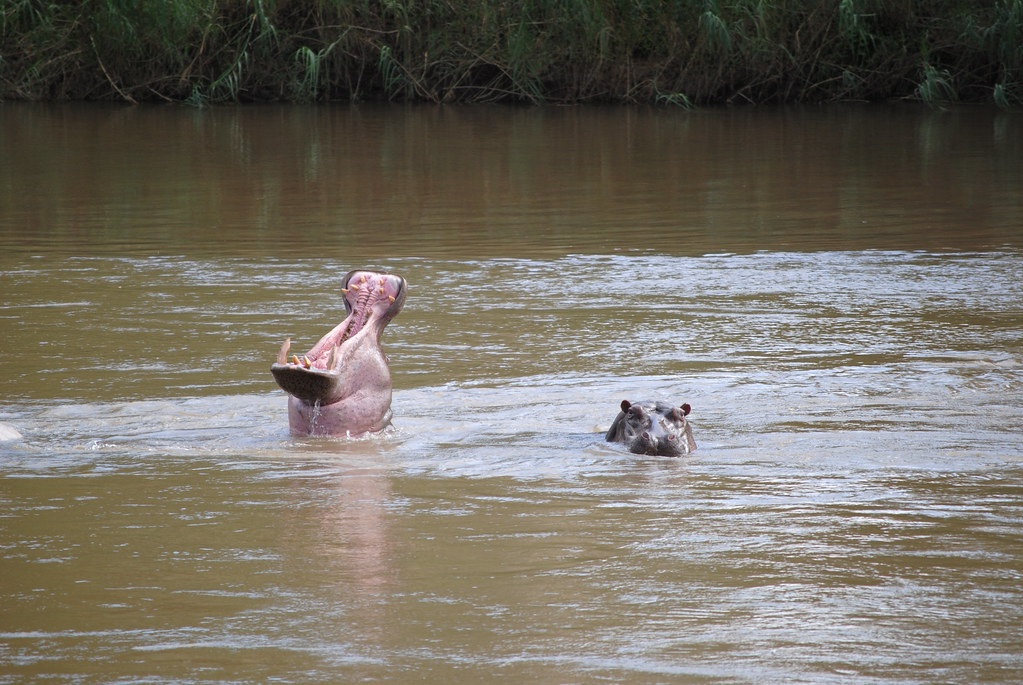
For travelers on an African safari, watching hippos is particularly memorable because they can appear almost motionless. A group may sit in a pool with only rounded backs and faces visible. Then, without warning, one animal may open its enormous mouth, another may snort loudly, and several may sink below the surface. The scene can look peaceful from a distance, but there is an extraordinary amount of biology behind it. In this detailed guide, we explore ten surprising facts that explain the hippo’s unusual relationship with water, including how they breathe underwater, why their skin needs protection, why they leave the water at night and why the phrase “hippos swim” can be misleading.
Hippo Water Behavior: Quick Facts
Before going deeper into the biology, it helps to see the main facts together. These quick facts explain why hippos have such a close relationship with water and why observing them in African rivers can reveal so much about their lifestyle.
| Feature | What It Means |
|---|---|
| Scientific name | Hippopotamus amphibius |
| Main daytime habitat | Rivers, lakes, pools, swamps and other suitable freshwater habitats |
| Why they stay in water | Water helps them remain cool and protects their sensitive, nearly hairless skin from drying conditions. |
| Daily feeding pattern | Hippos generally leave the water around dusk and feed on land during the night. |
| Underwater breathing | They can close their nostrils when submerged and hold their breath for several minutes. |
| Eyes and ears | The eyes and ears sit high on the head, allowing the animal to remain mostly submerged while observing its surroundings. |
| Swimming | Hippos are not conventional swimmers; they often push off or walk along the bottom, especially in shallow water. |
| Night activity | They commonly leave the water after sunset to graze on grass. |
| Social behavior | Hippos often rest in groups, with many individuals sharing suitable water. |
| Conservation importance | Protecting rivers, lakes, wetlands and connected grazing areas is essential for maintaining hippo habitat. |

Hippo Swimming in Water
A close look at a hippopotamus moving through water, illustrating the remarkable aquatic behavior visitors may observe on a PrideMark Safaris wildlife adventure.
Why Water Is So Important to Hippos
The easiest way to understand why do hippos spend so much time in water is to imagine the African landscape from the perspective of an animal with a huge body, little body hair and skin that must remain protected from excessive drying. A hippo cannot simply retreat into a cool forest every afternoon. Instead, it uses rivers and lakes as its daytime refuge. The water provides a physical environment where the animal can keep much of its body covered while waiting for the hottest hours to pass. This is particularly important because hippos are active mainly during the cooler parts of the day and night. San Diego Zoo notes that hippos spend their daytime hours in water and emerge after the sun has gone down to graze. :contentReference[oaicite:1]{index=1}
This explains an important part of hippo water behavior. The water is not simply a place where hippos find food. In fact, much of their main food—grass—is obtained on land. Instead, water acts as a daytime refuge between feeding periods. A hippo may spend hours resting in a river or pool before walking out at dusk along familiar paths toward grazing areas. The animal’s lifestyle therefore connects two very different environments: aquatic habitat for daytime refuge and terrestrial grassland for nighttime feeding.
The relationship is especially interesting because hippos are not fully aquatic animals like whales or seals. They are mammals that spend large amounts of time in water but must return to land to obtain much of their food. This makes them semi-aquatic specialists. Their bodies show the compromise clearly: they have aquatic adaptations such as closable nostrils and high-set eyes, but they also possess strong legs designed for moving across land.
1. Water Helps Hippos Escape the Heat
One of the biggest reasons behind why do hippos spend so much time in water is temperature. Africa’s tropical and subtropical environments can become intensely hot during daylight hours. A large mammal exposed directly to the sun has a considerable thermal challenge because a big body can retain heat. Rather than remaining exposed on open ground during the hottest part of the day, hippos spend those hours in water. The cooler environment helps them reduce their exposure to the heat and creates a more comfortable resting place.
This behavior is particularly visible during safari boat trips. Along African rivers, visitors may see hippos packed together in shallow channels with their backs emerging from the surface. Some individuals may be almost completely hidden except for their nostrils and eyes. Their stillness can be misleading. They are not necessarily inactive in the biological sense; they are conserving energy during the daytime and waiting for the cooler evening when they can travel and feed.
The water therefore functions almost like a natural daytime shelter. It allows hippos to spend the hottest hours without constantly walking or grazing under direct sunlight. When the evening cools the landscape, the animals become much more active and begin moving onto land. This day-night cycle is one of the clearest answers to the question of why hippos live in water during the day but spend significant time on land at night.
2. Their Skin Needs Protection
A hippo’s skin is another major clue to why do hippos spend so much time in water. Unlike many large African herbivores, hippos have relatively little hair covering their enormous bodies. Their skin therefore requires special protection. Extended exposure to harsh sunlight and dry conditions can be problematic, which is one reason remaining in water is so important.
Hippos also produce a distinctive reddish-orange secretion through their skin. It has sometimes been popularly called “blood sweat,” although it is neither blood nor ordinary sweat. Scientific descriptions identify compounds in these secretions that contribute to skin protection. The substance is part of the hippo’s remarkable adaptation to its environment and has contributed to many myths about why hippos appear to turn pink or red in bright sunlight.
The water adds another layer of protection. By keeping their bodies wet for much of the day, hippos reduce the amount of time their skin is directly exposed to the drying environment. This is why a hippo that spends hours in a river is not simply relaxing for pleasure. Its environment is closely connected to maintaining the condition of its skin.

Hippopotamus Resting at the Water Surface
A hippo resting close to the surface demonstrates the unusual way the animal can keep most of its body underwater. PrideMark Safaris highlights this behavior as one of Africa’s most fascinating wildlife experiences.
3. Hippos Are Built to Stay Mostly Submerged
Look closely at a hippo’s head and one of the answers to why do hippos spend so much time in water becomes obvious. Their eyes, ears and nostrils are positioned high on the head. This allows a hippo to keep most of its enormous body underwater while still being able to breathe, see and hear what is happening around it.
Imagine the advantage this provides. A hippo does not need to expose its entire body simply to look around. It can rise just enough for its eyes and nostrils to reach the surface. Its ears can detect sounds above the water while its nostrils remain positioned near the air. When it decides to submerge, the nostrils close and the ears fold, reducing the entry of water.
This arrangement gives the animal a distinctive appearance. From a safari boat, you might see what looks like only a pair of eyes, two small ears and two nostrils floating above the surface. Beneath those small visible features is an enormous animal resting in the water.
San Diego Zoo describes this as a key adaptation to the hippo’s aquatic lifestyle. The animals can hear, see and breathe while most of the body remains underwater, and a clear membrane protects their eyes while they are submerged.
4. Hippos Do Not Swim Quite Like You Think
This is perhaps one of the most surprising answers to why do hippos spend so much time in water. Despite spending so many hours in rivers and lakes, hippos are not graceful swimmers in the same sense as crocodiles, otters or seals. Their bodies are extremely dense. Instead of floating effortlessly and paddling like a typical swimming mammal, hippos often move through shallow water by pushing off the bottom or walking along the riverbed.
Their short legs are surprisingly powerful, and their feet help them move through shallow water. In deeper water, a hippo can propel itself beneath the surface, but the movement may look more like a slow underwater gallop than conventional swimming. This is one reason videos of hippos moving underwater can be so fascinating: the animal appears to run beneath the surface.
Animal Diversity Web describes hippos as semi-aquatic mammals adapted to shallow rivers, lakes and swamps. Their eyes, ears and nostrils sit high on the head, while their legs and feet allow them to move effectively through shallow water.
So when people ask, “Can hippos swim?” the most useful answer is that they can move effectively through water, including by submerging and propelling themselves, but their movement is not the classic floating-and-paddling style many people imagine.

A Hippo Group Resting Together
A group of hippopotamuses rests partly submerged in muddy water, showing the social side of hippo water behavior. This type of wildlife scene can be experienced on a PrideMark Safaris journey through East Africa.
5. Hippos Can Hold Their Breath Underwater
Another remarkable answer to why do hippos spend so much time in water is their ability to remain submerged without constantly returning to the surface. An adult hippo can hold its breath for several minutes. San Diego Zoo reports that hippos can remain underwater for five minutes or longer when submerged.
The ability is closely connected to their anatomy and lifestyle. When a hippo submerges, its nostrils close. It does not need to keep its nose exposed throughout an underwater movement. This allows the animal to disappear beneath the surface, travel through the water or rest underwater before rising again.
For visitors, this creates one of the most exciting moments during a boat safari. A hippo can disappear completely, leaving ripples on the surface, and then suddenly reappear several moments later. Because the animals spend so much time resting, a group may appear stationary one moment and become surprisingly active the next.
This ability also helps explain why a hippo’s head is shaped the way it is. The high position of the eyes and nostrils allows the animal to spend considerable time close to the surface without exposing its whole body. It is an elegant example of how anatomy follows lifestyle.
6. Hippos Can Sleep in the Water
One of the most fascinating facts about why do hippos spend so much time in water is that they can rest and even sleep while submerged. They have an automatic surfacing reflex that allows them to rise, breathe and return underwater without consciously waking in the same way a human swimmer would need to.
This is especially useful because the daytime water environment is where hippos spend much of their resting period. Instead of repeatedly leaving the water simply because they need to breathe, their physiology allows them to remain in their preferred environment.
San Diego Zoo notes that hippos can sleep underwater, using a reflex that allows them to bob upward for a breath and then sink back down.
This behavior makes the hippo’s daily routine very different from that of humans. For us, sleeping underwater would obviously be impossible without specialized equipment. For a hippo, however, the water can be a resting environment where breathing is managed automatically through its natural reflexes.
7. Water Is Central to Hippo Family Life
Water is not only important for an adult hippo’s comfort. It is also deeply connected to reproduction and family life. Hippos commonly mate in water, and females can give birth in water or on land. Newborn calves must be capable of reaching the surface for air, making the relationship between mother, calf and water particularly important.
A mother hippo may become especially protective around her young. The calf remains closely associated with the mother as it develops the strength and coordination needed for the demanding aquatic environment. Nursing can even occur underwater.
The importance of water during this stage shows that why do hippos spend so much time in water is not a question that can be answered only by talking about temperature. Water is part of the broader life history of the species. It provides a place for resting, social interaction, reproduction and raising young.
The San Diego Zoo reports that female hippos can give birth in water and that mothers nurse calves even underwater.

A Hippo Watching From the Water
The eyes and nostrils of a hippopotamus sit high above the water while much of the body remains hidden. PrideMark Safaris presents this as an example of the species’ remarkable aquatic adaptations.
8. Hippos Leave the Water to Feed at Night
If hippos spend so much time in water, you may reasonably ask why they ever leave it. The answer is food. Common hippos are primarily herbivores, and much of their diet comes from grass growing on land. Once the heat of the day has faded, hippos emerge from their daytime resting places and begin walking toward grazing areas.
This explains the striking contrast between a daytime hippo safari and an evening encounter. During the day, the animals may look sleepy and stationary. After sunset, they become much more active. They can walk considerable distances from the water to reach suitable grazing areas and then return before daylight.
San Diego Zoo notes that hippos leave the water in the evening for several hours of grazing and may sometimes travel significant distances to find food.
Their daily routine therefore forms a simple but highly effective cycle: water during the heat of the day, grassland feeding after dark, and water again as daylight returns. Understanding this cycle makes hippo behavior much easier to interpret when watching them in the wild.

Hippos in Uganda’s Kazinga Channel
A hippopotamus rests in the water of Uganda’s Kazinga Channel in Queen Elizabeth National Park. PrideMark Safaris connects travelers with Uganda’s remarkable wildlife landscapes and boat-safari experiences.
9. Hippo Water Behavior Shapes the Ecosystem
The answer to why do hippos spend so much time in water becomes even more interesting when we consider what hippos do to the ecosystems around them. Hippos are enormous herbivores, and their movements between water and land connect aquatic and terrestrial environments. They graze on land at night and return to the water during the day, carrying nutrients between these habitats.
Their presence can influence vegetation, water chemistry and the movement of organic material. Their dung enters aquatic systems, where it can become part of food webs. Fish and other organisms can make use of nutrients associated with hippopotamus waste, although the ecological effects vary depending on population size, water conditions and other factors.
This is why protecting hippo habitat means more than protecting a large animal. Rivers, floodplains, grazing areas and connected wetlands all contribute to the species’ way of life. If a river becomes unsuitable, the surrounding grazing landscape may also become less useful to the hippos that depend on it.
The San Diego Zoo notes that hippos contribute nutrients to African aquatic ecosystems through their waste and that other organisms can interact with this material.
10. Water Determines Where Hippos Can Live
Perhaps the biggest lesson from why do hippos spend so much time in water is that suitable water is not optional habitat. Hippos require places where they can submerge their bodies and remain close to the grasslands they use for feeding. Rivers, lakes, swamps and permanent or seasonally suitable pools can therefore become critical parts of their range.
Historically, hippos occupied a much broader area of Africa than they do today. Their modern distribution is more fragmented, with important populations occurring in parts of eastern, central and southern Africa. The availability of permanent water is one of the most important ecological conditions shaping where common hippos can survive.
Animal Diversity Web describes the common hippo as a semi-aquatic mammal associated with shallow lakes, rivers and swamps, with water deep enough to submerge the body. :contentReference[oaicite:9]{index=9}
This makes the protection of freshwater systems especially important. A wildlife area can have plenty of grass but still be unsuitable for hippos if there is no reliable water source. Likewise, a beautiful river may not support a healthy hippo population if surrounding grazing areas have been severely degraded or disconnected.
Where Do Hippos Live in Africa?
Common hippos are native to sub-Saharan Africa, particularly areas where permanent or sufficiently reliable water occurs alongside suitable grazing habitat. Their range includes parts of East Africa, Central Africa and Southern Africa. They are strongly associated with rivers and lakes, but their precise habitat requirements vary according to local environmental conditions.
For safari travelers, East Africa offers some of the most memorable opportunities to observe hippos. Uganda is particularly interesting because several major protected areas contain rivers, lakes and channels where hippos gather. Queen Elizabeth National Park, for example, is famous for the Kazinga Channel, where wildlife viewing by boat can bring visitors close to large concentrations of hippos.
The distribution of hippos is not random. Their location reflects the relationship between water, grassland, seasonal rainfall, safety and human activity. The species needs enough water to spend the day submerged and enough nearby vegetation to support nighttime grazing.
Hippo Distribution Map
The map below provides a visual overview of the known distribution of the common hippopotamus. It is useful when thinking about why do hippos spend so much time in water, because the species’ distribution is closely connected with suitable freshwater and wetland environments.

The distribution map should be read as a broad geographic guide rather than a guarantee that hippos occur in every water body within the highlighted areas. Wildlife populations are patchy, and suitable habitat can vary considerably from one location to another. Local water availability, habitat quality, protection and human land use all influence where hippos are actually found.
Hippo Adaptations for Water
| Adaptation | How It Helps |
|---|---|
| High-set eyes | Allows the hippo to see above the surface while most of the body remains submerged. |
| High-set nostrils | Allows breathing near the surface without exposing the entire head. |
| Closable nostrils | Helps prevent water from entering when the animal submerges. |
| Eye membrane | Provides protection while allowing underwater vision. |
| Strong short legs | Help the animal push along the bottom and move through shallow water. |
| Nearly hairless skin | Makes protection from excessive sun and drying conditions especially important. |
| Breath-holding ability | Allows the animal to remain underwater for several minutes. |
| Automatic surfacing reflex | Allows a resting or sleeping hippo to rise for air and return underwater. |
Seeing Hippos on an African Safari
There are few wildlife experiences quite like watching hippos from a safe safari boat. Their behavior is especially rewarding because it changes from moment to moment. At first, the river may appear almost empty except for a few dark shapes. Then you notice eyes above the water. Another hippo surfaces. A calf appears beside its mother. Somewhere nearby, a large adult opens its mouth in a dramatic display.
Uganda is particularly rewarding for travelers interested in hippo behavior. The Kazinga Channel in Queen Elizabeth National Park is one of the country’s best-known places for boat-based wildlife viewing. The channel connects Lake George and Lake Edward and supports an impressive concentration of wildlife along its shores and waters.
A PrideMark Safaris wildlife experience can combine hippo viewing with opportunities to see elephants, buffaloes, crocodiles, waterbirds and other wildlife. For travelers planning a Uganda safari, our Uganda safari programs can be explored alongside detailed information about Uganda’s national parks and wildlife experiences.
One important part of responsible wildlife viewing is maintaining an appropriate distance. Hippos are powerful wild animals and should never be approached casually on foot or encouraged to react to a boat. The best safari encounters allow visitors to observe natural behavior without disturbing the animals.
The Underwater Movement of a Hippo
A hippopotamus moves through water with its powerful body and legs. PrideMark Safaris celebrates the unusual underwater movement that makes hippos so fascinating to observe.
Why Hippos Prefer Water During the Day but Grass at Night
The apparent contradiction in hippo behavior becomes easier to understand when their day is divided into two different environmental needs. During daylight, the priority is remaining cool, protecting the skin and resting. Water provides the ideal refuge. At night, the priority changes to finding enough food. Grass grows on land, so hippos must leave the water and walk toward grazing areas.
| Time | Typical Activity | Why It Matters |
|---|---|---|
| Morning | Resting in or near water | Provides refuge from daytime heat and allows continued recovery after nighttime activity. |
| Midday | Mostly submerged and resting | Reduces exposure to intense daytime conditions. |
| Late afternoon | Increasing activity | The environment begins to cool as evening approaches. |
| Evening | Leaving water | Hippos begin their nighttime grazing routine. |
| Night | Grazing on land | Grass provides the majority of their terrestrial food. |
| Before dawn | Returning toward water | Hippos return to their daytime refuge as temperatures rise. |

A Hippo in Its Freshwater Habitat
A hippopotamus rests in freshwater habitat, showing the environment that supports its daytime routine. PrideMark Safaris encourages responsible wildlife tourism that helps travelers appreciate these ecosystems.
Frequently Asked Questions About Hippos and Water
Hippos spend so much time in water because it provides an important daytime refuge from heat and helps protect their sensitive skin. Their anatomy is adapted for remaining mostly submerged, while their nighttime routine takes them onto land to graze.
Hippos can move effectively through water and can become completely submerged, but they do not swim in exactly the same way as many aquatic animals. In shallow water they often push or walk along the bottom using their powerful legs.
Adult hippos can hold their breath for several minutes. San Diego Zoo reports that an adult hippo can remain underwater for five minutes or longer when submerged.
Yes. Hippos can rest and sleep underwater because they have an automatic surfacing reflex that allows them to rise for air and return beneath the surface without fully waking.
No. Hippos are semi-aquatic mammals. They spend much of the day in water but leave it at night to graze on land.
Their high-set eyes, ears and nostrils allow them to remain mostly submerged while still seeing, hearing and breathing near the water’s surface.
Yes. Like other mammals, hippos obtain water directly from their environment. However, the water has a much broader role in their lives because they also depend on it as a daytime refuge and part of their habitat.
Hippos generally emerge after the heat of the day has passed because their main feeding activity takes place on land. They graze on grass during the night before returning toward the water.
One of Uganda’s famous hippo-viewing locations is the Kazinga Channel in Queen Elizabeth National Park, where boat trips provide opportunities to observe hippos and other wildlife along the water.
Final Thoughts: The Real Reason Hippos Love the Water
So, why do hippos spend so much time in water? The answer is much richer than simply saying that hippos are water-loving animals. Water is central to their survival strategy. It gives them a place to rest during the hottest part of the day, helps protect their sensitive skin, allows them to remain largely submerged while watching their surroundings and provides an environment where they can rest for long periods.
Their remarkable anatomy makes this lifestyle possible. High-set eyes and nostrils allow a hippo to expose very little of its body while still interacting with the world above the surface. Closable nostrils help during submersion. Their ability to hold their breath allows them to disappear underwater for several minutes, and their automatic surfacing reflex allows them to rest and sleep without constantly remaining consciously alert to every breath.
Yet the story does not end in the water. Every night, hippos leave their rivers and lakes to graze. They follow familiar routes toward grassland, feed for hours and eventually return to the water as daylight approaches. This creates an extraordinary daily connection between aquatic and terrestrial ecosystems.
For safari travelers, this is exactly what makes hippos so captivating. They are not simply animals that happen to live beside water. Their entire daily rhythm is shaped by it. Watching a pod resting quietly on a Ugandan river can therefore become a lesson in adaptation, ecology and survival.
The next time you see only two eyes and a pair of nostrils above an African river, remember that there is a massive, highly specialized mammal beneath the surface. Its apparent laziness is actually part of a sophisticated routine that has evolved around heat, water, food and survival.
Discover Uganda’s Wildlife With PrideMark Safaris
Want to see hippos, elephants, buffaloes, lions, chimpanzees, gorillas and Uganda’s spectacular landscapes in the wild? Explore Uganda with PrideMark Safaris Uganda and experience the country’s rivers, lakes, forests and national parks through carefully planned safari adventures.