
A magnificent mountain gorilla in Uganda, where visitors can experience unforgettable gorilla trekking adventures in Bwindi Impenetrable National Park or Mgahinga Gorilla National Park.
Gorilla trekking costs in Uganda depends on more than just the price of a gorilla permit. Your total safari budget will also include accommodation, transportation, meals, guiding services, and any additional activities you choose. Whether you’re planning an affordable gorilla trekking adventure or a luxury safari, understanding these expenses will help you choose the right experience without unexpected costs.
Uganda is one of the world’s most rewarding destinations for encountering endangered mountain gorillas in their natural habitat. Visitors can enjoy this extraordinary wildlife experience in Bwindi Impenetrable National Park and Mgahinga Gorilla National Park, two protected rainforest destinations in southwestern Uganda.
For international visitors, the previously published Uganda Wildlife Authority conservation tariff listed a standard gorilla trekking permit at US$800 per person for foreign non-residents, covering July 2024 to June 2026. However, travelers planning gorilla trekking in late 2026 or 2027 should confirm the applicable updated permit fee before booking.
The permit is only one part of the overall safari price. A traveler choosing a budget lodge and shared transport will have different expenses from someone booking a private luxury safari with premium accommodation and personalized services.
At PrideMark Safaris, we organize tailor-made gorilla trekking adventures for solo travelers, couples, families, and small groups. Based in Kabale, southwestern Uganda, near the country’s famous gorilla trekking destinations, our team helps travelers plan practical itineraries that match their interests, travel dates, and budgets.
In this comprehensive guide, we’ll explain Uganda gorilla trekking permit prices, accommodation and transportation costs, budget versus luxury safari options, and the expenses involved in a typical three-day gorilla trekking safari. We’ll also compare trekking costs in Uganda and Rwanda and share practical ways to make your gorilla adventure more affordable.
If you’re still deciding which destination offers better value, explore our detailed Uganda vs Rwanda budget gorilla trekking comparison.
By the end of this guide, you’ll have a clearer understanding of what to budget for your gorilla trekking adventure and how to plan your trip with confidence.
Gorilla Trekking Costs in Uganda at a Glance
Wondering how much to budget for gorilla trekking in Uganda? The table below summarizes the main expenses for international travelers planning a gorilla safari in 2026/2027.
| Gorilla Trekking Expense | Estimated Cost |
|---|---|
| Standard gorilla permit (foreign non-resident) | US$800 per person |
| Standard gorilla permit (foreign resident) | US$700 per person |
| Standard gorilla permit (eligible African citizen) | US$500 per person |
| Standard gorilla permit (eligible EAC citizen) | UGX 300,000 per person |
| Budget 3-day gorilla trekking safari | US$1,200–1,600 per person |
| Mid-range 3-day gorilla trekking safari | US$1,600–2,500 per person |
| Luxury 3-day gorilla trekking safari | US$2,800–5,000+ per person |
| Optional porter services | Approximately US$15–20 |
| Uganda tourist visa, if required | Generally US$50 |
Note: Three-day safari estimates are per person, based on two travelers sharing accommodation and transportation, and include one standard US$800 gorilla permit per person. Prices are indicative and subject to official tariff confirmation, availability, and package inclusions.
Safari package estimates assume two people sharing accommodation and transportation, with one standard US$800 permit per person. Rates are indicative and subject to confirmation of current official tariffs, availability, and package inclusions.
The bottom line: For a three-day gorilla trekking safari in Uganda, most budget and mid-range travelers can plan for approximately US$1,200–2,500 per person, depending on their preferred comfort level and travel arrangements.
For an accurate quotation, contact PrideMark Safaris with your travel dates, group size, and accommodation preferences.
Uganda Gorilla Trekking Permit Prices in 2026/2027
One of the biggest expenses when planning a gorilla safari is the Uganda gorilla trekking permit, which gives visitors permission to track a habituated mountain gorilla family in its natural habitat.
For 2026 and 2027, the standard gorilla trekking permit costs US$800 per person for foreign non-residents, according to Uganda Wildlife Authority (UWA) tariffs. The permit price varies depending on your nationality and residency status.
Gorilla trekking permits are issued by the Uganda Wildlife Authority, the government agency responsible for managing Uganda’s national parks and protected wildlife areas.
How Much Is a Gorilla Trekking Permit in Uganda?
The following standard permit rates apply to gorilla trekking in Bwindi Impenetrable National Park and Mgahinga Gorilla National Park.
| Visitor Category | Gorilla Trekking Permit Cost |
|---|---|
| Foreign non-residents | US$800 per person |
| Foreign residents | US$700 per person |
| Rest of Africa citizens | US$500 per person |
| East African Community citizens | UGX 300,000 per person |
Note: Permit prices are subject to
Uganda Wildlife Authority regulations and availability.
Confirm the applicable 2026/2027 tariff before booking.
These are the standard rates retained in UWA’s announced tariff changes for 2027. Travelers should confirm the applicable rate and their eligibility category when making a reservation.
For example, two foreign non-resident travelers planning a gorilla trekking safari in Uganda would need US$1,600 for two standard gorilla permits, excluding accommodation, transportation, meals, and other safari expenses.
The permit fee is the same for standard gorilla trekking in Bwindi and Mgahinga, meaning your choice of national park does not change the standard permit price.
Are There Discounted Gorilla Trekking Permits in Uganda?
Yes. Uganda Wildlife Authority introduced special low-season gorilla trekking permit rates for April, May, and November.
Under the announced low-season arrangement:
- Foreign non-residents: US$600 per person
- Foreign residents: US$500 per person
This means eligible foreign non-resident travelers can save US$200 per permit compared with the standard US$800 rate.
However, low-season permits have an important restriction: they cannot be rescheduled. Travelers should therefore finalize their dates before purchasing these discounted permits.
Low-season gorilla trekking can be attractive to budget-conscious travelers, although April, May, and November may experience more rainfall, muddy trails, and challenging hiking conditions.
At PrideMark Safaris, we can help travelers compare available trekking dates, suitable accommodation, and transportation arrangements before confirming their safari.
What Does a Uganda Gorilla Trekking Permit Include?
A standard Uganda gorilla trekking permit covers the essential services required for the gorilla tracking experience.
Your permit includes:
- Access to the designated national park for the trekking day
- Guided gorilla tracking with authorized park personnel
- One hour observing a habituated mountain gorilla family after locating it
- A contribution toward wildlife conservation and local community development
The gorilla trekking experience begins with a briefing from park officials, followed by a guided hike through the forest to locate an assigned gorilla family.
Depending on the gorillas’ location and the terrain, the trek can take several hours. Once the group reaches the gorillas, visitors are normally allowed one hour to observe and photograph them while following the park’s conservation guidelines.
What is not included in the permit price?
Your permit does not normally cover your hotel or lodge, transportation to the national park, personal trekking equipment, optional porter services, travel insurance, or gratuities.
These additional expenses are important when calculating the total gorilla trekking cost in Uganda.
How to Book a Gorilla Trekking Permit in Uganda
Gorilla trekking permits are issued for specific dates and trekking locations, and availability is limited to protect the mountain gorillas from excessive human contact.
Travelers can arrange permits through Uganda Wildlife Authority or work with a safari operator to coordinate permits alongside accommodation and transportation.
When booking a permit, you should:
- Choose your preferred gorilla trekking dates.
- Decide whether to trek in Bwindi Impenetrable National Park or Mgahinga Gorilla National Park.
- Confirm permit availability for your travel dates.
- Provide the required passport and residency information.
- Complete payment and obtain confirmation of your permit reservation.
Booking well in advance is especially important during the popular travel periods of June to September and December to February, when demand for gorilla trekking experiences can be high.
At PrideMark Safaris, we help travelers coordinate gorilla permit arrangements with their safari itineraries, accommodation, and transportation so that the different parts of the journey fit together.
Is the Gorilla Trekking Permit Refundable?
Gorilla trekking permits are subject to Uganda Wildlife Authority’s official cancellation, refund, and rescheduling conditions.
Refunds are not automatically guaranteed if a traveler cancels or changes their plans. Eligibility depends on the circumstances and the applicable permit rules.
Special promotional permits, including the announced low-season permits, may have stricter conditions and cannot be rescheduled.
Before booking, travelers should review the latest Uganda Wildlife Authority permit guidelines and confirm the cancellation conditions associated with their reservation.
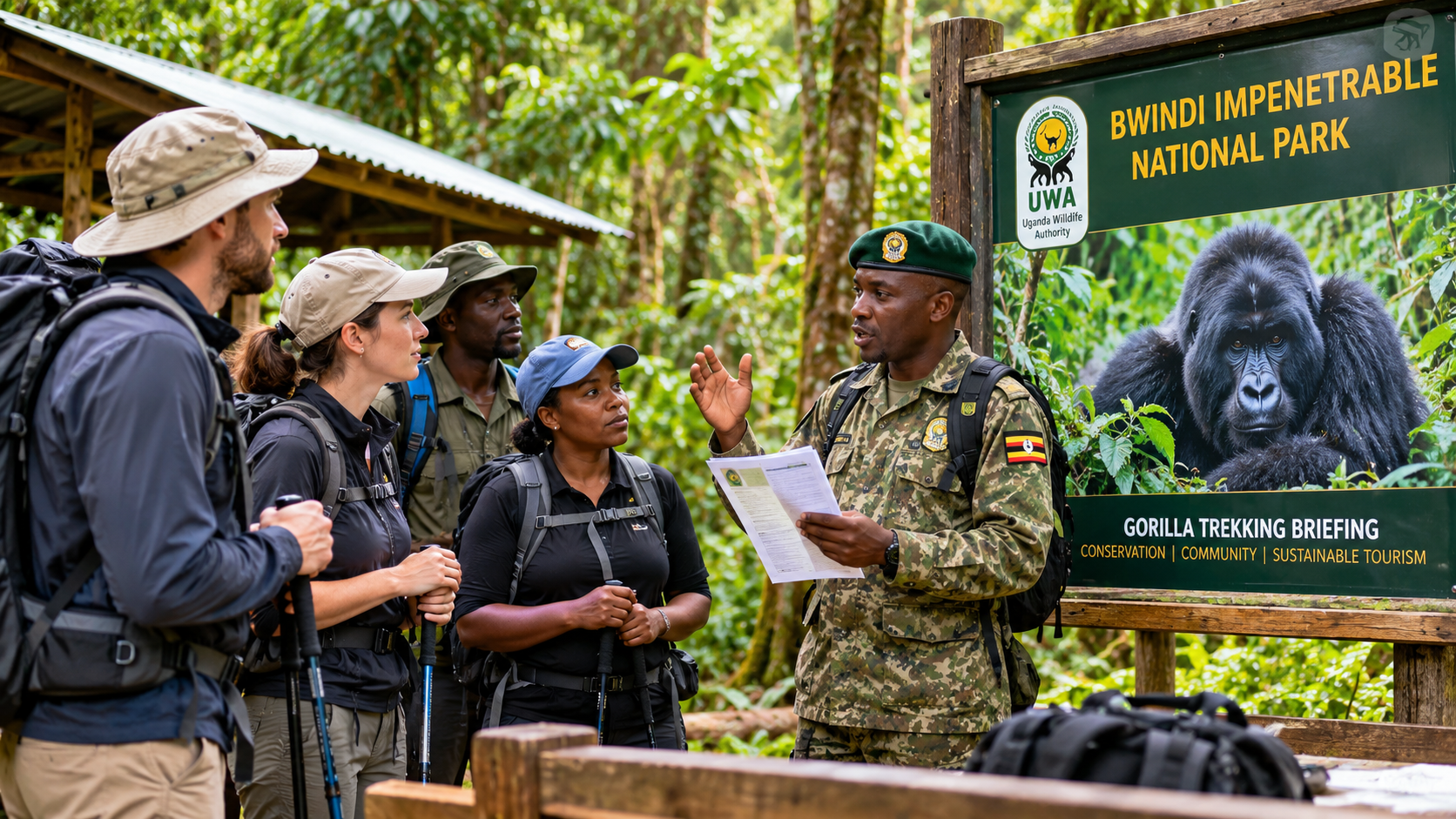
Visitors receive a briefing before gorilla trekking in Uganda. Permit refunds and rescheduling are subject to Uganda Wildlife Authority policies and applicable conditions.
Is a Gorilla Trekking Permit Worth US$800?
For many wildlife enthusiasts, the opportunity to observe endangered mountain gorillas in their natural environment is one of Africa’s most memorable wildlife experiences.
Unlike conventional game drives, gorilla trekking takes visitors on foot through protected rainforest, accompanied by experienced guides and trackers.
The permit fee also contributes to conservation management and community development initiatives that support the long-term protection of mountain gorillas and their habitats.
For travelers seeking a more extended encounter, Uganda also offers a separate gorilla habituation experience, which allows a longer period with gorillas under different conditions and at a higher permit price.
Read our detailed comparison of gorilla trekking vs gorilla habituation in Uganda to understand the differences in experience, duration, and cost.
Complete Breakdown of Gorilla Trekking Safari Costs in Uganda
While the gorilla trekking permit is usually the largest single expense, the total cost of gorilla trekking in Uganda also depends on your accommodation, transportation, meals, and additional safari services.
A typical three-day gorilla trekking safari from Entebbe or Kampala can cost approximately US$1,200–1,600 per person for a budget trip, US$1,600–2,500 for a mid-range safari, and US$2,800–5,000 or more for a luxury experience. These are illustrative planning ranges based on two people sharing accommodation and transport, with one standard US$800 gorilla permit per person.
Solo travelers may pay more because they cannot split private transportation and accommodation costs with another person. Larger groups can sometimes reduce the cost per traveler by sharing a safari vehicle and guide.
Let’s examine the major expenses involved.
1. Gorilla Trekking Permit Cost
Every visitor participating in a standard gorilla trek must have a valid permit issued by Uganda Wildlife Authority.
The standard permit costs US$800 for foreign non-residents, with different rates for other eligible visitor categories. Qualifying travelers may also benefit from discounted low-season permits.
For most budget travelers, the permit represents the largest portion of their total safari expenses.
Unlike accommodation or transportation, the official permit fee is fixed for each visitor category and cannot be negotiated with a tour operator.
2. Accommodation Costs Near Bwindi and Mgahinga
Accommodation is another important factor affecting your Uganda gorilla trekking budget.
Both Bwindi Impenetrable National Park and Mgahinga Gorilla National Park offer accommodation ranging from affordable guesthouses to high-end safari lodges.
Estimated accommodation prices per night:
| Accommodation Category | Estimated Cost |
|---|---|
| Budget guesthouses and camps | US$40–100 |
| Mid-range safari lodges | US$120–300 |
| Luxury safari lodges | US$350–1,000+ |
Note: Accommodation prices are approximate
US dollar rates per room per night and may vary depending
on the lodge, season, occupancy, and meal plan.
Confirm whether your quotation is per person or per room.
These are indicative room rates, not confirmed lodge quotations. Prices vary depending on season, room occupancy, location, meal plan, and the lodge’s facilities.
Budget accommodation generally provides simple but comfortable rooms, basic amenities, and convenient access to nearby trekking areas.
Mid-range lodges usually offer private cottages or rooms, comfortable bedding, hot showers, restaurant services, and scenic forest or mountain views.
Luxury safari lodges may include spacious suites, premium dining, personalized service, and exclusive locations overlooking the rainforest.
Most three-day gorilla trekking itineraries include two nights of accommodation, allowing travelers to arrive before their trekking day and depart afterward.
When choosing a lodge, location matters just as much as price. Bwindi has four main gorilla trekking sectors: Buhoma, Ruhija, Rushaga, and Nkuringo.
Booking accommodation near your assigned trekking sector can help reduce early-morning driving and unnecessary transportation expenses.
For travelers visiting Mgahinga Gorilla National Park, accommodation in and around Kisoro provides convenient access to the park.
3. Transportation Costs to Gorilla Trekking Destinations
Transportation can significantly influence the overall cost of a gorilla trekking safari in Uganda.
Most international visitors arrive through Entebbe International Airport before traveling to Bwindi or Mgahinga in southwestern Uganda.
There are three common transportation options.
Private Road Transfers
Private road transportation is one of the most popular choices for organized gorilla trekking safaris.
A safari vehicle with an experienced driver-guide provides flexibility, luggage space, and convenient transfers between the airport, accommodation, and trekking destination.
As a broad planning estimate, a private vehicle with a driver-guide may cost approximately US$150–250 or more per day, depending on vehicle type, fuel, distance, and included services.
The journey from Entebbe or Kampala to Bwindi generally takes around 8–10 hours, although the actual travel time depends on the trekking sector, road conditions, traffic, and stops.
Shared Transportation
Travelers joining a group safari can share the cost of transportation, making this option more affordable than hiring a private vehicle alone.
Shared transport is especially attractive to solo travelers and visitors looking for budget-friendly gorilla trekking packages.
However, availability depends on scheduled departures, group sizes, and the operator’s itinerary.
For additional planning advice, read our guide on gorilla trekking alone in Uganda.
Domestic Flights
Visitors who prefer to reduce long road journeys can fly from Entebbe to Kihihi or Kisoro, depending on their trekking destination.
Scheduled domestic flights can cost approximately US$250–450 or more per person each way, subject to availability, airline, baggage allowances, and travel dates.
After landing, travelers still require a road transfer to their lodge.
Flying is particularly appealing to luxury travelers, visitors with limited time, and those combining gorilla trekking with other safari destinations.
4. Food and Meal Expenses
Food costs depend largely on your accommodation arrangement.
Many gorilla trekking lodges offer full-board packages, which generally include breakfast, lunch, and dinner.
Other properties may offer bed-and-breakfast or half-board arrangements, meaning travelers need to budget separately for additional meals.
For visitors whose meals are not included, a practical planning allowance is approximately US$15–40 per person per day, although premium lodge dining can cost considerably more.
During the gorilla trekking day, travelers should carry drinking water and a packed lunch or snacks, as the time spent in the forest can vary.
When comparing safari quotations, always check whether meals and drinking water are included to avoid unexpected expenses.
5. Porter Fees and Tipping
Hiring a porter is optional but highly recommended for travelers who would appreciate assistance during the trek.
Gorilla trekking can involve steep hills, muddy trails, dense vegetation, and uneven terrain.
A porter can help carry your daypack and provide assistance on difficult sections of the trail.
Porter services commonly cost approximately US$15–20, although charges should be confirmed locally before the trek.
Hiring a porter also provides an opportunity to support local communities living around the gorilla trekking destinations.
Tipping guides, trackers, porters, and lodge staff is discretionary and should reflect your experience, budget, and satisfaction with the service.
Travelers may wish to set aside approximately US$20–50 or more for optional porter services and gratuities during a short gorilla trekking safari.
6. Visa, Travel Insurance, and Personal Expenses
International travelers should also consider expenses that may fall outside their safari package.
Depending on nationality and entry requirements, visitors may need a Uganda tourist visa.
Travel insurance is another important consideration. Choose a policy that covers trekking activities, medical emergencies, and evacuation where applicable.
Other potential expenses include personal shopping, laundry, beverages not included in the accommodation package, and optional cultural activities.
International flights are generally excluded from locally advertised gorilla trekking safari prices unless the operator specifically states otherwise.
Sample Gorilla Trekking Safari Cost Breakdown
The following example illustrates a three-day, two-night mid-range gorilla trekking safari in Uganda for two foreign non-resident travelers sharing a room and private vehicle.
| Expense | Estimated Cost Per Person |
|---|---|
| Standard gorilla trekking permit | US$800 |
| Two nights’ mid-range accommodation | US$250–400 |
| Share of private transport and driver-guide | US$250–400 |
| Meals and drinking water not included | US$30–60 |
| Optional porter and tips | US$20–50 |
| Estimated Total | US$1,350–1,710 |
Note: This is an illustrative per-person budget
for a three-day Uganda gorilla trekking safari, assuming two
travelers sharing accommodation and private transportation.
Actual prices depend on travel dates, availability, and inclusions.
This example assumes one gorilla trek per person, standard permit pricing, and two travelers sharing costs. It excludes international flights, visas, travel insurance, and optional activities. Actual safari quotations may also include operator fees and taxes, so the final package price can differ.
The most effective way to understand your actual gorilla trekking cost is to request an itinerary based on your preferred dates, accommodation category, number of travelers, and transportation arrangements.
At PrideMark Safaris, we help visitors plan gorilla trekking safaris with clear itineraries and suitable accommodation options, whether they prefer a budget-friendly adventure or a more exclusive experience.
Understanding these individual expenses makes it easier to compare safari packages and choose an experience that provides good value without compromising comfort, safety, or the quality of your gorilla trekking adventure.
Budget vs Mid-Range vs Luxury Gorilla Trekking Costs in Uganda
The cost of gorilla trekking in Uganda varies considerably depending on the type of safari you choose. While every traveler participating in a standard gorilla trek enjoys the same one-hour encounter with a habituated mountain gorilla family, the accommodation, transportation, and additional services can make the overall experience very different.
Uganda offers gorilla trekking experiences for budget-conscious adventurers, travelers seeking comfortable mid-range accommodation, and visitors looking for an exclusive luxury safari.
Understanding these differences will help you choose a safari that matches your travel style and budget.
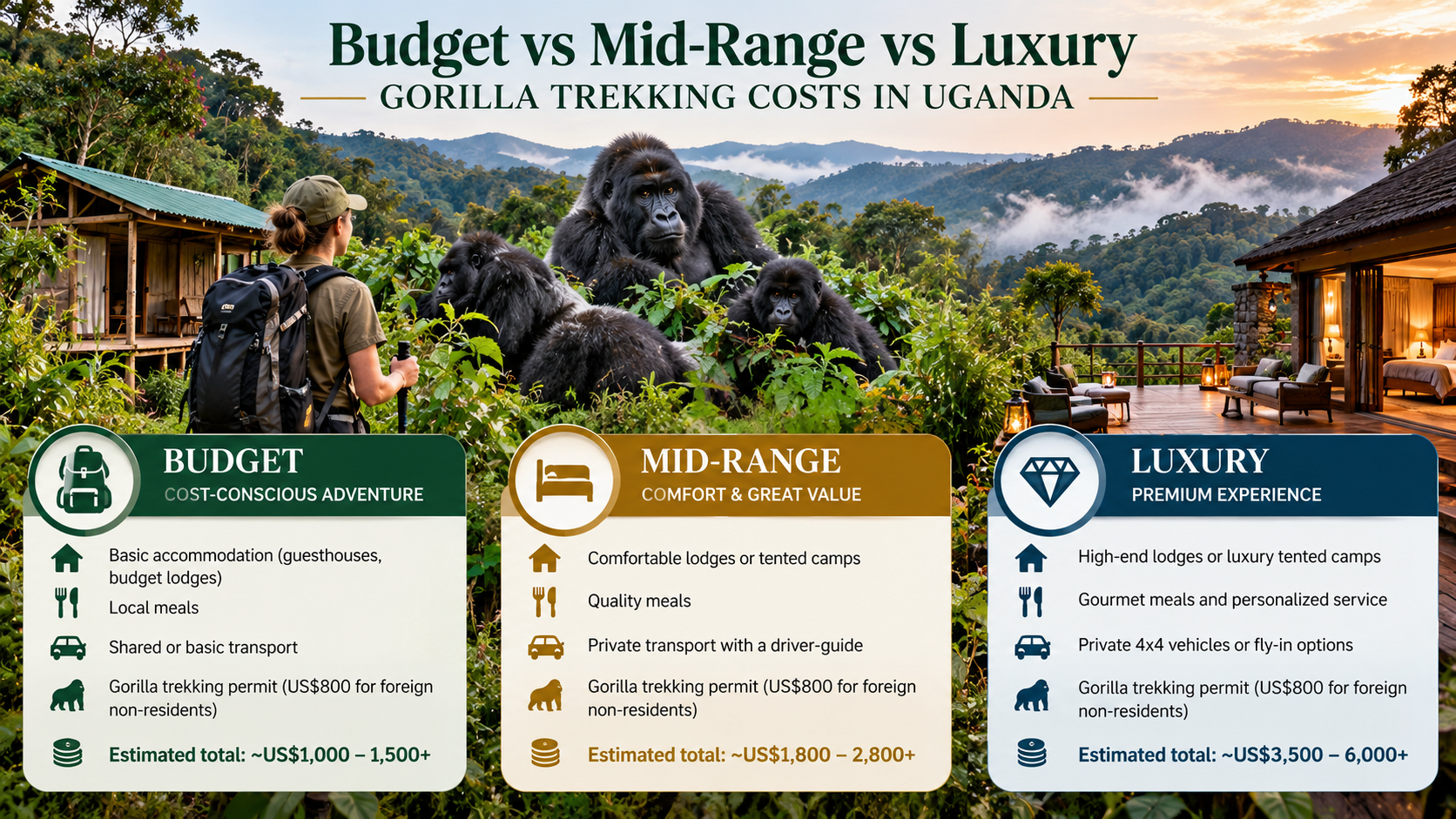
Compare budget, mid-range and luxury gorilla trekking safari options in Uganda, including different accommodation styles and comfort levels.
How Much Does Budget Gorilla Trekking Cost in Uganda?
A budget gorilla trekking safari in Uganda typically costs approximately US$1,200–1,600 per person for a three-day trip, assuming two travelers sharing transport and accommodation and one standard US$800 gorilla permit per person.
Budget gorilla trekking packages focus on providing the essential safari experience while keeping accommodation and transportation expenses manageable.
Budget packages commonly include:
- One standard gorilla trekking permit
- Two nights in a budget guesthouse or affordable lodge
- Road transportation with a driver-guide
- Meals according to the agreed itinerary
- Transfers between the lodge and gorilla trekking starting point
Budget accommodation usually offers clean rooms, basic facilities, and convenient access to the trekking destination rather than luxury amenities.
Travelers can sometimes reduce their expenses by joining group departures, traveling with friends, or choosing suitable accommodation outside the most expensive lodge categories.
Low-season promotional permits, when available and applicable to your travel dates, may also reduce the total cost.
Budget gorilla trekking is particularly suitable for backpackers, solo travelers joining groups, students, and adventurous visitors who prioritize the gorilla encounter over premium accommodation.
For travelers planning independently, our article on gorilla trekking alone in Uganda explains some of the practical considerations involved.
How Much Does Mid-Range Gorilla Trekking Cost in Uganda?
A mid-range gorilla trekking safari in Uganda generally costs approximately US$1,600–2,500 per person for a three-day experience, based on two travelers sharing.
Mid-range safaris provide a balance between comfort, convenience, and overall value.
Accommodation typically includes comfortable private rooms or cottages, en-suite bathrooms, hot showers, quality meals, and attractive views of the surrounding forest or hills.
Mid-range packages may include:
- One standard gorilla trekking permit
- Two nights in a comfortable safari lodge
- Private road transportation with a professional driver-guide
- Full-board accommodation, depending on the lodge
- Transfers to and from the gorilla trekking briefing point
- Assistance with safari planning and permit arrangements
For many visitors, a mid-range safari offers an appealing combination of comfort and affordability.
After several hours of trekking through the rainforest, returning to a comfortable lodge with a hot shower and a freshly prepared meal can make the overall journey more enjoyable.
Mid-range gorilla trekking is especially suitable for couples, families, first-time visitors to Uganda, and travelers who want a well-organized safari without paying luxury lodge prices.
How Much Does Luxury Gorilla Trekking Cost in Uganda?
A luxury gorilla trekking safari in Uganda can cost approximately US$2,800–5,000 or more per person for a three-day trip, depending on the lodge, transportation arrangements, and additional services.
Luxury gorilla trekking focuses on providing an exceptional overall travel experience alongside the mountain gorilla encounter.
Premium lodges near Bwindi may offer spacious suites, private terraces, forest views, fine dining, attentive service, and wellness facilities.
Luxury packages may feature:
- One standard gorilla trekking permit
- Two nights in a premium safari lodge
- Private transfers in a comfortable safari vehicle
- Optional domestic flights to Kihihi or Kisoro
- Full-board accommodation and selected premium services
- Personalized itinerary planning
- Optional additional experiences and activities
Some travelers choose to combine luxury gorilla trekking with wildlife safaris in Queen Elizabeth National Park, chimpanzee tracking in Kibale National Park, or a longer Uganda holiday.
Luxury accommodation does not provide additional time with the gorillas under a standard trekking permit. The one-hour viewing limit and conservation rules apply regardless of accommodation category.
Travelers interested in spending more time observing gorillas can explore the separate gorilla trekking vs habituation experience in Uganda comparison.
Budget vs Mid-Range vs Luxury Gorilla Trekking: Price Comparison
The following table summarizes typical planning estimates for a three-day gorilla trekking safari in Uganda.
| Safari Category | Estimated Cost Per Person | Accommodation | Transport |
|---|---|---|---|
| Budget | US$1,200–1,600 | Basic lodge or guesthouse | Shared or economical road transfer |
| Mid-range | US$1,600–2,500 | Comfortable safari lodge | Usually private road transfer |
| Luxury | US$2,800–5,000+ | Premium lodge or luxury retreat | Private road transfer or optional domestic flight |
Note: These are estimated three-day Uganda
gorilla trekking safari prices per person, assuming two
travelers sharing accommodation and transportation.
Estimates include one standard US$800 gorilla trekking
permit per person. Domestic flights may cost extra.
Final prices depend on season, availability, and package inclusions.
These are indicative prices for two people sharing, with one standard US$800 gorilla permit per person. They are not fixed PrideMark Safaris package rates. Final prices depend on travel dates, lodge availability, transport, inclusions, and group size.
Which Gorilla Trekking Safari Offers the Best Value?
The best-value gorilla trekking safari is not necessarily the cheapest option. It is the package that provides the right combination of comfort, reliable transportation, suitable accommodation, and a well-organized trekking experience.
For travelers with limited budgets, an affordable lodge and shared transportation can make gorilla trekking more accessible.
For couples and first-time visitors, a mid-range safari often provides a practical balance of cost and comfort.
For honeymooners, photographers, and travelers seeking premium accommodation, a luxury safari may be worth the additional expense.
Regardless of your budget, the most important part of the experience remains the opportunity to observe mountain gorillas in their protected natural habitat.
At PrideMark Safaris, we help travelers compare different safari options based on their available budget, preferred accommodation, travel dates, and group size.
Whether you are planning a budget-friendly gorilla trek or a private luxury safari, our goal is to help you enjoy a well-organized journey through southwestern Uganda.
You can also explore our Uganda safari options around US$2,000 to understand how gorilla trekking can fit into a broader Uganda travel budget.
How Much Does a 3-Day Gorilla Trekking Safari Cost in Uganda?
A 3-day gorilla trekking safari in Uganda typically costs between US$1,200 and US$2,500 per person for budget and mid-range packages, while luxury experiences can cost US$2,800–5,000 or more.
These estimates assume two travelers sharing accommodation and transportation, with one standard US$800 gorilla trekking permit per person. Actual prices depend on the lodge, travel season, departure location, transport arrangements, and services included.
A three-day safari is one of the most popular ways to experience mountain gorillas in Uganda because it provides enough time to travel to the trekking destination, complete the gorilla encounter, and return without requiring a longer holiday.
Most three-day gorilla trekking safaris from Entebbe or Kampala focus on Bwindi Impenetrable National Park, although Mgahinga Gorilla National Park is another option depending on permit availability and travel arrangements.
Sample 3-Day Gorilla Trekking Safari Itinerary
Day 1: Transfer from Entebbe or Kampala to Bwindi Impenetrable National Park
Your gorilla trekking adventure begins with a morning departure from Entebbe or Kampala, traveling southwest toward Bwindi Impenetrable National Park.
The drive generally takes approximately 8–10 hours, depending on your departure point, assigned trekking sector, traffic, road conditions, and planned stops.
Along the way, you’ll experience Uganda’s changing landscapes, including countryside, agricultural communities, rolling hills, and scenic highlands.
Depending on the selected route and available time, you may stop for lunch or photography before continuing to your accommodation near Bwindi.
On arrival, check in at your lodge, enjoy dinner, and prepare for the following morning’s gorilla trekking adventure.
Overnight: Budget, mid-range, or luxury lodge near your assigned Bwindi trekking sector.
Day 2: Gorilla Trekking Experience in Bwindi
After an early breakfast, you’ll travel to the designated park briefing point with your packed lunch, drinking water, and trekking equipment.
Uganda Wildlife Authority rangers will explain the gorilla trekking rules, safety guidelines, and procedures before assigning visitors to trekking groups.
Accompanied by experienced guides and trackers, you’ll enter the rainforest in search of a habituated mountain gorilla family.
The trek may take several hours, depending on the gorillas’ location, forest conditions, and terrain.
Once your group reaches the gorillas, you’ll have up to one hour to observe them in their natural habitat.
Watching gorillas feed, groom, rest, and interact within their family groups is an extraordinary wildlife experience.
After the encounter, you’ll return to the starting point and transfer back to your lodge.
Depending on the time and your energy levels, you may relax at the lodge or arrange an optional community or cultural experience.
Overnight: Your selected lodge near Bwindi Impenetrable National Park.
Day 3: Return to Entebbe or Kampala
After breakfast, check out of your lodge and begin the return journey to Kampala or Entebbe.
Depending on your route and schedule, the journey may include lunch stops and opportunities to enjoy southwestern Uganda’s scenery.
Your driver-guide will transfer you to your agreed drop-off location, bringing your three-day gorilla trekking safari to an end.
If you have an international departure scheduled for the same day, allow sufficient time for the long road transfer, traffic, and airport check-in. An additional overnight stay near Entebbe may be preferable for an early flight.
Uganda Gorilla Trekking Destinations Map
Explore Bwindi, Mgahinga and Uganda’s safari access routes
Explore the locations of Uganda’s mountain gorilla
trekking destinations, including Bwindi Impenetrable
National Park and Mgahinga Gorilla National Park.
Use this map to understand the geography of
southwestern Uganda and plan your safari journey.
3-Day Gorilla Trekking Safari Price Comparison
The table below provides indicative prices for three-day gorilla trekking safaris departing from Entebbe or Kampala.
| Safari Type | Estimated Price Per Person |
|---|---|
| Budget gorilla trekking safari | US$1,200–1,600 |
| Mid-range gorilla trekking safari | US$1,600–2,500 |
| Luxury gorilla trekking safari | US$2,800–5,000+ |
Note: Prices are estimated per person
for a three-day Uganda gorilla trekking safari,
assuming two travelers sharing accommodation and transport.
Final costs depend on travel dates, accommodation,
permit availability, and package inclusions.
These estimates assume two people sharing accommodation and transport, and include one standard gorilla permit per person. Prices are planning ranges rather than confirmed PrideMark Safaris package quotations.
Solo travelers may pay more because private vehicle and room expenses are not shared.
What Is Included in a 3-Day Gorilla Trekking Package?
A typical organized three-day gorilla trekking safari may include:
- One gorilla trekking permit per person
- Two nights of accommodation
- Ground transportation in a safari vehicle
- Services of an experienced driver-guide
- Meals as specified in the itinerary
- Transfers to the gorilla trekking briefing point
- Park-related arrangements specified in the quotation
Some operators also include drinking water and airport transfers.
Always confirm the exact inclusions before booking, as packages differ.
What Is Usually Excluded?
Common exclusions include:
- International flights
- Uganda visa fees, where applicable
- Travel and medical insurance
- Optional porter services
- Tips and personal expenses
- Alcoholic beverages and additional meals not specified
- Optional activities outside the itinerary
Domestic flights may also be charged separately unless explicitly included in a fly-in safari package.
Can You Do Gorilla Trekking in Uganda in Less Than 3 Days?
Yes. Shorter gorilla trekking itineraries are possible, especially for travelers starting in southwestern Uganda or traveling from Kigali, Rwanda.
For example, visitors already staying in Kabale or Kisoro may be able to arrange a shorter itinerary because they are closer to the gorilla trekking destinations.
A two-day gorilla trekking safari from Kigali may also be practical, depending on border crossing requirements, travel documents, the assigned trekking sector, and the overall schedule.
However, for visitors arriving through Entebbe International Airport, a three-day road safari generally provides a more practical balance between travel time and the gorilla trekking experience.
Book a 3-Day Gorilla Trekking Safari with PrideMark Safaris
Planning your gorilla trekking safari with a knowledgeable local operator can help simplify the process of coordinating permits, accommodation, transportation, and travel dates.
At PrideMark Safaris, we organize tailor-made gorilla trekking adventures in southwestern Uganda for solo travelers, couples, families, and groups.
Whether you’re interested in a budget safari, a comfortable mid-range experience, or a luxury gorilla trekking holiday, we can help you plan an itinerary based on your preferences.
Contact PrideMark Safaris for a personalized 3-day gorilla trekking quotation, including permit arrangements, accommodation options, transportation, and a clear breakdown of the services included in your trip.
Gorilla Trekking Costs in Bwindi vs Mgahinga: Which Is More Affordable?
When comparing gorilla trekking costs in Bwindi and Mgahinga, one of the first things travelers should understand is that both national parks charge the same standard gorilla trekking permit fee.
For foreign non-residents, the standard permit costs US$800 per person under Uganda Wildlife Authority’s announced 2026/2027 rates. Eligible visitors traveling during designated low-season months may qualify for discounted permits.
However, the overall cost of your safari can differ depending on the park you visit, the location of your accommodation, transportation arrangements, and additional activities.
Both destinations offer extraordinary opportunities to encounter endangered mountain gorillas, but they provide different landscapes, trekking environments, and itinerary options.
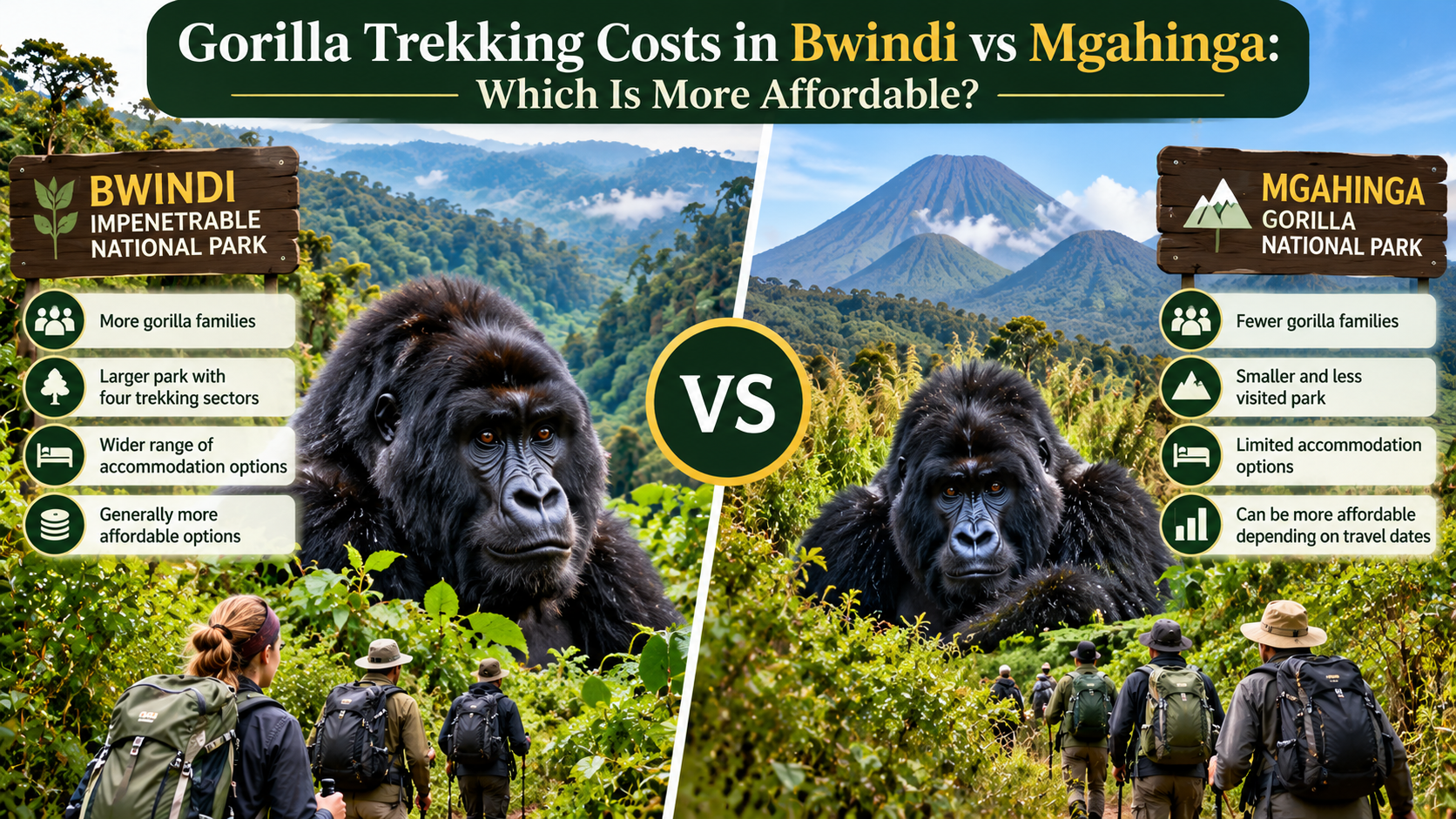
Compare gorilla trekking in Bwindi Impenetrable National Park and Mgahinga Gorilla National Park, including accommodation choices, trekking availability and overall safari costs.
Gorilla Trekking Costs in Bwindi Impenetrable National Park
Bwindi Impenetrable National Park is Uganda’s most established mountain gorilla trekking destination and a UNESCO World Heritage Site.
The park is located in southwestern Uganda and is famous for its ancient rainforest, exceptional biodiversity, and multiple habituated mountain gorilla families.
Bwindi has four main gorilla trekking sectors:
- Buhoma: Located in northern Bwindi, with a range of accommodation options and convenient connections to parts of Queen Elizabeth National Park.
- Ruhija: Situated in eastern Bwindi, known for its high-altitude forest scenery and birdwatching opportunities.
- Rushaga: Located in southern Bwindi, offering standard gorilla trekking and access to the separately priced gorilla habituation experience.
- Nkuringo: Located in southwestern Bwindi, known for its dramatic highland scenery and challenging terrain.
The standard gorilla trekking permit costs US$800 for foreign non-residents, regardless of which Bwindi sector you visit.
The total safari cost, however, depends on the lodge you choose and how far it is from your assigned trekking sector.
Bwindi offers a broad selection of budget guesthouses, mid-range lodges, and luxury safari properties. This accommodation variety gives travelers considerable flexibility when planning their gorilla trekking budget.
For a typical three-day safari from Entebbe or Kampala, budget packages may cost approximately US$1,200–1,600 per person, while mid-range and luxury packages can cost considerably more.
These are general planning estimates for two people sharing rather than fixed prices for Bwindi.
Gorilla Trekking Costs in Mgahinga Gorilla National Park
Mgahinga Gorilla National Park is located in Kisoro District, near Uganda’s borders with Rwanda and the Democratic Republic of Congo.
Although smaller than Bwindi, Mgahinga offers a distinctive mountain gorilla trekking experience against the dramatic backdrop of the Virunga volcanoes.
The park is associated with the habituated Nyakagezi gorilla family, making gorilla trekking opportunities more limited than in Bwindi.
The standard permit price is also US$800 for foreign non-residents, so choosing Mgahinga does not automatically reduce your permit expenses.
Accommodation around Kisoro ranges from affordable guesthouses to comfortable safari lodges, with higher-end options also available.
Mgahinga can be particularly convenient for travelers already staying in Kisoro, visitors entering Uganda from Rwanda, or those planning to combine gorilla trekking with golden monkey tracking.
However, the overall safari cost depends on your starting point, accommodation, and transport arrangements.
Because Mgahinga has fewer gorilla trekking permits available than Bwindi, travelers should confirm availability before committing to accommodation or transportation bookings.
Bwindi vs Mgahinga Gorilla Trekking Cost Comparison
| Cost Factor | Bwindi | Mgahinga |
|---|---|---|
| Standard gorilla permit | US$800 | US$800 |
| Budget accommodation | Widely available | Available around Kisoro |
| Mid-range accommodation | Extensive selection | Several options |
| Luxury accommodation | Wider selection | More limited selection |
| Road access | Depends on trekking sector | Primarily via Kisoro |
| Gorilla permit availability | More trekking groups | More limited |
| Additional activities | Forest walks, cultural experiences, habituation | Golden monkey tracking, volcano hiking, cultural experiences |
Note: The US$800 standard gorilla permit
price shown is for foreign non-residents.
Both parks follow Uganda Wildlife Authority permit tariffs.
Confirm current 2026/2027 rates and availability
before booking.
The US$800 permit rate applies to foreign non-residents under the announced standard tariff. Accommodation and transportation prices vary by provider, travel date, and itinerary.
Which Park Is Cheaper for Gorilla Trekking?
Neither Bwindi nor Mgahinga is automatically cheaper because the standard permit fee is identical.
Bwindi may offer better value for travelers seeking a wider choice of accommodation and greater flexibility when selecting trekking dates.
Mgahinga may be more convenient for visitors already staying in Kisoro or combining their gorilla trekking adventure with other activities in the Virunga region.
For travelers starting in Entebbe or Kampala, transportation costs will depend on the specific route and accommodation location.
For visitors traveling from Kigali, southern Bwindi and Mgahinga can be practical options, subject to border requirements and travel arrangements.
The most affordable choice is therefore the destination that allows you to combine an available permit, suitable accommodation, and efficient transportation within your budget.
Which Destination Offers the Better Gorilla Trekking Experience?
Both Bwindi and Mgahinga offer the same standard one-hour gorilla viewing experience once a habituated gorilla family has been located.
However, the trekking environments differ.
Bwindi features dense tropical rainforest, steep forested hills, and several trekking sectors. The park’s wider selection of gorilla families and accommodation options makes it attractive to travelers seeking flexibility.
Mgahinga offers volcanic landscapes, bamboo vegetation, and scenic mountain surroundings. It is particularly appealing to visitors who want to combine mountain gorilla trekking with golden monkey tracking or volcano hiking.
Neither destination guarantees an easier trek. The difficulty depends on the gorillas’ location, terrain, weather, and individual fitness.
For a more detailed comparison, read our guide to Bwindi vs Mgahinga gorilla trekking, which explores accessibility, trekking conditions, gorilla families, and the advantages of each park.
How PrideMark Safaris Helps You Choose Between Bwindi and Mgahinga
Choosing the right gorilla trekking destination involves more than comparing permit prices.
At PrideMark Safaris, we help travelers evaluate permit availability, accommodation preferences, travel routes, and additional activities before deciding which destination best suits their safari.
Whether you prefer Bwindi’s extensive rainforest or Mgahinga’s spectacular volcanic scenery, we can help organize a gorilla trekking itinerary that matches your budget and travel interests.
Our team can also help you combine gorilla trekking with other southwestern Uganda experiences while keeping transportation and accommodation arrangements practical.
Contact PrideMark Safaris to compare Bwindi and Mgahinga gorilla trekking options and request a personalized safari quotation.
Uganda vs Rwanda Gorilla Trekking Costs: Which Country Offers Better Value?
When comparing gorilla trekking costs in Uganda and Rwanda, Uganda is generally the more affordable destination for international visitors. Both countries offer opportunities to observe endangered mountain gorillas in their natural habitat, but their permit prices, accommodation options, transportation arrangements, and overall safari costs differ.
For foreign non-residents, Uganda’s published standard gorilla trekking permit rate is US$800 per person, compared with US$1,500 per person in Rwanda.
This represents a US$700 difference per person, or US$1,400 for two travelers, before accommodation and transportation expenses.
However, the cheapest permit does not always mean the cheapest overall safari. Rwanda’s Volcanoes National Park is considerably closer to Kigali International Airport than Uganda’s gorilla trekking parks are to Entebbe International Airport.
Your starting location, trip duration, and accommodation preferences therefore play an important role in determining which destination offers better value.
Gorilla Trekking Permit Prices: Uganda vs Rwanda
| Visitor Category | Uganda | Rwanda |
|---|---|---|
| Foreign non-residents | US$800 | US$1,500 |
| Foreign residents | US$700 | Varies by residency eligibility |
| Eligible African citizens | US$500 | US$500 promotional rate |
| Eligible East African citizens | UGX 300,000 | US$200 promotional rate |
Important: Prices are per person and
depend on nationality, residency status, and eligibility.
Rwanda’s promotional rates may have specific conditions
and validity periods. Verify current 2026/2027 permit
tariffs with the Uganda Wildlife Authority and Rwanda
Development Board before publishing or booking.
Uganda figures reflect the standard permit rates reported for the 2026–2028 tariff, which should be reconfirmed directly with Uganda Wildlife Authority before booking. Rwanda’s promotional rates are subject to eligibility and date restrictions, including exclusions during June–October 2026. Confirm applicable 2027 rates separately.
Rwanda’s standard US$1,500 permit fee for international visitors is published by the Rwanda Development Board.
Uganda’s permits are managed by the Uganda Wildlife Authority.
How Much Does Gorilla Trekking Cost in Rwanda?
Gorilla trekking in Rwanda takes place in Volcanoes National Park, located in the country’s northwestern region near Musanze.
For most international visitors, the standard gorilla trekking permit costs US$1,500 per person.
Beyond the permit, travelers must budget for accommodation, transportation, meals, and any additional services.
A short Rwanda gorilla trekking safari may cost approximately US$1,800–2,500 per person for a relatively economical trip, while premium and luxury experiences can cost considerably more.
These are indicative planning estimates, not guaranteed package prices.
Rwanda is especially convenient for travelers arriving through Kigali International Airport because Volcanoes National Park can generally be reached in approximately two to three hours by road, depending on the departure point and traffic.
This shorter journey makes one-night or two-day gorilla trekking itineraries more practical than similar road trips from Entebbe to Bwindi.
How Much Does Gorilla Trekking Cost in Uganda?
Uganda offers gorilla trekking in Bwindi Impenetrable National Park and Mgahinga Gorilla National Park.
For foreign non-residents, the standard permit rate is US$800 per person.
A typical three-day gorilla trekking safari from Entebbe or Kampala may cost approximately US$1,200–1,600 per person for a budget trip, US$1,600–2,500 for a mid-range experience, or US$2,800–5,000 or more for a luxury safari.
Uganda has a broad selection of affordable guesthouses, comfortable mid-range lodges, and premium accommodation near its gorilla trekking destinations.
Although the journey from Entebbe to Bwindi is longer, travelers can combine gorilla trekking with other wildlife and cultural experiences in southwestern Uganda.
These may include game drives in Queen Elizabeth National Park, boat cruises, chimpanzee tracking, and visits to Lake Bunyonyi.
For travelers planning a longer wildlife holiday, Uganda can offer excellent value because multiple safari experiences can be included in one itinerary.
Can You Trek Gorillas in Uganda from Kigali?
Yes. One way to reduce travel time to Uganda’s gorilla trekking destinations is to begin your safari in Kigali, Rwanda.
From Kigali, travelers can drive toward Uganda’s southwestern border crossings and continue to Bwindi or Mgahinga.
Depending on the border crossing, road conditions, immigration procedures, and selected trekking sector, the journey can take approximately four to six hours or longer.
This arrangement allows travelers to benefit from Kigali’s convenient international connections while trekking gorillas in Uganda under Uganda Wildlife Authority’s permit system.
A two-day or three-day gorilla trekking safari from Kigali can therefore be attractive to travelers with limited time.
However, visitors must satisfy the entry and immigration requirements of both countries. Travelers should confirm visa arrangements, border operating conditions, and transfer schedules before booking.
Uganda vs Rwanda: Total Gorilla Trekking Safari Cost Comparison
| Visitor Category | Uganda | Rwanda |
|---|---|---|
| Foreign non-residents | US$800 | US$1,500 |
| Foreign residents | US$700 | Varies by residency eligibility |
| Eligible African citizens | US$500 | US$500 promotional rate |
| Eligible East African citizens | UGX 300,000 | US$200 promotional rate |
Important: Prices are per person and
depend on nationality, residency status, and eligibility.
Rwanda’s promotional rates may have specific conditions
and validity periods. Verify current 2026/2027 permit
tariffs with the Uganda Wildlife Authority and Rwanda
Development Board before publishing or booking.
The figures above compare typical road access from Entebbe to Uganda’s trekking destinations and Kigali to Rwanda’s Volcanoes National Park. Travel times vary with road conditions, location, and border formalities.
Is Gorilla Trekking Cheaper in Uganda or Rwanda?
For most foreign non-resident travelers, Uganda offers the lower standard gorilla trekking permit price.
The US$700 permit difference can help cover part of the accommodation and transportation costs of a Uganda safari.
Uganda also provides more opportunities to combine gorilla trekking with other wildlife experiences, making it appealing to travelers planning an extended African safari.
Rwanda may be more convenient for visitors who prioritize a shorter transfer from an international airport or have limited time for their gorilla trekking adventure.
For travelers already arriving in Kigali, crossing into Uganda for gorilla trekking can offer a useful balance between accessibility and permit costs.
Ultimately, the best choice depends on your budget, available travel time, accommodation preferences, and overall safari plans.
For a more detailed analysis, explore our Uganda vs Rwanda budget gorilla trekking comparison.
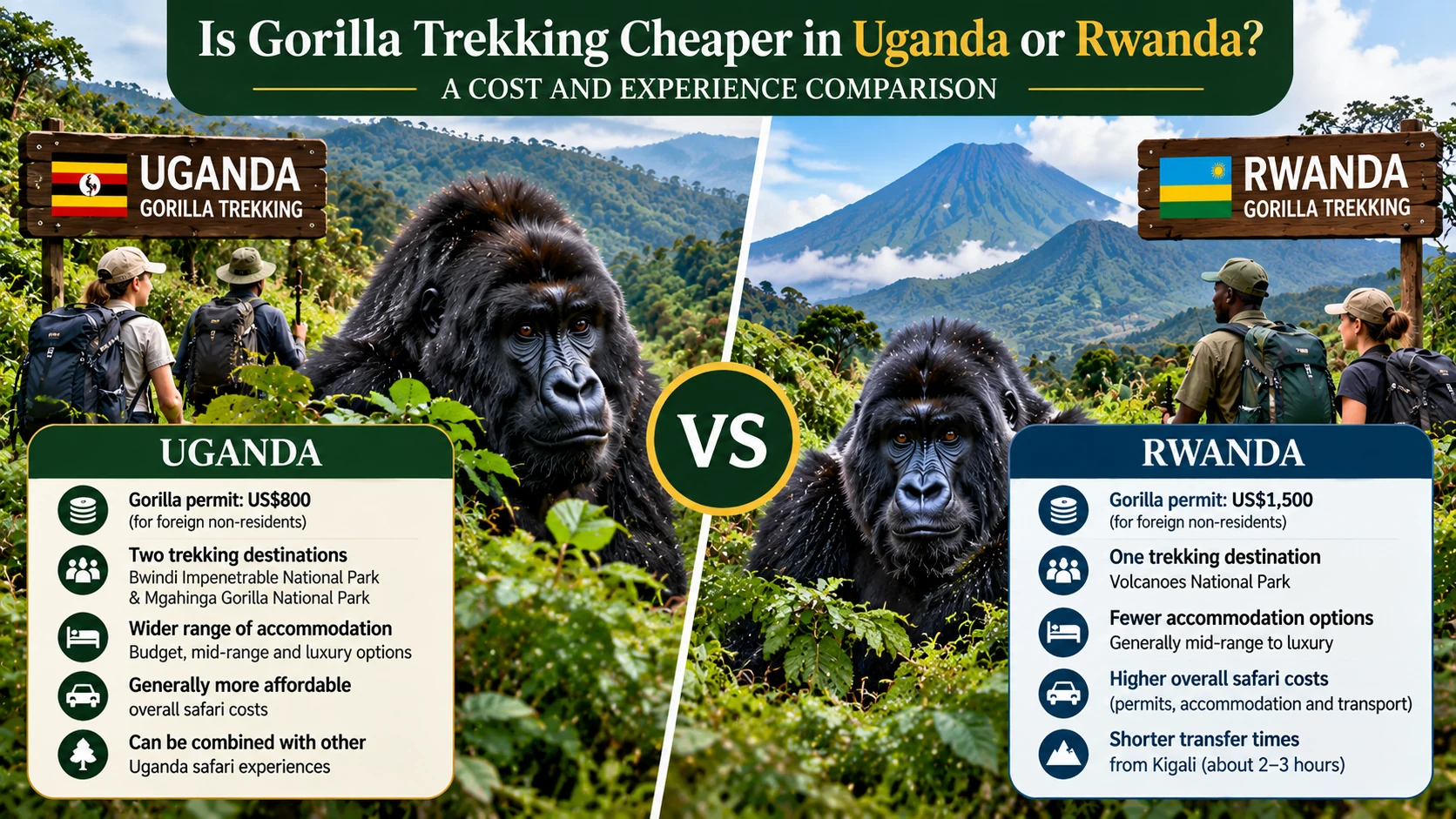
Compare gorilla trekking costs in Uganda and Rwanda, including permit prices, accommodation options and transportation expenses.
Plan Your Uganda Gorilla Trekking Safari with PrideMark Safaris
At PrideMark Safaris, we help travelers plan gorilla trekking experiences in Uganda, including itineraries starting from Entebbe, Kampala, Kigali, Kabale, and Kisoro.
Whether you’re looking for an affordable gorilla trekking adventure or a comfortable private safari, we can help you compare travel routes, accommodation options, and permit arrangements.
Our local knowledge of southwestern Uganda allows us to design practical itineraries around Bwindi Impenetrable National Park, Mgahinga Gorilla National Park, and nearby attractions.
Contact PrideMark Safaris for a personalized Uganda gorilla trekking quotation and discover an itinerary that matches your budget, interests, and travel dates.
Hidden and Additional Gorilla Trekking Costs in Uganda
When calculating the total cost of gorilla trekking in Uganda, it’s important to consider expenses beyond the gorilla trekking permit, accommodation, and transportation.
Some safari packages include most essential services, while others exclude certain costs that travelers must pay separately.
These additional expenses may seem small individually, but they can affect your overall travel budget, especially if you’re planning a longer safari or traveling with family.
Understanding these costs before booking will help you avoid unexpected expenses and compare gorilla trekking packages more accurately.
1. Uganda Tourist Visa Fees
International visitors may need a tourist visa to enter Uganda, depending on their nationality.
Uganda’s ordinary single-entry tourist visa generally costs US$50 per person for travelers who require one.
Visitors planning to combine Uganda with Kenya and Rwanda may also consider the East Africa Tourist Visa, where eligible, which generally costs US$100.
However, not all nationalities require a visa, and visa eligibility and entry conditions can change.
Before traveling, check the latest requirements through the Uganda Electronic Visa Portal.
Travelers entering Uganda from Rwanda should also confirm whether their visa arrangements allow the intended border crossing and return journey.
2. Travel Insurance Costs
Travel insurance is another expense to include in your gorilla trekking budget.
Although insurance is normally purchased separately from the safari package, it can provide important financial protection if your trip is interrupted by illness, flight cancellation, lost luggage, or other unexpected circumstances.
For gorilla trekking, choose a policy that specifically covers hiking or trekking activities, emergency medical treatment, and evacuation where applicable.
A short-trip travel insurance policy might cost approximately US$30–100 or more, depending on your age, nationality, trip value, coverage limits, and medical circumstances.
The cheapest policy is not always the most suitable. Review exclusions and confirm that your planned activities are covered.
3. Gorilla Trekking Porter Fees
Hiring a porter is optional but can make your trekking experience more comfortable.
Mountain gorilla trekking often involves walking through dense vegetation, muddy trails, steep hills, and uneven terrain.
A porter can help carry your backpack and provide assistance along difficult sections of the route.
Porter services commonly cost around US$15–20 per person, although rates should be confirmed locally.
Hiring a porter also provides direct employment opportunities for people living around Uganda’s gorilla trekking destinations.
For travelers concerned about the physical demands of trekking, porter assistance can be a worthwhile addition to the safari budget.
4. Tips for Gorilla Trekking Guides and Lodge Staff
Tipping is customary in many safari settings but remains voluntary.
Visitors may choose to tip park guides, trackers, porters, driver-guides, and lodge staff to show appreciation for good service.
There is no single mandatory tipping amount that applies to every safari.
For a short gorilla trekking trip, travelers may wish to budget approximately US$20–50 or more for discretionary gratuities, depending on the services received.
Tips should reflect your satisfaction, personal budget, and the number of people providing assistance.
5. Gorilla Trekking Equipment and Clothing
You don’t need expensive specialist equipment to enjoy gorilla trekking in Uganda, but appropriate clothing and footwear are essential.
The forest environment can be wet, muddy, and physically demanding, particularly during the rainy seasons.
Recommended trekking items include:
- Waterproof hiking boots with good grip
- Long trousers and long-sleeved clothing
- A lightweight waterproof jacket
- Gardening or trekking gloves
- A small daypack
- Drinking water and energy snacks
- Insect repellent and sun protection
- Gaiters, particularly during wet conditions
If you already own suitable outdoor clothing, you may not need to purchase much additional equipment.
Travelers buying new boots, rainwear, and accessories might spend approximately US$50–200 or more, depending on the brands and items selected.
Make sure you break in new hiking boots before your safari to reduce the risk of discomfort during the trek.
6. Airport Transfers and Additional Hotel Nights
Some gorilla trekking packages include airport pickup and drop-off, while others begin and end at a designated meeting point.
If airport transfers are not included, you’ll need to arrange transportation separately.
Travelers arriving late at night or departing early in the morning may also need an additional hotel night near Entebbe International Airport.
This is particularly relevant for visitors traveling by road to Bwindi, as the journey from Entebbe is long.
An extra overnight stay can provide more flexibility and reduce the risk of missing an international flight after a delayed road transfer.
Before booking, confirm whether your safari quotation includes airport transfers, pre-safari accommodation, and post-safari accommodation.
7. Optional Activities Around Bwindi and Mgahinga
Many visitors choose to add other experiences to their gorilla trekking safari.
Southwestern Uganda offers beautiful landscapes, cultural activities, and additional wildlife encounters that can enrich your trip.
Popular optional activities include:
- Batwa cultural experiences: Learn about the heritage, traditions, and history of Indigenous Batwa communities through locally organized experiences.
- Guided nature walks: Explore designated forest trails with authorized guides.
- Golden monkey tracking: Available in Mgahinga Gorilla National Park under a separate permit.
- Lake Bunyonyi excursions: Enjoy canoeing, boat trips, birdwatching, and scenic views around one of Uganda’s most beautiful lakes.
- Community visits: Discover local crafts, farming traditions, and community tourism initiatives.
These activities usually involve additional fees, which vary by provider and experience.
Travelers should ask their safari operator for the current prices before adding activities to their itinerary.
For visitors interested in exploring more of Uganda without greatly increasing their budget, our guide to Uganda safaris around US$2,000 provides additional travel ideas.
8. Currency Exchange and Payment Charges
Another easily overlooked expense is the cost of making international payments.
Depending on your payment method, you may incur bank transfer fees, currency conversion charges, or card processing fees.
Some hotels and service providers quote prices in US dollars, while smaller businesses may prefer Ugandan shillings.
Travelers should confirm accepted payment methods and any applicable transaction charges before making large payments.
Carrying a reasonable amount of local currency can also be useful for personal purchases, optional services, and small expenses during the safari.
Estimated Additional Gorilla Trekking Expenses
The following table summarizes some common expenses that may fall outside a standard gorilla trekking package.
| Additional Expense | Estimated Cost |
|---|---|
| Uganda tourist visa, if required | US$50 |
| Short-trip travel insurance | US$30–100+ |
| Optional porter | US$15–20 |
| Optional tips | US$20–50+ |
| Trekking clothing and equipment | US$50–200+ |
| Optional activities | Varies |
| Additional hotel nights | Varies |
| Bank and payment charges | Varies |
Note: These are approximate additional
expenses for a Uganda gorilla trekking safari.
Actual costs depend on travel dates, personal preferences,
service providers, and package inclusions.
Some expenses may already be covered by your safari package.
These are general planning estimates, not mandatory charges or confirmed PrideMark Safaris prices. Visa and insurance costs depend on individual circumstances, and optional expenses can be reduced or avoided.
How to Avoid Unexpected Gorilla Trekking Expenses
The best way to manage your gorilla trekking budget is to understand exactly what your safari quotation includes before confirming your reservation.
Ask your tour operator whether the quoted price covers the gorilla permit, accommodation, meals, drinking water, vehicle fuel, driver-guide services, and all scheduled transfers.
You should also confirm which expenses are excluded and whether optional activities or additional hotel nights are necessary.
At PrideMark Safaris, we help travelers plan gorilla trekking itineraries based on their available budget, accommodation preferences, and travel arrangements.
Whether you’re organizing a short three-day adventure or a longer Uganda safari, understanding the full range of possible expenses will help you make informed decisions.
Request a personalized gorilla trekking quotation from PrideMark Safaris to understand the expected costs and inclusions before booking your trip.
How to Save Money on Gorilla Trekking in Uganda
Gorilla trekking is one of Africa’s most remarkable wildlife experiences, but it doesn’t have to mean booking an expensive luxury safari. With careful planning, travelers can reduce accommodation, transportation, and other expenses while still enjoying the same unforgettable encounter with mountain gorillas.
If you’re wondering how to save money on gorilla trekking in Uganda, the most effective approach is to choose suitable travel dates, compare accommodation options, share transportation costs, and book a safari itinerary that matches your budget.
Here are nine practical ways to make your Uganda gorilla trekking adventure more affordable.
1. Travel During the Low Season
One of the best ways to reduce your gorilla trekking expenses is to travel during Uganda’s quieter tourism months.
April, May, and November generally experience fewer visitors than the peak travel periods of June to September and December to February.
Some accommodation providers offer more competitive rates during quieter months, although discounts depend on the individual lodge.
Uganda Wildlife Authority has also announced discounted gorilla trekking permits for eligible foreign visitors during designated low-season periods.
Where applicable, these promotional permits can reduce the standard permit cost by US$200 for foreign non-residents.
However, promotional permits may have stricter booking conditions, including restrictions on rescheduling. Always confirm the applicable tariff, travel dates, and permit conditions before making payment.
The main trade-off is weather. Rainfall can make forest trails muddy and slippery, so suitable hiking boots, waterproof clothing, and flexibility are especially important.
For travelers comfortable with these conditions, low-season gorilla trekking can provide excellent value.
2. Travel with Friends or Join a Small Group
Transportation is one of the largest expenses after the gorilla trekking permit.
A private safari vehicle, fuel, and driver-guide can be expensive when the cost is paid by a single traveler.
However, when two, four, or more travelers share the same vehicle, the transportation cost per person can decrease considerably.
For example, if a vehicle and driver-guide cost US$600 for a particular itinerary, splitting that amount between two travelers would mean US$300 each. Four travelers sharing the same cost would pay US$150 each.
This is only an illustration; actual vehicle costs depend on the itinerary and operator.
Traveling with friends, family members, or an organized small group can therefore make gorilla trekking more affordable.
Solo travelers may also benefit from joining scheduled group departures when available.
If you’re considering traveling independently, read our guide on whether you can go gorilla trekking alone in Uganda.
3. Choose Budget Accommodation Near Your Trekking Sector
You don’t need to stay in a luxury lodge to enjoy an exceptional mountain gorilla encounter.
Uganda offers budget guesthouses, camps, and affordable safari lodges around its gorilla trekking destinations.
Choosing comfortable but economical accommodation can significantly reduce the overall price of your safari.
However, the location of your lodge is important.
Bwindi Impenetrable National Park has four main trekking sectors: Buhoma, Ruhija, Rushaga, and Nkuringo.
Staying near your assigned sector can help reduce unnecessary driving, fuel expenses, and early-morning travel.
A cheaper lodge located far from your trekking briefing point may ultimately be less convenient or more expensive once additional transportation is considered.
When comparing accommodation, consider both the nightly rate and the distance to your trekking starting point.
4. Consider Gorilla Trekking from Kigali
For travelers with limited time, beginning a Uganda gorilla trekking safari in Kigali, Rwanda, can be a practical alternative to driving from Entebbe.
Kigali is closer to southern Bwindi and Mgahinga than Entebbe, making shorter road itineraries possible.
Depending on the border crossing, immigration procedures, and trekking location, travelers may reach southwestern Uganda in approximately four to six hours or longer.
This can make a two-day gorilla trekking safari possible in some circumstances, potentially reducing the number of accommodation nights and days of vehicle hire.
However, travelers must account for Rwanda and Uganda entry requirements, border procedures, and any additional cross-border transportation charges.
A Kigali departure is not automatically cheaper for everyone. The savings depend on your international flight arrangements and overall itinerary.
For a detailed comparison of the two destinations, see our Uganda vs Rwanda budget gorilla trekking guide.
5. Book Your Gorilla Permit Early
Booking your gorilla trekking permit well in advance can help you avoid unnecessary changes to your travel plans.
Gorilla trekking permits are limited, particularly during the popular dry-season travel months.
If permits are unavailable for your preferred dates or trekking sector, you may need to adjust your itinerary, accommodation, or transportation arrangements.
These changes can increase your total safari expenses.
Booking early also gives you more time to compare lodges and choose accommodation that suits your budget.
The official permit price is determined by Uganda Wildlife Authority, so booking early does not automatically provide a discount.
However, early planning can help you secure a more convenient itinerary and avoid paying extra for last-minute arrangements.
6. Choose Road Transportation Instead of Domestic Flights
Domestic flights can significantly reduce travel time to Uganda’s gorilla trekking destinations, but they usually increase the total safari cost.
Travelers can fly from Entebbe to Kihihi or Kisoro and continue by road to their lodge.
For budget-conscious visitors, traveling by road is often the more economical option, especially when vehicle expenses are shared among several people.
Road transfers also provide opportunities to experience Uganda’s countryside, towns, and highland scenery.
However, the journey from Entebbe or Kampala to Bwindi can take approximately eight to ten hours or longer.
If your schedule allows, choosing road transportation can help you save money while enjoying more of the country’s landscapes.
7. Avoid Paying for Activities You Don’t Need
Uganda offers many excellent experiences beyond gorilla trekking, including golden monkey tracking, nature walks, community visits, boat excursions, and wildlife safaris.
These activities can make your holiday more memorable, but they also increase your overall travel budget.
If your main priority is seeing mountain gorillas, a focused three-day itinerary may provide better value than a longer safari with several additional activities.
You can always extend your trip if your budget allows.
Travelers looking for a broader adventure can explore our article on Uganda safari experiences around US$2,000 for inspiration.
The most affordable itinerary is often the one that focuses on your preferred experiences without adding unnecessary travel days or activities.
8. Compare Safari Packages Based on What Is Included
When searching for affordable gorilla trekking packages, don’t choose an operator based only on the lowest advertised price.
A cheaper quotation may exclude important expenses such as the gorilla permit, meals, park transfers, or vehicle fuel.
Before booking, check whether your package includes:
- Gorilla trekking permit
- Accommodation and specified meals
- Transportation and fuel
- Driver-guide services
- Transfers to the trekking briefing point
- Drinking water and other agreed services
You should also ask about visa fees, porter services, tips, and optional activities.
A clearly priced package with the essential services included may offer better value than a lower-priced quotation with numerous additional charges.
9. Book with a Knowledgeable Local Safari Operator
Working with a local safari operator can help you plan an efficient itinerary and avoid unnecessary travel expenses.
A company familiar with southwestern Uganda can recommend suitable accommodation, practical driving routes, and appropriate trekking destinations based on your budget.
At PrideMark Safaris, we help travelers organize gorilla trekking safaris in Bwindi Impenetrable National Park and Mgahinga Gorilla National Park.
Our approach focuses on understanding your travel dates, group size, accommodation preferences, and available budget before recommending a suitable itinerary.
Whether you’re traveling alone, as a couple, or with friends, we can help you explore affordable gorilla trekking options without sacrificing the essential experience.
What Is the Cheapest Way to See Gorillas in Uganda?
For many international visitors, the cheapest practical way to see mountain gorillas in Uganda is to combine an eligible discounted permit, budget accommodation, and shared road transportation.
Traveling during quieter months may also help reduce lodge costs.
However, the lowest possible price depends on your nationality, residency status, departure location, travel dates, and the number of people sharing transportation.
It is important to remember that legitimate gorilla trekking permits are issued under Uganda Wildlife Authority’s official tariff system.
Be cautious of offers promising unusually cheap permits without clear booking arrangements or verifiable confirmation.
A properly organized gorilla trekking safari should prioritize valid permits, safe transportation, suitable accommodation, and responsible wildlife tourism.
Looking for an affordable gorilla trekking safari in Uganda?
Contact PrideMark Safaris with your preferred travel dates, number of travelers, and approximate budget. We’ll help you explore suitable gorilla trekking options and understand the costs before making a reservation.
Is Gorilla Trekking in Uganda Worth the Cost?
For many wildlife enthusiasts, gorilla trekking in Uganda is worth the cost because it offers a rare opportunity to observe endangered mountain gorillas in their natural rainforest habitat. Although the standard US$800 permit for foreign non-residents represents a significant expense, the experience goes far beyond an ordinary wildlife excursion.
Unlike a traditional game drive, where animals are usually observed from a safari vehicle, gorilla trekking takes visitors on foot through protected forests accompanied by experienced park guides and trackers.
The reward is an extraordinary encounter with a habituated mountain gorilla family, where visitors can watch these remarkable primates feed, groom, rest, and interact in the wild.
For travelers who value wildlife conservation, nature, photography, and meaningful travel experiences, this can be one of the highlights of an African safari.
1. A Rare Opportunity to See Mountain Gorillas in the Wild
Mountain gorillas live naturally in only a small region of East and Central Africa, within protected forests spanning Uganda, Rwanda, and the Democratic Republic of Congo.
Uganda’s two mountain gorilla trekking destinations, Bwindi Impenetrable National Park and Mgahinga Gorilla National Park, provide carefully managed opportunities to observe these animals in their natural environment.
During a standard gorilla trek, visitors are allowed up to one hour with an assigned habituated gorilla family once it has been located.
Watching a silverback resting among the vegetation, young gorillas playing, or a mother caring for her infant creates a wildlife experience that is difficult to compare with conventional sightseeing.
Although gorilla sightings are highly likely on organized treks, wildlife encounters can never be absolutely guaranteed.
The rarity of the experience and the limited number of daily trekking permits contribute to its value.
2. Your Gorilla Trekking Permit Supports Conservation
A major reason gorilla trekking costs more than many other wildlife activities is the conservation work required to protect mountain gorillas and their habitats.
Mountain gorillas face threats that include habitat pressure, disease transmission, and human-wildlife conflict.
Revenue generated through regulated tourism contributes to national park management, wildlife monitoring, ranger operations, and conservation initiatives.
Uganda Wildlife Authority also operates revenue-sharing arrangements intended to benefit communities living near protected areas.
These initiatives help connect wildlife conservation with local economic opportunities.
By purchasing an official gorilla trekking permit, visitors contribute to a tourism system that supports the continued protection of Uganda’s mountain gorillas.
For more information about conservation management, visit the Uganda Wildlife Authority.
3. Gorilla Trekking Offers More Than One Hour with Gorillas
Some travelers initially question whether paying hundreds of dollars for one hour with gorillas represents good value.
However, the gorilla encounter is only one part of the overall trekking experience.
The adventure begins with an early-morning briefing before visitors enter the forest with professional guides and trackers.
Depending on the gorillas’ location, the trek may involve several hours of walking through dense vegetation, forested hills, and beautiful mountain landscapes.
Along the way, visitors experience the sounds, scenery, and biodiversity of Uganda’s protected rainforests.
The journey through the forest, anticipation of locating the gorillas, and eventual wildlife encounter all contribute to the experience.
The one-hour viewing limit is an important conservation measure designed to reduce prolonged human contact with gorilla families.
4. Uganda Offers Excellent Value Compared with Rwanda
Another reason many travelers choose Uganda is its comparatively affordable standard gorilla trekking permit.
For foreign non-residents, Uganda’s standard permit costs US$800, while Rwanda’s standard permit costs US$1,500.
Both destinations provide regulated gorilla trekking experiences, but Uganda’s lower permit price can leave more room in a travel budget for accommodation, transportation, and other safari activities.
Uganda also offers opportunities to combine gorilla trekking with chimpanzee tracking, wildlife game drives, boat cruises, and visits to scenic destinations such as Lake Bunyonyi.
For travelers planning a longer East African wildlife holiday, this variety can make Uganda particularly appealing.
Explore our detailed Uganda vs Rwanda budget gorilla trekking comparison to understand the differences in permit prices, travel logistics, and overall safari expenses.
5. Is Gorilla Habituation Worth the Extra Cost?
Travelers who want a longer experience with mountain gorillas may consider Uganda’s gorilla habituation experience.
Unlike standard gorilla trekking, which allows up to one hour with a habituated gorilla family, the gorilla habituation experience allows visitors to spend up to four hours observing gorillas during a specialized conservation-related activity.
The experience involves accompanying authorized personnel to observe a gorilla group undergoing habituation.
Gorilla habituation permits cost more than standard trekking permits, and availability is more limited.
For wildlife photographers, researchers, and visitors with a strong interest in gorilla behavior, the additional time may justify the higher expense.
However, standard gorilla trekking remains an excellent choice for first-time visitors and travelers who want a memorable encounter without paying for the longer experience.
Read our guide on gorilla trekking vs gorilla habituation in Uganda to compare the experiences and decide which is right for you.
6. Who Should Consider Gorilla Trekking in Uganda?
Gorilla trekking can be particularly rewarding for:
- Wildlife enthusiasts who want to observe endangered primates in their natural habitat.
- Nature photographers seeking opportunities to photograph mountain gorillas in a rainforest environment.
- Couples and honeymooners looking for a distinctive shared travel experience.
- Adventure travelers who enjoy guided hiking and exploring protected natural landscapes.
- Conservation-minded visitors interested in responsible wildlife tourism.
- First-time safari travelers who want to combine gorilla trekking with other Ugandan wildlife experiences.
Gorilla trekking does require some physical effort, and forest conditions can be challenging.
Travelers should consider their fitness, mobility, and health before booking and discuss any relevant requirements with their safari operator.
Uganda Wildlife Authority also applies minimum age and health-related rules to gorilla trekking, which visitors should confirm before purchasing permits.
7. When Might Gorilla Trekking Not Be Worth the Expense?
Although gorilla trekking is a remarkable experience, it may not suit every traveler.
Visitors who dislike hiking, have a very limited travel budget, or expect guaranteed close-up wildlife photography may find the experience less suitable.
The forest environment can be wet, steep, and unpredictable, and the gorillas’ location changes naturally.
The cost can also be significant for families or larger groups because every eligible participant requires an individual permit.
Travelers should therefore consider their interests, physical abilities, available time, and financial priorities before booking.
Choosing the right safari is more important than simply selecting the most expensive package.
Our Verdict: Is Gorilla Trekking in Uganda Worth It?
For travelers passionate about wildlife and conservation, gorilla trekking in Uganda can be one of the most rewarding experiences in Africa.
The combination of protected rainforest landscapes, knowledgeable park guides, and the opportunity to observe mountain gorillas in the wild makes the experience distinctive.
Although the permit is expensive, Uganda’s relatively lower standard permit price compared with Rwanda and its range of accommodation options make it an attractive destination for different travel budgets.
At PrideMark Safaris, we help travelers organize gorilla trekking adventures based on their interests, available time, and preferred level of comfort.
Whether you’re planning your first gorilla trek or combining the experience with a longer Uganda wildlife safari, we can help you explore suitable itineraries and understand the expected costs.
Ready to experience mountain gorillas in Uganda? Contact PrideMark Safaris to discuss your travel dates and receive a personalized gorilla trekking safari quotation.
Frequently Asked Questions About Gorilla Trekking Costs in Uganda
1. How much does gorilla trekking cost in Uganda in 2026/2027?
The standard gorilla trekking permit in Uganda costs US$800 per person for foreign non-residents under the announced 2026/2027 tariff. However, the total cost of a gorilla trekking safari also includes accommodation, transportation, meals, and other services. A typical three-day budget safari may cost approximately US$1,200–1,600 per person when two travelers share accommodation and transportation. Always confirm current permit rates before booking.
2. How much is a gorilla trekking permit in Uganda?
The standard Uganda gorilla trekking permit costs US$800 for foreign non-residents, US$700 for foreign residents, US$500 for eligible citizens of other African countries, and UGX 300,000 for eligible East African Community citizens. Rates and eligibility requirements are determined by the Uganda Wildlife Authority.
3. What is the cheapest way to see gorillas in Uganda?
One of the cheapest practical ways to see gorillas in Uganda is to travel during an eligible low-season discount period, stay in budget accommodation, and share transportation with other travelers. Joining a small-group safari can reduce vehicle expenses, while choosing accommodation near your trekking sector can help avoid unnecessary transfers.
4. How much does a 3-day gorilla trekking safari cost in Uganda?
A three-day gorilla trekking safari typically costs approximately US$1,200–1,600 per person for a budget package, US$1,600–2,500 for a mid-range safari, and US$2,800–5,000 or more for a luxury experience. These are planning estimates based on two travelers sharing costs and one standard gorilla permit per person, not fixed package quotations.
5. Is gorilla trekking cheaper in Uganda or Rwanda?
Uganda is generally cheaper for foreign non-resident travelers because its standard gorilla trekking permit costs US$800, compared with Rwanda’s standard US$1,500 permit. This represents a US$700 difference per person before accommodation and transportation. However, Rwanda’s shorter transfer from Kigali International Airport can make short itineraries convenient. Read our Uganda vs Rwanda gorilla trekking comparison for more details.
6. Can I get a discounted gorilla trekking permit in Uganda?
Uganda Wildlife Authority has announced discounted gorilla trekking permits for eligible foreign visitors during designated low-season months, including April, May, and November. The announced promotional rate is US$600 for foreign non-residents and US$500 for foreign residents. Availability, eligibility, validity periods, and restrictions must be confirmed before booking.
7. Does a gorilla trekking permit include accommodation?
No. A standard gorilla trekking permit does not include hotel accommodation, transportation, or personal expenses. It covers the authorized gorilla tracking experience and related park services. Travelers must arrange accommodation and transportation separately or choose a safari package that includes these services.
8. How long can you stay with gorillas in Uganda?
A standard gorilla trekking permit allows visitors up to one hour with a habituated mountain gorilla family once it has been located. The full trekking experience may take several hours, depending on the gorillas’ location, weather, terrain, and walking conditions. Uganda also offers a separate gorilla habituation experience that permits up to four hours with a gorilla group under specific arrangements.
9. Is gorilla trekking in Bwindi cheaper than Mgahinga?
No. Bwindi Impenetrable National Park and Mgahinga Gorilla National Park use the same standard Uganda Wildlife Authority gorilla trekking permit tariff. However, the total safari cost can differ because of accommodation prices, transport routes, and lodge locations. The more affordable destination depends on your itinerary and starting point.
10. Can I book a gorilla trekking permit without a tour operator?
Yes. Travelers can arrange gorilla trekking permits through the Uganda Wildlife Authority’s authorized booking procedures, subject to availability and payment requirements. However, many visitors prefer working with a safari operator who can coordinate permits, accommodation, transportation, and trekking-sector logistics.
11. How far in advance should I book gorilla trekking in Uganda?
Booking several months in advance is advisable, especially for travel during the popular June–September and December–February periods. Gorilla trekking permits are limited, and availability varies by date and trekking location. Early planning can also provide a wider choice of accommodation and transportation arrangements.
12. Can I do gorilla trekking in Uganda from Kigali?
Yes. Travelers can begin a Uganda gorilla trekking safari from Kigali, Rwanda, and cross into southwestern Uganda to visit Bwindi or Mgahinga. This can reduce road travel time compared with starting from Entebbe. However, visitors must meet the entry requirements for both countries and allow sufficient time for immigration procedures and transfers.
13. How much should I budget for gorilla trekking tips and porter services?
Porter services commonly cost approximately US$15–20 per trek, while tipping remains optional. Travelers may wish to budget around US$20–50 or more for discretionary gratuities during a short safari, depending on the services received. Porter charges and tipping practices should be confirmed locally.
14. Is gorilla trekking in Uganda worth US$800?
For many wildlife enthusiasts, gorilla trekking is worth the standard US$800 permit fee because it offers a rare opportunity to observe endangered mountain gorillas in their natural rainforest habitat. Permit revenue also supports protected-area management and conservation initiatives. Whether the experience is worth the expense ultimately depends on your interests, travel budget, and expectations.
15. Can I see mountain gorillas in Uganda without buying a permit?
No. Visitors participating in an official mountain gorilla trekking experience in Bwindi or Mgahinga must have a valid permit issued through Uganda Wildlife Authority’s authorized procedures. The permit system helps regulate visitor numbers, protect gorilla families, and support conservation management.
16. How much does gorilla trekking cost for two people in Uganda?
For two foreign non-resident travelers, standard gorilla trekking permits alone cost US$1,600 in total. A three-day budget safari may cost approximately US$2,400–3,200 for two people sharing accommodation and transportation, while mid-range and luxury packages cost more. Final prices depend on travel dates, lodge selection, transportation, and package inclusions.
17. What is the best time for affordable gorilla trekking in Uganda?
April, May, and November can offer opportunities for lower accommodation rates and eligible low-season permit discounts. However, these months may experience heavier rainfall and muddy trekking conditions. Travelers prioritizing drier trails may prefer June–September or December–February, although accommodation demand can be higher.
18. How can I book an affordable gorilla trekking safari with PrideMark Safaris?
You can contact PrideMark Safaris with your preferred travel dates, number of travelers, departure location, and approximate budget. Our team can help you explore suitable gorilla trekking itineraries, accommodation options, transportation arrangements, and permit availability before confirming your safari.
Final Thoughts: How Much Should You Budget for Gorilla Trekking in Uganda?
The cost of gorilla trekking in Uganda depends on your travel dates, accommodation preferences, transportation arrangements, and the type of safari experience you choose. While the standard gorilla trekking permit costs US$800 for foreign non-residents under the announced 2026/2027 tariff, the total cost of your trip will be higher once accommodation, transportation, meals, and other expenses are included.
For a typical three-day gorilla trekking safari, budget travelers can plan for approximately US$1,200–1,600 per person, while mid-range experiences may cost US$1,600–2,500. Luxury gorilla trekking safaris can cost US$2,800–5,000 or more per person.
These estimates assume two travelers sharing accommodation and transportation, with one standard gorilla trekking permit per person. Final costs vary depending on availability, travel dates, and package inclusions.
Uganda remains an attractive destination for travelers seeking an unforgettable mountain gorilla encounter at a comparatively lower standard permit price than Rwanda.
Whether you choose Bwindi Impenetrable National Park or Mgahinga Gorilla National Park, the experience offers a rare opportunity to observe endangered mountain gorillas in their natural habitat while supporting conservation efforts.
Travelers looking to reduce their expenses can consider budget accommodation, shared transportation, eligible low-season permit discounts, and shorter itineraries starting from southwestern Uganda or Kigali.
The most important step is to plan ahead, confirm permit availability, and understand exactly what your safari package includes.
Book Your Uganda Gorilla Trekking Safari with PrideMark Safaris
At PrideMark Safaris, we help travelers organize memorable gorilla trekking adventures in Uganda’s beautiful southwestern region.
Whether you’re planning an affordable three-day gorilla trekking safari, a comfortable mid-range holiday, or a private luxury experience, we can help you explore suitable itineraries based on your interests and budget.
Our safari planning services can help you coordinate:
- Gorilla trekking permit arrangements
- Budget, mid-range, and luxury accommodation
- Private or group transportation options
- Gorilla trekking safaris from Entebbe, Kampala, Kigali, Kabale, or Kisoro
- Additional wildlife, cultural, and scenic experiences
- Personalized itineraries and clear safari quotations
With local knowledge of Bwindi, Mgahinga, and the surrounding destinations, we aim to make your gorilla trekking adventure convenient, rewarding, and well-organized.
Ready to plan your gorilla trekking adventure in Uganda?
Contact PrideMark Safaris today for a personalized quotation based on your preferred travel dates, number of travelers, accommodation preferences, and budget.