PrideMark Safaris • Uganda Wildlife Guide
A Day in the Life of a Mountain Gorilla Family in Bwindi: 7 Amazing Facts
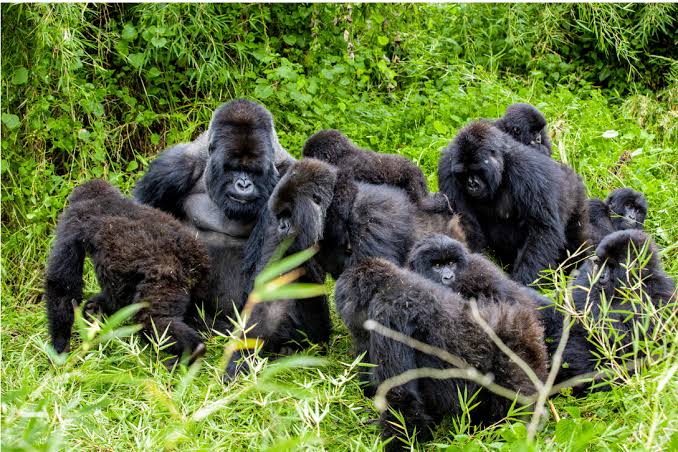
A mountain gorilla family in Bwindi spends its day feeding,
moving through the forest, resting, caring for young and
maintaining social relationships. Discover seven amazing facts
that make these everyday moments so memorable to observe.

Wikimedia Commons — photograph credits and licensing
.
Deep inside the forested hills of southwestern Uganda,
gorillas follow a rhythm shaped by food, weather, terrain
and the needs of their group. Their day is not a fixed
timetable. Feeding can lead to movement, movement can lead
to rest, and a quiet moment can suddenly become a scene
of juvenile play.
Understanding a day in the life of a mountain gorilla
family in Bwindi adds depth to a gorilla trekking safari.
Instead of concentrating only on photographs, you begin
to notice relationships: an infant holding onto its mother,
a juvenile exploring nearby vegetation, or a silverback
resting close to other group members.
This guide explains seven aspects of gorilla family life,
followed by practical information for planning a respectful
visit with PrideMark Safaris.
Mountain Gorilla Family in Bwindi: Trekking at a Glance
Southwestern Uganda, within Bwindi Impenetrable National Park.
Buhoma, Ruhija, Rushaga and Nkuringo.
UWA describes approximately 2–7 hours; actual conditions vary.
One hour with a habituated gorilla family.
Feeding, resting, movement, infant care and social interaction.
A guided forest trek with potentially steep and muddy terrain.
See the
Uganda Wildlife Authority gorilla tracking information
for official visitor guidance.
1. A Mountain Gorilla Family in Bwindi Begins Its Day Around the Sleeping Nests
Mountain gorillas rest overnight in nests made from
vegetation. As daylight returns, group members gradually
become active and begin another cycle of feeding and
movement. The precise timing differs between days and
families, so there is no universal wake-up time.
A morning may begin quietly. An adult adjusts its position,
an infant remains close to its mother, and another gorilla
starts feeding on nearby plants. These small actions are
part of a daily routine that continues whether visitors
are present or not.
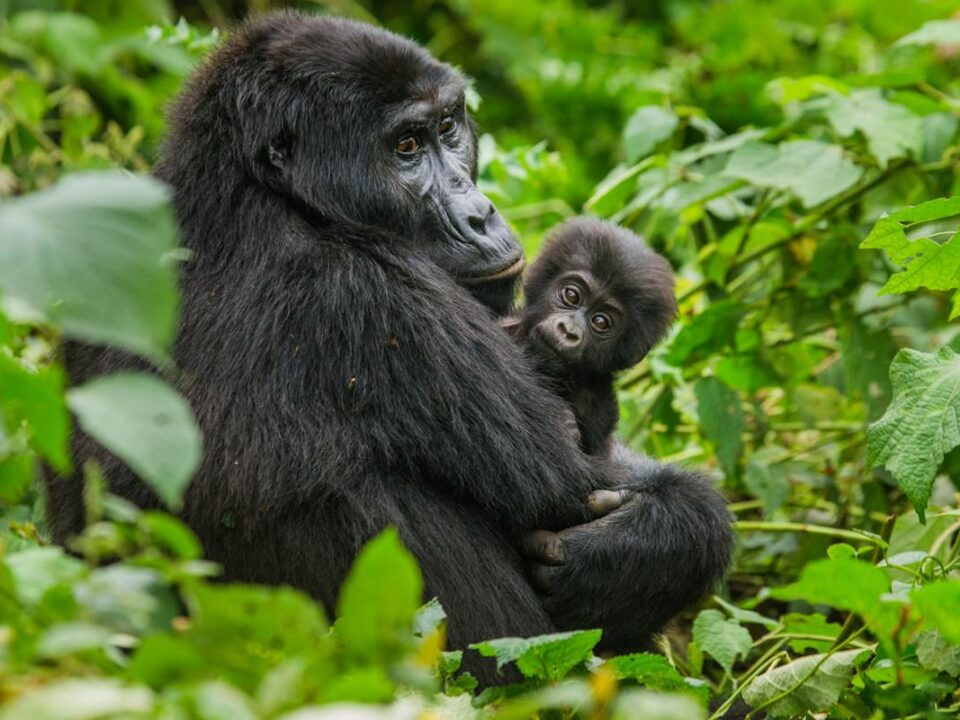
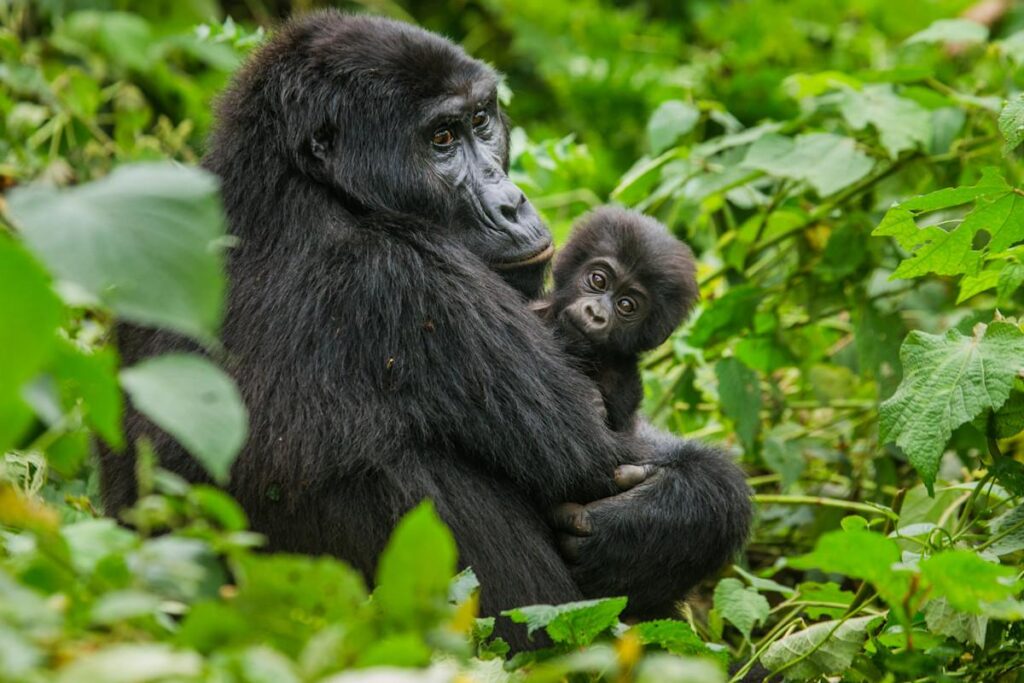
Mothers provide close care for dependent infants.
A young gorilla may cling to its mother while she moves,
keeping the infant near her as the family leaves its
nesting area.
Your trek follows the family’s movements. Gorillas do not
gather at a fixed viewing point or wait for visitors to arrive.
2. Feeding Shapes Much of the Family’s Day
Feeding occupies an important part of mountain gorilla
life. Their diet is largely plant-based and includes leaves,
stems, shoots and other vegetation. In Bwindi, fruit may
also be eaten when available. The foods selected depend
on habitat, season and local availability.
A family can remain in an area while individuals feed,
then gradually move towards another patch of suitable
vegetation. Feeding and travel therefore overlap rather
than always occurring as separate activities.
Watch closely and you may see a gorilla select particular
plant parts, pull vegetation towards its mouth, or strip
material from a stem. These deliberate movements reveal
how familiar the animals are with their forest home.
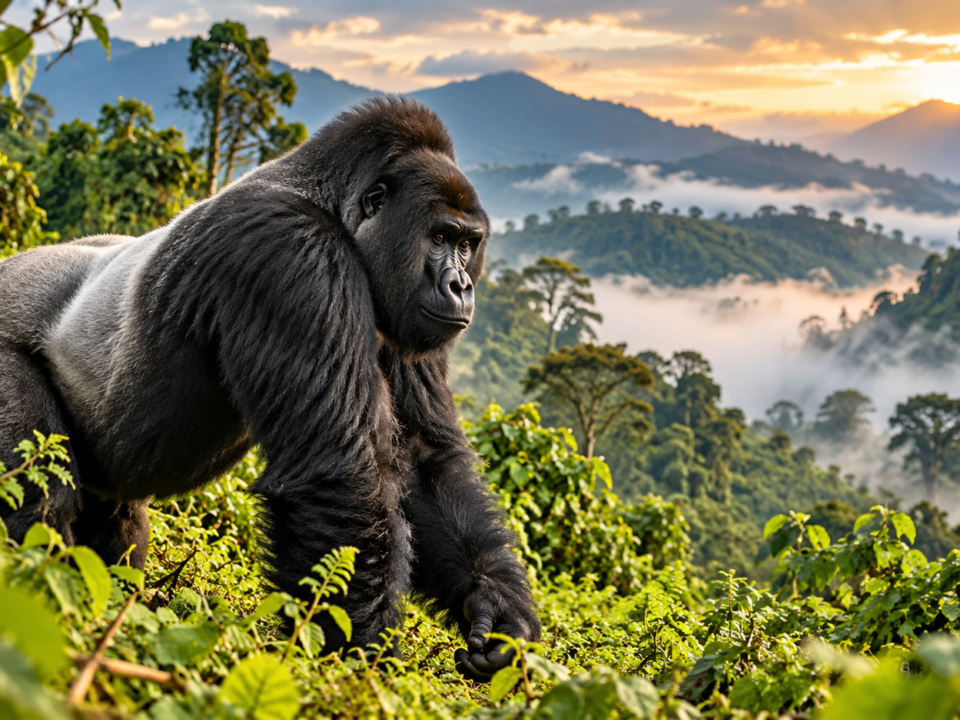
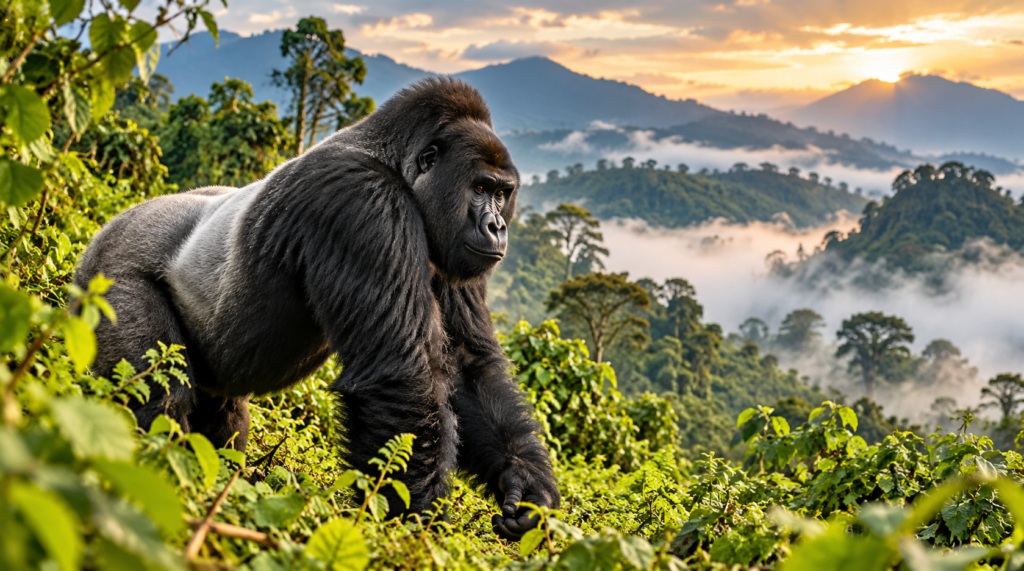
For visitors, feeding can be one of the most rewarding
behaviors to observe. A powerful silverback may sit
calmly among leaves while other members eat nearby.
The quiet sounds of chewing and vegetation being pulled
apart can make the encounter feel especially intimate.

the original photograph and licensing information
.
3. Forest Movement Explains Why Every Gorilla Trek Is Different
A mountain gorilla family in Bwindi moves through its
habitat as feeding opportunities and group needs change.
The animals may cross slopes, pass through thick vegetation
and pause repeatedly along the way.
This movement helps explain why trekking duration varies.
A family can be relatively accessible on one day and
farther from the trailhead on another. A previous visitor’s
short trek does not guarantee that yours will be short.
Bwindi’s terrain also affects the journey. Forest paths
can include muddy ground, exposed roots, steep sections
and dense undergrowth. Guides and trackers help visitors
navigate these conditions while locating the assigned group.
Once the gorillas are found, they may continue moving.
Follow your guide’s instructions and allow the animals
to choose their direction. Your experience is an
observation of wild behavior as it unfolds.
Tell your safari operator about mobility concerns before
booking. Discuss support options and realistic expectations,
while recognizing that the family’s location cannot be guaranteed.
4. The Silverback Has an Important Role in Family Life
A silverback is a mature male gorilla with distinctive
silver-colored hair across part of his back. In many groups,
a dominant silverback plays an important role in protection,
group cohesion and movement.
Group composition varies. Some groups contain more than
one adult male, and relationships within a family are more
complex than a simple image of one male directing every
action.
Visitors sometimes expect constant chest beating or
dramatic displays. Much of a silverback’s day can instead
involve ordinary feeding, resting and social interaction.
Observing him quietly beside other gorillas often provides
a more revealing picture of group life.
Displays and vocalizations are forms of communication.
If the guide interprets a change in behavior and asks
visitors to move or remain still, follow that instruction
immediately. Avoid trying to provoke a response for a
photograph or video.
The size of a silverback is impressive, but understanding
his place within the group makes the encounter more
meaningful than focusing on size alone.
5. Young Gorillas Learn Through Play and Exploration
Young gorillas often bring energy to a family encounter.
Juveniles may chase, wrestle, climb or investigate nearby
vegetation between feeding and resting periods.
Play creates opportunities to develop coordination and
practice social interactions. A young gorilla learning
to balance on vegetation or engage another juvenile is
developing skills used throughout its life.
Infants remain more dependent on their mothers, while
older juveniles gradually explore with greater independence.
Their behavior can differ considerably depending on age
and the circumstances of the moment.
Seeing infants is never guaranteed. The family assigned
to your trek, its composition and visibility on the day
all influence what you observe. A rewarding encounter
may involve young gorillas playing, or adults quietly
feeding with no infants in view.
Make Time to Observe, Not Just Photograph
Spend part of your viewing period watching without a
camera. Small gestures, expressions and interactions
can be among the most memorable parts of your safari.
6. Rest Is an Essential Part of the Daily Rhythm
Feeding and movement are interspersed with periods of
rest. A family may settle in one area, with individuals
sitting or lying near one another.
A resting encounter offers its own opportunities for
observation. You may notice how members position
themselves within the group, how a mother keeps an
infant close, or how an animal responds to nearby sounds.
Gorillas communicate through vocalizations, gestures,
body movements and physical interaction. Some exchanges
are subtle. A brief sound or shift in position may be
easy to miss if you are concentrating entirely on photographs.
Rest does not occur at one fixed hour for every family.
Weather, feeding conditions and individual needs can
affect activity. The gorillas may be resting when you
arrive, feeding throughout your visit, or moving between
those behaviors.
Every encounter reflects the family’s circumstances at
that moment. Appreciating quiet behavior is part of
understanding life in Bwindi.
7. Fresh Sleeping Nests Mark the End of the Day
Towards the end of the day, mountain gorillas prepare
sleeping nests by bending and arranging vegetation.
These temporary structures provide a place to rest overnight.
Nests can be built on the ground or in trees, depending
on the animal and available surroundings. Dependent
infants generally share their mother’s nest, while
older animals build their own.
Gorillas generally construct fresh night nests rather
than maintaining permanent sleeping shelters. Nesting
locations therefore change as the group moves through
its habitat.
Old nests and other signs of activity can help experienced
trackers understand where gorillas have been. They are
part of the evidence used when following a family through
the forest.
Ordinary tourist treks take place during daylight.
Visitors should not expect to follow a family through
its entire day or watch it settle overnight. Leaving
the animals undisturbed is part of responsible wildlife viewing.
The Daily Rhythm of a Mountain Gorilla Family in Bwindi
The table below illustrates how activities may fit together.
It is a general explanation, not a fixed timetable for
any particular family.
| Part of the Day | Possible Activities | What to Understand |
|---|---|---|
| Morning | Leaving nests, feeding and beginning to move. | Activity starts vary with conditions and group behavior. |
| Later morning | Feeding, travel, infant care and juvenile play. | Several activities can happen within the group at once. |
| Middle of the day | Resting, interaction and additional feeding. | A quiet family encounter can still be rewarding. |
| Afternoon | Further feeding, movement and social activity. | The family’s position may change during the day. |
| Evening and night | Building sleeping nests and resting overnight. | Standard tourist visits do not follow gorillas overnight. |
What You Experience During a Bwindi Gorilla Trek
A visitor’s day usually begins with breakfast and a transfer
to the designated trekking center. Your accommodation
should be planned around the sector associated with your
permit, so that the morning transfer is practical.
At the briefing, park staff explain the activity and
visitor conduct. After group arrangements are completed,
your guide leads you into the forest.
The walk is part of the experience. You pass through
vegetation, listen to forest sounds and follow the route
towards the family. Conditions can change, so maintain
a manageable pace and communicate with your guide if
you need assistance.
Standard gorilla tracking allows one hour of observation
after the family is reached. During that period, you may
observe one or several of the behaviors described above.
No particular scene can be promised.
When the observation period ends, you return with your
guide. Avoid planning an inflexible onward transfer
immediately after trekking, because the return time varies.
Where Is Bwindi, and Which Sector Should You Choose?
Bwindi Impenetrable National Park lies in southwestern
Uganda. Its forest supports mountain gorillas alongside
a rich variety of plants, birds and other wildlife.
Learn more about its ecological importance through
UNESCO’s Bwindi World Heritage information
.
The four principal trekking sectors are Buhoma, Ruhija,
Rushaga and Nkuringo. Your permit sector, accommodation
and arrival route should be coordinated when planning
the trip.
Rather than choosing a sector solely because someone
describes it as easy, consider permit availability,
your wider route, lodge preferences and support needs.
Actual trekking difficulty depends on the gorillas’
location and conditions on the day.
Open Bwindi in Google Maps
.
Confirm your exact briefing location before traveling;
this general park map is not a substitute for sector directions.
How to Prepare for Your Gorilla Trek
Preparation helps you enjoy the forest and concentrate
on the encounter. Bwindi can be wet, and steep or uneven
ground requires suitable footwear and a realistic assessment
of your hiking ability.
Useful Items to Pack
- Hiking boots with dependable grip.
- A lightweight waterproof jacket.
- Long trousers and a comfortable long-sleeved shirt.
- Drinking water and the packed lunch arranged for your trek.
- A small backpack with rain protection.
- A camera or phone with sufficient battery and storage.
- Personal medication needed during the day.
- Gardening gloves if you want hand protection on rough vegetation.
Ask about porter availability before the trek. Carrying
assistance can make the hike more manageable and
provides paid work for local people. Confirm any
charges and arrangements directly.
Allow Enough Time in Your Itinerary
Arriving near your trekking sector before the activity
gives you time to settle in, prepare your equipment
and confirm morning arrangements. A relaxed schedule
after trekking also allows for an unexpectedly long walk.
If you have particular fitness or mobility concerns,
raise them while planning the safari. Early discussion
makes it easier to assess appropriate accommodation,
transport and available support.
Protecting the Mountain Gorilla Family in Bwindi
Responsible observation respects the gorillas’ health,
space and behavior. Follow the park briefing and your
ranger’s instructions throughout the encounter.
- Maintain the distance required by your guide.
- Do not touch, feed or deliberately attract the gorillas.
- Keep voices low and avoid sudden movements.
- Follow photography instructions, including restrictions on flash.
- Tell park staff if you feel unwell before trekking.
- Follow current health precautions and any mask instructions.
- Keep food away from the gorilla viewing area.
- Carry rubbish out of the forest.
- Allow gorillas to move freely and follow the guide if they approach.
Habituation allows carefully managed viewing, but the
gorillas remain wild animals. Familiarity with human
presence does not make them pets or remove the need
for respectful conduct.
A thoughtful safari also considers the communities
surrounding the park. Local accommodation, guiding,
porter services and community visits can create
opportunities for people who live alongside this
protected forest.
Plan Your Gorilla Safari with PrideMark Safaris
PrideMark Safaris can help you build a trip around
your travel dates, available permits, accommodation
preferences and preferred arrival route. Planning
these elements together helps avoid mismatches
between your lodge and trekking sector.
A Bwindi visit can be the focus of a short safari or
part of a longer Uganda journey. Depending on your
time and interests, discuss combining it with Lake
Bunyonyi, Queen Elizabeth National Park, Kibale,
Lake Mburo or other destinations.
What to Include in Your Inquiry
- Your preferred travel dates.
- The number of travelers.
- Your arrival and departure location.
- Your preferred accommodation standard.
- Your approximate budget.
- Any mobility or trekking support needs.
- Other wildlife or cultural experiences you would like to include.
Request a quotation that clearly separates included
permits, accommodation, meals, transport and activities
from optional extras. This makes it easier to compare
the complete trip cost.
Ready to Experience Bwindi?
Share your dates and interests with PrideMark Safaris.
Start planning a gorilla safari that gives you time
to appreciate the forest, the journey and the family
you meet.
Mountain Gorilla Family in Bwindi: Frequently Asked Questions
What do mountain gorillas do during the day?
They feed, travel, rest and interact with other group
members. Mothers care for infants, young gorillas
play and explore, and adults maintain social relationships.
What time does a mountain gorilla family in Bwindi wake up?
There is no fixed wake-up time for every family.
Activity generally follows daylight, with weather,
group needs and individual behavior affecting the routine.
What do mountain gorillas eat?
Their diet is mainly vegetation, including leaves,
stems and shoots. Bwindi gorillas may also eat fruit
when it is available. Diet varies with habitat and season.
Where do mountain gorillas sleep?
They build temporary nests from vegetation on the
ground or in trees. Dependent infants generally
share a nest with their mother.
Does every gorilla family contain only one silverback?
No. Group composition varies, and some mountain
gorilla groups contain more than one adult male.
A dominant silverback often has an important role
in protection and group cohesion.
Will I definitely see baby gorillas?
No. Infant sightings depend on the assigned family,
its composition and visibility during your encounter.
No particular behavior or individual animal is guaranteed.
How long does gorilla trekking take?
UWA describes tracking as approximately 2–7 hours.
The time varies with the family’s location, terrain
and walking conditions, so keep your schedule flexible.
How long can I observe the gorillas?
Standard gorilla tracking provides one hour of
observation with a habituated family. Confirm the
exact activity booked and follow the park briefing.
Can I watch the family for an entire day?
A standard tourist trek does not provide an entire
day beside the gorillas. Your observation is limited
to the authorized viewing period.
Can I trek if I am concerned about fitness?
Discuss your concerns before booking. Trekking can
involve steep, slippery ground and several hours
of walking. Ask about available support and suitable
planning, without assuming a short trek can be guaranteed.
How do I start planning with PrideMark Safaris?
Use the
PrideMark Safaris contact page
to send your dates, group size, accommodation
preferences and any trekking support requirements.
Further Reading and Image Sources
Uganda Wildlife Authority — Gorilla Tracking
for official tracking information.
UNESCO — Bwindi Impenetrable National Park
for the park’s World Heritage significance.
Wikimedia Commons — Gorilla Family Photograph
for original image credits and reuse conditions.
Wikimedia Commons — Feeding Mountain Gorilla Photograph
for original image credits and reuse conditions.