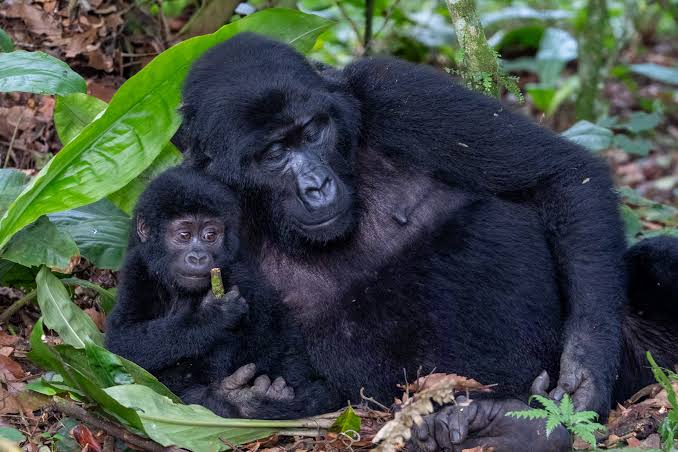
Mountain Gorilla Mothers: How They Raise Their Babies in the Wild
Inside the remarkable world of mountain gorilla motherhood, where protection, nursing, carrying, grooming, play and social learning prepare the next generation for life in Africa’s misty forests.
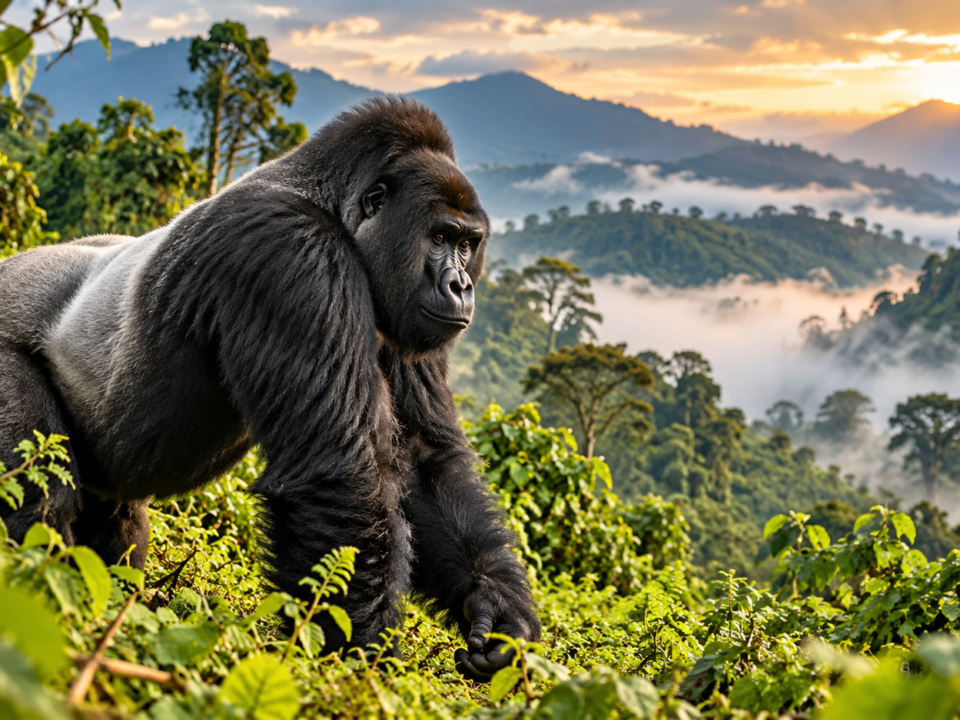
Mountain gorilla mothers play one of the most important roles in the survival of their species. From the moment a tiny infant is born, its mother becomes its primary source of warmth, nutrition, transportation, protection and early learning. In the dense montane forests of Uganda, Rwanda and the Democratic Republic of Congo, raising a baby is not simply a matter of keeping it alive. It is a long process of teaching a young gorilla how to feed, move, communicate, socialize and eventually become an independent member of its family.
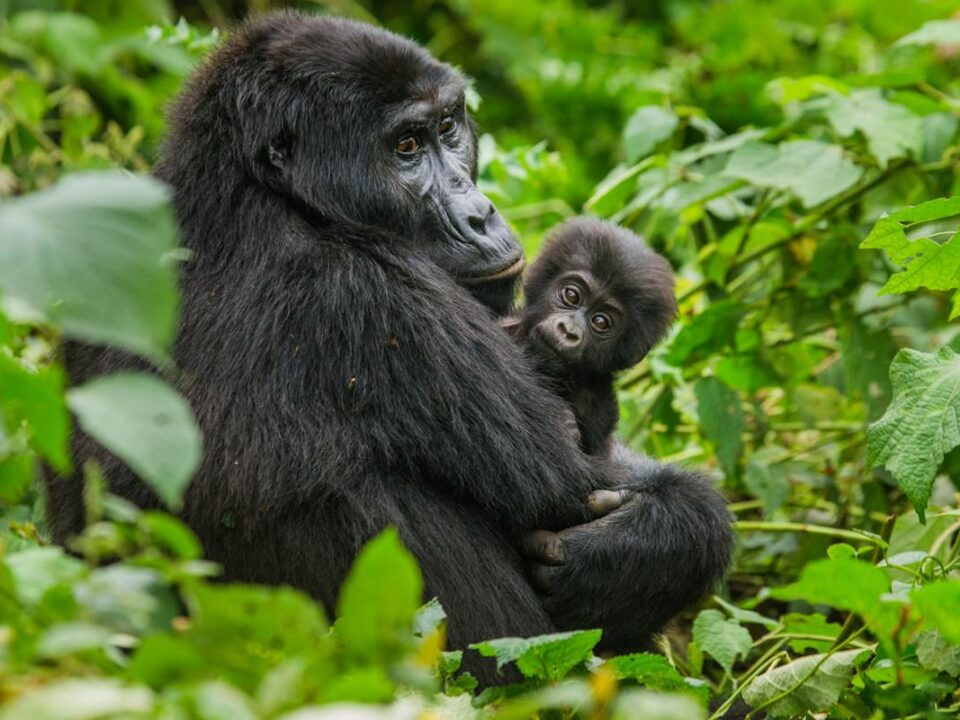
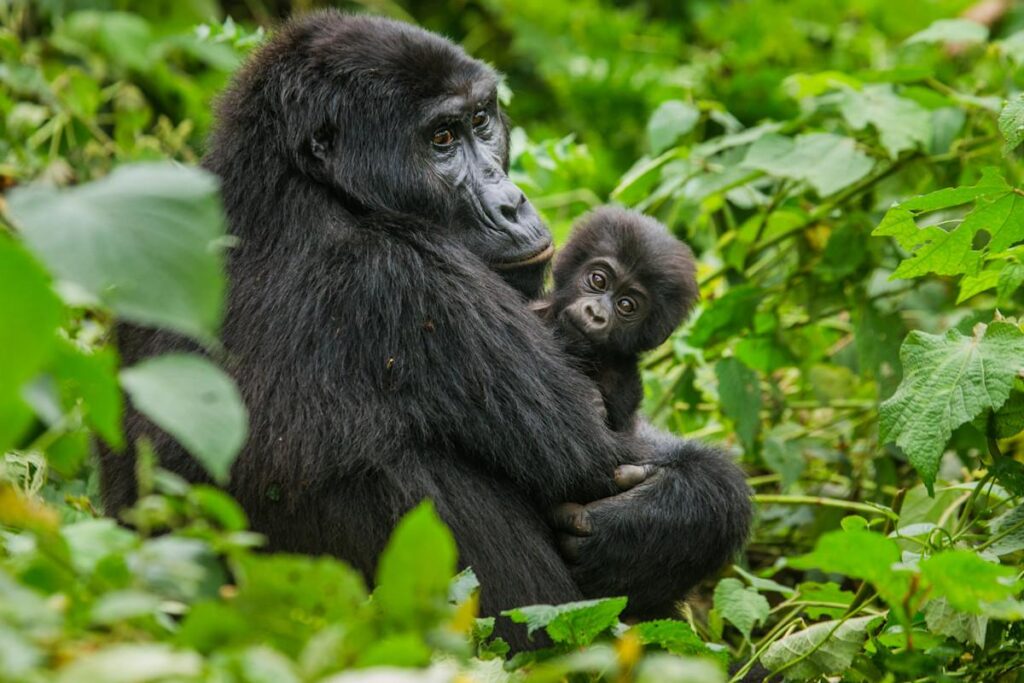
For travelers on a Uganda gorilla trekking adventure, seeing a mother gently carrying her infant through the vegetation can be one of the most memorable moments of a lifetime. The seemingly simple image of a baby clinging to its mother reveals an extraordinary story of maternal care and social development.
Approximate pregnancy length
Usually born at a time
Typical weaning period varies
Extended period of close dependence

The Beginning: When a Mountain Gorilla Baby Is Born
The story of a mountain gorilla begins long before the infant first clings to its mother’s fur. Female mountain gorillas have a pregnancy lasting roughly nine months, after which they normally give birth to a single infant. Newborns are extremely dependent and have limited ability to move independently. Their strongest survival skill at the beginning is their ability to cling tightly to their mother.
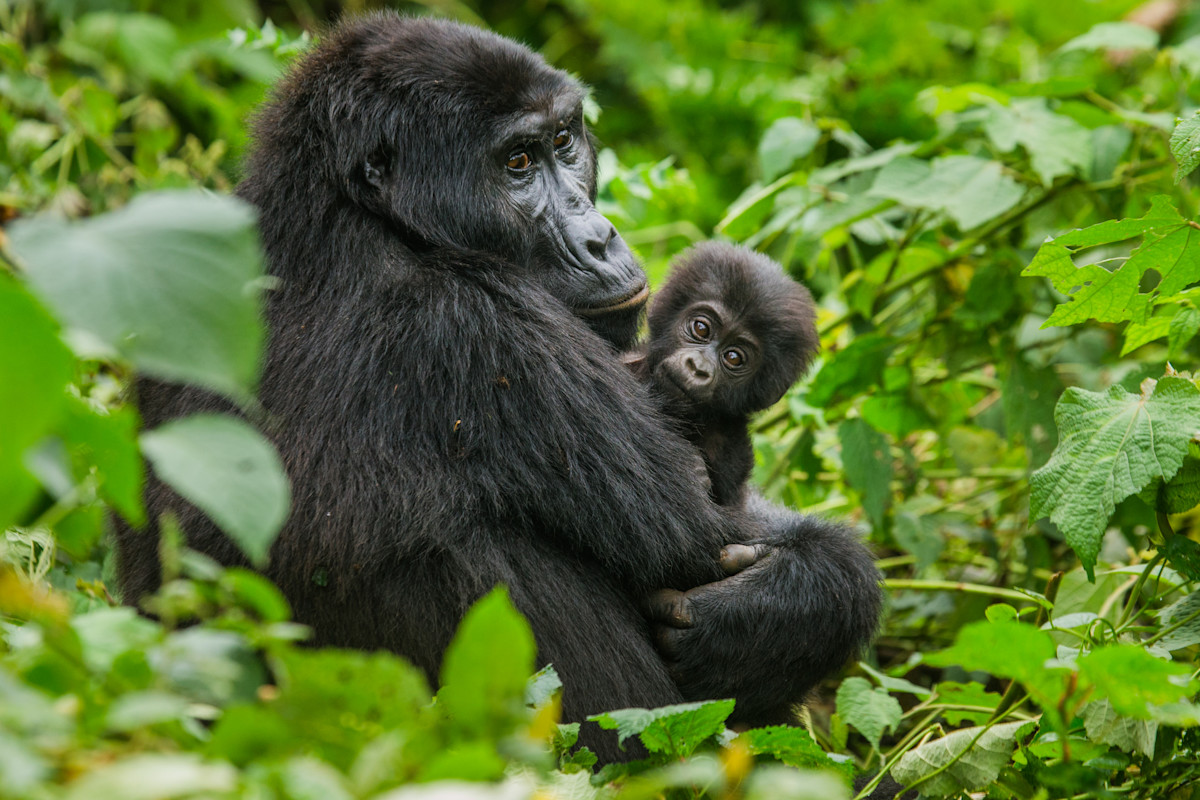
Unlike many mammals whose young quickly begin following their mothers on their own legs, a newborn gorilla spends its earliest months in almost constant physical contact with its mother. This contact provides warmth and security while allowing the mother to continue moving through the forest in search of food.
The early relationship between mother and infant is therefore both emotional and practical. Every movement through the forest has to account for the baby, while the infant gradually develops the strength and coordination required for greater independence.
Mountain gorilla infants are tiny compared with adults and initially depend almost completely on their mothers. Their ability to cling to their mother’s fur is essential during the earliest stage of life.
The Extraordinary Bond Between Mother and Infant
The bond between mountain gorilla mothers and their babies is one of the most visible relationships in a gorilla family. Mothers frequently keep infants close, allowing them to rest against the body while feeding or moving through the forest.
Researchers and field observers have documented mothers holding, carrying and closely monitoring their young. This physical closeness is important because the infant is not yet capable of independently navigating the group’s environment.
Gorilla mothers also provide opportunities for their young to observe the behavior of other members of the group. As the infant grows, it becomes increasingly interested in what happens around it. The mother therefore becomes the baby’s first window into the complex social world of the gorilla family.
How Mountain Gorilla Mothers Feed Their Babies
Nutrition is one of the most important responsibilities of a gorilla mother. During infancy, the baby depends on its mother’s milk while gradually becoming interested in the foods eaten by adults.
As the young gorilla develops, it begins to observe feeding behavior. Mountain gorillas consume a wide variety of vegetation, including leaves, shoots, stems, roots and other plant material. The mother does not need to formally “teach” the baby through lessons. Instead, the young gorilla learns through constant observation, imitation and exploration.
Research on mountain gorillas in Bwindi has found that weaning can occur considerably later than many people might expect. One study of Bwindi mountain gorillas recorded an average age at weaning of approximately 57.5 months, although individual timing varies.
This long period of maternal investment helps explain why a gorilla mother does not produce babies at very short intervals. Raising an infant requires considerable time and energy.
Why Mountain Gorilla Mothers Carry Their Babies
One of the most recognizable sights during gorilla trekking in Uganda is an infant clinging to its mother’s body. Carrying serves several important purposes.
Safety
A very young infant cannot travel independently through dense forest. Staying close to its mother reduces the risk of becoming separated from the group.
Transportation
The mother can move between feeding and resting areas while keeping the infant with her.
Comfort
Physical contact provides warmth and reassurance while strengthening the mother-infant relationship.
As the infant becomes stronger, it gradually spends more time exploring around its mother. Eventually, the baby becomes capable of climbing, walking, playing and moving short distances independently. National Geographic observations describe young gorillas progressively developing from completely dependent infants into active youngsters that explore their surroundings.
How Mountain Gorilla Mothers Protect Their Babies
Life in the forest requires constant awareness. Although mountain gorillas have few natural predators that regularly threaten healthy adults, young infants are vulnerable and depend heavily on the adults around them.
Mountain gorilla mothers therefore keep their infants close and remain alert to changes within the group. Their protection is also supported by the larger family structure.
When danger or unusual activity occurs, adult gorillas may respond collectively. The silverback’s presence is particularly important because he provides group leadership and protection. Field observations have also documented adult males displaying remarkable tolerance toward infants and interacting with them through grooming and play.
A gorilla infant grows up within a social family where mothers, silverbacks, juveniles and other adults all contribute to the social environment in which the young animal develops.
The Role of the Silverback in Raising Young Gorillas
The dominant silverback is not the biological mother, but he plays an important role in the security and social organization of the family.
The silverback determines many aspects of group movement, including when the family feeds, rests or travels. His physical presence also gives younger animals a protective center around which they can move.
Interestingly, silverbacks can show strong interest in infants. Observations of mountain gorillas have recorded adult males grooming young gorillas and displaying protective behavior toward them.
This means that when you see a mountain gorilla family in Bwindi, the infant may not be interacting exclusively with its mother. It is growing up within a complex social community.

How Baby Gorillas Learn to Become Independent
A young gorilla does not suddenly become independent. Independence develops gradually through thousands of small experiences.
Learning to move
At first, the infant’s world is largely defined by its mother. Eventually, it begins to crawl, climb and walk short distances. Its coordination improves through constant practice.
Learning what to eat
Young gorillas watch adults feed and gradually experiment with vegetation. This is an important part of transitioning from dependence on milk to the plant-based diet of the family.
Learning social behavior
Perhaps the most fascinating part of growing up as a gorilla is learning the rules of social life. Young gorillas observe grooming, vocalizations, body postures, play, feeding and interactions between adults.
They gradually learn which behaviors are acceptable and how to respond to different members of the group.
Learning through observation
Much of a young gorilla’s education happens simply by watching. The mother, silverback and other family members provide a living classroom in which the infant can observe and imitate behavior.
Play: A Serious Part of Gorilla Childhood
Gorilla babies may look playful when they climb, tumble, chase one another or investigate vegetation, but play is an important part of development.
Play allows young gorillas to develop strength, coordination and confidence. It also provides opportunities to practice social skills.
Young gorillas may wrestle gently, chase one another, climb, swing and experiment with their surroundings. Observations of mountain gorillas have documented young animals playing with one another as well as interacting with adults.
For a trekking visitor, watching a baby suddenly leave its mother’s side to investigate a leaf or play with another youngster can be a wonderful reminder that these animals are not simply wildlife subjects. They are intelligent, socially complex animals developing their own personalities.

How Mothers Communicate With Their Babies
Communication is another important part of gorilla parenting. Mountain gorillas use vocalizations, facial expressions, body posture and physical contact to communicate.
Field observations have documented several gorilla vocalizations. For example, softer sounds can occur during normal group interactions, while other vocalizations may signal curiosity, alarm or social control. Female gorillas have also been observed using sounds to control or discipline infants.
Physical communication is equally important. A mother can communicate reassurance simply through touch and proximity. A young gorilla can also learn by observing how its mother reacts to other members of the family.
Touch, facial expressions, posture, movement and proximity all form part of the social language young gorillas must learn.
When Do Mountain Gorilla Babies Stop Nursing?
One of the most interesting facts about mountain gorilla mothers is how long they may continue investing in their offspring.
Weaning is not necessarily a sudden event. A young gorilla gradually becomes more independent as it develops the ability to feed on vegetation and spend more time away from its mother’s body.
Research involving Bwindi mountain gorillas found an average weaning age of approximately 57.5 months, with variation between individuals. The study also found that sons were weaned later than daughters on average.
This extended maternal relationship is one reason gorilla populations grow relatively slowly. Every successful birth and surviving infant is therefore important for the long-term conservation of the species.
| Stage | What the Young Gorilla Is Learning | Mother’s Role |
|---|---|---|
| Newborn | Clinging, resting and basic interaction | Warmth, feeding, carrying and constant protection |
| Young infant | Movement and observation | Carrying, nursing and close supervision |
| Older infant | Walking, climbing and playing | Supervision and social guidance |
| Juvenile | Independent feeding and complex social skills | Increasing independence with continued social support |
Mountain Gorilla Mothers in Uganda’s Bwindi Forest
For travelers interested in seeing mountain gorilla mothers in their natural environment, Uganda’s Bwindi Impenetrable National Park is one of the world’s most important destinations.
Bwindi is home to habituated mountain gorilla families that can be visited by tourists under regulated trekking arrangements. The forest’s dense vegetation creates the perfect setting for observing natural family behavior, although the animals always remain wild.
Uganda has also recorded numerous new gorilla births in recent years. In 2025, for example, two new mountain gorilla babies were reported in Bwindi’s Nkuringo and Busingye families, with both mothers and infants reported to be healthy.
These births are more than exciting news for tourism. They represent the continuation of generations and demonstrate why long-term conservation, habitat protection and responsible tourism are so important.
What You May See During a Gorilla Trek
If you join PrideMark Safaris for a Uganda gorilla trekking experience, there is no guarantee of a particular behavior because gorillas are wild animals. However, observing family life is often one of the most rewarding aspects of the experience.
You may see a mother feeding while her baby rests nearby. You might see an infant clinging to her body, a youngster playing with another juvenile or an adult gorilla grooming a younger member of the family.
Sometimes the most memorable moments are quiet ones: a mother resting beneath the vegetation while her infant stays close, a baby carefully investigating a leaf, or a young gorilla looking around with the curiosity characteristic of growing animals.
Experienced trackers and guides help visitors understand these behaviors while ensuring that the encounter follows established wildlife-viewing rules.
Gorilla Trekking in Bwindi
Explore the misty forests of southwestern Uganda in search of habituated mountain gorilla families.
Gorilla Habituation Experience
For travelers seeking a longer and more immersive forest experience, ask PrideMark Safaris about habituation options.
Custom Uganda Safaris
Combine gorilla trekking with wildlife viewing in destinations such as Queen Elizabeth, Murchison Falls or Kibale.
Why Protecting Gorilla Mothers and Babies Matters
The survival of mountain gorillas depends on successful reproduction and the survival of young animals. Because mothers invest so much time in each infant, the loss of a mother can have serious consequences for a young gorilla.
Conservation organizations and wildlife authorities therefore monitor gorilla families closely. Veterinary teams such as Gorilla Doctors have intervened in cases where individual gorillas have been injured by snares. In one documented Ugandan case, a mother named Inshuti continued holding and caring for her four-month-old infant despite suffering a severe snare injury. After veterinary intervention, she was able to reunite with and hold her baby again.
Stories like this demonstrate the importance of protecting the entire forest ecosystem. Conservation is not simply about protecting individual gorillas. It means protecting mothers, infants, silverbacks, juveniles, vegetation, water sources and the communities surrounding the forest.
The Human Connection: Why Gorilla Motherhood Fascinates Us
There is something immediately recognizable about a gorilla mother caring for her baby. The gestures may be different from those of humans, but the themes of protection, dependence, learning and growing up within a family are surprisingly familiar.
This does not mean gorillas should be treated as humans. They are wild animals with their own unique social systems. But their close evolutionary relationship with humans helps us appreciate just how complex great-ape family life can be.
For travelers who witness this relationship in Bwindi, the experience can change the way they think about wildlife. A gorilla trekking encounter becomes more than a search for a photograph. It becomes an opportunity to witness a family living its everyday life in one of Africa’s most extraordinary forests.
Mountain Gorilla Mothers: A Remarkable Story of Survival
Mountain gorilla mothers are central to the survival and social development of the next generation. They provide food, warmth, transportation and protection while gradually introducing their young to the complicated social world of the gorilla family.
From the first days of constant physical contact to the later stages of climbing, playing, feeding and social exploration, growing up as a mountain gorilla is a long journey. The mother is at the heart of that journey, but she is supported by the wider family and the protection of the forest.
When you trek to see mountain gorillas in Uganda, remember that the most remarkable part of the experience may not be the size of the silverback or the photograph you capture. It may be the quiet sight of a mother and her baby sharing a moment in the misty forest.
Ready to Meet Uganda’s Mountain Gorillas?
Let PrideMark Safaris help you experience the incredible world of Bwindi’s mountain gorillas with a carefully planned Uganda safari designed around your interests, schedule and budget.
Frequently Asked Questions About Mountain Gorilla Mothers
How long do mountain gorilla mothers care for their babies?
Mountain gorilla mothers care for their offspring for several years. Infants are highly dependent during their earliest months, while independence develops gradually. Research from Bwindi found an average weaning age of approximately 57.5 months, although individual variation occurs.
How do mountain gorilla mothers carry their babies?
Very young infants cling to their mothers’ fur and are carried as the mother moves through the forest. As they grow stronger, young gorillas increasingly move independently while remaining close to their mothers.
Do gorilla mothers breastfeed their babies?
Yes. Infant mountain gorillas depend on their mother’s milk during early development and gradually transition toward the vegetation eaten by adults.
Do silverback gorillas help raise babies?
Silverbacks play an important protective and social role within the family. Field observations have documented adult males grooming infants and interacting with young gorillas, while their leadership helps organize and protect the group.
Where can I see mountain gorilla mothers in Uganda?
Uganda’s Bwindi Impenetrable National Park is one of the world’s premier destinations for seeing mountain gorillas in the wild. Mgahinga Gorilla National Park is another Ugandan destination where mountain gorillas can be found.
Can I see baby gorillas during a Uganda gorilla trek?
Yes, it is possible to encounter families containing infants and juveniles, although wildlife behavior can never be guaranteed. Your guide and trackers will help you understand what you are seeing while maintaining appropriate viewing practices.
Why are mountain gorilla babies important for conservation?
Each surviving infant represents the continuation of a small and carefully protected population. Successful births and survival of young gorillas are essential for maintaining healthy populations over generations.