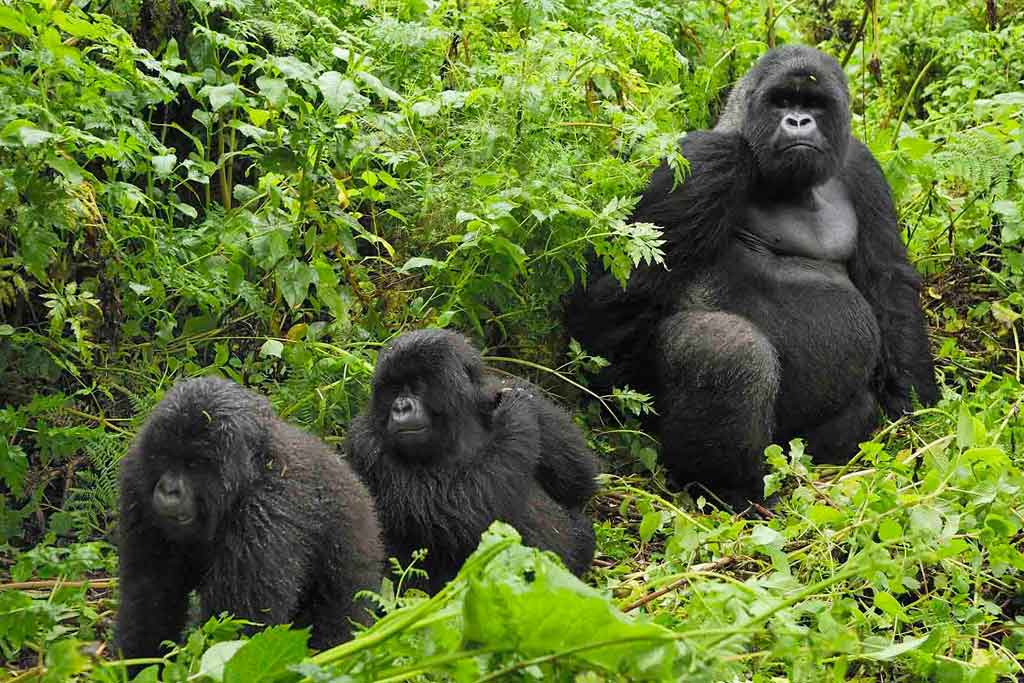
Why Mountain Gorillas Live in Families: 7 Amazing Secrets of Gorilla Social Life
Discover why mountain gorillas live in families, how silverbacks protect their groups,
how mothers raise infants, and why social bonds are essential to survival in Uganda’s
Bwindi Impenetrable Forest.
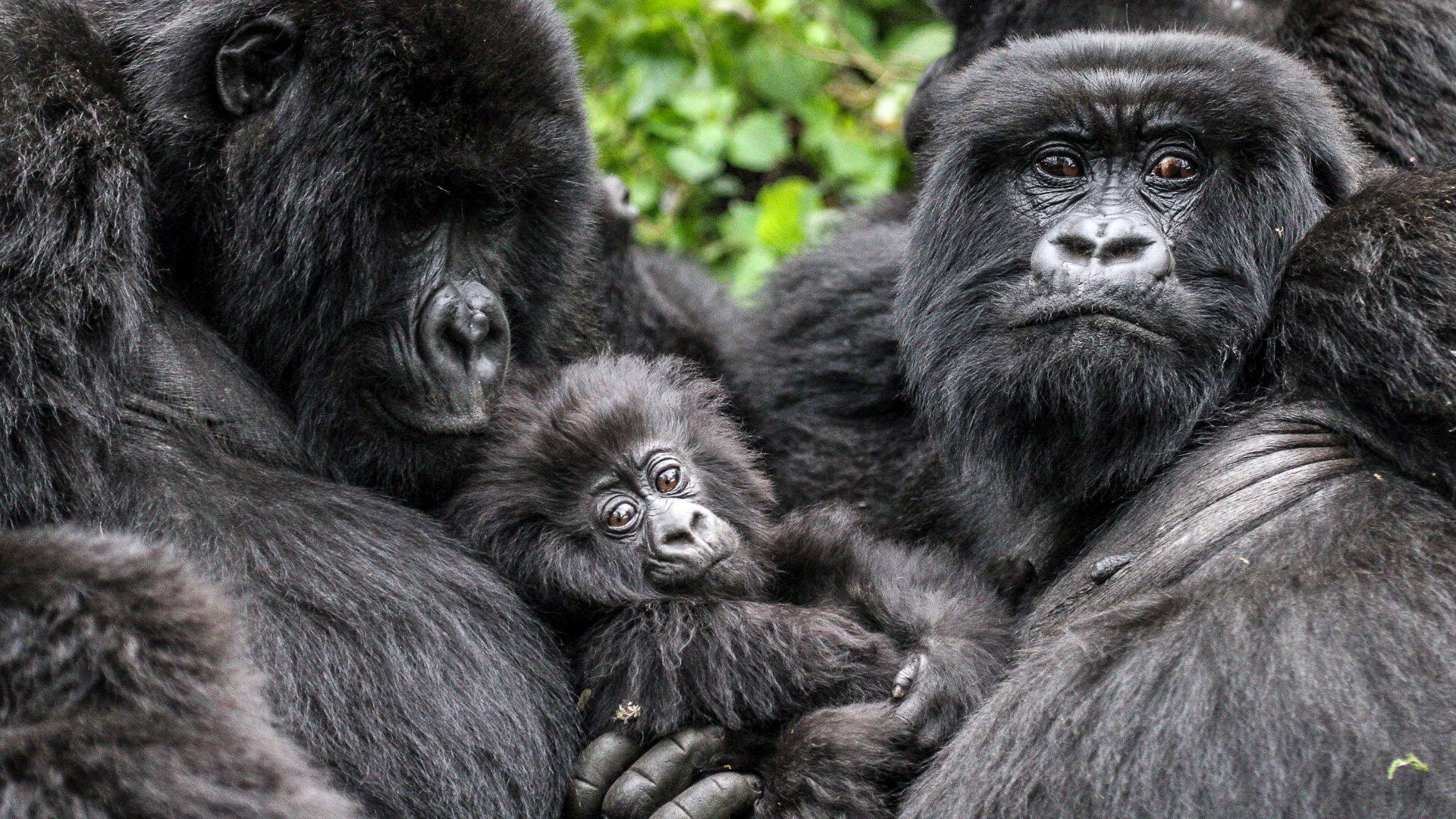
mountain gorilla survival and social development.
Mountain gorillas live in family groups because social living provides protection,
companionship, opportunities for learning, access to reproductive partners, and support
for raising young. A typical gorilla group can include a dominant silverback, adult
females, blackbacks, juveniles and infants. These relationships are not simply about
staying together; they form a sophisticated social system that shapes almost every part
of a gorilla’s life.
When travelers go
gorilla trekking in Bwindi, one of the most fascinating things they discover is that
they are not simply looking at individual animals. They are observing a society.
A silverback may sit nearby while females feed, juveniles play around adults, and infants
remain close to their mothers. The group may appear peaceful, but beneath the calm surface
are complex relationships involving leadership, parenting, communication, protection,
cooperation and sometimes competition.
Uganda is one of the world’s most important destinations for seeing these remarkable
animals. Uganda Wildlife Authority identifies mountain gorillas in both
Bwindi Impenetrable National Park and Mgahinga Gorilla National
Park.
Mountain Gorilla Family Life: Quick Facts
Mountain gorillas normally live in cohesive social groups rather than as isolated
individuals.
A dominant silverback commonly provides leadership and protection.
Infants remain closely associated with their mothers and learn through observation
and interaction.
Gorillas use vocalizations, facial expressions, body posture, touch and displays
to communicate.
Grooming, resting together, playing and feeding near one another reinforce social
relationships.
Bwindi and Mgahinga are Uganda’s two mountain gorilla destinations.
Table of Contents
- Why Do Mountain Gorillas Live in Families?
- How Is a Gorilla Family Organized?
- The Role of the Silverback
- The Role of Mothers
- How Young Gorillas Learn
- How Gorilla Families Communicate
- Family Life and Protection
- Why Gorillas Feed and Rest Together
- Gorilla Social Bonds and Grooming
- Can Gorilla Families Change?
- What Family Life Means During Gorilla Trekking
- Responsible Gorilla Trekking in Uganda
- Frequently Asked Questions
Why Do Mountain Gorillas Live in Families?
The simplest answer is that family life gives mountain gorillas important social and
survival advantages. Living together allows individuals to cooperate, reproduce, raise
young, communicate, learn and respond collectively to potential threats.
Mountain gorillas are highly social primates. Their lives are built around relationships.
Instead of spending most of their time alone, they typically move, feed, rest and sleep
in association with other members of their group. This creates a social environment in
which younger gorillas can observe adults and gradually learn the behaviors they will
need later in life.
Family groups can also provide safety. A large silverback can act as a powerful defensive
presence, while other members of the group remain nearby. When another gorilla group is
encountered, silverbacks may display, vocalize or beat their chests as part of social
communication and assessment.
A gorilla family is much more than a group of animals occupying the same forest.
It is a social community where individuals recognize one another, develop relationships,
raise young and respond to changing circumstances together.
How Is a Gorilla Family Organized?
Mountain gorilla groups can contain several age and sex classes. The exact composition
changes over time because gorillas are not permanently locked into one unchanging family.
Individuals can mature, leave, join other groups, or establish new social relationships.
A commonly observed family structure includes a dominant silverback, additional adult
males, adult females, juveniles and infants. Some groups may contain more than one
silverback, and relationships between males can be particularly important when leadership
or group stability is being tested.
To understand why mountain gorillas live in families, it is important to look at the different roles played by silverbacks, females, juveniles and infants.
| Gorilla | Typical role in the group | What visitors may observe |
|---|---|---|
| Silverback | Leadership, protection, social coordination and reproduction.The role of the silverback also helps explain why mountain gorillas live in families, particularly when it comes to protection and maintaining social stability. | Resting centrally, monitoring surroundings, displaying or interacting with younger gorillas. |
| Adult females | Motherhood, feeding, social relationships and reproduction.The close relationship between mothers and infants is another important reason why mountain gorillas live in families. | Feeding, resting, grooming and caring for infants. |
| Blackbacks | Young adult males developing toward maturity. | Following older males, playing or becoming increasingly independent. |
| Juveniles | Learning and developing social skills. | Playing, climbing, wrestling and interacting with adults. |
| Infants | Early development and learning under close maternal care. | Clinging to mothers, nursing, resting and gradually exploring their surroundings. |
Field observations in Bwindi demonstrate just how varied gorilla groups can be. Gorilla
Doctors’ monitoring reports have documented groups containing silverbacks, adult females,
juveniles and infants, while also recording changes in group composition over time.

The Important Role of the Silverback
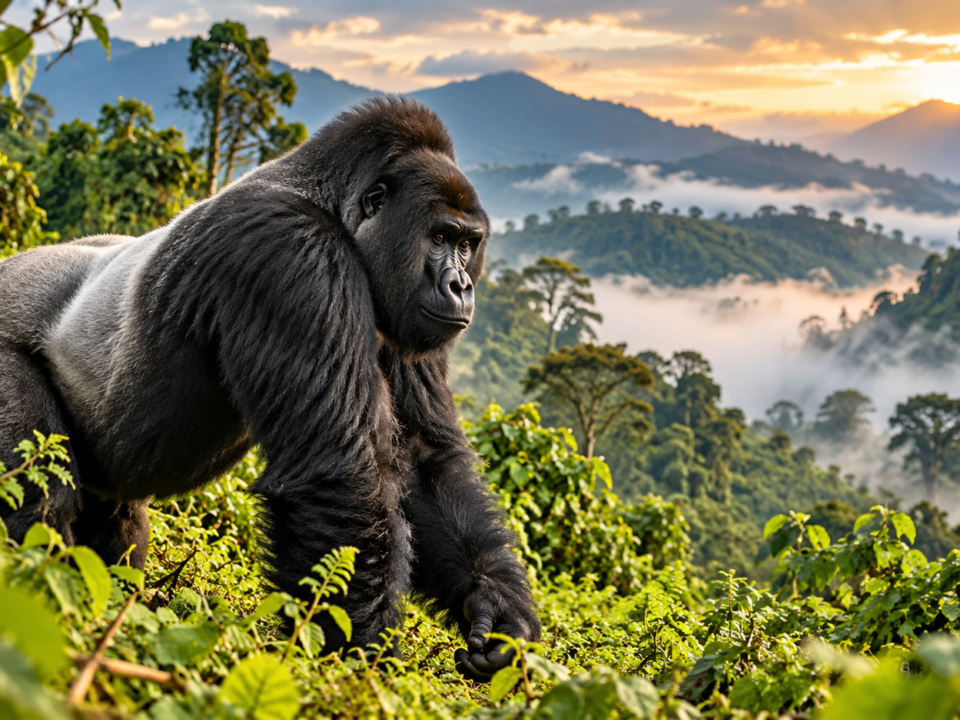
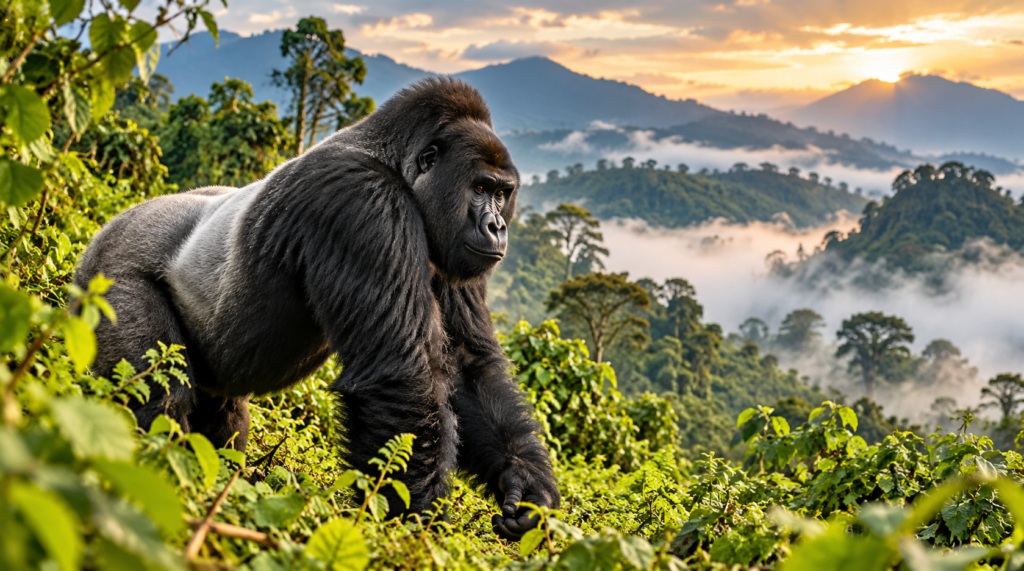
The silverback is often the most visually impressive member of a gorilla family, but his
role goes far beyond physical strength. A dominant silverback can influence the movement
of the group, respond to threats, maintain social order and protect vulnerable members.
His presence can be particularly important when the family encounters another gorilla
group. Rather than immediately engaging in physical fighting, gorillas can use displays,
vocalizations and body language to communicate. Chest beating is one of the most famous
examples. It can communicate information about a male and his intentions without
automatically meaning that an attack is about to happen.
PrideMark Safaris explores this fascinating behavior in more detail in our guide:
Why Do Gorillas Beat Their Chests?
Leadership does not mean that the silverback controls every movement of every individual.
Gorilla society is more nuanced than that. Members maintain their own relationships,
and group dynamics can change as individuals mature or as leadership changes.
The Special Role of Gorilla Mothers
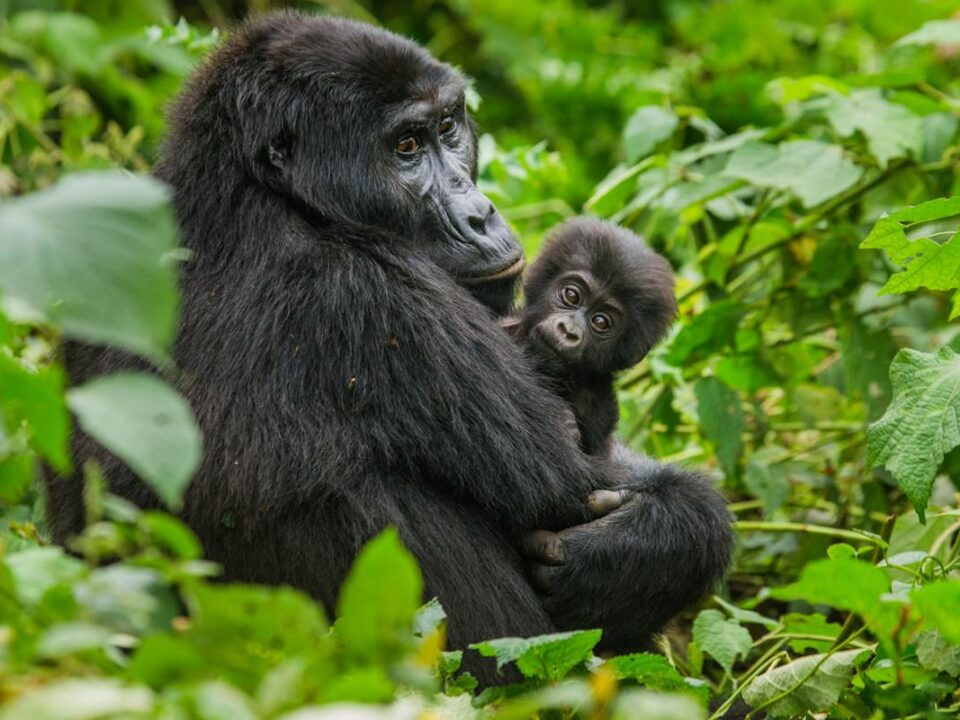
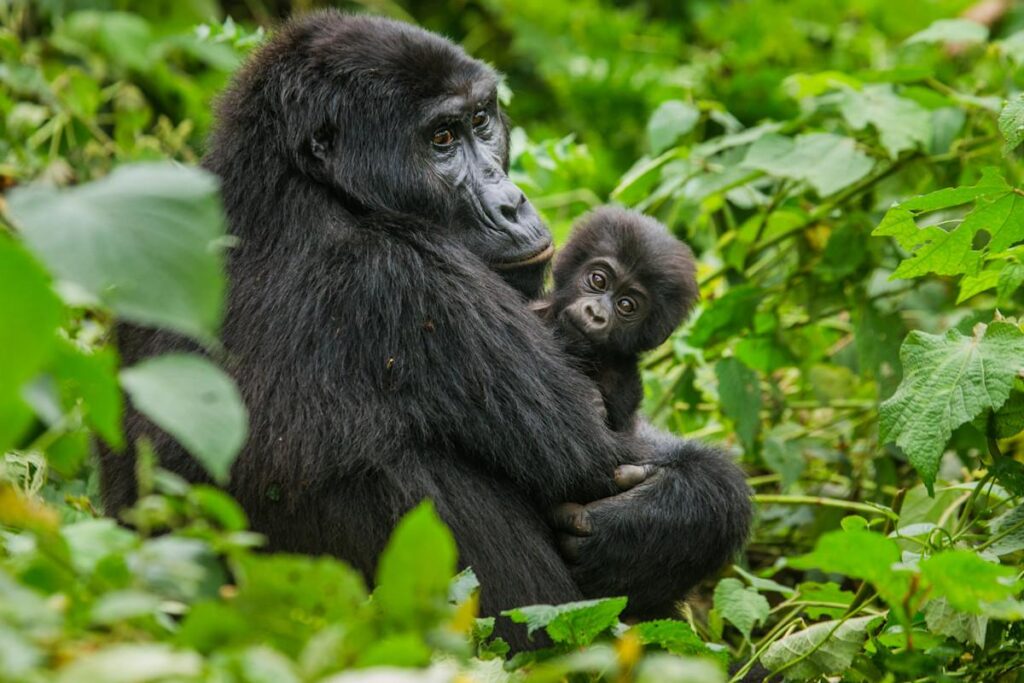
If the silverback represents protection and leadership, the mother-infant relationship is
at the heart of early gorilla development. A newborn mountain gorilla depends heavily on
its mother for warmth, transport, nutrition and security.
During the earliest stage of life, an infant stays extremely close to its mother. As it
becomes stronger and more curious, it begins to explore its surroundings while remaining
within the safety of the family group.
Mothers therefore provide much more than physical care. Through everyday interaction,
infants gradually encounter the sounds, movements, feeding habits and social behaviors
that characterize gorilla life.
One of the most memorable experiences is watching the subtle relationship between a
mother and infant. A mother may allow her youngster to explore while keeping it within
reach, creating a balance between protection and independence.
How Young Gorillas Learn From Their Families
Mountain gorilla youngsters are not born knowing how to behave within a complex social
group. They learn by watching and interacting with others.
Play is particularly important. Young gorillas may wrestle, chase one another, climb,
tumble and investigate leaves or branches. These activities look entertaining, but they
also provide opportunities to develop coordination, strength and social skills.
Youngsters can also observe adults while they feed, move through the forest or interact
with other group members. Over time, these observations contribute to the development of
adult behavior.
This is one reason gorilla trekking can be so fascinating. Visitors are not simply seeing
wildlife; they may be witnessing a young primate learning how to become an adult member
of its society.
How Gorilla Families Communicate
Communication helps keep a family together. Mountain gorillas use a mixture of sounds,
facial expressions, gestures, body positions and physical contact.
Some signals are subtle. A change in posture can communicate tension or submission.
A facial expression can accompany an interaction. A vocalization can help individuals
maintain contact or communicate their emotional state.
More dramatic displays, such as chest beating, can be used during competitive or social
encounters. These behaviors become particularly interesting when viewed as part of a
larger communication system rather than as isolated actions.
Communication provides another fascinating explanation for why mountain gorillas live in families, because individuals constantly exchange information through sounds, gestures and body language.
Read our detailed guide:
How Mountain Gorillas Communicate: Sounds, Gestures and Body Language.
Family Life Provides Protection
Living in a group has obvious advantages when danger appears. A lone animal does not have
the same social support as an animal surrounded by relatives and companions.
The silverback can act as the main defensive figure, particularly during encounters with
other gorillas or perceived threats. Younger gorillas can remain close to adults while
the group assesses the situation.
This does not mean gorilla families are completely conflict-free. Competition, injuries,
leadership struggles and interactions between neighboring groups can occur. Gorilla
Doctors’ field reports from Bwindi have documented injuries and changes in group dynamics
associated with interactions and competition.
The ability of gorillas to manage these relationships is part of what makes their social
system so fascinating.
Ultimately, protection is one of the clearest answers to the question of why mountain gorillas live in families.
Why Do Gorillas Feed and Rest Together?
Mountain gorillas spend a significant part of their day feeding on vegetation. They may
move through the forest while searching for leaves, stems, shoots, fruits and other
available plant foods.
Feeding together also provides social opportunities. While individuals may spread out
slightly to reach vegetation, they often remain within the social group rather than
disappearing independently into the forest.
Resting periods are equally important. After feeding, family members may settle down,
groom, play or simply remain near one another. These quiet moments can reveal social
relationships that are easy to miss when focusing only on dramatic behaviors.
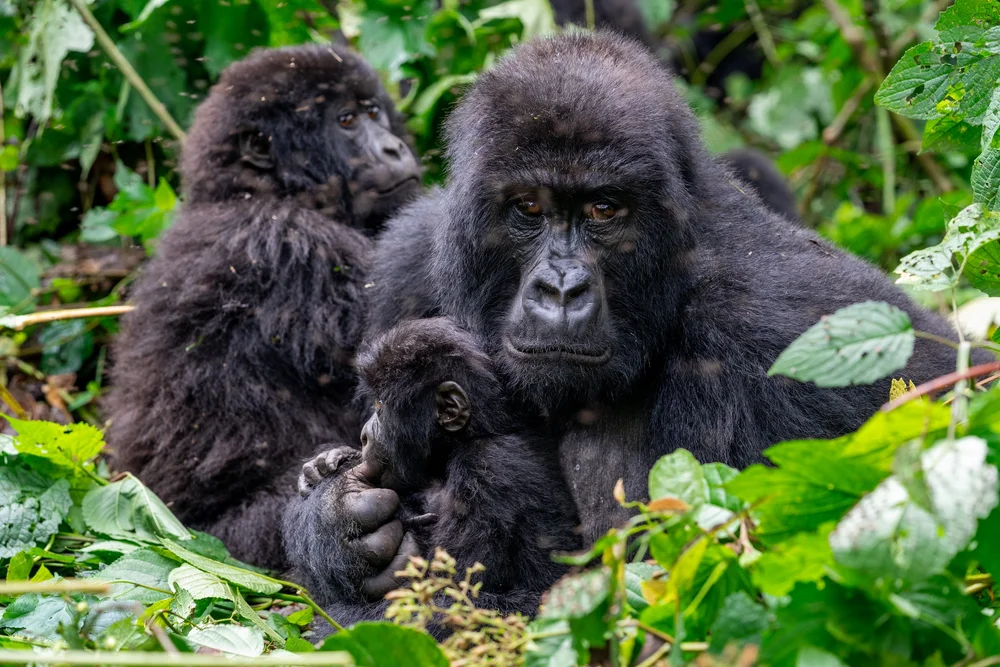
Gorilla Social Bonds and Grooming
Social bonding is one of the most important reasons to understand gorilla families as
communities rather than simple collections of animals.
Grooming and physical contact can help reinforce relationships. Gorillas may also sit
close together, interact with youngsters and play. These repeated interactions help
maintain familiarity and social cohesion.
A traveler watching a gorilla family for the first time may be tempted to focus on the
largest animal in the group. However, some of the most meaningful behavior may happen
between individuals that appear less dramatic: a juvenile playing with another youngster,
an infant approaching an adult, or two gorillas resting close together.
These interactions are part of what makes a gorilla trek different from a conventional
wildlife drive. You are not simply searching for an animal. You are observing an entire
social world.
Can Gorilla Families Change?
Yes. Gorilla family groups are dynamic.
A group that you see today may not have exactly the same composition years later.
Young males can mature and eventually leave. Individuals may transfer between groups,
while groups can split or change leadership.
Field research in Bwindi provides excellent examples of this dynamic social structure.
Gorilla Doctors has documented groups changing composition after births, maturation,
leadership struggles, interactions with neighboring groups and other social events.
This is important when planning a gorilla safari. A named gorilla family is not a static
tourist attraction. It is a living community whose members and relationships can change.
Mountain Gorilla Family Life vs Solitary Wildlife
| Aspect | Mountain Gorilla Family | Why It Matters |
|---|---|---|
| Protection | Individuals remain within a social group. | Group members can respond to potential threats together. |
| Parenting | Infants develop within a stable social environment. | Youngsters have opportunities to observe and interact with adults. |
| Learning | Young gorillas learn through observation and play. | Social experience prepares them for adulthood. |
| Communication | Members use sounds, gestures, postures and touch. | Communication helps coordinate social life. |
| Companionship | Gorillas rest, feed and interact together. | Relationships contribute to social cohesion. |
What Gorilla Family Life Means During Gorilla Trekking
Understanding gorilla social life can completely change the way you experience
gorilla trekking in Bwindi.
Instead of looking only for the biggest silverback, you begin watching the entire family.
You may notice how juveniles interact, how mothers position themselves near infants, how
the silverback responds to movements around the group and how different individuals behave
toward one another.
Learning why mountain gorillas live in families can make your Uganda gorilla trekking experience much more meaningful.
Uganda Wildlife Authority describes gorilla tracking as an opportunity to find and observe
mountain gorillas in their natural habitat. Uganda’s official gorilla guidelines also
distinguish standard tracking from the Gorilla Habituation Experience, where visitors
accompany researchers and habituators while gorillas become accustomed to controlled human
presence.
This is why responsible trekking is so important. Visitors are entering the gorillas’
natural environment, not visiting a zoo enclosure. The objective is to observe without
disrupting the family’s normal behavior.
When you reach the gorilla family, resist the temptation to focus only on photography.
Watch the relationships. Observe who stays close to whom, how the youngsters play,
how the mother responds to her infant and how the silverback monitors the group.
Those details can become the most memorable part of your trek.
Responsible Gorilla Trekking in Uganda
Mountain gorillas are endangered and live in a very restricted range. Uganda’s two
mountain gorilla destinations are Bwindi Impenetrable National Park and Mgahinga Gorilla
National Park.
Gorilla tourism therefore has to balance visitor experiences with conservation.
Following park rules, listening to guides and maintaining appropriate behavior around
the animals helps protect both visitors and gorillas.
Bwindi’s official visitor information emphasizes the importance of following gorilla
tracking rules and guidelines.
PrideMark Safaris encourages travelers to treat every gorilla encounter as a privilege.
The goal is not simply to obtain the perfect photograph. It is to experience the forest,
understand the animals and contribute to a tourism system that values their continued
protection.Once you understand why mountain gorillas live in families, every interaction you witness in Bwindi becomes more fascinating.

Continue Exploring Uganda’s Mountain Gorilla World
If you are planning a gorilla adventure with PrideMark Safaris, these related guides can
help you understand the experience before you travel:
Bwindi Gorilla Trekking 2027: Ultimate Planning Guide
Gorilla Tracking in Bwindi: How Trackers Find Mountain Gorillas
Gorilla Trekking vs Gorilla Habituation in Uganda
Bwindi vs Mgahinga: Which Is Better for Gorilla Trekking?
Why Do Gorillas Beat Their Chests?
How Mountain Gorillas Communicate: Sounds, Gestures and Body Language
Uganda vs Rwanda Gorilla Trekking
Ready to Meet a Mountain Gorilla Family in Uganda?
Imagine walking through the misty forest of Bwindi, following experienced trackers,
and suddenly finding an entire gorilla family resting only a few metres away.
From playful juveniles to protective silverbacks and curious infants, every encounter
tells a different story.
Let PrideMark Safaris design your Uganda gorilla trekking adventure around your budget,
travel dates, preferred accommodation and wider safari interests.
Frequently Asked Questions About Mountain Gorilla Family Life
Why do mountain gorillas live in families?
Mountain gorillas live in social groups because living together provides important
advantages including protection, companionship, reproduction, parenting, learning and
social communication.
What is a gorilla family called?
Gorilla groups are commonly referred to as groups, troops or families. During tourism
in Uganda, you will often hear guides and travelers refer to habituated gorilla groups
as gorilla families.
Who leads a mountain gorilla family?
A dominant silverback commonly provides leadership within a gorilla group. He may
influence movement, respond to threats, maintain social order and protect members of
the group.
Do gorilla mothers take care of their babies?
Yes. Gorilla mothers provide essential care to infants, including close physical
contact, protection and feeding. As young gorillas grow, they increasingly explore
their surroundings while remaining within the social group.
Do young gorillas play with each other?
Yes. Play is an important part of juvenile development. Young gorillas may wrestle,
chase, climb and interact with other youngsters. These activities help them develop
physical coordination and social skills.
Can a mountain gorilla family change over time?
Yes. Gorilla groups are dynamic. Individuals mature, move between groups, leave,
join new groups and sometimes establish new social relationships. Field observations
in Bwindi have documented significant changes in group composition over time.
Where can I see mountain gorilla families in Uganda?
Mountain gorillas in Uganda are found in Bwindi Impenetrable National Park and
Mgahinga Gorilla National Park. Bwindi has several trekking sectors, including
Buhoma, Ruhija, Rushaga and Nkuringo.
Can I see a gorilla family during a Uganda gorilla trek?
Yes. Standard gorilla trekking in Uganda gives visitors the opportunity to track and
observe a habituated mountain gorilla family in its natural forest habitat, subject
to the official park regulations and trekking arrangements.
Final Thoughts: A Gorilla Family Is a Living Community
The question “why mountain gorillas live in families” has a much deeper
answer than simply saying that gorillas are social animals. Their family groups are the
foundation of their daily lives. Within these communities, individuals find protection,
companionship, reproductive opportunities, parenting support and opportunities to learn.
The silverback protects and helps coordinate the group. Mothers provide essential care to
their infants. Juveniles learn through play and observation. Older individuals contribute
to the social environment, while the entire group responds to the changing conditions of
life in the forest.
This social complexity is one of the reasons a Uganda gorilla trekking experience can be
so powerful. When you finally encounter a mountain gorilla family in Bwindi, you are not
simply looking at a rare animal. You are witnessing relationships that have developed over
years inside one of Africa’s most remarkable forests.
For travelers who want to understand mountain gorillas beyond the famous photograph,
watching their social life may be the most rewarding part of the entire experience.
Useful Conservation & Research Sources
Tailor-Made African Adventures