PrideMark Safaris
| Gorilla Behaviour & Conservation
What Happens to a Mountain Gorilla Baby If Its Mother Dies?
A mountain gorilla baby depends on its mother
for milk, warmth, carrying and close contact. If she dies,
the youngster’s survival depends on its feeding independence,
health and the support available within its gorilla family.
Silverbacks and siblings can provide important social care,
but they cannot automatically replace breastfeeding.
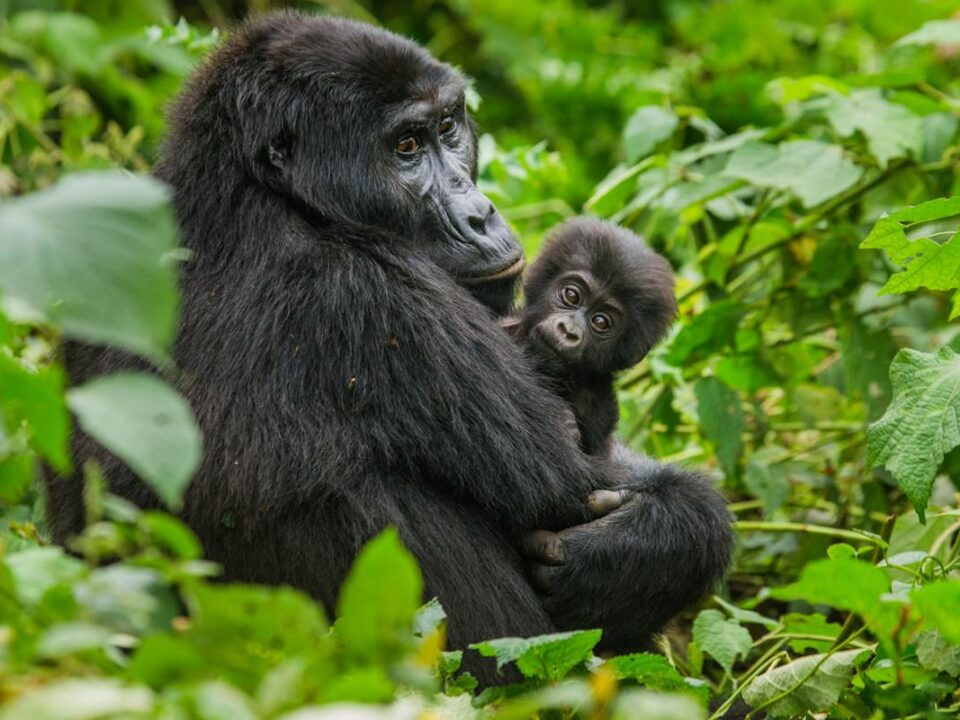
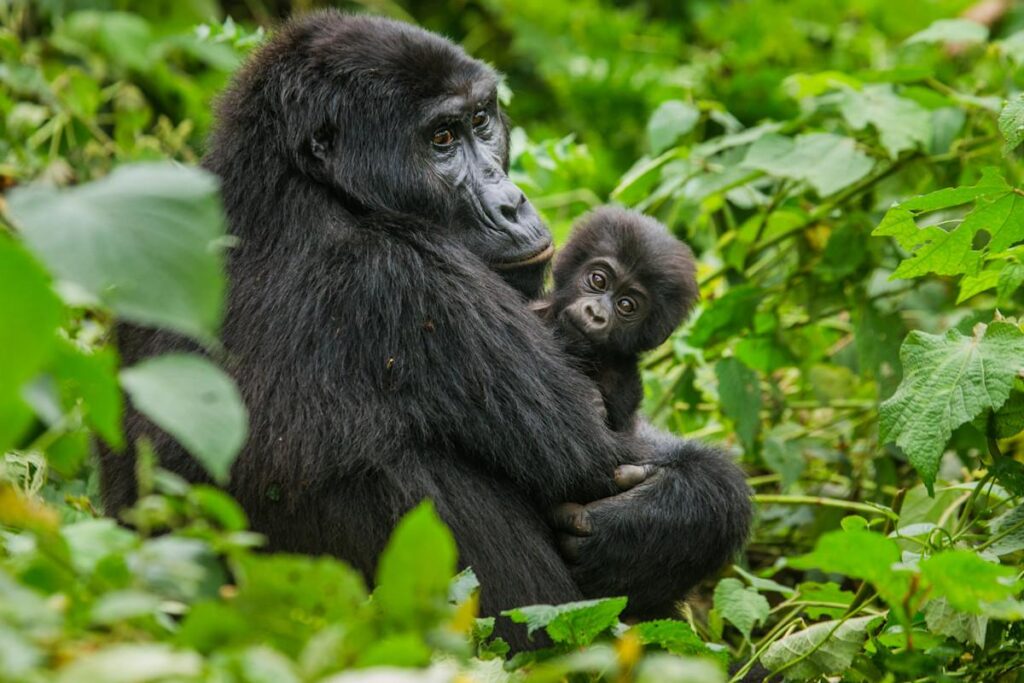
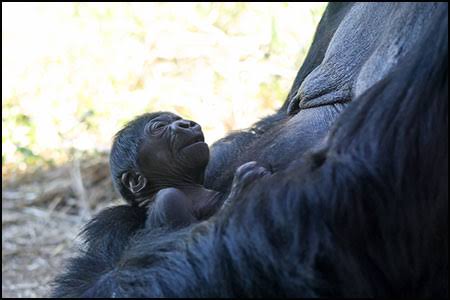
Watching a mother carry her infant through the forest is one
of the most memorable moments on a gorilla safari. The baby
may cling to her body, nurse while she rests or explore nearby
before returning to her side. These interactions show why
maternal care matters throughout early development.
However, maternal loss does not have the same outcome for
every youngster. A newborn faces a different situation from
an older gorilla that can already obtain enough food
independently. Understanding this distinction helps explain
both the vulnerability of infants and the value of stable
gorilla groups.

where relationships can provide protection and companionship.
Why a Mountain Gorilla Baby Depends on Its Mother
A mother provides several forms of care at once. Feeding
is only part of the relationship: her body gives a small
infant a secure place to cling, and her movements keep it
with the group as the family travels between feeding and
resting areas.
Milk and the transition to vegetation
An infant initially relies on its mother’s milk. As it
develops, it begins exploring and eating vegetation.
Nevertheless, eating some leaves does not necessarily
mean it can survive entirely without nursing.
Weaning is a gradual transition. A youngster may chew
plants while still obtaining an important part of its
nutrition from milk. After maternal loss, its actual food
intake matters more than whether it has been seen eating
vegetation occasionally.
Warmth, carrying and physical security
Staying close to the mother provides warmth and transport.
A small infant that cannot travel effectively alone may
struggle to keep up when its family moves through thick
vegetation. Losing its usual carrier adds another challenge
to the loss of nursing.
A familiar social relationship
The mother is also a consistent social partner. Her
youngster rests beside her, follows her movements and
explores its surroundings while remaining near a familiar
adult. Losing that relationship changes daily life even
when other gorillas remain nearby.
Read more about
how mountain gorilla mothers raise their babies
to understand the care that supports early development.
What Happens Immediately After a Gorilla Mother Dies?
There is no fixed sequence that every gorilla family
follows. The circumstances matter: the baby may have been
injured, other members may also have died, or the family
may have experienced additional disruption.
The immediate concerns are the loss of nursing, carrying
and regular maternal contact. Observers need to establish
whether the infant can remain warm, move with the group
and obtain adequate nutrition.
Other gorillas may remain close or allow the youngster to
accompany them. However, companionship observed during
one encounter does not establish that all its needs are
being met. Its condition must be followed over time.
Does the baby understand that its mother has died?
A photograph or brief encounter cannot reveal a gorilla’s
exact understanding of death. Researchers can document
behaviour, proximity and changes in relationships, but
an individual’s thoughts cannot be established directly
from those observations.
Losing a close social partner is a major disruption.
Describing every orphan as following the same human-style
grieving process, however, would go beyond the evidence.
How Age Affects an Orphaned Mountain Gorilla Baby
A newborn and an older infant exploring vegetation do not
have the same needs. Feeding independence, mobility and
health are therefore essential when assessing the risks
after a mother dies.
| Developmental stage | Main concern | What family support can provide |
|---|---|---|
| Newborn or very young infant | Loss of essential milk, warmth and carrying. | Contact and protection may help, but do not automatically meet nutritional needs. |
| Older infant still nursing | Vegetation may not yet provide enough nutrition; travelling independently may remain difficult. |
Companionship and, in documented cases, carrying by other youngsters. |
| Nutritionally independent youngster | Loss of a close social partner and changes in everyday relationships. |
Continued group membership, protection and stronger relationships with other gorillas. |
A newborn faces a serious nutritional challenge
A very young mountain gorilla baby cannot simply replace
milk with an adult gorilla’s diet. A tolerant silverback
or attentive sibling may provide contact and protection,
but those behaviours do not supply the missing nutrition.
An older infant may still be vulnerable
A youngster may appear active and already eat soft leaves
while still relying on breastfeeding. Its prospects
depend on actual food intake, health, mobility and the
family’s response, rather than age alone.
Independent youngsters have more options
Once a youngster can meet its nutritional needs without
nursing, the situation changes. Maternal loss remains
significant, but milk dependence is no longer the same
immediate obstacle. A cohesive family can provide
protection and opportunities for stronger social bonds.
Can a Silverback Help an Orphaned Mountain Gorilla Baby?
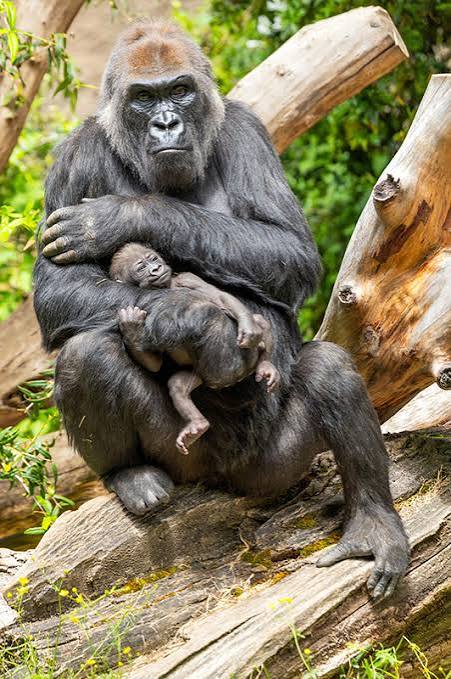
gorillas, although their support does not replace milk.
A silverback can provide protection, tolerance and social
support after maternal loss. Research has documented
strengthened relationships between motherless youngsters
and dominant males, showing that an orphan does not
necessarily become socially isolated.
Remaining close to an established group member may help
the youngster maintain social contact. However, saying
that every silverback automatically adopts every orphan
would overstate the evidence. Individual relationships
and group circumstances differ.
Is the silverback always the baby’s father?
Social care does not establish biological paternity.
Some groups contain more than one adult male, and
identifying the father requires more evidence than
watching which male sits beside an infant.
The silverback’s importance extends beyond size and
strength. For another perspective on family stability,
explore
what happens when a silverback gorilla dies
.
Do Other Gorillas Care for a Motherless Baby?
Other members may contribute through companionship,
tolerance, travelling together and, in some cases,
carrying. These behaviours can help a youngster remain
within its familiar social group.
Siblings and young companions
Familiar companions may become especially important after
maternal loss. Young gorillas already interact through
play and proximity, so an orphan may retain relationships
that existed before its mother died.
Carrying can help an infant move with the family.
Nevertheless, a juvenile carrying a baby does not show
that the baby’s nutritional needs have been solved.
Can another female breastfeed the baby?
Another female should not be assumed to replace the
mother’s milk. Acceptance, contact, carrying and
breastfeeding are different behaviours. Staying beside
an infant is not evidence of nursing.
Any claim that a particular orphan received milk from
another female needs observations of that individual.
A milk-dependent infant may remain vulnerable despite
receiving attention from its family.
Why group stability matters
Losing a mother while remaining within a familiar group
differs from losing the mother and becoming separated
from the family. A stable group preserves opportunities
for protection and social contact.
What Research Says About Mountain Gorilla Maternal Loss
The 2021 peer-reviewed study
Social groups buffer maternal loss in mountain gorillas
examined long-term records and social relationships.
Relationships with other group members strengthened
following maternal loss, particularly those involving
dominant males and companions close in age.
Among the youngsters examined, the researchers did not
detect the expected disadvantages in several outcomes,
including survival and female reproductive measures.
These findings support the value of a cohesive social group.
The results should not be interpreted as evidence that
newborns can survive without milk. An early, dependent
infant faces a different nutritional problem from an
older youngster that can feed independently.
The study helps explain why conserving gorillas involves
their relationships as well as their habitat. Keeping
families stable can matter to the young animals developing
within them.
Documented Cases of Orphaned Mountain Gorillas
Imbanzabigwi: an infant carried by juveniles
In February 2020, a lightning strike killed several
members of Hirwa group in
Mgahinga Gorilla National Park
,
including the female Kabatwa.
Her surviving infant, Imbanzabigwi, was approximately
14 months old. Gorilla Doctors reported that juveniles
were carrying him. He had been breastfeeding and had
begun eating soft leaves, so the team planned close
monitoring.
This example illustrates both family care and continuing
nutritional vulnerability. The initial report describes
his condition at that time; it does not establish a
particular long-term outcome.
Read the original
Gorilla Doctors report about the Hirwa group lightning strike.
Ndakasi: a rescued orphan in specialist care
Virunga National Park documents the story of Ndakasi,
an orphaned mountain gorilla who received long-term care
at the Senkwekwe Center. Her case illustrates the role
specialist care can play for a rescued infant.
Rescue cases differ from youngsters that remain within
their wild families. They do not imply that every orphan
is removed from the forest or that every rescued gorilla
can later return to the wild.
Learn more through
Virunga National Park’s account of Ndakasi.
How Teams Monitor an Orphaned Mountain Gorilla Baby
Repeated observations are more informative than a single
sighting. Trackers, researchers and veterinarians need
to establish whether the youngster remains with its
group and maintains its condition.
Relevant observations include feeding, movement, contact
with other gorillas and signs of injury or illness.
Changes in energy or ability to keep up with the family
may be important. Teams also consider the circumstances
of the mother’s death and whether other animals were affected.
Why intervention is a specialist decision
Removing a wild infant is not a routine response to
maternal death. Intervention has implications for health,
social relationships and long-term care. Park authorities
and wildlife veterinarians must assess the individual case.
A youngster able to remain safely within its family
presents a different situation from a severely compromised
infant or one separated from its group.
Visitors should never attempt to feed, carry or comfort
a gorilla infant. Report any concern to the ranger and
follow the ranger’s instructions.
Why Protecting Gorilla Mothers Protects Their Babies
Protecting an adult female also protects the care she
provides to dependent offspring. Her death can affect
more than one individual, especially when her baby still
needs milk and carrying.
Not every death results from human activity. The Hirwa
incident shows that natural hazards also occur in mountain
forests. Conservation teams respond to the circumstances
of each loss.
Protected forests support healthy families
Suitable habitat supports feeding, movement and the
social setting in which young gorillas develop. Learn
about Uganda’s gorilla habitat through our guide to
Bwindi Impenetrable National Park
.
Responsible visitors have a practical role
Following park instructions, respecting viewing distance
and reporting illness before a trek help reduce avoidable
risks and disturbance. These actions protect the whole
family, including its youngest members.
Observing a Mountain Gorilla Baby During a Safari
Gorilla trekking offers a brief opportunity to observe
a wild family. An infant sighting may be possible, but a
particular youngster or interaction cannot be guaranteed.
Habituated gorillas remain wild animals.
Watch quietly and ask your ranger
Notice how youngsters move, feed and remain close to
other members. Your ranger can help explain known
identities and family histories.
A baby sitting alone is not necessarily an orphan:
its mother may be hidden by vegetation. An infant beside
a silverback is not necessarily motherless either.
Give infants space
Do not approach for a closer photograph, offer food or
encourage contact. Follow the distance, hygiene and
photography instructions given at the briefing. If a
gorilla approaches, follow the ranger’s directions.
Photograph from your permitted position using a suitable
lens. A calm encounter gives you time to appreciate
natural behaviour while respecting the family.
Plan Your Gorilla Safari With PrideMark Safaris
Tell us your travel dates, group size, preferred
accommodation and starting point. We can help you
compare itineraries and plan a gorilla trekking trip
suited to your interests.
Gorilla Safari Options to Explore
3-Day Gorilla Trekking in Uganda
Explore a short itinerary centred on gorilla
trekking in Bwindi, with opportunities to observe
feeding, resting and family interactions.
4-Day Mgahinga Gorilla and Golden Monkey Safari
Explore an itinerary combining gorilla trekking
and golden monkey tracking in Uganda’s volcanic
landscape.
Browse our
Uganda and Rwanda safari ideas
for more itinerary options.
Mountain Gorilla Baby Survival: Frequently Asked Questions
What happens to a mountain gorilla baby if its mother dies?
It loses its main source of maternal care. A very young,
milk-dependent infant faces serious danger. An older
youngster that can feed independently may remain within
its family and receive support from other gorillas.
Can a baby gorilla survive without breast milk?
A newborn depends on milk. An older infant may eat
vegetation while still relying on nursing. Survival
without milk depends on whether it can meet its
nutritional needs independently.
Will a silverback adopt an orphaned baby?
A silverback can provide protection and social support.
Research documents strengthened relationships with
dominant males after maternal loss. This does not mean
every male takes over all maternal care.
Can siblings carry an orphaned gorilla infant?
Yes. Gorilla Doctors reported juveniles carrying
Imbanzabigwi after his mother died in the 2020 Hirwa
group lightning strike. Carrying helps with movement
but does not itself replace milk.
Will another female automatically breastfeed the baby?
No automatic replacement should be assumed. Staying
nearby, accepting contact and breastfeeding are different
behaviours. Nursing by another female requires evidence
from the particular case.
Do all orphaned gorillas enter a sanctuary?
No. Some remain within their wild families. Rescue and
long-term specialist care depend on the individual
circumstances and decisions by conservation authorities
and veterinarians.
Can an orphaned youngster continue developing?
Some youngsters continue developing within supportive
groups. Research shows that social relationships can
buffer maternal loss. Outcomes still depend on feeding
independence, health and circumstances.
Can tourists request to see an orphaned mountain gorilla baby?
A standard trek visits an allocated habituated group,
subject to park management and conditions. It does not
guarantee an encounter with an orphan or a particular
infant.
Understanding Infant Survival and Gorilla Family Care
What happens after a mother dies depends on what her
youngster still needs from her. For a milk-dependent
infant, the loss can threaten survival. An older,
independent youngster may continue living within a
supportive family.
Silverbacks, siblings and companions can play meaningful
roles. Their care should be understood alongside the
nutritional needs of the individual, rather than treated
as a guaranteed replacement for the mother.
Understanding these relationships adds depth to a gorilla
encounter. Behind quiet moments of feeding and resting
are the bonds that support young animals and the
conservation teams working to protect their families.
Research and Further Reading
- Morrison and colleagues, 2021:
Social groups buffer maternal loss in mountain gorillas,
published in eLife. - Gorilla Doctors:
Lightning Strikes Mountain Gorillas in Uganda,
February 2020. - Virunga National Park:
Ndakasi’s story. - Dian Fossey Gorilla Fund
— gorilla research and conservation.