This guide explains when a walking stick helps, how to choose between wooden sticks and trekking poles, and why support from a porter may matter more than a particular brand of equipment. It also connects practical advice to official conservation rules and relevant PrideMark Safaris itineraries, helping travelers make decisions before booking.
Are Walking Sticks Allowed on Gorilla Treks in Uganda?
Visitors frequently ask whether they can bring a walking stick into the forest, particularly when they expect steep slopes or have previously relied on a pole during mountain hikes. Walking sticks are commonly used during guided gorilla treks in Uganda. Their practical purpose is to improve balance on irregular ground, not to help visitors approach or interact with the animals.
The distinction between ordinary trail equipment and conduct near gorillas matters. A stick can be helpful during the approach, but a ranger may ask you to lower, hold, or set it aside once the group reaches a gorilla family. Always follow the instructions given at the briefing and again at the encounter itself.
Gorilla trekking with a walking stick should never be treated as permission to push vegetation toward wildlife, point at a gorilla, or test how an animal responds. A walking stick is a mobility aid for the trail. The viewing period is governed by separate conservation rules intended to reduce disturbance and disease transmission.
If you already use a particular walking aid at home, tell your safari organizer before paying for a permit. Describe whether it is needed for balance, pain relief, or weight bearing. That conversation helps identify practical questions to raise with park staff without assuming that every route or mobility need can be accommodated.
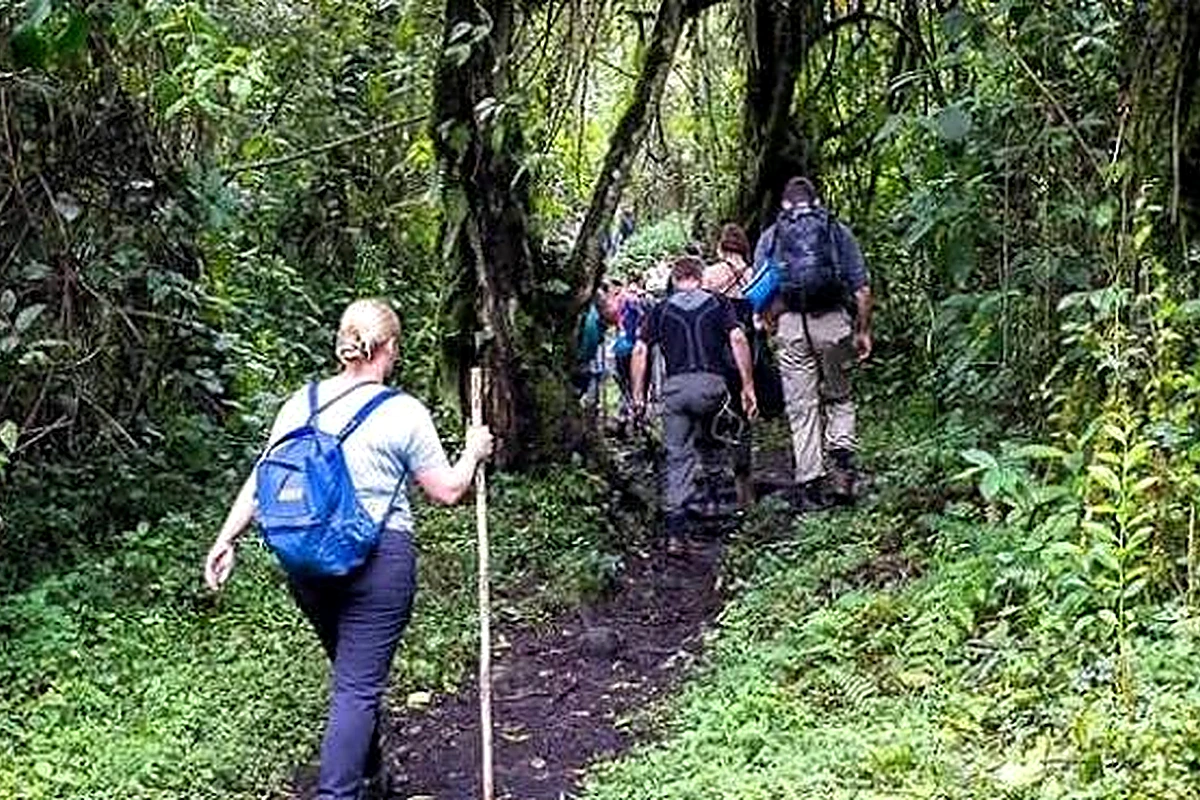
Gorilla trekking visitors follow a muddy forest trail, with a hiker using a wooden walking stick for support.
Why a Walking Stick Helps on Bwindi’s Steep, Muddy Trails
Bwindi Impenetrable National Park has dense vegetation, deeply cut valleys, and slopes that can feel very different from maintained hiking paths. A trekking route may involve wet roots, narrow earth tracks, exposed clay, or a descent that becomes slippery after rain. A well-positioned stick gives an additional point of contact with the ground.
Downhill sections often surprise travelers more than climbs. Your thighs may already be tired, while loose soil and wet leaves make each step less predictable. Planting the tip carefully before transferring weight can help control a descent. The technique works best when you move slowly and keep your attention on the next secure foothold.
On an ascent, the walking stick can provide rhythm and modest support, but it cannot substitute for adequate fitness. A visitor who is struggling to breathe or keep pace should tell the ranger rather than leaning harder on the pole. A steady pace and sensible rest breaks are more useful than forcing the group uphill.
Forest paths are not uniformly difficult. Some stretches are relatively open and manageable, while others may require careful steps through vegetation or over uneven ground. Gorilla families also move, meaning the exact walking distance cannot be promised beforehand. Prepare for variable conditions even when your itinerary describes the trek as moderate.
For gorilla trekking with a walking stick, choose secure foot placement over speed. Keep your pole close to your body when passing other trekkers and avoid swinging it through vegetation. A stick improves stability only when its tip is planted on reliable ground; a slippery rock or rotten branch can turn that extra support into a hazard.
| Trail condition | How a stick may help | Important limitation |
|---|---|---|
| Wet clay | Additional balance point | Tip can still slide |
| Steep descent | More controlled stepping | Cannot replace grip and fitness |
| Roots and stones | Check footing before moving | Do not jam tip into unstable gaps |
| Narrow vegetation | Support on clear ground | Keep stick close to your body |
3. Where to Get a Walking Stick Before the Trek
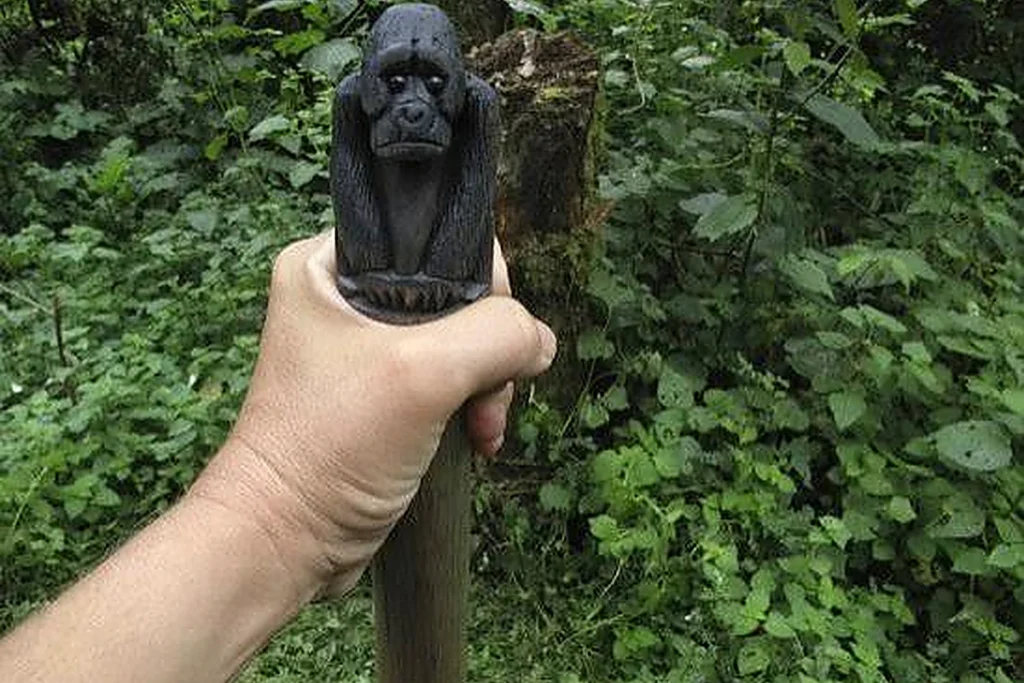
Many visitors encounter locally made wooden walking sticks around gorilla trekking briefing areas. Availability and arrangements can differ by location, operator, and day, so do not assume a stick will always be waiting for every traveler. Ask your guide the evening before trekking whether one can be arranged and whether a charge applies.
Wooden sticks are often straightforward to use because they have no adjustment locks or folding joints. Their limitations are equally important: height, grip shape, weight, and tip condition vary. Before leaving the briefing point, hold the stick upright and check whether its length feels natural with your elbow slightly bent.
If you prefer an adjustable trekking pole, you may bring one from home, subject to your airline baggage rules and the ranger’s instructions. Practice adjusting its length before the safari rather than experimenting on a steep slope. Make sure the locking mechanism holds securely and that no loose component can detach in the forest.
Ask about walking-stick arrangements when you inquire about the 3-Day Gorilla Trekking in Uganda package. The itinerary specifically describes trekkers setting out with walking sticks after their briefing, but arrangements should still be confirmed for your departure. Package descriptions are planning guides rather than guarantees about individual equipment availability.
Before accepting a borrowed stick, inspect it for cracks, splinters, a slippery handle, or a damaged tip. A comfortable grip matters because wet hands and repeated downhill pressure can cause rubbing. If the stick feels too tall or short, request a different one rather than assuming you will become accustomed to it.
Walking Sticks Versus Trekking Poles: Which Is Better?
A traditional wooden walking stick is simple, sturdy, and convenient for someone who wants one extra contact point. Adjustable trekking poles offer more flexibility in length and may be familiar to experienced hikers. Neither option is automatically superior for every traveler, because grip comfort, trail conditions, and personal coordination all influence the choice.
One pole leaves a hand free for balancing against a stable surface when directed, carrying a small item, or adjusting a jacket. Two poles can distribute some effort during long walks but may be awkward in dense undergrowth or when a ranger asks the group to keep equipment compact. Consider what you can control confidently.
For gorilla trekking with a walking stick, stability matters more than technical specifications. A lightweight pole with an unreliable lock is less useful than a basic wooden stick that stays firmly planted. Rubber tips may grip some hard surfaces, while other ground conditions require different traction. Check your equipment before traveling.
Trekking poles also need to be carried safely during transfers. Collapsible poles should be secured inside or against a bag rather than projecting into vehicle aisles. If flying domestically, check the carrier’s current baggage restrictions. Do not assume that equipment accepted on an international flight will automatically be accepted in cabin baggage on another service.
| Equipment | Advantages | Points to check |
|---|---|---|
| Wooden walking stick | Simple and often locally available | Length, grip, cracks, tip |
| Single adjustable pole | Portable and familiar to hikers | Lock strength and grip |
| Pair of trekking poles | Useful to experienced users | Handling in dense vegetation |
| Medical cane | Familiar daily support | Traction and suitability on mud |
Bwindi or Mgahinga: How the Terrain Changes Your Choice
Uganda offers gorilla trekking in Bwindi Impenetrable National Park and Mgahinga Gorilla National Park. Both are mountainous environments, but their landscapes and approaches differ. Bwindi is known for dense forest and steep, sometimes muddy valleys, while Mgahinga lies on the slopes of the Virunga volcanoes, where elevation and volcanic terrain shape the walk.
Bwindi has several trekking sectors, including Buhoma, Ruhija, Rushaga, and Nkuringo. Sector names help organize permits and accommodation, but they do not guarantee a particular difficulty level. Gorilla movements, weather, and the starting location affect the day’s route. A walking stick can be useful in any sector when footing becomes uncertain.
In Mgahinga, exposed stretches and changing mountain weather can make wind, rain, and footing relevant considerations. A pole should feel stable without requiring you to lean heavily on it. Travelers who are sensitive to altitude or concerned about stamina should discuss those issues separately from their equipment choice, because a stick does not solve them.
Gorilla trekking with a walking stick can be a sensible plan in either park, yet selecting a park solely because someone described it as easier is risky. Ask about your own mobility, the access roads, the planned lodge, and the permit location. The 4-Day Mgahinga Gorilla and Golden Monkey Safari offers a different setting from Bwindi-focused itineraries.
For travelers comparing destinations, the Uganda Wildlife Authority provides general information about the trekking experience and official regulations. Use those resources alongside local planning advice rather than treating online accounts of one visitor’s easy trek as a prediction. Two groups leaving the same briefing point may experience quite different walking conditions.
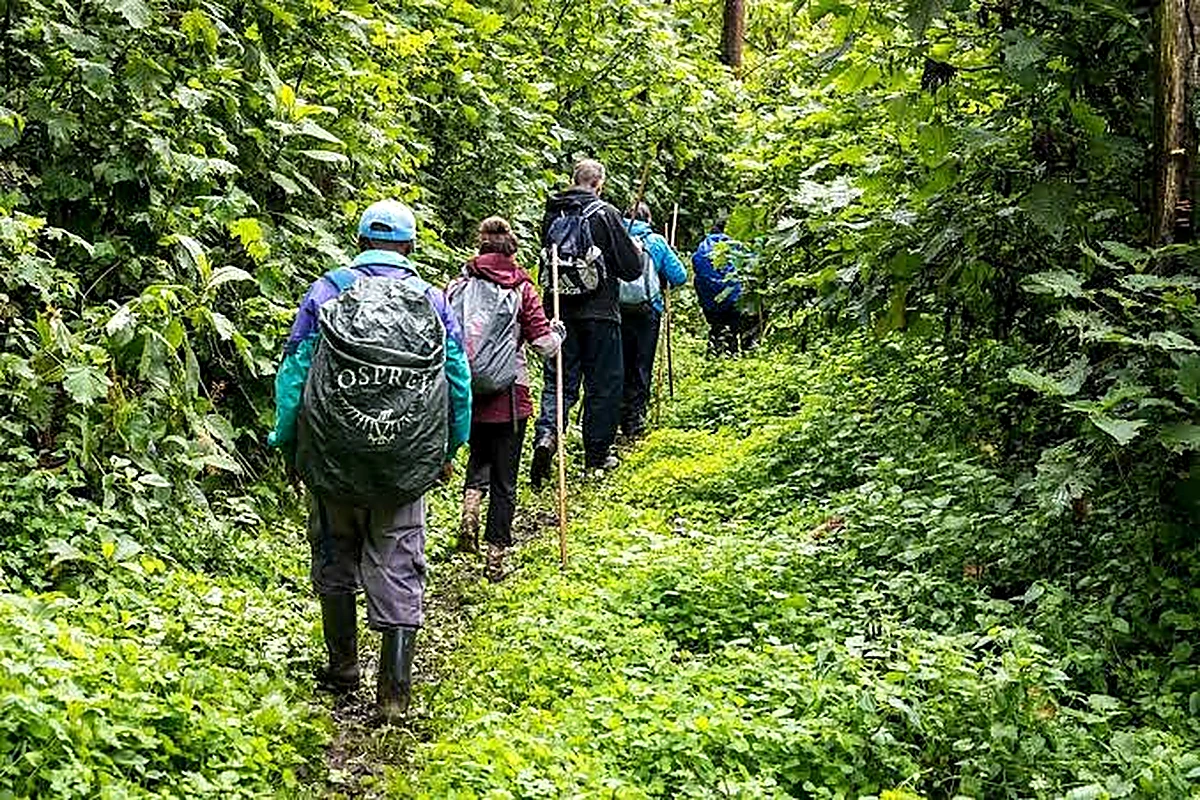
Gorilla trekking visitors use walking sticks while following a narrow trail through lush rainforest vegetation.
Should You Hire a Porter If You Have a Walking Stick?
A walking stick and a porter serve different purposes. The stick can help you balance, while a porter may carry your daypack and offer practical assistance on difficult sections where permitted. Having less weight on your shoulders can be valuable on a long climb or descent, especially when the weather turns wet.
Porter services are generally arranged locally around trekking departures, and prices and procedures should be confirmed for the particular park and sector. Ask what the fee covers, how payment is handled, and whether tipping is separate. Avoid presenting any single amount as a permanent official rate without checking it for your date.
Travellers sometimes assume that hiring a porter means someone will carry them or guarantee an easy route. Ordinary porter assistance should not be confused with specialized mobility arrangements. If you cannot walk for an extended period or require significant physical support, discuss your needs with park management and your tour operator before booking.
For gorilla trekking with a walking stick, a porter may be particularly helpful when you want one hand free and do not want to manage a heavy camera bag. Tell the porter which items you may need during the walk, such as water or a rain jacket. Keep medication and essential personal items accessible.
Booking support through PrideMark Safaris can include discussing porter availability and the kind of assistance you expect, but any final arrangement depends on local providers and park procedures. Sharing your concerns early allows the team to ask useful questions rather than making promises about terrain, trekking duration, or the assistance available.
Using Your Stick Safely Near Mountain Gorillas
The forest walk and the gorilla viewing period are different parts of the experience. During the approach, your walking stick is primarily about footing. Once the ranger locates the gorillas, the group must follow instructions about positioning, movement, noise, and equipment. Do not raise a pole toward an animal or use it to clear space near the group.
Official Uganda Wildlife Authority rules limit viewing time and require visitors to maintain the prescribed distance from gorillas. The current park rules in the conservation tariff specify ten metres, while some older travel pages still quote shorter distances. Follow the ranger and the latest official guidance rather than relying on outdated descriptions.
If a gorilla approaches unexpectedly, remain calm and follow the ranger’s directions. Do not use your walking stick as a barrier, gesture toward the animal, or try to redirect it. Your priority is to avoid sudden movements and allow trained staff to manage the encounter according to the situation.
Gorilla trekking with a walking stick does not change the rules on food, smoking, flash photography, or illness. Visitors with infectious symptoms may be excluded to protect the animals. These restrictions are conservation measures, not inconveniences that can be bypassed because someone has traveled a long distance to reach the park.
Before the viewing hour begins, consider where your stick can be held without blocking other visitors or creating a trip hazard. Do not place it where it could roll downhill. If the ranger requests that equipment be left in a safe spot, follow that instruction and collect it only when permitted.
Packing and Preparation for Better Balance
The best walking stick cannot compensate for unsuitable footwear. Choose hiking boots or sturdy trail shoes that fit properly, offer reliable grip, and have already been worn on uneven ground. New footwear can cause blisters, while smooth soles may be slippery on wet clay. Test your shoes on local hills before traveling.
Bring a lightweight rain jacket and clothing that allows comfortable movement. Long trousers and sleeves can help reduce scratches from vegetation, while gaiters may be useful in muddy conditions. Keep your daypack compact, distribute weight evenly, and avoid attaching dangling objects that might catch on branches during narrow passages.
Water, a small packed meal for the trail where appropriate, personal medication, and a waterproof bag for electronics deserve attention. Your guide can explain where eating is allowed and when the group must stop consuming food before viewing gorillas. Pack only what you need, because every unnecessary kilogram becomes more noticeable uphill.
For gorilla trekking with a walking stick, practice on a modest hill with both upward and downward sections. Learn how the stick behaves on wet ground and how to switch hands without losing balance. If you are using an unfamiliar adjustable pole, practice the locking mechanism and grip before your flight.
People with existing balance difficulties, recent injuries, or joint problems should seek individualized medical advice before committing to a strenuous trek. A doctor can advise on your own health, while park staff can clarify operational possibilities. Neither a walking stick nor a tour operator can guarantee that a challenging forest route will be suitable.
Plan enough time to reach the correct trekking sector and sleep nearby before the briefing. Long road transfers immediately before a physically demanding morning are tiring. Travelers who prefer to avoid an extended drive can examine the 3-Day Uganda Gorilla Flying Luxury Safari, which uses domestic flights and still includes a guided forest trek.
| Pack item | Reason | Preparation tip |
|---|---|---|
| Broken-in hiking boots | Grip and foot support | Test on slopes |
| Rain jacket | Changing mountain weather | Keep accessible |
| Compact daypack | Water and essentials | Avoid excess weight |
| Walking stick or pole | Extra balance | Check grip and tip |
| Dry bag | Protect electronics | Seal before departure |
Planning the Right Uganda Gorilla Safari With a Walking Stick
Begin with your actual travel needs rather than choosing a package based only on the number of days. Tell your safari planner whether you regularly hike, use a cane at home, prefer one or two poles, or need porter assistance. These details can influence accommodation suggestions, transfer arrangements, and questions asked of the trekking team.
A short itinerary such as the 3-Day Gorilla Trekking in Uganda is designed around the gorilla encounter and travel to Bwindi. It can work for visitors with limited holiday time, but the forest walk remains physically variable. The schedule does not mean the trekking route itself will be short or flat.
Visitors wanting a broader holiday can explore the 5-Day Gorilla & Game Safari Adventure, which combines forest trekking with wildlife experiences elsewhere in Uganda. The extra days create a different travel rhythm, not a guarantee of easier trekking. Compare the pace, road transfers, and activities rather than judging only the headline duration.
PrideMark Safaris can help you compare Uganda safari packages and raise practical questions about equipment, porters, lodging, and permits. When contacting the team, explain your expected walking ability and ask for the latest arrangements at the intended trekking sector. Clear information makes a more useful starting point than simply requesting the easiest gorilla family.
Gorilla trekking with a walking stick can be rewarding when expectations are realistic. Prepare for mud, variable walking times, and the possibility of tiring climbs. Choose equipment that you can control, accept help when useful, and remember that the ranger’s instructions take priority over personal preferences once the trek begins.
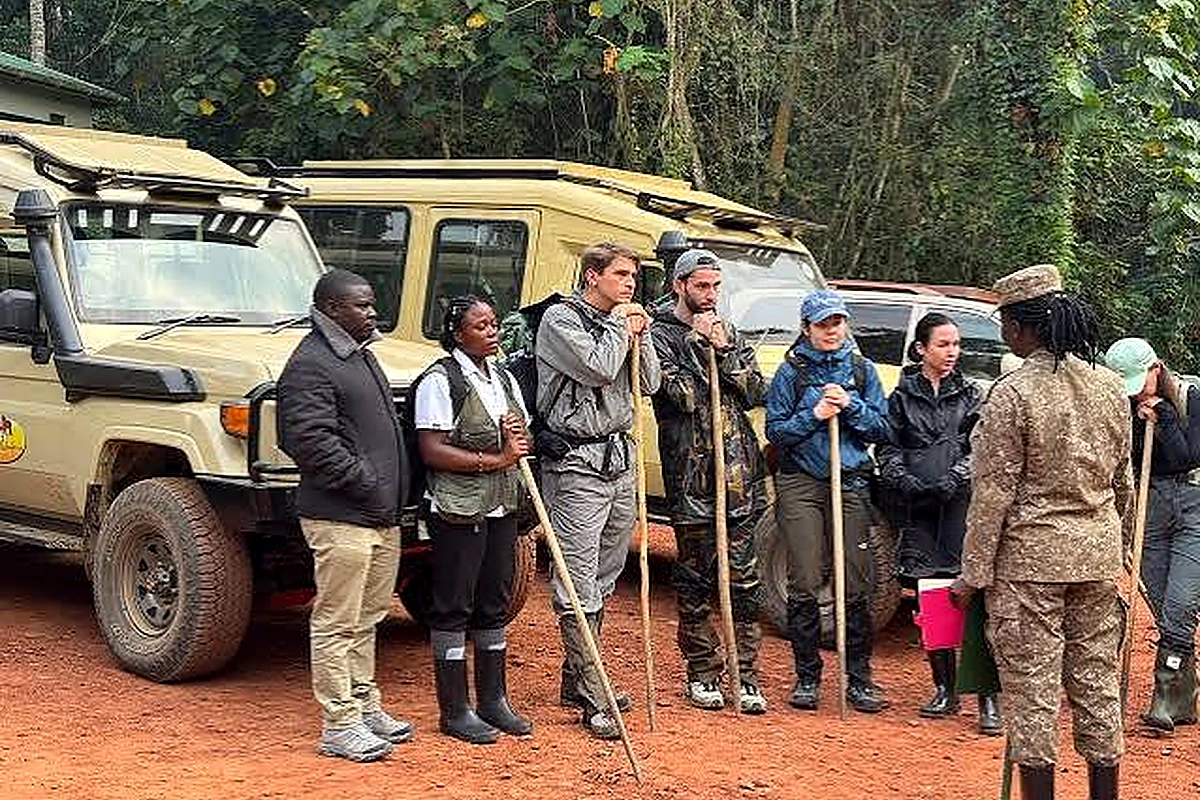
Gorilla trekking visitors holding wooden walking sticks gather beside a safari vehicle before their forest trek
How to Test a Stick Before Leaving the Briefing Area
A quick equipment test is worth several minutes before the group starts walking. Stand on level ground, grip the handle naturally, and take a few steps at your normal pace. The stick should touch the ground without forcing your shoulder upward or making you bend awkwardly. If your wrist or elbow feels strained, ask for another length.
Test the tip on a patch of firm earth rather than on polished concrete alone. Notice whether it slips when you apply light pressure. Do not deliberately load your full body weight onto an unfamiliar stick. A wooden shaft that flexes excessively, has a split, or feels unstable should be replaced before entering a remote forest route.
If you normally carry a pole in your right hand, practice switching to your left hand while stationary. A trail may have a steep drop on one side, and the most convenient hand can change with the slope. Learn to pause before switching instead of trying to transfer equipment while stepping over roots or loose stones.
What a Walking Stick Cannot Do
One common planning mistake is treating a walking stick as a substitute for route suitability. It may help with balance but cannot shorten the distance to a gorilla family or flatten a steep hillside. If you are unable to climb steps or walk on irregular ground, explain that limitation clearly before buying a permit.
Another mistake is assuming that a ranger can always select the nearest gorilla family for a visitor who requests an easier trek. Group allocation and tracking decisions depend on several operational considerations. Staff may take visitor circumstances into account where feasible, but travelers should not interpret a request for assistance as a confirmed route guarantee.
Gorilla trekking with a walking stick is also different from traveling with a medically prescribed mobility device. Some visitors need substantial weight-bearing support, while others simply prefer a hiking pole for confidence. The practical implications are not identical, so provide a precise description of your needs rather than using the general phrase limited mobility.
Questions to Ask Your Operator Before Paying
Ask which trekking sector your permit will use and whether the proposed accommodation is convenient for that departure point. A lodge described as being near Bwindi may still require a substantial drive to a different sector. Confirming the sector reduces avoidable early-morning travel and makes equipment arrangements easier to discuss.
Ask how porters are arranged, whether walking sticks can be obtained locally, and what happens if weather makes the path unusually slippery. These questions do not guarantee special treatment, but they clarify what is routinely available. A helpful operator should distinguish services it can organize from decisions that belong to park authorities.
Finally, ask what costs are included in your quote. Gorilla permits, accommodation, road or air transfers, porter services, and optional activities may be listed differently across itineraries. Compare the actual inclusions rather than choosing the lowest headline price. Any extra assistance should be discussed openly before you make a deposit.
Walking Technique on Common Forest Obstacles
When you reach a short muddy descent, stop briefly and look for firm footholds before moving. Place the stick where the ground appears stable, then step carefully without lunging forward. Keep your knees relaxed and take smaller steps than you would on a paved path. Rushing downhill often increases the chance of slipping.
Roots can be particularly deceptive after rain because their smooth surfaces offer less grip than surrounding soil. Avoid planting a pole directly on a rounded root when you can use firm earth beside it. If the path is crowded, allow enough space between walkers so a sudden stop does not cause a collision.
Where a trail narrows beside thick vegetation, hold the stick closer to your body and wait for clear instructions. Do not use it to hook branches or pull yourself forward on plants that may break. If you cannot see a safe next step, tell the guide. Asking for help is preferable to making an uncertain movement.
How Weather Affects Walking-Stick Performance
Mountain weather can change during the same outing. Rain may soften the trail and reduce grip, while mist can make obstacles harder to see. Even during a relatively dry period, shaded ground can remain damp. Carrying a stick is useful preparation, but your footwear and attention remain essential to safe movement.
After rainfall, check whether mud has collected around the stick tip. A thick layer can reduce traction and make a rubber tip behave differently from when it was clean. Remove debris only when the group is safely stopped. Never delay on an exposed or narrow section merely to adjust equipment.
If your hands become wet or cold, a comfortable grip becomes especially important. Avoid handles that require excessive squeezing, and consider gloves you have already tested for dexterity. A secure hold helps you place the stick accurately without tiring your forearm. Keep any spare gloves protected from rain inside your pack.
Making the Most of Your Gorilla Viewing Hour
Once the gorillas are found, the value of the trek changes from walking efficiently to observing quietly. Listen carefully when the ranger explains where to stand and how to move. The animals may be partly concealed by foliage, and visitors sometimes need to wait patiently for a clear view rather than changing position independently.
If you carry a camera, organize it before reaching the family so you are not juggling lenses, a bag, and a walking stick simultaneously. A camera strap or secure pocket can help keep your hands free when moving between safe viewing positions. Remember that flash photography is prohibited under the park rules.
Gorilla trekking with a walking stick should still feel like a wildlife experience, not an equipment exercise. Once the ranger has directed you to a suitable position, focus on the gorillas and the forest sounds. Follow instructions if the family moves, and avoid stepping closer simply to improve a photograph.
Travel Planning for Different Visitor Profiles
A regular hillwalker may already own trekking poles and only need advice about whether to bring them. Someone visiting Uganda for the first time may prefer a locally available wooden stick and a porter. Both approaches can be reasonable, provided the visitor understands the trail demands and follows the same ranger instructions.
For a traveler recovering from an injury, the planning conversation should begin much earlier. A walking stick may not provide enough support on steep or muddy terrain. Ask a healthcare professional about strenuous walking and consult park management about any practical restrictions before committing to travel dates or nonrefundable arrangements.
Visitors combining gorilla trekking with game drives may appreciate a varied itinerary, but long vehicle transfers can still be tiring. Compare the sequence of activities and rest periods in each package. A more expensive itinerary is not necessarily physically easier, and an extra safari day does not change the terrain of the gorilla trek.
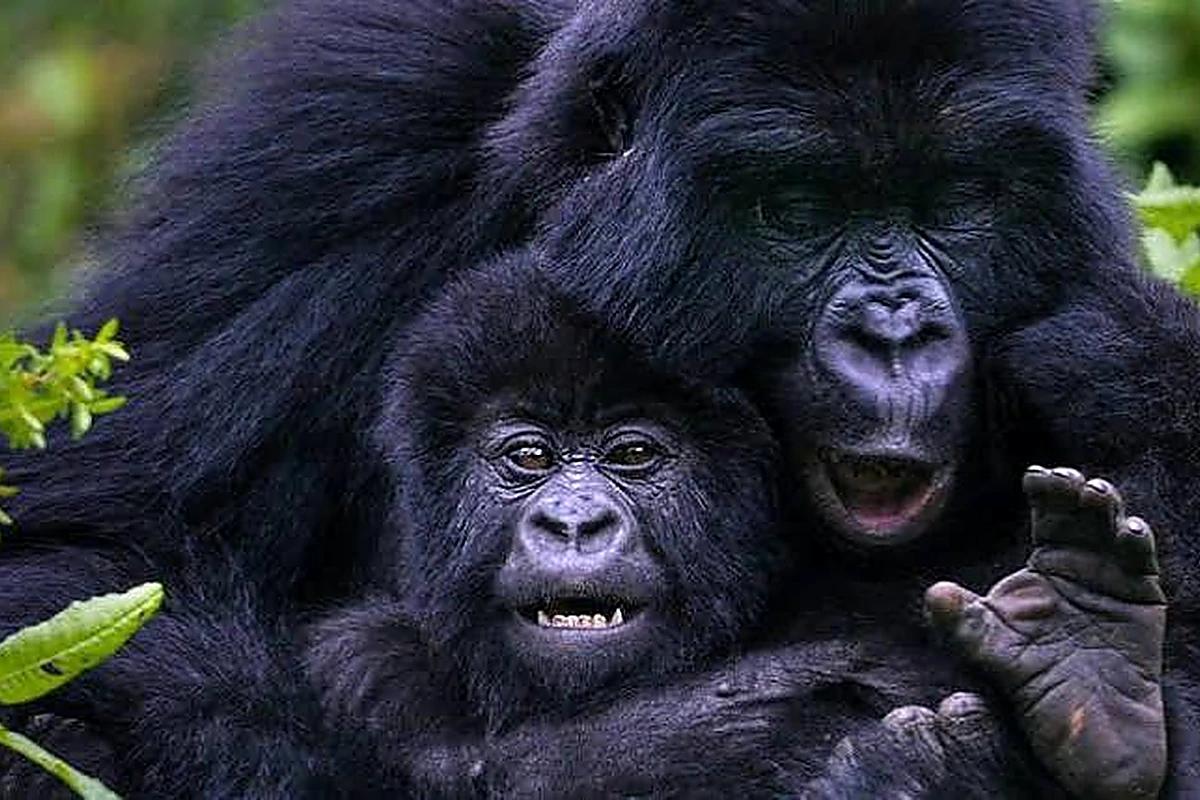
An adult mountain gorilla holds a young gorilla close, revealing their expressive faces and dark fur.
Respecting the Forest and Local Communities
Walking sticks and porter services are practical parts of a visit, but they also connect travelers to the communities around the protected forest. Where locally provided equipment or assistance is available, ask about fair payment and treat service providers respectfully. A porter is a professional helper, not a guarantee against every possible difficulty.
Use the stick only for walking support and avoid damaging plants or disturbing wildlife. Do not leave broken equipment, packaging, or other litter in the park. The forest is a sensitive habitat, and even small actions matter when many groups visit the same general areas throughout the trekking season.
PrideMark Safaris can help travelers plan a journey that respects local services and park conservation requirements. Good preparation means knowing when to ask for assistance, when to follow ranger directions, and when a particular trek may be unsuitable. Responsible decisions benefit visitors, guides, porters, and the gorillas themselves.
Final Pre-Trek Checklist
The evening before your trek, confirm the departure point and briefing time with your guide. Check that your boots are dry enough to wear comfortably, your rain jacket is accessible, and your walking stick or pole is in good condition. Ask any remaining questions about local stick availability and porter arrangements before the morning rush.
On trekking morning, carry your permit documentation as instructed, eat breakfast, and arrive ready to listen to the ranger briefing. Mention any balance concerns privately to the guide before the group sets off. Make sure you can comfortably manage your stick while keeping your pack secure and your hands available when assistance is required.
The best preparation for gorilla trekking with a walking stick is practical rather than complicated. Know your limits, wear suitable footwear, and allow the ranger to set the pace and rules. When you are uncertain about a slippery section or the handling of equipment near gorillas, ask for instructions instead of guessing. That approach protects both visitors and wildlife.
Frequently Asked Questions
Can I take my own walking stick into Bwindi?
You can ask to use your own walking stick, and trekking poles are commonly used on hiking routes. Confirm the arrangement with your operator and follow the ranger’s instructions on the day. An item suitable for walking may still need to be lowered or set aside near gorillas for safety.
Are walking sticks provided at gorilla trekking starting points?
Locally made walking sticks are often available around trekking departure areas, but availability and any fees may vary. Ask your guide before the trekking morning rather than assuming every visitor automatically receives one. Check the height, grip, and condition of any borrowed stick before entering the forest.
Is one stick enough for gorilla trekking?
For many walkers, one sturdy stick provides a useful extra point of balance on uneven ground. Others prefer two trekking poles because they already use them regularly. The better choice is the one you can manage confidently without obstructing other people or losing control on narrow trails.
Will a walking stick make a difficult gorilla trek easy?
A stick may improve stability but does not remove steep climbs, mud, altitude, or long walking distances. Gorilla families move, and the route can change with weather and tracking information. Good footwear, suitable fitness, realistic expectations, and ranger guidance remain more important than any single piece of equipment.
Can I use a walking stick near the gorillas?
Follow the ranger’s specific instructions when your group reaches the gorillas. Never point the stick toward an animal, wave it, or use it to move vegetation around the viewing area. You may be asked to hold it quietly or leave it safely aside while observing the family.
Do I need a porter if I have a walking stick?
Not every visitor needs a porter, but one can help by carrying a daypack and providing practical assistance where permitted. A stick and a porter solve different problems. Ask about the available services, their cost, and the limits of assistance before deciding what is appropriate for your needs.
Which Bwindi sector is easiest with a walking stick?
No Bwindi sector can reliably promise an easy trek because gorilla locations and trail conditions vary. Buhoma, Ruhija, Rushaga, and Nkuringo each have different landscapes and access arrangements. Discuss your walking ability before booking, and avoid choosing a permit based solely on an online claim about difficulty.
Is Mgahinga better than Bwindi for people who use poles?
Mgahinga and Bwindi offer different landscapes, but neither guarantees an easier route. Mgahinga lies in volcanic mountain terrain, while Bwindi contains steep forested valleys. Weather, altitude, and the gorillas’ movements all matter. Ask your operator about the whole itinerary rather than judging by one terrain description.
Can older travelers go gorilla trekking with a walking stick?
Age alone does not determine whether someone can manage a gorilla trek. Walking ability, stamina, balance, and individual health are more useful considerations. Older travelers who are concerned about mobility should discuss their needs with a healthcare professional and the park team before committing to a permit.
Can I use a medical cane instead of a hiking pole?
A medical cane may be familiar and helpful, but the ground in gorilla habitat is different from pavement. Some cane tips offer poor grip in mud, and steep sections may require additional assistance. Explain your mobility requirements to the operator and park management so they can discuss practical limitations.
What happens if it rains during my trek?
Rain can make roots, clay, and slopes more slippery, so slow down and place the stick carefully. Wear suitable footwear and keep rain protection accessible. Your ranger will determine the group’s route and safe conduct; do not assume that a walking stick makes every wet section safe to cross.
How do I book a safari if I need walking assistance?
Contact PrideMark Safaris before selecting your dates and describe how far you can normally walk, the support you use, and any concerns about steep terrain. Ask about porters, the trekking sector, and what park staff can realistically arrange. Confirm the details before making nonrefundable travel commitments.
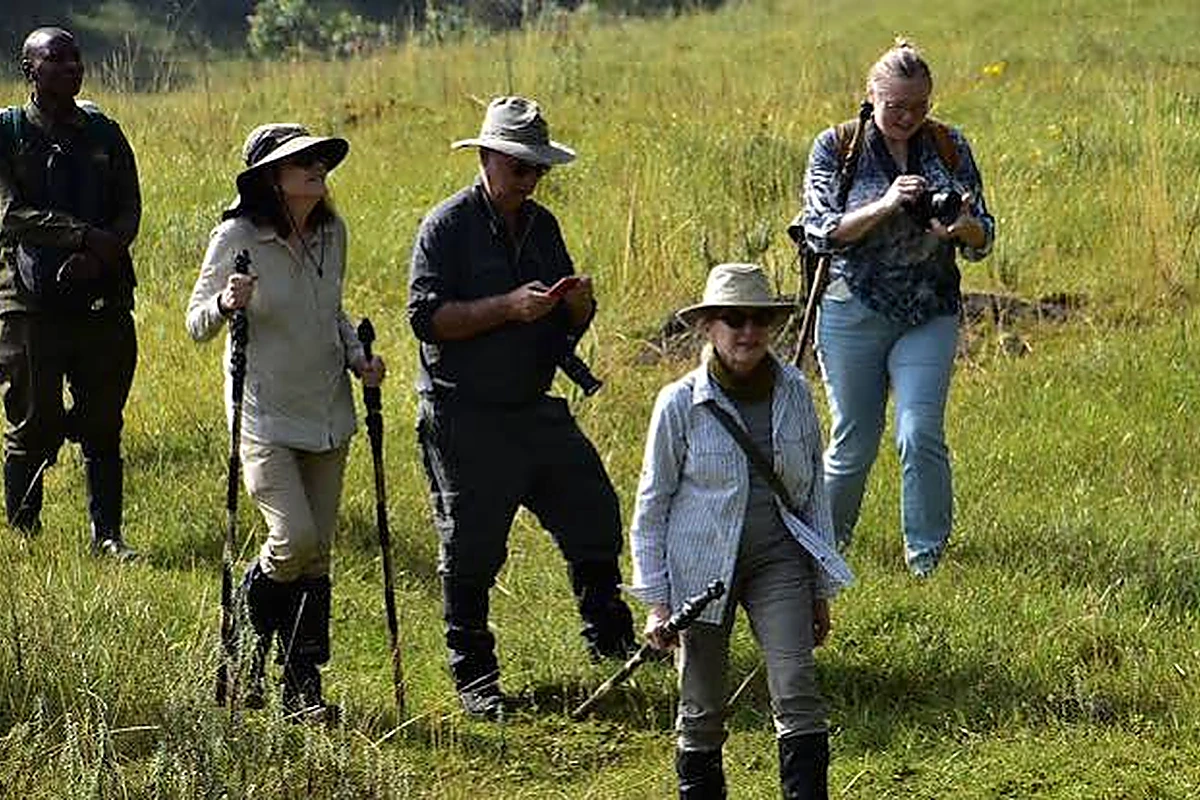
Visitors use walking sticks and trekking poles while walking through an open grassy landscape.
Official Guidance and Further Reading
For park rules and trekking information, consult the Uganda Wildlife Authority and its gorilla tracking guidelines. The official conservation tariff outlines important visitor requirements, including minimum age, illness restrictions, group size, viewing time, and distance from gorillas. Always check the latest guidance and obey instructions from your ranger on the day.
- Uganda Wildlife Authority: Gorilla Tracking
- UWA Gorilla and Chimpanzee Tracking Guidelines
- UWA Conservation Tariff and Park Rules
Plan Your Uganda Gorilla Trek
Ready to explore Uganda’s gorilla forests? Contact PrideMark Safaris to discuss walking-stick arrangements, porter support, permit planning, and the most suitable itinerary for your interests. You can also compare the 3-Day Gorilla Trekking in Uganda, 3-Day Uganda Gorilla Flying Luxury Safari, and 5-Day Gorilla & Game Safari Adventure before requesting a tailored quote.