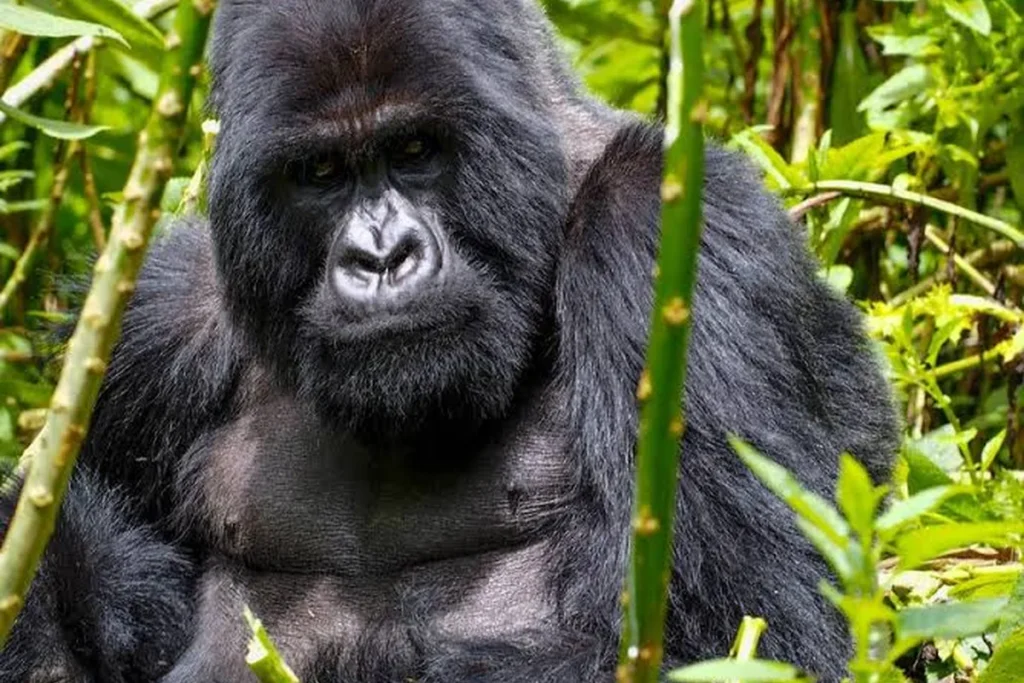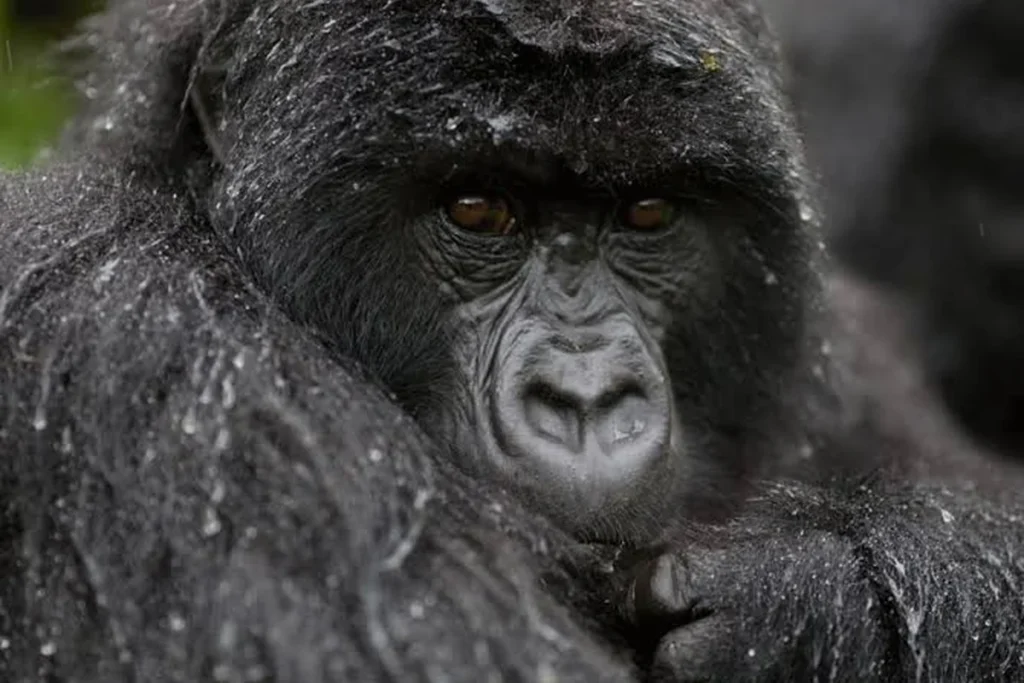
Gorilla trekking with glasses is entirely possible, but preparing for rainforest conditions can make the experience more comfortable.
Can You Trek With Glasses in Uganda?
Yes. For gorilla trekking with glasses, wearing prescription glasses is not, by itself, a reason to avoid a gorilla trek in Uganda. Visitors regularly arrive with ordinary spectacles, reading glasses, sunglasses, and prescription lenses. The practical question for gorilla trekking with glasses is whether you can see comfortably while walking through changing forest light and moisture. Your eyesight needs are personal, so prepare the equipment you normally rely on rather than assuming you must change it for a safari.
The gorilla trekking experience is managed by Uganda Wildlife Authority rangers in designated forest areas. You do not need perfect unaided vision to join, but you should be able to follow the ranger’s directions, watch your footing, and recognize obstacles on the trail. If your glasses are essential for walking safely, keep them accessible from the moment you leave the lodge, not buried in a daypack.
At PrideMark Safaris, our planning approach starts with ordinary travel details that can make a forest day easier. Eyewear is one of those details. A traveler who wears glasses for distance vision may need a different solution from someone who only uses them for reading. We encourage guests to explain their requirements early so the packing advice fits the person, the itinerary, and the expected conditions.
Bwindi Impenetrable National Park is known for steep slopes, thick vegetation, and trails that can become slippery after rain. Mgahinga Gorilla National Park has a different landscape, with montane forest and volcanic terrain. Neither setting calls for fashionable equipment over functional equipment. A familiar pair of well-fitted prescription glasses, supported by a sensible backup plan, is often more useful than a new pair bought just before departure.
The central message is straightforward: gorilla trekking with glasses is entirely realistic for many visitors, but eyewear should be treated as essential outdoor equipment. Plan for fogging, droplets, sweat, and accidental damage. Also remember that ranger instructions and gorilla protection rules apply equally to everyone, regardless of whether they wear glasses, contact lenses, or neither. Good preparation should make those rules easier to follow, not distract from them.Gorilla trekking with glasses does not require special permission, although visitors should ensure their eyewear fits securely.
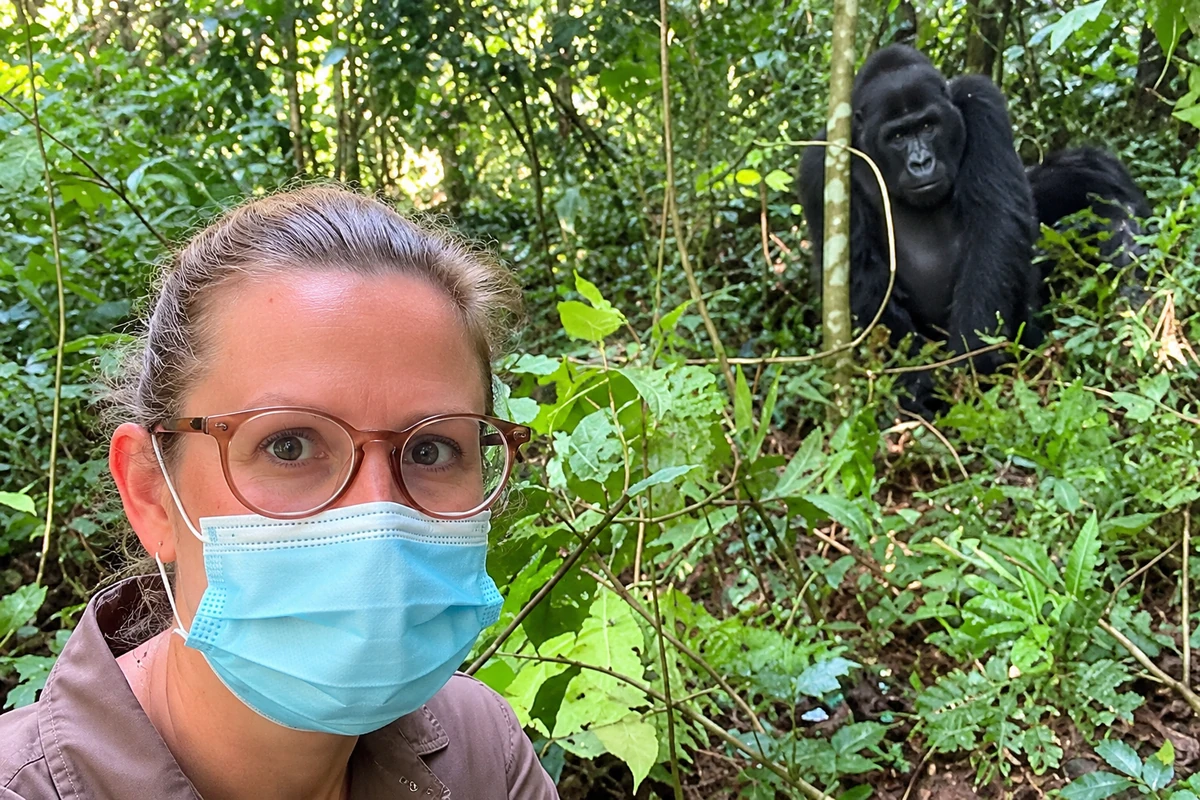
A visitor wearing glasses and a protective face mask during a close-range gorilla viewing experience.
How Rain, Humidity and Forest Light Affect Vision
Uganda’s mountain gorillas live in high-altitude forest habitats where conditions can shift within a single trek. A morning may begin cool, become warmer during the hike, and turn wet without much warning. For gorilla trekking with glasses, these changes affect lenses and frames in different ways. Moisture on the lens can obscure a root or rock, while sweat can make frames slide when you are concentrating on a steep descent.Gorilla trekking with glasses during rainy conditions requires a suitable cleaning cloth and a way to protect lenses from moisture.
Fogging happens when moisture condenses on a cooler lens surface. A visitor moving from cool air into warmer, humid conditions may notice a temporary haze, particularly when wearing a face covering or breathing heavily on an uphill stretch. Wiping immediately with a dirty sleeve can smear the lens. A clean microfiber cloth, kept dry in a sealed pouch, is a small item with a surprisingly useful role.During gorilla trekking with glasses, clean lenses help visitors identify obstacles along muddy and uneven forest trails.
Rain droplets cause a different problem from fog. They sit on the outside of the lens and scatter light, sometimes making leaves and branches harder to distinguish. A hat with a short brim can help shield glasses without restricting your field of view. A hood may offer additional protection, but make sure it does not block your hearing or peripheral vision when the ranger is speaking.
Forest light can be patchy rather than uniformly dark. Openings in the canopy may be bright while the next section of trail is shaded. Very dark sunglasses can make the shaded sections harder to navigate. If you use prescription sunglasses, carry your regular clear lenses as well. Photochromic lenses may help some travelers, but their response varies, so test them outdoors before the safari rather than depending on a new feature.
A useful distinction is between seeing gorillas clearly and seeing the trail safely. The forest walk may require you to notice wet roots and changes in ground level for several hours, while the viewing period is limited and managed by rangers. Choose eyewear that serves the entire activity. A lens that is excellent for photographs or bright sunshine may not be the best lens for a shaded, uneven path.
During a wet trek, stop in a safe place before cleaning your glasses. Ask a ranger or guide to pause if your vision is significantly blurred. Trying to wipe lenses while stepping over roots can create a preventable fall risk. The same principle applies when switching between glasses and sunglasses: make the change while standing securely, then put the unused pair into a protective case.
| Forest condition | What you may notice | Practical response |
|---|---|---|
| Mist or humid air | Temporary lens fogging | Pause safely; use a dry microfiber cloth |
| Rainfall | Droplets scatter light | Use a brimmed hat; wipe only while stationary |
| Shaded canopy | Reduced contrast | Use clear lenses when dark sunglasses hinder vision |
| Wet trails | Roots and rocks harder to judge | Slow down and follow ranger directions |
Choosing Frames, Lenses and Practical Accessories
The best trekking frames are generally the pair that already fits securely and feels comfortable during a long walk. Lightweight frames can reduce pressure around the nose and ears, while adjustable nose pads may help with slipping. Avoid bringing an untested frame simply because it looks rugged. A familiar fit is especially important when you may be wearing a hat, rain jacket, or backpack for several hours.
During gorilla trekking with glasses, a simple retainer strap can reduce the chance of glasses falling into vegetation when you lean forward or adjust a hood. Choose one that is comfortable and does not swing across your face. Test it with your rain jacket and hat before traveling. Some visitors prefer a snug sports-style strap, while others find a lightweight cord sufficient. There is no single accessory that works for every face shape.
Scratch-resistant lens coatings can be helpful, but they do not make glasses immune to damage. Fine grit on a wet lens can scratch the surface if rubbed hard. Rinse with clean water when practical, or gently remove loose particles before wiping. Avoid strong cleaning chemicals unless the lens manufacturer recommends them. An inexpensive microfiber cloth and protective case can be more valuable than elaborate gadgets.
Anti-fog products are another optional accessory. Their performance depends on the lens material and coating, and some products are unsuitable for certain prescription lenses. Check the manufacturer instructions and test the product well before the trek. If it leaves a film, causes irritation, or affects clarity, do not experiment with it for the first time on a steep rainforest trail.
Bring a hard case rather than relying on a soft fabric pouch alone. The case protects spare glasses when your daypack is compressed by a rain cover or placed on the ground. Keep it inside a waterproof bag or dry compartment. If you travel with expensive prescription lenses, consider bringing an older but usable backup pair with the same current prescription, provided you can see safely through it.
A small hat brim, clean cloth, protective case, and optional retainer strap form a practical eyewear kit. None of these items replaces sturdy boots, suitable clothing, water, or the directions of your ranger. Think of the kit as a way to remove distractions. When your lenses remain clear and your frames stay secure, you can give more attention to the forest and the gorillas.
Contact Lenses Versus Prescription Glasses
For gorilla trekking with glasses, contact lenses are an alternative for some travelers, but they bring different considerations from spectacles. A person who comfortably wears contacts for long outdoor days may prefer the unobstructed field of view. Someone who rarely uses them should not start just before a gorilla trek. Fit, hygiene, and eye comfort matter more than the assumption that one type of vision correction is automatically superior.Choosing between contact lenses and gorilla trekking with glasses depends on personal comfort, hygiene and individual vision needs.
The rainforest can be wet and humid, yet contact lens wearers may still experience irritation from wind, dust on access roads, or long travel days. Hands can become muddy during the hike, making it difficult to handle a lens hygienically. If a contact moves or becomes uncomfortable, do not touch your eye with unwashed hands. Ask to stop and follow the care guidance given by your eye-care professional.
Daily disposable lenses may simplify some travelers’ routines, but suitability depends on prescription and individual eye health. Carry sealed spares only if they are part of your normal approved routine. Never rinse lenses or storage cases with untreated stream water. Use the recommended sterile solution, and follow the wear and replacement schedule provided by your optometrist or ophthalmologist.
Even if you intend to trek in contact lenses, carry prescription glasses in a hard case. They provide a fallback if a lens is lost, damaged, or uncomfortable. A backup pair is especially important on an itinerary involving remote accommodation and early departures. Do not assume you can buy your exact prescription or preferred contact lens brand near a national park gate.
For people with dry eyes, recurrent infections, allergies, or complex prescriptions, a conversation with an eye-care professional before travel is sensible. The goal is not to obtain a special gorilla trekking clearance, but to decide what you can wear comfortably and safely for a full outdoor day. Personal medical advice should come from a qualified clinician who knows your eye history.
If you alternate between contacts and glasses, plan where each item will be stored. Keep spare lenses, solution, and spectacles protected from moisture and crushing. Avoid making a lens change in the forest unless absolutely necessary and hygienically possible. The most reliable arrangement is often the one that minimizes handling, particularly when the ground is muddy and clean running water is not available.For travelers who depend on corrective lenses, gorilla trekking with glasses is often more practical than switching to unfamiliar eyewear.
| Consideration | Prescription glasses | Contact lenses |
|---|---|---|
| Rain and fog | Lenses may collect moisture | No spectacle lens to fog |
| Hygiene | Can usually be wiped with clean cloth | Require clean hands and appropriate solutions |
| Backup | Bring spare glasses | Bring prescription glasses and lens supplies |
| Trail convenience | Secure fit and retainer may help | Avoid touching eyes with muddy hands |
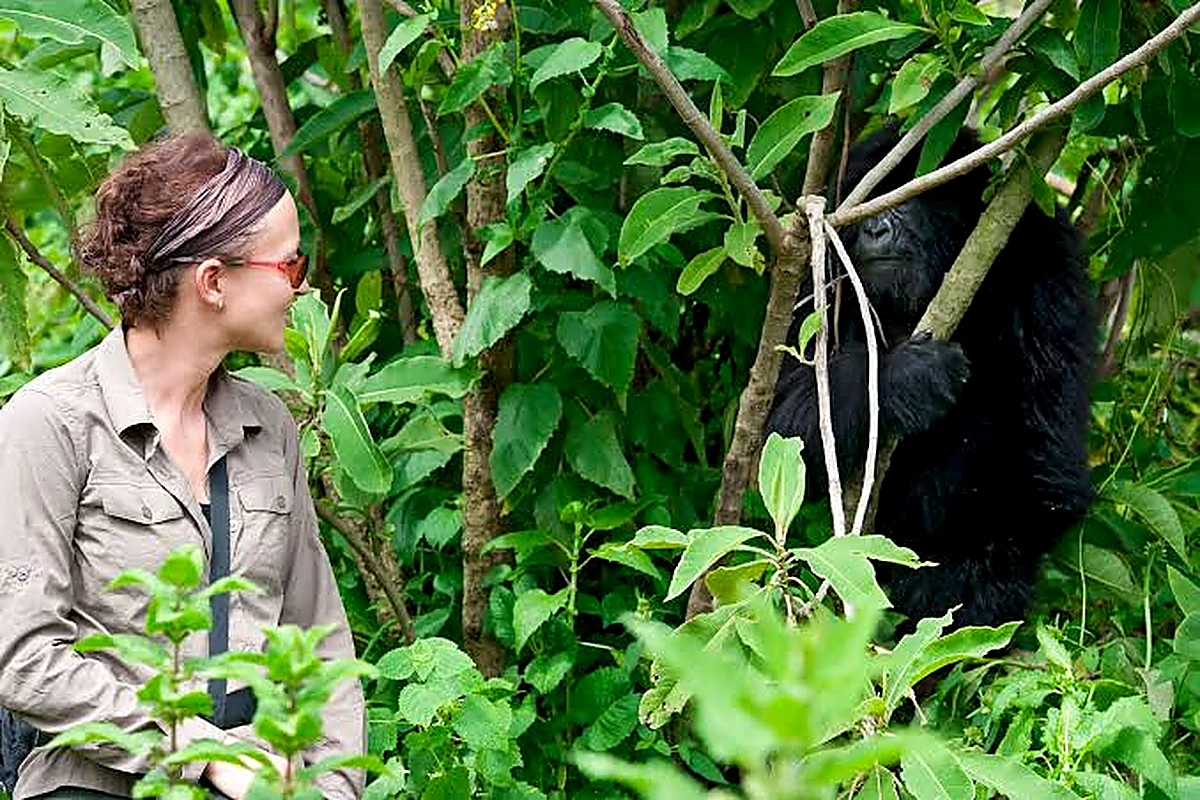
A visitor wearing glasses observes a gorilla surrounded by lush forest vegetation.
Trail Safety and Ranger Instructions
Gorilla trekking with glasses involves walking rather than simply arriving at a viewing platform. The route and duration depend on where a gorilla family is located, the terrain, and the group’s pace. Some walks are relatively manageable; others involve sustained climbing or uneven ground. If your glasses affect depth perception, peripheral vision, or balance, discuss those practical limitations before booking and again at the morning briefing.
Rangers set the pace and explain how the group should move in the forest. They may ask visitors to remain together, keep quiet, or step aside in a particular direction. Good hearing and clear communication are therefore as important as visual sharpness. A hood pulled tightly around your head should not prevent you from hearing instructions, and a lens-cleaning stop should never separate you from the group.
Look down often enough to place your feet safely, but do not stare at the ground continuously. Roots, branches, and low vegetation may appear at different heights. A walking stick, where provided or permitted, can offer additional stability. If your glasses slip when you bend forward, adjust them at a safe stop rather than while negotiating a steep or narrow stretch of path.
Some visitors worry that removing glasses during the gorilla encounter will somehow be expected. There is no general reason to remove prescription glasses simply because you are viewing gorillas. Keep the eyewear you need to see and move safely. The critical behavior is to follow the ranger’s directions, avoid sudden movements, respect the required viewing distance, and never attempt to touch an animal.
If a gorilla moves toward your group, do not let concern about your glasses lead to a sudden retreat or an attempt to grab dropped equipment. Follow the ranger’s instructions calmly. Gorilla encounters are managed with conservation and visitor safety in mind. The same guidance applies to photographers, people wearing contacts, and travelers using prescription spectacles: the animal’s welfare and the ranger’s directions come first.
Tell the team early if you need a slower pace to see the path clearly. Asking for a brief pause is better than risking a fall. PrideMark Safaris can help discuss trekking expectations during trip planning, but the park authorities and rangers determine the actual trekking arrangements and on-the-ground instructions. Clear communication helps everyone plan realistically without promising an easy or identical route.
Packing and Protecting Eyewear on Safari
When preparing for gorilla trekking with glasses, pack your main glasses in your carry-on bag during international travel, especially if you cannot function comfortably without them. Checked luggage can be delayed, and a replacement prescription may be difficult to arrange on a tight itinerary. A second pair in a separate protective case offers additional reassurance. Keep a copy of your prescription if you have one, although it does not guarantee a quick replacement locally.A small protective case is useful for gorilla trekking with glasses, especially when carrying spare prescription eyewear.
For the trekking day, put a dry microfiber cloth inside a small resealable bag. Add your spare glasses in a hard case, a retainer strap if you use one, and a lens cleaner approved for your lenses. Place the kit near the top of your daypack, not beneath heavy water bottles. You should be able to reach it without emptying the bag on a muddy forest floor.
Waterproof backpacks and rain covers help, but they are not always completely watertight. Small sealed pouches provide a second layer of protection for prescription items and cleaning cloths. Separate wet gloves or rainwear from your eyewear kit. If your cloth becomes soaked, it may no longer remove droplets effectively. Carrying a second small cloth takes little space and avoids repeated smearing.
Think about what happens after the trek as well. Wet glasses and cases should be dried before they are stored for the night. A damp cloth left in a sealed bag can develop an unpleasant smell and may transfer dirt to your lenses. At the lodge, use clean water and suitable cleaning materials, then let accessories dry in a safe place away from direct heat.
Travelers who also use binoculars or cameras should check how those devices work with glasses. Some binocular eyecups fold down to accommodate spectacles, while camera viewfinders have adjustable settings. Test the arrangement before your safari. Do not assume you will have time to make technical adjustments during the gorilla viewing period, when quiet behavior and ranger guidance are more important than equipment experimentation.
A good packing list is deliberately short. Bring what you know you will use, protect it well, and leave unnecessary accessories behind. This is particularly relevant when hiring a porter or arranging a daypack for a long hike. PrideMark Safaris can discuss ordinary safari packing considerations, while prescription choices and lens-care instructions should remain guided by your own eye-care professional.Gorilla trekking with glasses becomes easier when visitors use properly fitted frames and a comfortable retaining strap.
| Item | Why it matters | Packing advice |
|---|---|---|
| Primary prescription glasses | Clear vision on trails | Wear your familiar pair |
| Backup glasses | Contingency for loss or breakage | Hard case inside waterproof pouch |
| Microfiber cloths | Remove moisture and smears | Carry two dry cloths in sealed bags |
| Hat with brim | Helps shield lenses from droplets | Test with hood and glasses |
| Retainer strap | Reduces accidental loss | Choose a comfortable, tested fit |
Photography, Masks and Gorilla Viewing
Many travelers planning gorilla trekking with glasses want to take photographs of gorillas. That is possible, but camera viewfinders, fogged lenses, and changing forest light can complicate the experience. Practice using your camera with your prescription eyewear before leaving home. Learn where the diopter adjustment is, how to change focus modes, and how to protect the camera from moisture without constantly looking away from your surroundings.Gorilla trekking with glasses may require small adjustments when looking through a camera viewfinder or using binoculars.
When using a camera, avoid moving closer to compensate for a blurred viewfinder. Rangers manage viewing distance for the welfare of gorillas and visitors. Use the camera’s settings and permitted zoom capabilities instead of stepping forward. Flash photography is prohibited during gorilla visits, so become comfortable with natural-light settings. An image is never worth disregarding a conservation rule or putting yourself on unstable ground.
Face coverings may be required or recommended under park health protocols, and the applicable instructions should be confirmed for your trekking date. A mask can direct warm breath upward toward glasses, increasing fogging. A properly fitted nose bridge and careful placement of the upper edge may help. Do not remove a required face covering merely to clear your lenses; pause safely and follow the ranger’s directions.
The gorilla viewing period is usually limited to one hour once the group is located, subject to park rules and circumstances. Spending the whole encounter wiping glasses or adjusting equipment can be frustrating. Prepare your camera, cloth, and eyewear before approaching the gorillas. Then prioritize observation over constant photography. The most meaningful moments are not always the ones you capture on a screen.
If you wear bifocals or progressive lenses, you may notice that the reading segment is helpful for camera controls but less convenient for uneven ground. Practice switching your gaze between the path, distant subjects, and camera display. Avoid walking while looking through the near-vision portion of your lenses if it distorts your perception of steps or roots. Stop when you need to check photographs or settings.
For many visitors, a few clear photographs and an uninterrupted view are more satisfying than hundreds of rushed images. Ask a companion to help with a group photograph only when the ranger says it is appropriate. Keep bags and loose accessories controlled. PrideMark Safaris encourages travelers to enjoy the encounter respectfully, remembering that the gorillas are wild animals rather than subjects positioned for a photo session.
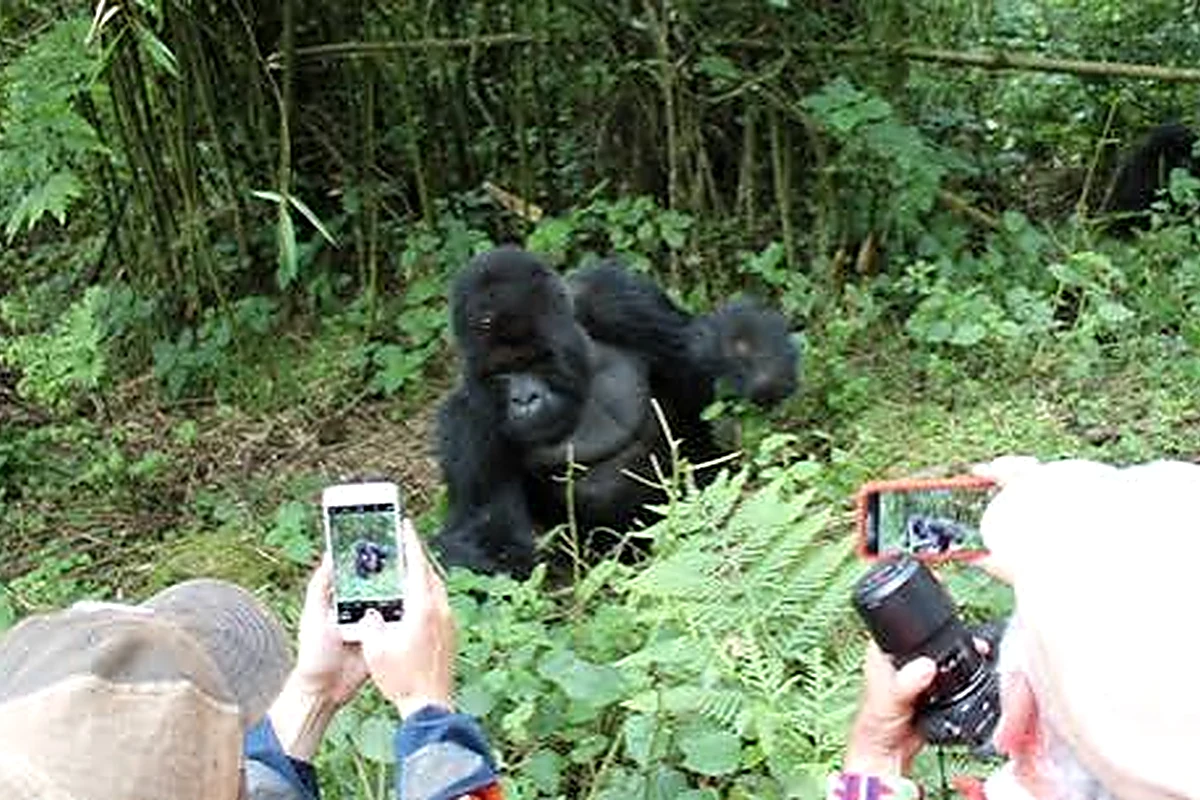
Visitors capture photographs of gorillas surrounded by lush forest vegetation.
Planning a Comfortable Trek With PrideMark Safaris
Planning gorilla trekking with glasses begins with a realistic conversation about your needs. If glasses are central to your mobility or you have limited vision in one eye, explain how that affects walking on slopes and in low light. You do not need to disclose unrelated medical details. The useful information is what practical support, pacing, or itinerary planning might help you participate safely and confidently.
Permit availability and park allocations influence the itinerary, and gorilla families may move across different parts of the forest. No tour operator can guarantee a flat trail, a specific hiking duration, or a particular gorilla encounter. PrideMark Safaris can help you consider travel timing, accommodation, transfers, and the questions to raise with the trekking authorities. The final route and operational decisions remain with park staff.
Accommodation location matters because trekking briefings typically begin early. A lodge near the correct sector reduces unnecessary morning travel and gives you time to check your glasses, pack spare lenses, and prepare rainwear. Uganda’s Bwindi sectors are not interchangeable at the last minute, so confirm the permit sector before finalizing accommodation. Good logistics support a calmer morning, particularly for travelers managing multiple pieces of equipment.
Transport days also affect eyewear comfort. Dust, air-conditioning, and long drives can irritate some contact lens wearers, while bright sunshine can make prescription sunglasses useful. Keep your main spectacles accessible during road transfers. Do not store them loose on a vehicle seat where they can be sat on or fall between cushions. A small routine for protecting your glasses can prevent avoidable problems before trekking begins.
If you have significant visual impairment, ask specific questions rather than relying on broad assurances that gorilla trekking is easy. Discuss whether you normally use a mobility aid, how you manage steps, and what assistance might be appropriate. Accessibility options vary with terrain and park operations, and any special arrangements require advance discussion and confirmation. Honest planning is more helpful than promising a particular outcome.
To discuss a personalized itinerary, contact PrideMark Safaris with your preferred travel dates, group size, and the practical support you may need. Our role is to help organize the safari and communicate relevant requirements, not to replace park authorities or medical professionals. With the right preparation, travelers who wear glasses can concentrate on the wildlife experience rather than worrying about their prescription lenses.
Common Mistakes and Final Practical Advice
One common mistake during gorilla trekking with glasses is relying on a single pair of glasses for an entire international safari. Even sturdy frames can break, and lenses can be scratched by grit. If a second usable pair is available, pack it separately. Another mistake is leaving the microfiber cloth exposed in a pocket where rain and mud can soak it. Simple redundancy often works better than expensive accessories.
Another problem is buying new contact lenses, anti-fog coatings, or unfamiliar frames immediately before departure. An item that seems convenient in a shop may cause discomfort after several hours outdoors. Test new products on ordinary walks at home, ideally while wearing the hat and jacket you plan to bring. If anything causes headaches, slipping, or poor visibility, return to equipment that works reliably.
Do not confuse a foggy lens with a reason to rush. If you cannot see a steep step, ask for a pause. The trek is guided, and safety depends on communication. Likewise, do not remove necessary prescription glasses simply to look better in a photograph. Your ability to follow instructions and move safely is more important than how you appear in an image.
It is also unwise to assume that all rainforest weather is heavy rain. A trek may be dry, misty, humid, or wet, and conditions can change quickly. Prepare for several possibilities without carrying a suitcase of optical accessories. A clear primary pair, a protected backup, dry cloths, and sensible headwear will cover many ordinary problems that glasses wearers encounter outdoors.
Finally, remember that eyewear is only one part of responsible gorilla trekking. Follow park health screening and conservation rules, keep the required distance, do not use flash, and listen to the ranger throughout the visit. If you are unwell, disclose symptoms and follow the applicable guidance. Clear vision should support safe, respectful behavior around wildlife, not encourage you to move closer than permitted.
Gorilla trekking with glasses should not feel like a specialist expedition simply because you use prescription lenses. With realistic expectations and a few familiar accessories, many travelers can manage the conditions comfortably. PrideMark Safaris can help plan the travel arrangements and explain what to expect, while your eye-care professional can advise on prescription-specific questions. The best preparation is practical, personal, and grounded in the realities of Uganda’s forests.
Additional Field Guide: From Preparation to the Return Walk
Before You Leave Home
For gorilla trekking with glasses, begin with an eyewear check rather than a shopping spree. Tighten loose screws through an optician if necessary, inspect nose pads, and confirm that your prescription is still comfortable for distance walking. If you normally switch between two pairs, practice doing so outdoors. A small problem that is manageable at home may become distracting during a full trekking day in unfamiliar terrain.Before gorilla trekking with glasses, travelers should check their prescription, clean their lenses and inspect their frames.
Walk outside in your planned trekking hat and rain jacket. Turn your head, look down at steps, and check whether the hood presses the frames against your ears. Try the retainer strap while carrying a backpack. These simple tests reveal slipping and pressure points before you reach Uganda, where the trekking morning is not an ideal time for equipment adjustments.
If you have a complicated prescription, ask your optician whether an emergency backup is appropriate. A spare pair does not need to be fashionable, but it should provide adequate vision for moving around safely. Travelers with only one functioning eye or significant vision limitations may benefit from individualized advice about glare, contrast, and depth perception. Avoid relying on generic internet recommendations for those decisions.
Keep the prescription information with your travel documents and store a separate copy securely. It may help explain your requirements if glasses are damaged, although a local replacement may not be available quickly. Insurance coverage for eyewear varies, so read your policy rather than assuming accidental damage is included. The objective is to reduce disruption, not to promise that every problem can be solved near the forest.
The Evening Before Trekking
Before gorilla trekking with glasses, lay out your glasses kit alongside your permit details, boots, rain jacket, water, and packed lunch arrangements. Clean the lenses using approved materials and put the spare pair in its case. Check that the microfiber cloth is dry. Preparing everything the night before prevents hurried decisions when you wake early and need to reach the park briefing point on time.
Ask your lodge about the expected departure time and the transport arrangements to your designated briefing point. Do not assume that a short distance on a map means a short drive on rural roads. Keep your primary glasses on your person rather than in a bag loaded into another vehicle. If the morning is misty, give yourself a moment to adjust before stepping onto wet ground.
Charge any camera batteries and test the viewfinder with your glasses. If you plan to use a mask, check the fit around your nose without compromising the mask’s protective function. Set out a cap or brimmed hat that does not obstruct your vision. Small preparations are valuable because the actual gorilla location and the day’s walking conditions will not be known in advance.
If your eyes are irritated or you develop an unexpected vision problem, do not attempt to solve it with unfamiliar medication. Seek appropriate medical advice. Sudden visual changes, severe eye pain, or a significant injury deserve prompt professional assessment rather than a plan to continue trekking regardless. The safari schedule can be discussed with the operator, but eye health decisions should not be improvised.
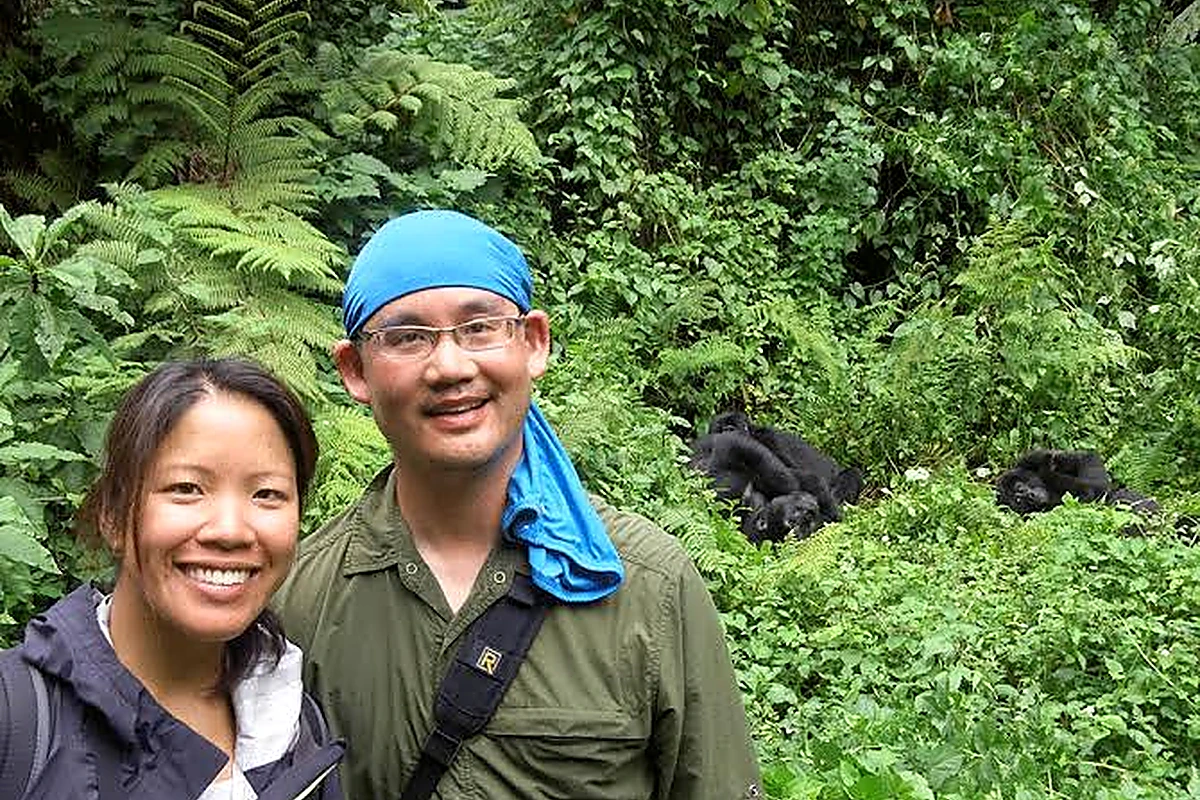
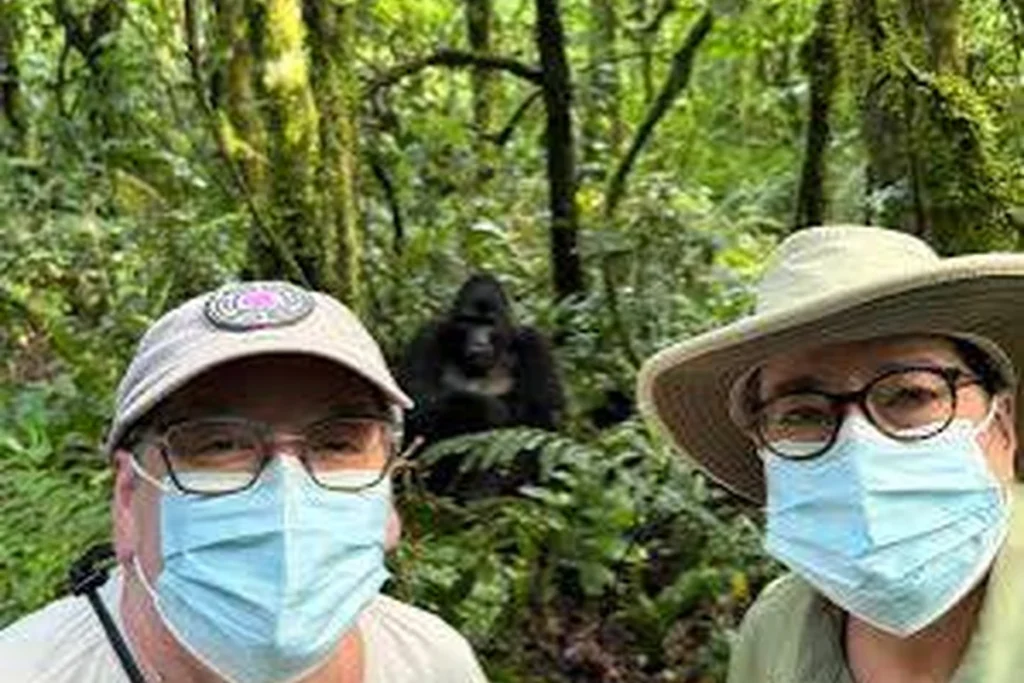
Two visitors pose for a photograph with gorillas visible among the lush rainforest vegetation behind them.
At the Briefing and on the Trail
During gorilla trekking with glasses, listen closely at the park briefing to the ranger’s instructions and mention any practical limitation that affects your walking. If you need to stop occasionally to clear your glasses, say so early. Rangers manage groups and routes according to operational conditions, and advance communication is easier than explaining a problem after you have slipped or fallen behind.
During the walk, keep one hand available when moving through vegetation or using a walking stick. Do not carry loose glasses in your hand while climbing. If you remove sunglasses, put them into a case or a secure pocket immediately. Hanging them loosely from your shirt collar can be convenient on a city walk but unreliable in dense undergrowth.
When the group pauses, check whether your lenses are clean enough for the next section. A brief maintenance stop can prevent repeated interruptions. Use a clean cloth, and avoid wiping across gritty mud. If the lenses become scratched or your frame breaks, switch to the spare pair while stationary and tell the ranger if your visibility has been affected.
Keep your attention on the terrain even when other visitors begin talking excitedly about gorilla tracks or distant sounds. Your eyes may need extra moments to adapt from a bright clearing to shaded vegetation. There is no prize for moving fastest. A steady pace, appropriate footwear, and clear communication contribute more to a successful experience than rushing to reach the viewing area.
After the Gorilla Encounter
After gorilla trekking with glasses, the walk back still requires concentration. Some visitors relax too early and pay less attention to wet ground on the return journey. Check that your glasses remain secure before the descent, and take care when fatigue sets in. A successful viewing hour does not remove the ordinary risks of roots, slopes, and changing weather.
Back at the lodge, rinse or clean lenses according to the manufacturer guidance and dry the frames carefully. Open the case so trapped moisture can escape. If your retainer strap became wet, allow it to dry separately. This routine is especially useful if you will travel onward to another national park or undertake additional outdoor activities during the same safari.
Review what worked for you. Perhaps the hat brim was helpful, the strap uncomfortable, or the spare cloth essential. Small adjustments can improve the next walking day. Travelers often focus on camera settings after a gorilla encounter, but comfortable eyewear also deserves attention because it supports safe sightseeing during the remainder of the journey.
If your glasses were damaged, contact your insurer or optician as appropriate and discuss itinerary implications with PrideMark Safaris. Do not assume a replacement can be delivered immediately to a remote lodge. A functioning backup pair may allow the trip to continue while you arrange professional advice. Practical planning helps manage setbacks without making unrealistic promises about local optical services.
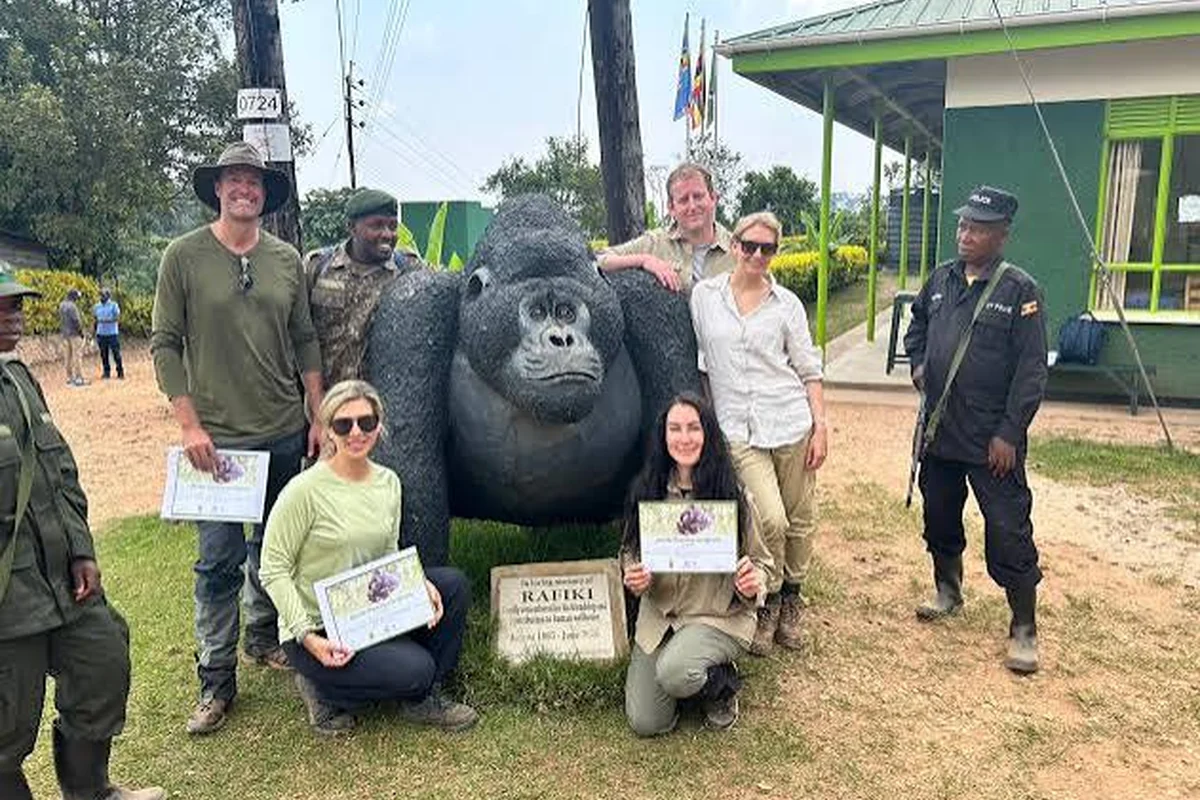
Gorilla trekking visitors celebrate their experience with certificates beside a large gorilla statue.
Frequently Asked Questions About Gorilla Trekking With Glasses
Gorilla trekking with glasses is generally manageable for visitors who normally wear prescription eyewear every day.
Can I wear prescription glasses during gorilla trekking?
Yes. Prescription glasses are generally compatible with a guided gorilla trek. The important considerations are secure fit, clear visibility, and safe movement on uneven terrain. Keep the glasses you need for walking, carry a dry cloth, and follow ranger instructions. If you have significant vision limitations, discuss practical arrangements before booking rather than assuming every trail will be suitable.
Are contact lenses better than glasses for gorilla trekking?
Neither option is automatically better. Contacts may avoid rain droplets on spectacle lenses, but they require careful hygiene and may irritate some eyes. Glasses are easier to remove and clean but can fog. Choose the correction you already use comfortably outdoors, and bring prescription spectacles as a backup if you normally trek in contact lenses.
What if my glasses fog up in the rainforest?
Stop in a safe place, let the group know if needed, and clean the lenses with a dry microfiber cloth. A hat brim and a well-fitted face covering can sometimes reduce moisture problems. Avoid wiping lenses while walking on slippery ground. Test any anti-fog product beforehand and confirm that it is compatible with your lens coating.
Should I bring spare glasses to Bwindi?
A spare pair is strongly recommended when prescription glasses are essential for your vision. Store the backup in a hard case and waterproof pouch, separate from the primary pair. Optical replacement services may not be readily available near the trekking sectors, and a damaged frame could otherwise disrupt the safari. Make sure the spare prescription is still usable.
Can I wear sunglasses on the gorilla trek?
You may find sunglasses useful during bright travel sections, but dark lenses can reduce visibility under a shaded forest canopy. Carry clear prescription lenses if you need them for walking safely. Choose frames that stay secure and avoid changing pairs while moving. The best choice depends on your eyesight, the weather, and the particular light conditions.
Will rain damage my prescription glasses?
Ordinary rain does not necessarily damage modern spectacles, but moisture, grit, and careless cleaning can cause problems. Protect lenses from scratches by avoiding dirty sleeves, and dry frames and cases after the trek. Check the manufacturer instructions for any special coatings. A brimmed hat and a clean cloth are often practical additions to your kit.
Can I photograph gorillas while wearing glasses?
Yes. Practice using your camera viewfinder or screen with glasses before the trip, and adjust the camera settings while stationary. Do not move closer to gorillas because a viewfinder looks blurred. Follow ranger directions and the applicable no-flash rule. Photography is secondary to conservation requirements, visitor safety, and respectful observation of wild animals.
Are progressive lenses suitable for trekking?
Many people use progressive lenses comfortably, but some notice distortion when looking down at steps through the near-vision portion. Practice walking on uneven ground with your normal lenses before departure. If you regularly struggle with depth perception, ask your optician whether another pair would be appropriate. Avoid changing prescriptions solely on the basis of general travel advice.
What happens if I drop my glasses near gorillas?
Do not rush forward or attempt to retrieve equipment without guidance. Stay calm, keep your distance, and follow the ranger’s instructions. Gorilla movements and the group position take priority over dropped personal items. A secure retainer strap may reduce the likelihood of losing your glasses, while a spare pair helps if the primary pair cannot be recovered.
Can travelers with poor eyesight book a gorilla safari?
Many travelers with corrected vision can participate, but suitability depends on their functional vision, mobility, and the terrain. If you have substantial visual impairment, explain your practical needs to the operator and seek relevant professional advice. Park authorities manage trekking operations, and no company can guarantee a particular route or level of difficulty for a moving gorilla family.
Do I need special anti-fog glasses?
Not necessarily. Familiar prescription glasses, a brimmed hat, and clean dry cloths may be enough for many travelers. Anti-fog coatings and sprays vary in effectiveness and compatibility. If you decide to use one, test it in advance and follow the lens manufacturer guidance. Avoid introducing unfamiliar products during the trek itself.One challenge of gorilla trekking with glasses is lens fogging when warm breath meets cooler surfaces.
How can PrideMark Safaris help me prepare?
PrideMark Safaris can help with itinerary planning, accommodation near the appropriate trekking sector, transfers, and practical packing discussions. Tell the team about relevant mobility or visibility needs so they can be raised in advance. Prescription decisions remain with your eye-care professional, while park rangers control the trekking route and instructions during the actual forest experience.With sensible preparation, gorilla trekking with glasses can be a comfortable and rewarding wildlife experience in Uganda.
Useful Official and Practical References
For current trekking requirements, consult the Uganda Wildlife Authority and the IUCN SSC Primate Specialist Group’s great ape conservation resources. For contact lens hygiene and prescription questions, consult your own qualified eye-care professional. For itinerary planning and sector-specific travel arrangements, contact PrideMark Safaris before confirming your safari.
Ready to plan your gorilla safari? Share your preferred dates, number of travelers, and any practical walking or vision requirements with PrideMark Safaris. We can discuss transport, accommodation, trekking-sector logistics, and sensible preparations while keeping the final trekking decisions with the park authorities. A well-organized safari leaves you more time to appreciate Uganda’s remarkable mountain gorillas.