At PrideMark Safaris, we encourage visitors to think about the complete trekking experience: supportive footwear, weather protection, a comfortable pace, local guidance and appropriate respect for wildlife. A trekking pole can be useful, but it is only one part of preparation. A simple walking stick may serve an occasional visitor as well as an expensive pair of collapsible poles.
This detailed guide explains how to compare wooden sticks, adjustable poles, aluminium and carbon-fibre shafts, grips, lengths and tips. It also covers using poles responsibly around gorillas and maintaining them after wet forest walks. For official activity information, consult the Uganda Wildlife Authority gorilla tracking page.
1. Why Trekking Poles Matter for Gorilla Trekking
Balance on unpredictable ground
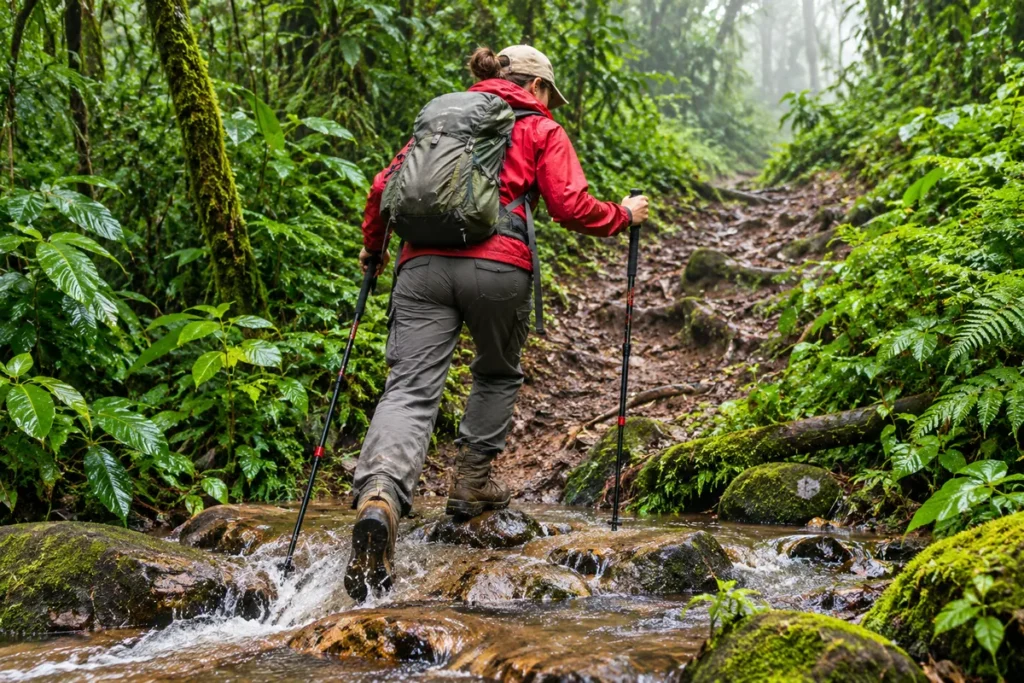
A gorilla trek can move from a firm approach path into soft earth, exposed roots, wet stones and short steep slopes. A pole adds a deliberate third point of contact while the walker judges each foothold. It cannot make a slippery surface safe by itself, but it can help people move at a controlled pace instead of rushing to regain balance.
A practical test is to ask whether you can release, carry and store the equipment without stopping other trekkers. Look for simple operation and predictable handling rather than complicated features. If a design feels unfamiliar, rehearse it before your trip so the trekking morning can focus on listening to your ranger.
Managing fatigue without promising miracles
Trekking poles can distribute some work through the arms and make a long ascent feel more manageable for some hikers. Their usefulness depends on technique, fitness, terrain and personal comfort. Anyone with a joint condition should ask a clinician about individual needs rather than treating a pole as a substitute for physical preparation.
Think about the whole journey from your accommodation to the briefing point and back. A pole needs to fit into your luggage, survive transport and remain comfortable after repeated use. The best choice is often the simplest option that you already know how to handle safely.
Why gorilla trekking is different from a normal hike
The aim is not to cover a known distance at speed. Rangers select a route according to where the habituated gorilla family is located, and conditions can change during the morning. A useful walking aid must be easy to carry, quiet, and simple to put aside when guides instruct visitors to stop or prepare for viewing.
Walking sticks may already be available
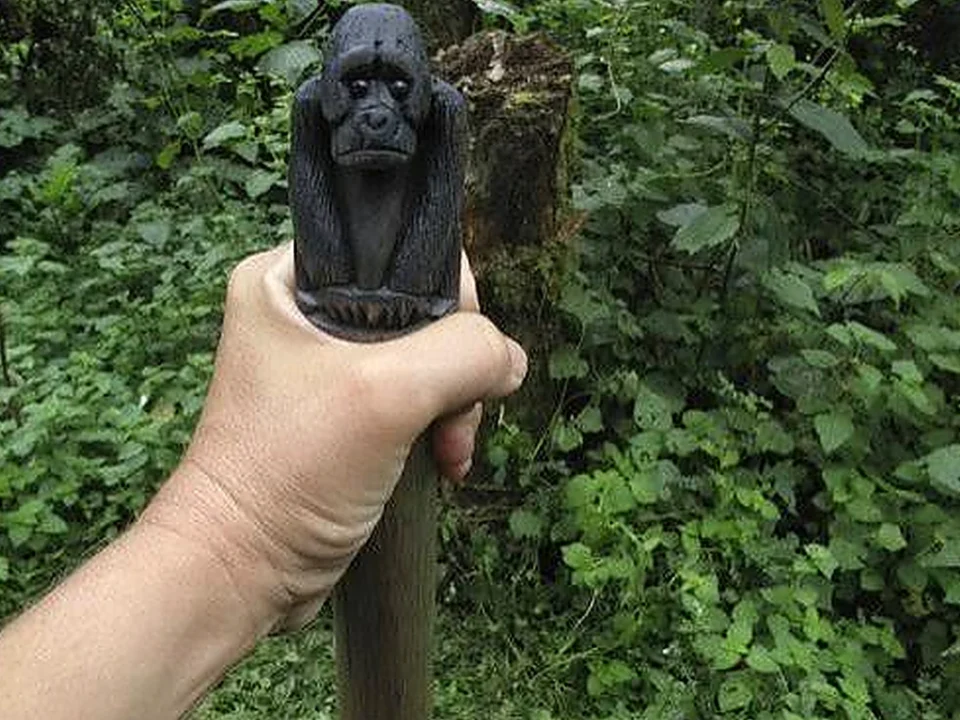
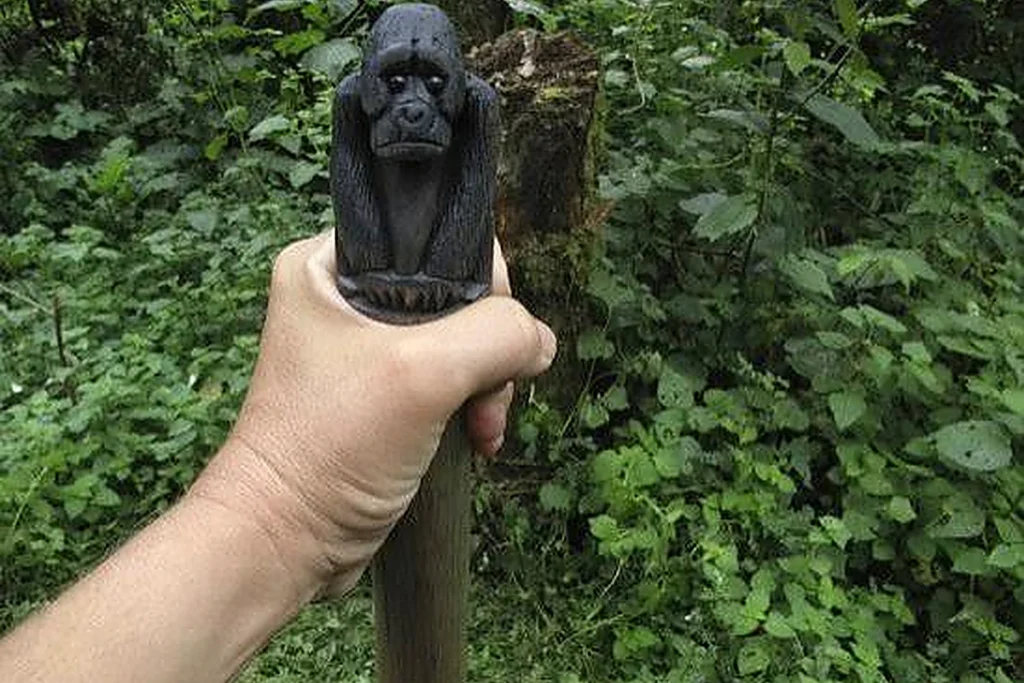
At many gorilla trekking briefing points, local walking sticks are commonly offered or available to arrange. Availability and any local arrangements can vary. Ask your operator before buying an expensive pair for a single excursion. A simple wooden stick can be a sensible choice when the trail is narrow and one hand must remain free.
Comfort is personal. Two travelers of the same height may prefer different grip shapes or pole lengths because their stride, gloves and hiking habits differ. Make your decision through a short trial rather than relying on a photograph, a product label or someone else’s favorite model.
Plan the whole day, not only the pole
Footwear, gaiters, rainwear, drinking water and a manageable daypack matter alongside a walking aid. An excellent pole will not compensate for unsuitable shoes or an overloaded backpack. When discussing a route with PrideMark Safaris, mention your walking experience and whether you prefer one stick or two so the preparation advice suits you.
Forest conditions can vary considerably within the same day. A muddy slope may demand more concentration than a level approach path, and a dry section may require no walking aid at all. Good judgment includes knowing when to put the pole away, shorten your stride and accept help from a trained local guide.
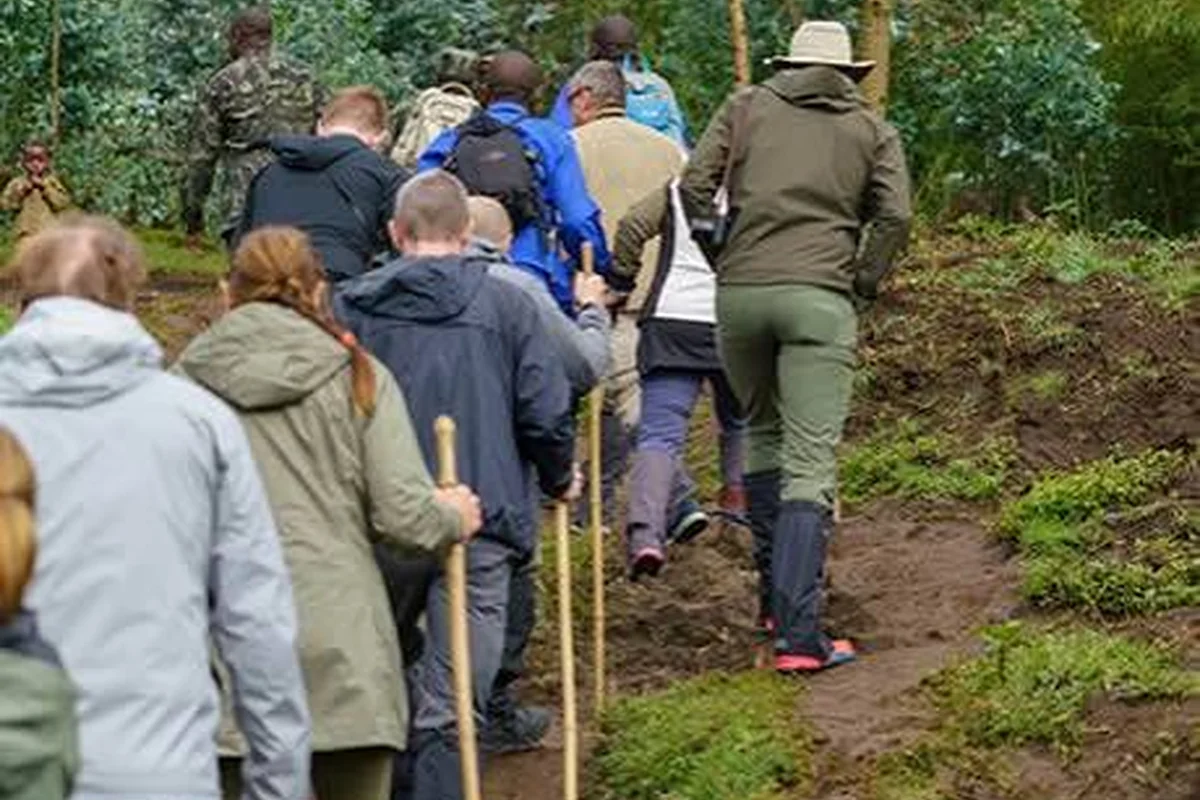
Trekkers use wooden walking sticks for support while following a steep, muddy forest trail during a guided hike.
2. Best Types of Trekking Poles for Gorilla Trekking
Choosing the best trekking poles for gorilla trekking requires matching equipment to your own abilities and the expected terrain. PrideMark Safaris can help you plan your safari, while park rangers remain responsible for on-trail directions. The following considerations are general guidance rather than promises that a particular product will prevent slips or injuries.
Single wooden walking stick
A sturdy wooden stick is straightforward, usually easy to grip and often sufficient for occasional muddy sections. It avoids the adjustment mechanisms of technical poles. The disadvantages are limited length adjustment, possible weight differences and the absence of a dedicated wrist strap. Never cut vegetation or collect wood from a protected forest to make one.
Telescopic aluminium poles
A telescopic pole uses sliding sections that lock at the desired height. This is convenient for different users and changing gradients. Look for locks that remain secure when wet and are easy to operate with damp hands. Check the assembled pole before starting; an unsecured section can collapse at exactly the wrong moment.
Forest conditions can vary considerably within the same day. A muddy slope may demand more concentration than a level approach path, and a dry section may require no walking aid at all. Good judgment includes knowing when to put the pole away, shorten your stride and accept help from a trained local guide.
Folding trekking poles
Folding designs pack into shorter sections and can fit inside luggage more easily. They are useful for travelers who want to bring poles from home without checking unusually long equipment. Some have limited adjustment ranges, so verify the stated fit range before purchase. Rehearse assembly before travel rather than learning beside a muddy trail.
Think about the whole journey from your accommodation to the briefing point and back. A pole needs to fit into your luggage, survive transport and remain comfortable after repeated use. The best choice is often the simplest option that you already know how to handle safely.
Shock-absorbing poles
Some trekking poles have springs or other damping mechanisms. They may feel comfortable to certain walkers on hard ground, but added moving parts can introduce noise, weight and maintenance. Shock absorption is not essential for forest trekking. A secure lock, suitable grip and correct length usually deserve attention first.
Forest conditions can vary considerably within the same day. A muddy slope may demand more concentration than a level approach path, and a dry section may require no walking aid at all. Good judgment includes knowing when to put the pole away, shorten your stride and accept help from a trained local guide.
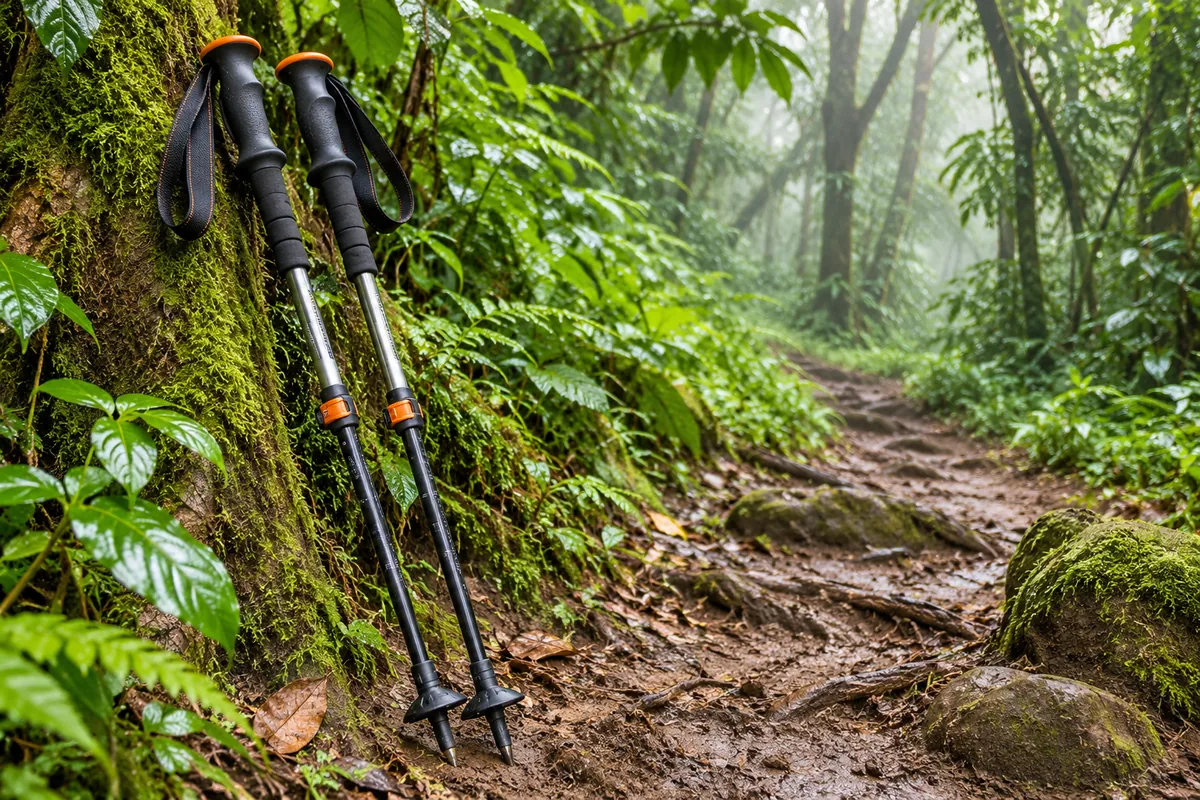
Adjustable trekking poles with comfortable grips and wrist straps beside a rainforest hiking trail.
One pole or two?
Two poles can provide a regular rhythm on open tracks, while one may be easier to manage when stepping around vegetation or carrying a camera. The appropriate choice depends on the trail and ranger directions. If you bring two, be ready to stow one or both rather than insisting on using them in every section.
Forest conditions can vary considerably within the same day. A muddy slope may demand more concentration than a level approach path, and a dry section may require no walking aid at all. Good judgment includes knowing when to put the pole away, shorten your stride and accept help from a trained local guide.
| Pole type | Potential advantage | Main consideration |
|---|---|---|
| Local wooden walking stick | Simple support and often available locally | Limited length adjustment; confirm availability |
| Telescopic aluminium pole | Adjustable and commonly durable | Check locks and packed size |
| Folding pole | Compact for travel | Check assembly and fit range |
| Shock-absorbing pole | May feel comfortable on firm surfaces | Extra complexity is not essential |
3. Wooden Walking Sticks Versus Adjustable Trekking Poles
The simplicity advantage
A traditional stick has few parts to fail and can be passed from one hand to the other quickly. On short forest sections it may provide all the support a traveler wants. However, the grip may not be shaped for prolonged use and the length may be inconvenient on descents or for shorter walkers.
A practical test is to ask whether you can release, carry and store the best trekking poles for gorilla trekking without stopping other trekkers. Look for simple operation and predictable handling rather than complicated features. If a design feels unfamiliar, rehearse it before your trip so the trekking morning can focus on listening to your ranger.
Adjustability on slopes
An adjustable pole can be shortened for climbing and lengthened slightly for descending, depending on technique. That flexibility is valuable on rolling terrain, but it also means stopping to make changes safely. Do not adjust a locking mechanism while placing your full weight on the pole.
Before committing to a purchase, imagine using this option while carrying a small daypack, wearing rainwear and moving behind a group on a narrow path. Equipment that works beautifully on a dry pavement may feel awkward in a damp forest. Try it on uneven but safe ground, and pay attention to how naturally your hands and feet coordinate.
Grip and wrist considerations
Manufactured poles offer foam, cork or rubber grips, sometimes with extended sections for changing hand position. A wooden stick may feel more natural to some people. Wrist straps are not always appropriate around dense vegetation; if a strap catches or pulls the hand, it can create a problem rather than solve one.
A practical test is to ask whether you can release, carry and store the equipment without stopping other trekkers. Look for simple operation and predictable handling rather than complicated features. If a design feels unfamiliar, rehearse it before your trip so the trekking morning can focus on listening to your ranger.
Practical recommendation
For a traveler doing one gorilla trek, a locally available walking stick may be adequate. For someone already accustomed to hiking with adjustable poles, bringing a familiar pole can be reasonable if park staff permit its use. PrideMark Safaris can help guests ask about local arrangements before departure, without suggesting that any particular accessory guarantees a successful trek.
A practical test is to ask whether you can release, carry and store the best trekking poles for gorilla trekking without stopping other trekkers. Look for simple operation and predictable handling rather than complicated features. If a design feels unfamiliar, rehearse it before your trip so the trekking morning can focus on listening to your ranger.
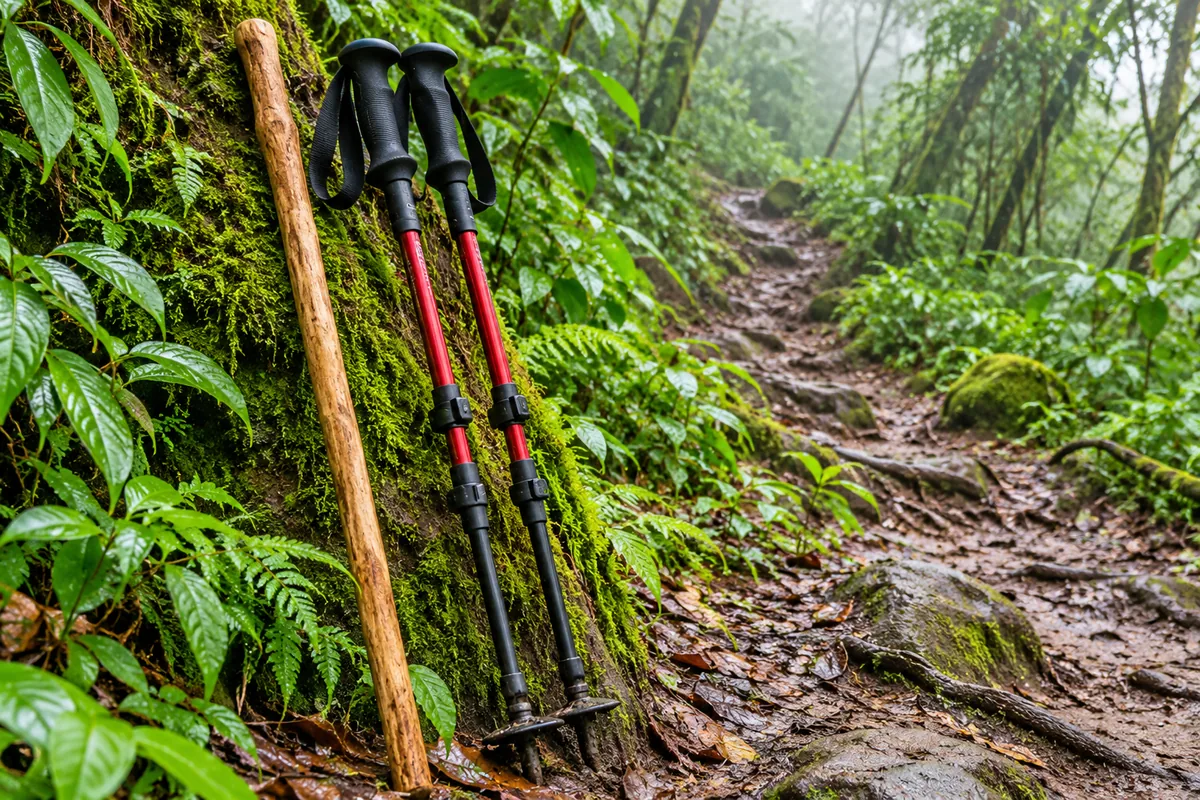
A traditional wooden walking stick compared with adjustable trekking poles on a forest trail.
4. Aluminium Versus Carbon-Fibre Trekking Poles
Aluminium construction
Aluminium poles are common, generally robust and often less costly than comparable carbon-fibre options. A bent section may remain visibly deformed after a heavy impact. Inspect the shaft and joints regularly. An affordable pole with reliable locks is often preferable to a premium pole with a grip that does not suit your hand.
Before committing to a purchase, imagine using this option while carrying a small daypack, wearing rainwear and moving behind a group on a narrow path. Equipment that works beautifully on a dry pavement may feel awkward in a damp forest. Try it on uneven but safe ground, and pay attention to how naturally your hands and feet coordinate.
Carbon-fibre construction
Carbon-fibre models can be light and stiff, which appeals to frequent hikers. Their behavior under sharp impact varies by construction, and damaged composite sections may fracture rather than bend. Do not assume every carbon-fibre pole is fragile or every aluminium pole is stronger; product quality and design matter.
Weight versus reliability
The lightest equipment is not always the best choice for a humid, muddy trip. A pole that is comfortable to hold, simple to clean and easy to lock securely can be more useful than saving a small amount of weight. Consider replacement parts and how easily you can test the pole before travel.
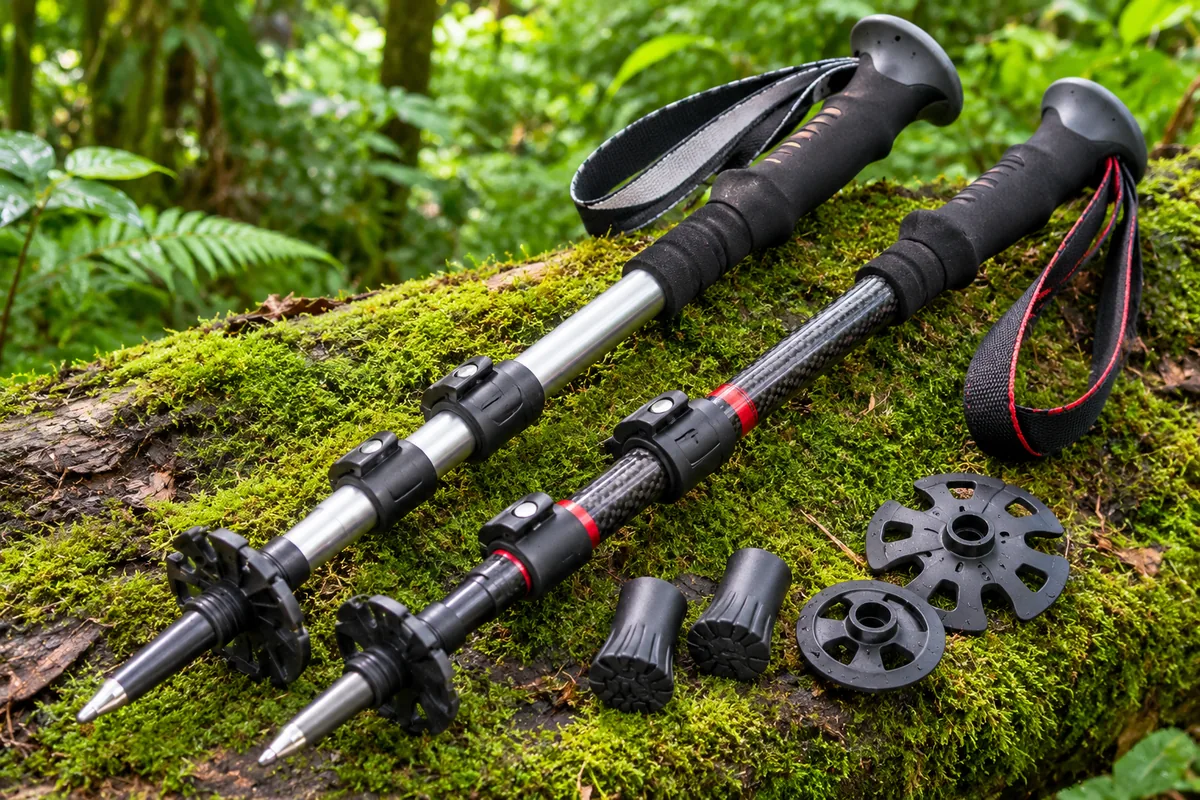
Aluminium and carbon-fibre trekking poles displayed with their grips, straps and interchangeable accessories.
Tips and baskets
Many poles have metal tips with removable rubber covers. A rubber cover can reduce noise and protect hard surfaces, but traction differs on wet rock and mud. Small baskets may limit sinking into soft ground, although they can snag vegetation. Ask guides which configuration is appropriate and avoid damaging delicate forest plants.
Comfort is personal. Two travelers of the same height may prefer different grip shapes or pole lengths because their stride, gloves and hiking habits differ. Make your decision through a short trial rather than relying on a photograph, a product label or someone else’s favorite model.
| Feature | Aluminium | Carbon fibre |
|---|---|---|
| Typical appeal | Often affordable and robust | Often lightweight and stiff |
| Possible damage | May bend under heavy force | May crack or fracture after impact |
| What matters most | Lock quality and grip comfort | Construction quality and shaft inspection |
| Best buying approach | Test before travel | Test before travel |
5. Choosing the Correct Pole Length, Grip and Wrist Strap
Choosing the best trekking poles for gorilla trekking requires matching equipment to your own abilities and the expected terrain. PrideMark Safaris can help you plan your safari, while park rangers remain responsible for on-trail directions. The following considerations are general guidance rather than promises that a particular product will prevent slips or injuries.
Start with a neutral position
As a starting point on level ground, hold the pole with the tip beside your foot and aim for a comfortable elbow bend near a right angle. This is a guideline rather than a fixed rule. Terrain, arm length, footwear and personal technique can all change the most comfortable setting.
Think about the whole journey from your accommodation to the briefing point and back. A pole needs to fit into your luggage, survive transport and remain comfortable after repeated use. The best choice is often the simplest option that you already know how to handle safely.
Test uphill and downhill
A slightly shorter pole may be easier uphill, while a longer setting can help some walkers on descents. Make adjustments only while stopped in a secure position. If changing lengths repeatedly feels distracting, choose a comfortable middle setting and prioritize foot placement over perfect geometry.
Choose a grip for wet hands
Foam grips are soft and often comfortable, cork can feel pleasant over longer hikes, and rubber may be durable but can feel different in heat. Try holding the grip with the gloves you intend to wear. Avoid a grip that forces your wrist into an awkward angle or feels slippery when damp.
A practical test is to ask whether you can release, carry and store the equipment without stopping other trekkers. Look for simple operation and predictable handling rather than complicated features. If a design feels unfamiliar, rehearse it before your trip so the trekking morning can focus on listening to your ranger.
Use straps cautiously
A wrist strap can reduce the need to squeeze a pole continuously, but dense branches and sudden movements create snagging risks. Follow guide advice, especially around wildlife. You may prefer to keep hands out of the straps in crowded vegetation so you can release a pole immediately if necessary.
Before committing to a purchase, imagine using this option while carrying a small daypack, wearing rainwear and moving behind a group on a narrow path. Equipment that works beautifully on a dry pavement may feel awkward in a damp forest. Try it on uneven but safe ground, and pay attention to how naturally your hands and feet coordinate.
Check the locking system
Extend and lock each section, then apply moderate downward pressure on safe ground before starting. Twist locks and lever locks both require maintenance. If the pole slips, clean and reset it according to the manufacturer rather than forcing a damaged mechanism. PrideMark Safaris recommends testing all gear before the trek morning.
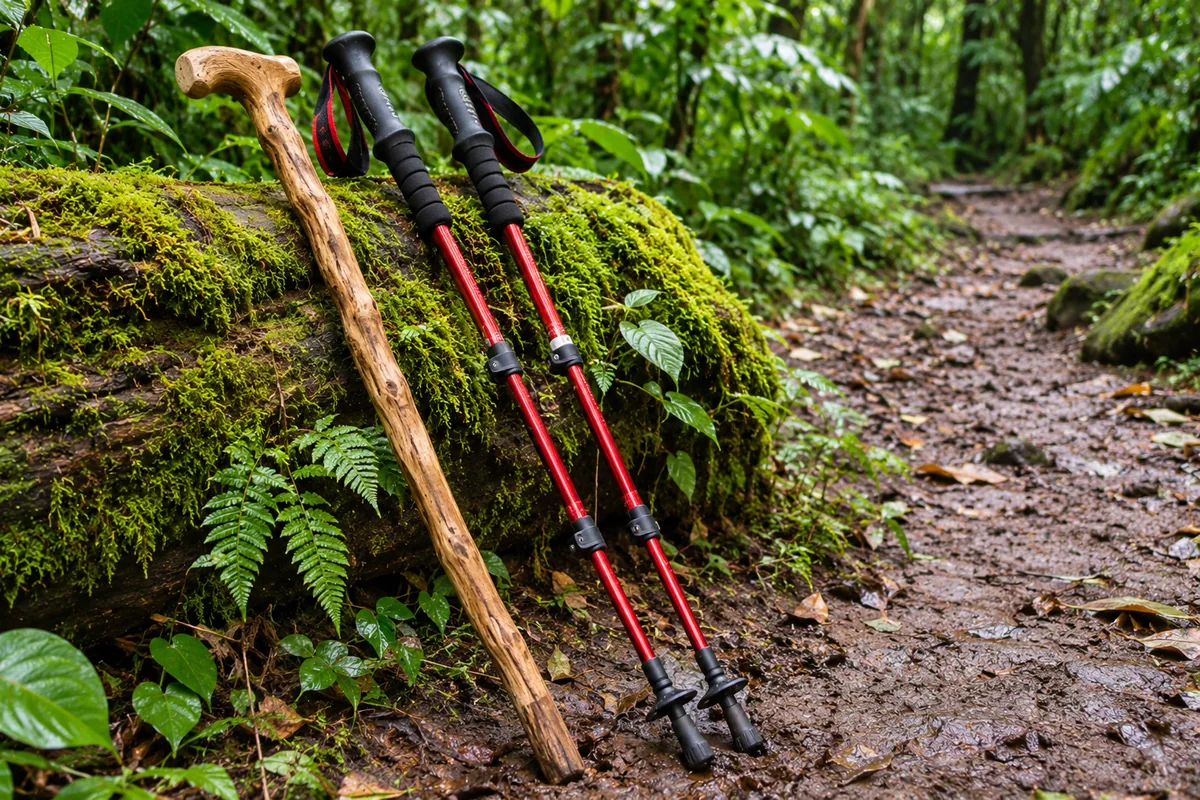
Adjustable trekking poles showing their grips, wrist straps, locking systems and interchangeable tips.
6. Using Trekking Poles on Bwindi and Mgahinga Forest Trails
Bwindi forest terrain
Bwindi trekking can involve steep hillsides, thick vegetation and slick patches after rain. A pole can help test a muddy foothold, but probing must be gentle to avoid damaging roots or plants. Stay behind your guide and follow the chosen path. Trekking sectors differ, and no single description fits every gorilla family location.
A practical test is to ask whether you can release, carry and store the best trekking poles for gorilla trekking without stopping other trekkers. Look for simple operation and predictable handling rather than complicated features. If a design feels unfamiliar, rehearse it before your trip so the trekking morning can focus on listening to your ranger.
Mgahinga conditions
Mgahinga lies in a mountainous landscape where elevation, weather and terrain can affect comfort. A walking aid may help on uneven slopes, but exposed areas and forest sections require different techniques. Bring layers and weather protection, not just poles. Ask for route-specific guidance rather than assuming a fixed difficulty.
Wet weather preparation
Rain can arrive even when the morning looks clear. Mud on grips and locks may make equipment harder to operate. Carry a cloth or use a clean section of fabric to wipe the handle if necessary. Keep a rain cover for your daypack and place electronics in a waterproof inner bag.
Keep a respectful wildlife distance
The purpose of trekking is to observe gorillas without disturbing them. When you reach the viewing area, listen to the rangers about where to stand and what to do with walking aids. Never point a pole toward a gorilla, use it to move vegetation around an animal, or leave it where someone may trip.
Work with the guide
Rangers and local guides understand the route and may recommend a different way to cross a slippery patch. A pole should support those instructions, not override them. PrideMark Safaris helps travelers prepare for forest conditions while emphasizing that the park team has the final say on movement and conduct during the activity.
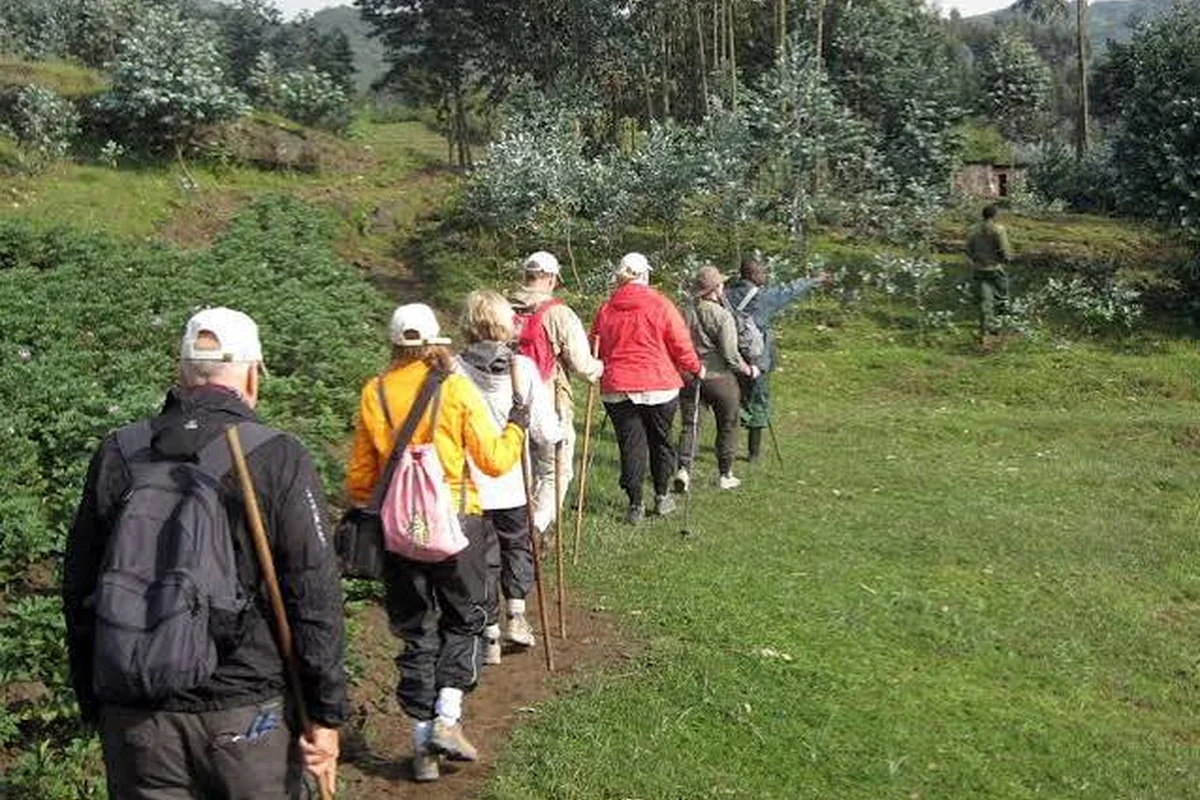
A group of trekkers follows a green forest trail with wooden walking sticks for additional support during their hike.
7. Trekking Poles for Steep Slopes, Mud and Stream Crossings
Climbing steep ground
Keep movements small and deliberate. Plant the pole on a stable spot before transferring part of your weight, then step up using your legs rather than hauling your body with your arms. Avoid planting the tip in loose leaves that may conceal a hole or rolling stone.
Forest conditions can vary considerably within the same day. A muddy slope may demand more concentration than a level approach path, and a dry section may require no walking aid at all. Good judgment includes knowing when to put the pole away, shorten your stride and accept help from a trained local guide.
Descending safely
On a descent, maintain space between yourself and the person ahead. A pole can help judge the next step, but leaning too far forward may reduce stability. Short steps and well-fitted boots are more important than reaching far downhill with the pole. Ask for help when a section feels beyond your comfort.
Think about the whole journey from your accommodation to the briefing point and back. A pole needs to fit into your luggage, survive transport and remain comfortable after repeated use. The best choice is often the simplest option that you already know how to handle safely.
Mud and roots
A metal tip may sink into soft earth or slip from a rounded root. Do not rely on a single pole placement to hold your entire weight. Watch for roots hidden by leaves, and avoid pulling the pole sharply if its tip becomes stuck. Slow, balanced movement reduces unnecessary strain.
Comfort is personal. Two travelers of the same height may prefer different grip shapes or pole lengths because their stride, gloves and hiking habits differ. Make your decision through a short trial rather than relying on a photograph, a product label or someone else’s favorite model.
Crossing shallow water
Only cross where the ranger directs. Test the ground cautiously and keep your steps short. Water can hide slippery stones, holes and moving sediment. If the crossing is difficult, accept assistance or wait for the guide to identify a safer route. A trekking pole is not a substitute for a secure crossing.
When to stop using a pole
In very dense undergrowth, during a scramble that requires both hands, or when viewing gorillas, the safest option may be to stow the pole. Never wedge a pole into vegetation or abandon it on the path. Plan how you will carry it before the trail becomes difficult.
A practical test is to ask whether you can release, carry and store the equipment without stopping other trekkers. Look for simple operation and predictable handling rather than complicated features. If a design feels unfamiliar, rehearse it before your trip so the trekking morning can focus on listening to your ranger.
8. Nine Essential Tips for Choosing and Using Trekking Poles
Choosing the best trekking poles for gorilla trekking requires matching equipment to your own abilities and the expected terrain. PrideMark Safaris can help you plan your safari, while park rangers remain responsible for on-trail directions. The following considerations are general guidance rather than promises that a particular product will prevent slips or injuries.
Tip 1: Decide whether you need to buy one
Ask whether a walking stick is normally available at your briefing point. Buying technical poles may be unnecessary for a single outing. If you already own a reliable pole, consider bringing it rather than purchasing another.
Tip 2: Prioritize a secure locking mechanism
Test the locking system repeatedly before travel. A pole that collapses under normal use is unsuitable regardless of price or appearance. Check each section after a long transfer and before entering the forest.
A practical test is to ask whether you can release, carry and store the equipment without stopping other trekkers. Look for simple operation and predictable handling rather than complicated features. If a design feels unfamiliar, rehearse it before your trip so the trekking morning can focus on listening to your ranger.
Tip 3: Choose a comfortable grip
Hold the pole for several minutes and simulate a walking motion. Your hand should remain relaxed. Test the grip with gloves if you expect to wear them, and avoid pressure points that become uncomfortable quickly.
Comfort is personal. Two travelers of the same height may prefer different grip shapes or pole lengths because their stride, gloves and hiking habits differ. Make your decision through a short trial rather than relying on a photograph, a product label or someone else’s favorite model.
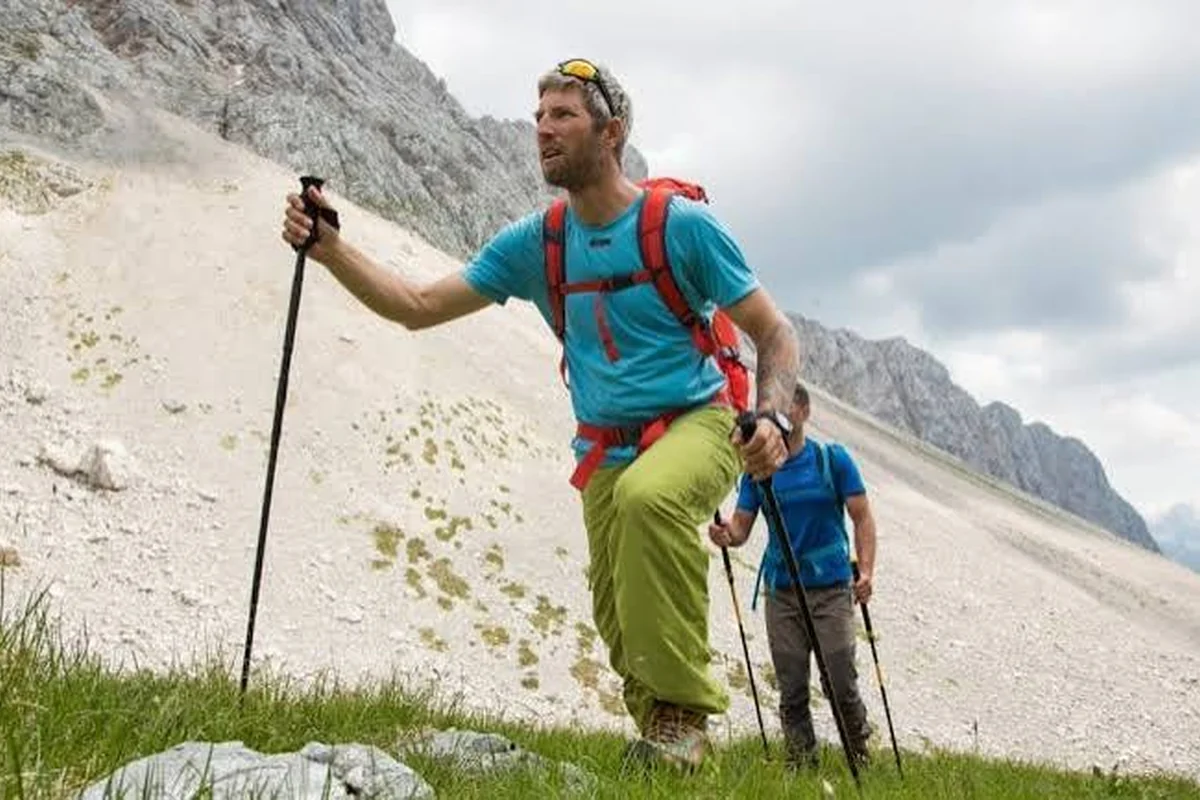
Two hikers use trekking poles for stability while navigating a rocky mountain trail, demonstrating the importance of reliable walking support.
Tip 4: Select a manageable weight
A heavy pole may tire the arm over a long day, while an ultralight model may cost more without offering a practical advantage. Balance weight against reliability, comfort and ease of packing.
Tip 5: Learn to adjust the length
Practice changing the length while standing still. Make small changes for slopes when helpful, and secure the locks fully. Do not attempt adjustments while moving across slippery ground.
Tip 6: Think about travel and luggage
Check whether a folding or telescopic pole fits your baggage. Airline and airport security rules for carrying trekking poles vary, so verify your carrier’s current policy before departure.
Tip 7: Protect the forest
Avoid dragging metal tips across exposed roots or striking vegetation. Keep baskets and straps from snagging plants. Stay on the route chosen by the ranger and carry out any broken equipment.
Tip 8: Practice on local walks
A few walks on hills or uneven ground can reveal whether you prefer one pole or two. Practice helps you develop a natural rhythm and recognize when the pole is interfering rather than helping.
Forest conditions can vary considerably within the same day. A muddy slope may demand more concentration than a level approach path, and a dry section may require no walking aid at all. Good judgment includes knowing when to put the pole away, shorten your stride and accept help from a trained local guide.
Tip 9: Follow ranger instructions
Your guide may ask you to set the pole aside, keep it pointed downward or leave it with a porter before approaching the viewing area. Cooperate promptly. PrideMark Safaris considers responsible wildlife conduct more important than any piece of gear.
| Common mistake | Why it matters | Better approach |
|---|---|---|
| Buying without checking local sticks | May add unnecessary cost and luggage | Ask your operator first |
| Using an unlocked pole | Can collapse during a step | Test locks before departure |
| Relying on the pole instead of boots | Does not replace traction | Wear suitable footwear |
| Ignoring ranger instructions | Can disrupt safe wildlife viewing | Stow poles when directed |
9. Practical Buying, Packing and Maintenance Checklist
Before buying
Check the assembled length, grip comfort, lock reliability, tip condition, replacement parts and packed size. Read the product’s instructions and return policy. Avoid selecting a pole solely because its marketing claims promise pain relief or exceptional performance.
A practical test is to ask whether you can release, carry and store the equipment without stopping other trekkers. Look for simple operation and predictable handling rather than complicated features. If a design feels unfamiliar, rehearse it before your trip so the trekking morning can focus on listening to your ranger.
Before leaving home
Walk with your chosen pole, check the joints and clean the shaft. Pack tip covers if useful and confirm airline baggage rules. Keep the pole accessible in your main luggage rather than assuming you can carry it into an aircraft cabin.
Forest conditions can vary considerably within the same day. A muddy slope may demand more concentration than a level approach path, and a dry section may require no walking aid at all. Good judgment includes knowing when to put the pole away, shorten your stride and accept help from a trained local guide.
The evening before trekking
Prepare boots, socks, gaiters, waterproof jacket, drinking water, snacks and a compact daypack. Confirm the meeting time and sector with your operator. Ask whether walking sticks and porter services are available locally. PrideMark Safaris can discuss these practical questions as part of trip preparation.
Before committing to a purchase, imagine using this option while carrying a small daypack, wearing rainwear and moving behind a group on a narrow path. Equipment that works beautifully on a dry pavement may feel awkward in a damp forest. Try it on uneven but safe ground, and pay attention to how naturally your hands and feet coordinate.
On the trail
Move at a manageable pace, keep enough space from other trekkers and ask for assistance when needed. Do not use a pole to clear branches, touch wildlife or probe sensitive habitat. Stow it securely whenever the guide requests.
After the trek
Wipe off mud, let the pole dry fully, inspect locks and tips, and store it according to the manufacturer’s instructions. Do not leave damp equipment sealed inside a bag for days. Simple maintenance helps prevent corrosion and seized mechanisms.
Forest conditions can vary considerably within the same day. A muddy slope may demand more concentration than a level approach path, and a dry section may require no walking aid at all. Good judgment includes knowing when to put the pole away, shorten your stride and accept help from a trained local guide.
Final perspective
The best trekking poles for gorilla trekking are not necessarily the most expensive models. They are the ones that suit your height, hand comfort, luggage, walking habits and the route conditions. For many travelers, a simple local stick is sufficient. The lasting highlight is the forest and the gorillas, not the equipment you carried.
Before committing to a purchase, imagine using this option while carrying a small daypack, wearing rainwear and moving behind a group on a narrow path. Equipment that works beautifully on a dry pavement may feel awkward in a damp forest. Try it on uneven but safe ground, and pay attention to how naturally your hands and feet coordinate.
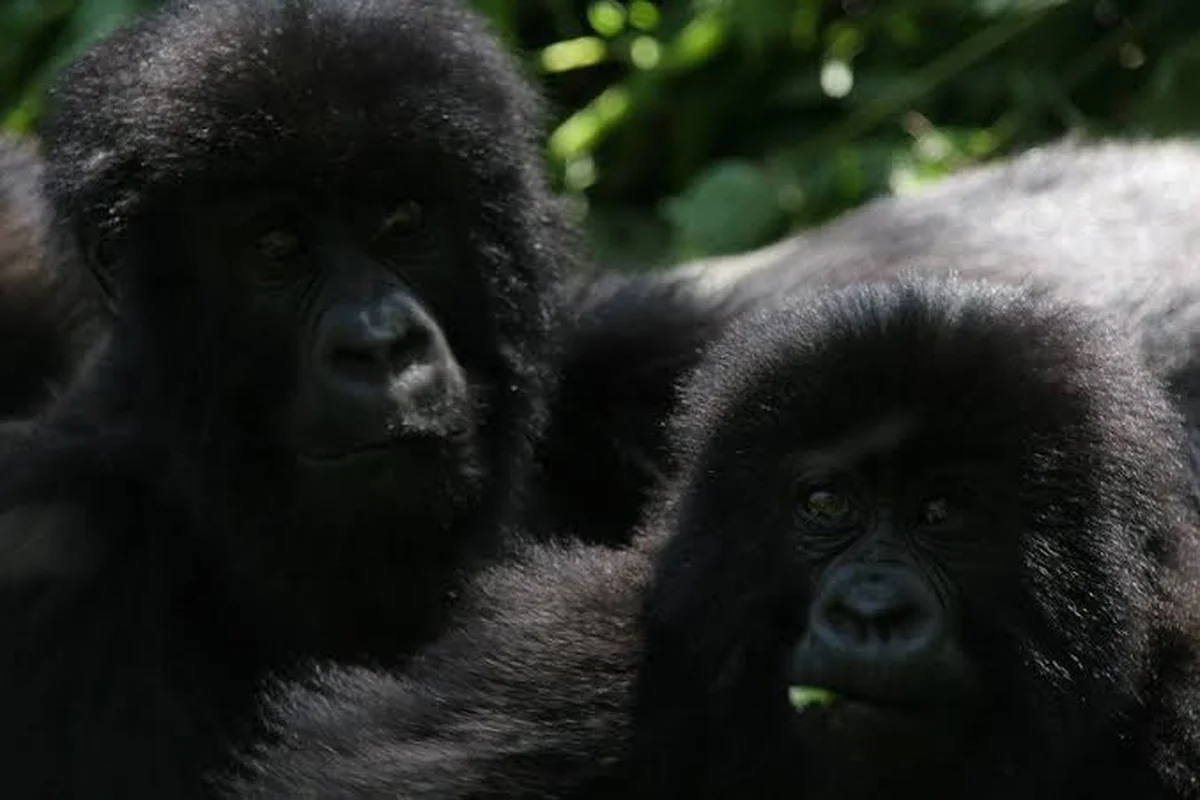
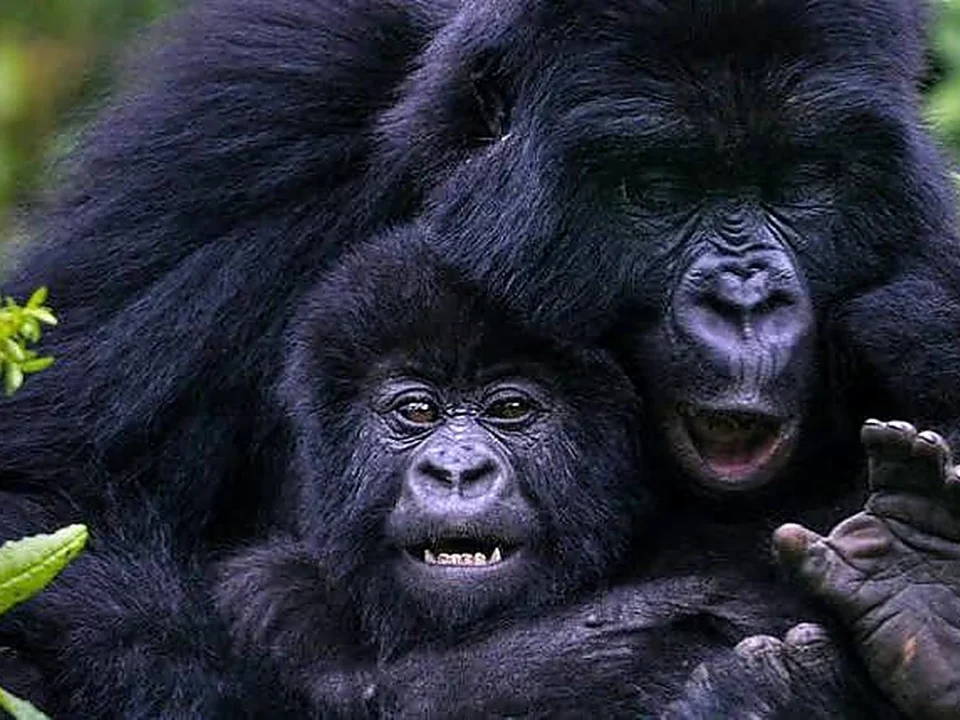
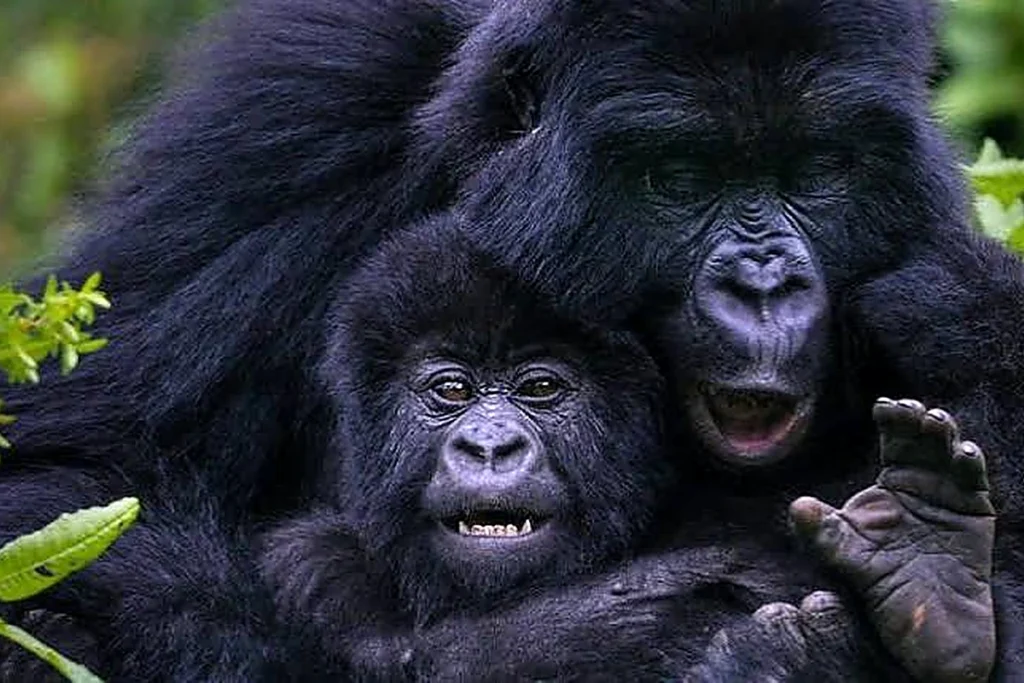
Two gorillas resting close together in their natural forest habitat, highlighting the extraordinary wildlife encounters that make gorilla trekking unforgettable.
Frequently Asked Questions About the Best Trekking Poles for Gorilla Trekking
Do I need trekking poles for gorilla trekking?
Not necessarily. Many visitors manage with a local walking stick or no pole, depending on trail conditions and individual mobility. A pole may be useful on steep or muddy sections, but boots, pacing and ranger guidance remain essential. Ask about walking sticks before buying equipment.
For travelers preparing a Uganda safari, the most useful next step is to confirm the expected trekking sector, ask about local support and prepare suitable clothing. PrideMark Safaris can help coordinate those planning questions. Always prioritize the instructions given by the park team on the day.
Are walking sticks provided at Bwindi?
Walking sticks are commonly available or offered at trekking briefing points, but the arrangement can vary by sector and provider. Confirm with your operator before traveling rather than assuming a specific stick, price or supply is guaranteed.
For travelers preparing a Uganda safari, the most useful next step is to confirm the expected trekking sector, ask about local support and prepare suitable clothing. PrideMark Safaris can help coordinate those planning questions. Always prioritize the instructions given by the park team on the day.
Should I bring one trekking pole or two?
One pole leaves a hand free and can be easier to manage in narrow vegetation. Two poles may feel familiar to regular hikers on open paths. Rangers may ask you to stow either option during certain sections or when observing gorillas.
For travelers preparing a Uganda safari, the most useful next step is to confirm the expected trekking sector, ask about local support and prepare suitable clothing. PrideMark Safaris can help coordinate those planning questions. Always prioritize the instructions given by the park team on the day.
What is the best pole material for wet forest trails?
Both aluminium and carbon-fibre poles can work when well designed and maintained. Reliable locks, a comfortable grip and suitable tip matter more than material alone. Inspect composite shafts for cracks and metal shafts for bending or damaged joints.
For travelers preparing a Uganda safari, the most useful next step is to confirm the expected trekking sector, ask about local support and prepare suitable clothing. PrideMark Safaris can help coordinate those planning questions. Always prioritize the instructions given by the park team on the day.
Are carbon-fibre poles better than aluminium poles?
They are often lighter, but that does not automatically make them better. Compare overall design, durability, price, packed size and your own experience. A dependable aluminium pole may be the more practical purchase for an occasional trekker.
For travelers preparing a Uganda safari, the most useful next step is to confirm the expected trekking sector, ask about local support and prepare suitable clothing. PrideMark Safaris can help coordinate those planning questions. Always prioritize the instructions given by the park team on the day.
Can trekking poles help on muddy slopes?
They can add a point of contact and help some walkers maintain balance, but a tip can still slip or sink. Take small steps, wear suitable boots and follow the ranger’s route. Never rely on a pole to support all your body weight.
For travelers preparing a Uganda safari, the most useful next step is to confirm the expected trekking sector, ask about local support and prepare suitable clothing. PrideMark Safaris can help coordinate those planning questions. Always prioritize the instructions given by the park team on the day.
How long should a trekking pole be?
On level ground, start with a comfortable elbow bend around ninety degrees while the tip rests beside your foot. Adjust for your height and the terrain. Stop in a secure place before changing the length on a steep or slippery trail.
For travelers preparing a Uganda safari, the most useful next step is to confirm the expected trekking sector, ask about local support and prepare suitable clothing. PrideMark Safaris can help coordinate those planning questions. Always prioritize the instructions given by the park team on the day.
Can I take trekking poles on an airplane?
Rules depend on the airline, airport and security authority. Trekking poles are often restricted in cabin baggage, so confirm current requirements and plan checked baggage if necessary. Folding poles are easier to pack but do not guarantee cabin acceptance.
For travelers preparing a Uganda safari, the most useful next step is to confirm the expected trekking sector, ask about local support and prepare suitable clothing. PrideMark Safaris can help coordinate those planning questions. Always prioritize the instructions given by the park team on the day.
Can I use trekking poles when close to gorillas?
Follow the ranger’s instructions. You may be asked to put poles aside or secure them during viewing. Never extend a pole toward a gorilla or use it to push aside vegetation near an animal. Respect the current wildlife viewing rules.
For travelers preparing a Uganda safari, the most useful next step is to confirm the expected trekking sector, ask about local support and prepare suitable clothing. PrideMark Safaris can help coordinate those planning questions. Always prioritize the instructions given by the park team on the day.
Are trekking poles useful for older travelers?
Some older travelers find a walking aid helpful, but needs vary widely. Anyone with mobility limitations, balance concerns or joint problems should seek individual medical advice and discuss the trek with the operator. Porter assistance may also be worth considering.
For travelers preparing a Uganda safari, the most useful next step is to confirm the expected trekking sector, ask about local support and prepare suitable clothing. PrideMark Safaris can help coordinate those planning questions. Always prioritize the instructions given by the park team on the day.
Do trekking poles replace hiking boots?
No. Poles do not provide foot traction, ankle support or protection against mud and wet vegetation. Appropriate footwear, socks, rain protection and a manageable backpack are still important for comfort and stability.
For travelers preparing a Uganda safari, the most useful next step is to confirm the expected trekking sector, ask about local support and prepare suitable clothing. PrideMark Safaris can help coordinate those planning questions. Always prioritize the instructions given by the park team on the day.
How do I arrange a gorilla trekking safari with PrideMark Safaris?
Contact PrideMark Safaris with your travel dates, group size, preferred accommodation level and any walking concerns. The team can help plan an itinerary, discuss permit arrangements and explain what to ask about walking sticks and porter services before the trek.
For travelers preparing a Uganda safari, the most useful next step is to confirm the expected trekking sector, ask about local support and prepare suitable clothing. PrideMark Safaris can help coordinate those planning questions. Always prioritize the instructions given by the park team on the day.
Plan Your Gorilla Trekking Adventure with PrideMark Safaris
Ready to turn your packing list into a carefully planned journey? PrideMark Safaris creates tailored Uganda and Rwanda safaris with accommodation, transfers, wildlife experiences and gorilla trekking arrangements. Tell us your dates, preferred travel style and any concerns about uneven terrain so we can discuss appropriate preparation and practical options.
For official rules and conservation guidance, see the Uganda Wildlife Authority and its published conservation tariff and gorilla viewing guidance. For information about our team, visit the company overview, or contact PrideMark Safaris to plan your safari.