Mountain Gorilla Nests: 7 Amazing Facts About Their Sleeping Habits
Discover how mountain gorillas shape leaves and branches into resting places, choose nesting sites in Bwindi’s forest, care for their young at night and leave clues that help researchers understand their lives.
When people imagine mountain gorillas in Uganda, they often picture a powerful silverback, a mother carrying her infant or a playful youngster moving through the undergrowth. Yet one of the most revealing parts of gorilla life can be found after the animals have moved on: the nest. These carefully arranged beds of vegetation offer a quiet record of how gorillas rest, use their habitat and move through the forest.
Mountain gorilla nests are not permanent shelters built once and used forever. Gorillas generally create fresh nests from nearby plant material for sleeping, and they can leave these resting places behind when the group moves on. The shape, position and plant material of a nest may tell researchers something about the surrounding vegetation, the behaviour of the gorillas and the habitat they are using. In Bwindi Impenetrable National Park, scientists have specifically examined which plants gorillas select when constructing their night nests.
For travellers exploring Uganda with PrideMark Safaris, learning about gorilla nests adds another layer of meaning to a trekking experience. A visitor may spend only a short time observing a habituated gorilla family, but the forest contains evidence of its daily routine long before and after that encounter.

A gorilla nest made from surrounding vegetation. Nest form varies by species, habitat and local conditions. Image source: The Gorilla Organization.
What Is a Mountain Gorilla Nest?
A mountain gorilla nest is a resting platform made from vegetation. Depending on its location and the material available, it may look like a shallow bowl of leaves and stems on the forest floor or a loosely assembled platform supported by branches in a tree. It is better to think of a nest as a temporary bed than as a den: it is generally an open resting place, not an enclosed structure with walls or a roof.
Gorillas are great apes, and nest building is a familiar part of their daily behaviour. Individuals often make nests for night-time sleep, and they may also build resting nests during the day. The whole group does not necessarily sleep in one shared bed. A nesting area can contain several nests close together, with individuals resting near other group members while maintaining their own space. Very young infants are an important exception because they depend closely on their mothers.
Mountain gorillas live in a forest environment where vegetation is readily available, but not every plant or location is equally useful. Plants differ in their leaf size, flexibility, stem strength and arrangement. The nest is therefore a small example of how a wild animal uses its surroundings to meet a practical need.
Fact 1: Mountain Gorillas Build Nests from Plants Around Them
The basic materials used for mountain gorilla nests are collected directly from the environment. Leaves, soft stems, grasses, ferns, flexible branches and other available plant parts may be gathered, bent or arranged into a resting surface. The exact mixture depends on the vegetation in the immediate area, so a nest built in one section of forest may look different from one built somewhere else.
Gorillas do not carry bedding supplies from a central store. They use what grows around them, which means nest building connects their sleeping habits with their daily movements through the forest. A group that has travelled into a patch with abundant soft undergrowth may have different materials available from a group resting among taller trees or a more open section of forest.
Vegetation arranged under the body can create a more supportive surface than bare, uneven ground. It may also help separate the animal from damp leaf litter and small irregularities on the forest floor. These are reasonable functional explanations for a plant-based bed, though the precise comfort or thermal benefit of any particular nest is difficult to measure just by looking at it. Researchers study nest structure and plant selection to learn more about how gorillas use materials and habitats.
Fact 2: Bwindi Gorillas Select Nesting Plants Rather Than Using Every Plant Equally
One of the most interesting facts about gorilla nesting comes from research carried out in Bwindi Impenetrable National Park. A 2006 study examined the plants used by a group of gorillas when choosing nesting locations and constructing individual night nests. The researchers recorded use of 62 plant genera out of 108 genera available in the immediate environment. They also found that the group selected some plant types more often than would be expected from their availability alone.
The study identified plant groups including Pteridium and Mimulopsis in preferred nesting habitats, and reported that Pteridium and Ipomoea were used in individual nests in greater quantities relative to their availability nearby. In everyday terms, the gorillas appeared selective: their nests were not simply random piles of whatever leaves happened to be closest.
This matters because the plants around a nest site help researchers understand how gorillas interact with forest vegetation. If certain plants are repeatedly selected, the availability of those plants may influence where suitable nesting areas occur. It does not mean that every mountain gorilla group uses precisely the same species in the same proportions. Plant communities differ across Bwindi, and behaviour can vary between groups and habitats.
Fact 3: Nests Can Be Built on the Ground or in Trees
Many mountain gorilla nests are built on the ground, but tree nesting also occurs. The balance between ground and tree nests varies with habitat, vegetation and the gorilla population being studied. The Bwindi forest is especially useful for illustrating why it is unwise to assume all mountain gorillas nest in exactly the same way: studies and field projects have documented both ground-based and arboreal nesting in parts of Bwindi.
A ground nest may be created in dense herbs, ferns, secondary vegetation or a suitable opening in the canopy. A tree nest requires branches and a supporting structure that can bear the animal’s weight. Younger gorillas may be more likely than adults to engage in climbing and arboreal activity, but individual habits and local conditions matter. It is not accurate to say that every gorilla group chooses trees in wet weather or ground nests in dry weather as a fixed rule; researchers have found that nest type is influenced by several interacting factors.

The choice between ground and tree nests can be affected by what is physically available. A location with abundant ground-level nesting vegetation offers different options from a site where suitable materials are higher in the understory. For researchers, comparing nest types across sites can reveal how gorillas respond to forest structure and environmental variation.
Fact 4: Nest Building Is Part of the Daily Routine
Gorillas commonly build new sleeping nests as they move through their home range. Nests are usually temporary rather than permanent beds. At the end of a day, members of a group may settle in the same general area, with each individual or family member using a suitable place to rest. They may also make resting nests during the day, depending on their activity and circumstances.
This repeated nest building leaves a trail of signs that can help trackers follow gorilla movements. A recently used nesting area may contain flattened or bent vegetation, compressed leaves, disturbed stems, and other evidence of animals resting there. Trackers do not rely on one clue alone. They look at multiple signs, local knowledge and the broader pattern of the group’s movement.
For visitors on a gorilla trek, these traces help explain the work that takes place before the gorillas are seen. The forest is dense, and the animals are free to move wherever suitable food and habitat occur. Finding them is a skilled tracking exercise, not a matter of simply walking to a fixed viewing point.
Learn more in PrideMark Safaris’ companion article, Gorilla Tracking in Bwindi: How Trackers Find Mountain Gorillas, which explains how trackers interpret signs and navigate the forest.
Fact 5: Mothers and Infants Can Share Nests
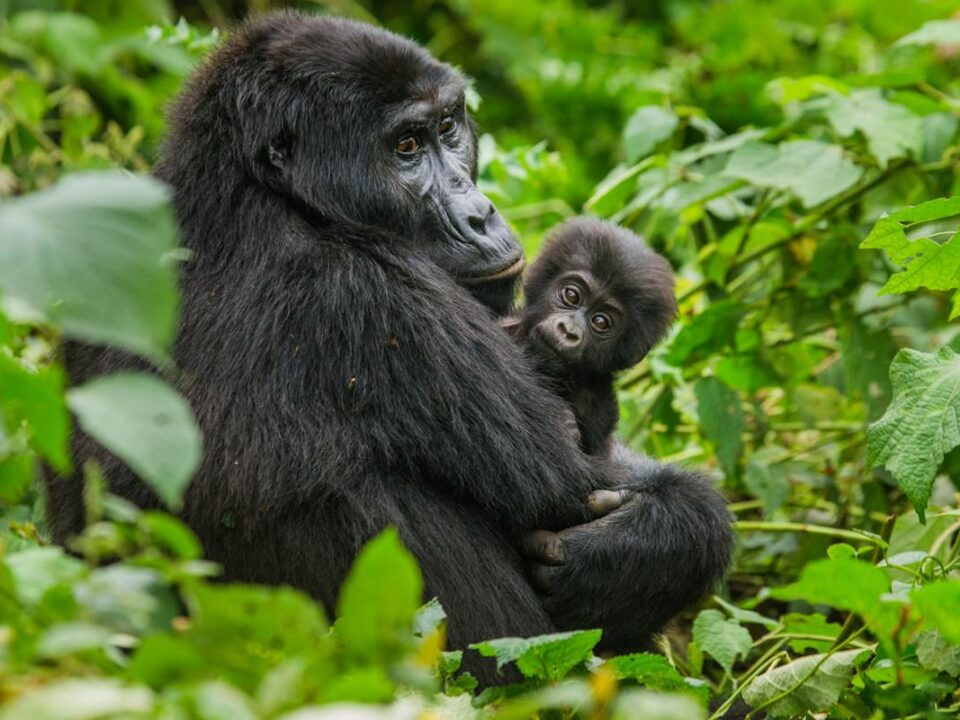
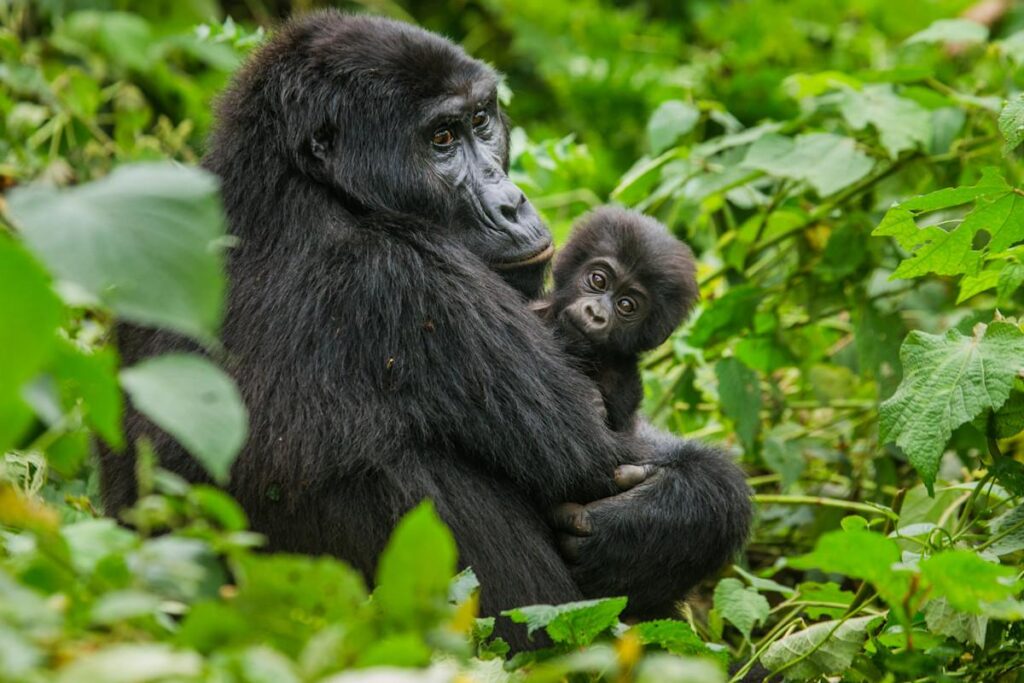
Mountain gorilla infants spend their early lives very close to their mothers. A young infant may rest and sleep in its mother’s nest, protected by her body and physical closeness. As the youngster grows and becomes more independent, its behaviour changes gradually. Nesting is one small part of the wider development through which young gorillas learn to move, feed, rest and interact with other members of the group.
The relationship between mother and infant is not just about sleep. Mothers carry infants, nurse them, groom them and help them remain close to the group. Over time, juveniles explore their surroundings, observe older individuals and build skills through everyday experience. Nesting behaviour should therefore be viewed as part of gorilla development rather than an isolated trick.
Age-related patterns should not be treated as rigid deadlines for every animal. Development varies, and scientific accounts describe typical behaviours rather than a timetable that applies identically to all individuals. What is clear is that very young gorillas rely heavily on maternal care, including during rest.
Use a PrideMark Safaris-owned or properly licensed image of a mountain gorilla mother and infant here. Maternal care is closely linked to the infant’s early resting and sleeping behaviour.
For a deeper look at maternal care, read PrideMark Safaris’ guide to Mountain Gorilla Mothers: How They Raise Their Babies in the Wild.
Fact 6: Reusing a Nesting Site Is Not the Same as Reusing the Same Nest
This distinction is important when interpreting old nests in the forest. Research accounts describe mountain gorillas revisiting the same general nesting locations or areas, but they generally do not reuse the exact nest structure from a previous night. Vegetation changes, nests flatten or decay, and the group’s position can shift as it travels.
A nesting site is the broader place where one or several nests are found. It may be a suitable patch of forest that provides enough vegetation or appropriate terrain for members of the group to sleep. The individual nests are the particular beds constructed at that site. If researchers return to a site and find traces of earlier nests, they must determine whether the traces belong to a new visit, how much time has passed and what evidence supports their interpretation.
Why not use one permanent bed? Gorillas are moving wild animals. Their daily routes are influenced by feeding, social behaviour, habitat and other circumstances. Building nearby makes use of local materials without requiring them to remain tied to a single sleeping place. Moving also means that the animals are not confined to a den-like shelter or a fixed campsite.
This behaviour is one reason gorilla tracking requires patience. Trackers follow signs left by a moving group while respecting the rules and distance requirements designed to reduce disturbance and disease risks.
Fact 7: Abandoned Nests Help Researchers Understand Gorilla Life

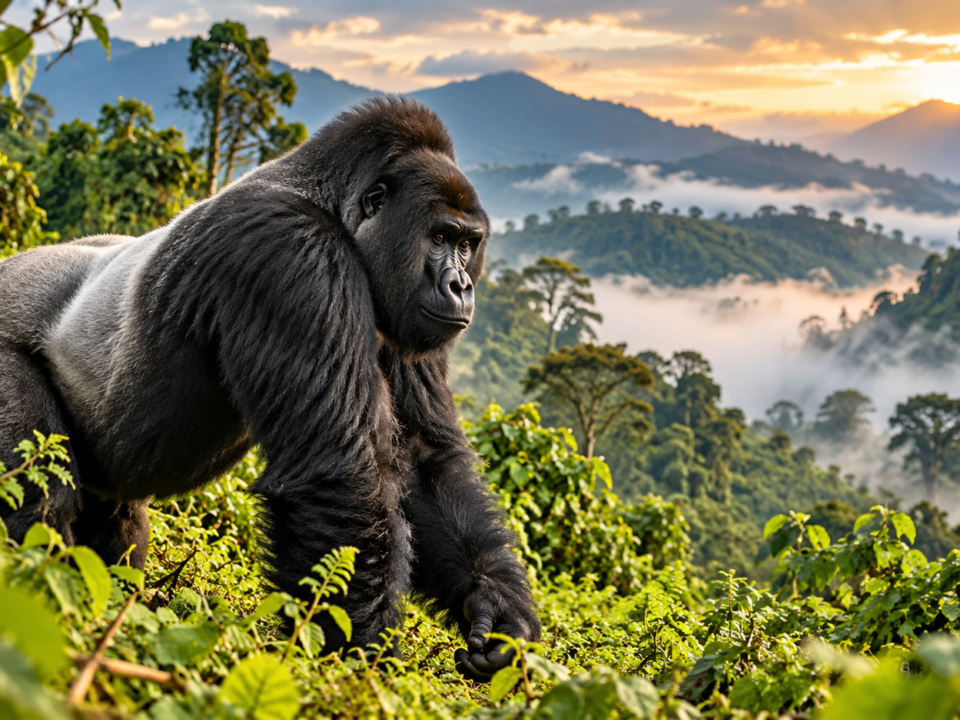
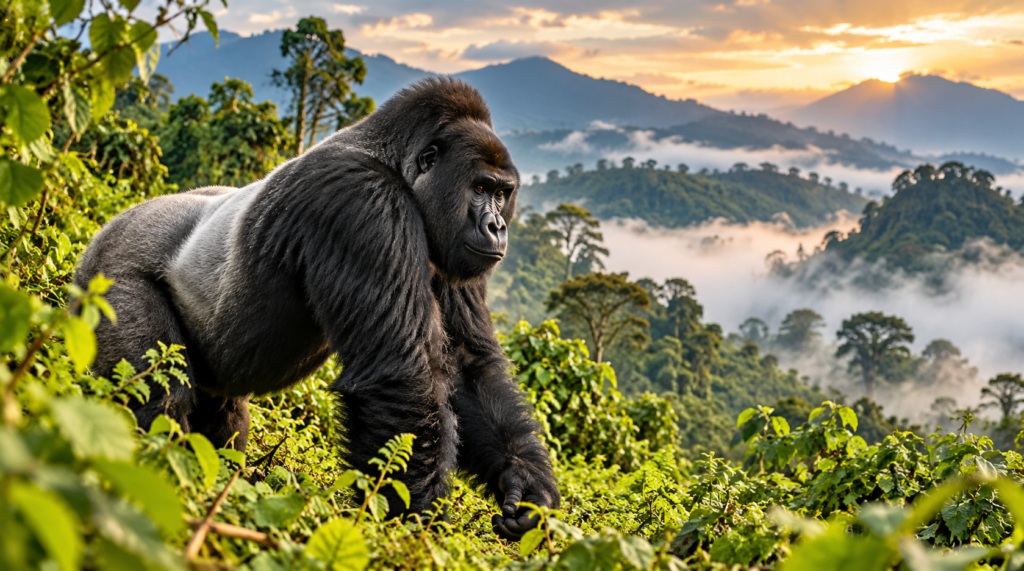
A powerful mountain gorilla calmly seated deep in the lush Ugandan forest
An abandoned nest is more than discarded vegetation. For researchers, it can be a field record. By mapping nest sites and examining the number, type and distribution of nests, scientists can study where a group rests, how it uses different habitats and how its movements relate to food and vegetation. Nest observations can also form one part of population surveys, although nest counts must be interpreted with appropriate methods and other evidence.
Researchers may record whether nests are on the ground or in trees, which plant materials appear to have been used, how many nests occur together and what surrounding habitat is present. When these observations are combined across many sites and dates, patterns may emerge. For example, differences between areas could suggest that vegetation structure influences the places gorillas choose for resting.
Nest remains may also provide clues about how recently a group passed through. Trackers can assess the condition of leaves and stems and compare the nest area with other signs such as bent plants or feeding remains. These clues help build a picture, but they should not be treated as an exact clock on their own. Rain, humidity, plant type and local conditions can all affect how quickly traces change.
Counting nests is not always a simple one-nest-equals-one-gorilla exercise. Infants may share nests with their mothers, nests can be missed, and survey methods affect how many are detected. Scientific teams use established protocols and interpret nest data alongside other information rather than treating a casual visual count as a precise census.
Field research matters because conservation works best when management decisions are informed by evidence. Data about habitat use, movements and nesting can help researchers understand the needs of gorillas and the forest areas on which they depend.
How Do Mountain Gorillas Build Their Nests?
Every nest is shaped by its immediate surroundings, so there is no single blueprint that all gorillas follow. Still, the process can be understood in several broad stages.
This simple sequence should not be mistaken for a claim that researchers have documented the same exact order for every gorilla or every nest. It is a practical description of the observable behaviours involved in building a vegetation bed. Some nests may be more elaborate than others, depending on the site, the individual and available material.
Ground Nests vs Tree Nests: What Is the Difference?
Ground and tree nests are both useful ways to understand how gorillas interact with their habitat. Ground nests are made at ground level, often using herbs, ferns, leaves and stems. Tree nests are formed in branches or supporting vegetation above the ground. Neither type should be considered automatically superior in every circumstance. The suitability of a site depends on the local environment and what materials can support a resting animal.
| Feature | Ground nest | Tree nest |
|---|---|---|
| Location | On the forest floor among vegetation or in an appropriate opening | Supported by branches or a tree structure |
| Common materials | Leaves, herbs, ferns, stems and flexible plant matter | Leaves, stems and branches arranged within or across supporting vegetation |
| Important conditions | Suitable ground, available nesting plants and room to settle | Strong supporting branches and vegetation that can hold the structure |
| Research value | Shows how gorillas use ground-level plants and forest-floor habitat | Shows how gorillas use the understory and arboreal parts of the forest |
Studies on gorilla nesting show that the relative frequency of ground and tree nests differs by habitat and population. This is why photographs of one nest should not be used to make universal claims about all mountain gorillas in Bwindi. When interpreting a nest, researchers consider the local forest rather than focusing only on its shape.
Do Gorillas Sleep Alone or Together?
Mountain gorillas are social animals, and members of a family group often settle in a shared general nesting area. However, a group sleeping near one another does not mean that all members use one large bed. A nest site may contain multiple individual nests, and individuals can rest close to companions while still using separate platforms.
Infants may share a nest with their mothers during early development. Other members generally make their own resting nests, with differences according to age and circumstances. Nest arrangement is therefore connected to social life: where individuals settle can reflect group cohesion while allowing separate resting spaces.
To explore gorilla group relationships more broadly, continue reading PrideMark Safaris’ article on why mountain gorillas live in families. You can also learn about their vocal and physical signals in our guide to how mountain gorillas communicate.
What Gorilla Nests Tell Us About Forest Conservation
Mountain gorillas depend on a healthy forest not only for food, but also for the vegetation, topography and cover that allow them to move, rest and raise young. Nesting research adds another way to examine that relationship. If a particular group uses a wide range of plants or selects particular habitat types for nesting, changes to forest structure can affect the options available to the animals.
Forest conservation is not just about keeping trees standing. Understory plants, saplings, shrubs, ferns, vines and ground vegetation can all be part of the environment used by gorillas. Research into nest construction highlights why the smaller parts of the forest deserve attention alongside large trees and scenic canopy views.
Gorilla conservation also involves field monitoring, trained trackers, ranger protection, veterinary expertise, scientific research and collaboration with surrounding communities. No single activity is sufficient by itself. Protecting a species requires an understanding of its habitat and habits, together with sustained management that helps reduce risks and disturbances.
Responsible tourism can support the wider conservation system when it is properly managed and local communities are included. But observing gorillas should never override their welfare. Visitors must follow ranger instructions, respect required distances, avoid touching or feeding wildlife and comply with health precautions. The purpose of the experience is to observe wild animals without turning their habitat into a stage.
How Visitors Can Respect Gorilla Nesting Habitat
Most travellers will not be shown a nest as a formal stop during a gorilla trek, and nests should never be approached or disturbed just for a photograph. However, visitors can still learn to appreciate the evidence left in the forest and the skilled work that goes into tracking.
- Stay with your ranger and guide. Do not leave the route or search for nests independently.
- Do not handle or rearrange vegetation. Nesting material may be part of the animals’ habitat and field evidence.
- Follow wildlife-distance and health rules. Gorillas can be vulnerable to human-borne disease, so visitor compliance matters.
- Choose responsible local safari arrangements. Ask questions, respect park regulations and support conservation-aware tourism.
- Use accurate wildlife information. Remember that a nest is a clue, not a complete record of an individual gorilla’s life.
If mountain gorillas are part of your Uganda itinerary, start with the Bwindi Gorilla Trekking planning guide for practical information on trekking sectors and preparation. Travellers looking to combine gorillas with other wildlife experiences can explore the PrideMark Safaris tour and safari ideas.
Discover More About Mountain Gorillas with PrideMark Safaris
Mountain gorilla nests reveal a quieter side of gorilla life. These simple structures show how gorillas use nearby plants, respond to the forest around them, care for their young and leave evidence that helps researchers study their movements. In Bwindi, scientific research into nest-plant choice demonstrates that even a temporary bed can reveal complex relationships between wildlife and habitat.
During a gorilla trekking safari, the most memorable moment may be seeing a silverback resting or an infant staying close to its mother. Knowing about nesting behaviour helps put those moments into context. The gorillas are not simply waiting to be seen: they are following their own routines of feeding, resting, travelling and social interaction in a living forest.
Plan Your Uganda Gorilla Trekking Safari
Explore Bwindi with PrideMark Safaris and discover the forest that supports Uganda’s remarkable mountain gorillas. We can help you plan a safari around your dates, preferred comfort level and wider wildlife interests.
Explore Bwindi Gorilla Trekking
Browse Safari Packages
Contact PrideMark Safaris
Frequently Asked Questions About Mountain Gorilla Nests
1. What are mountain gorilla nests made of?
Mountain gorilla nests are made from nearby vegetation, which can include leaves, stems, ferns, herbs and flexible branches. The exact material varies with what grows around the nesting site.
2. Do mountain gorillas sleep in trees?
Yes, tree nesting occurs, including among some gorillas in Bwindi. Many nests are on the ground, and the balance between ground and tree nests varies with habitat and population.
3. Do mountain gorillas use the same nest every night?
They generally build fresh nests rather than reusing the exact same bed. Groups may revisit the same general nesting locations, but an old nest and a nesting site are not the same thing.
4. Do baby mountain gorillas sleep with their mothers?
Very young infants may share their mothers’ nests while they depend closely on maternal care. Nesting behaviour changes as young gorillas grow and become more independent.
5. Can researchers tell how many gorillas live in a group by counting nests?
Nest counts can contribute to field surveys, but they are not always a simple one-nest-per-gorilla calculation. Infants may share nests, nests can be missed, and researchers use established methods and additional evidence when estimating populations.
6. What can an abandoned gorilla nest tell researchers?
An old nest can help indicate where gorillas rested and which plants or habitat features they used. Its condition may offer clues about how recently the group passed, although weather and local conditions affect how quickly traces change.
7. What did researchers discover about mountain gorilla nests in Bwindi?
A study published in 2006 examined nest construction by a group in Bwindi and recorded use of 62 plant genera out of 108 available in the immediate environment. The group selected some plant types more often than their availability alone would predict.
8. Can tourists visit gorilla nests during a trek?
Gorilla trekking focuses on observing habituated gorillas under ranger supervision. Visitors should never seek out, approach or disturb nests independently and must follow the instructions and rules provided by park staff.
Research and Further Reading
The following references support the nesting information discussed in this article. They are provided for readers who want to explore the research in more detail.
- Rothman, J. M. and colleagues (2006). Plant choice in the construction of night nests by gorillas in the Bwindi Impenetrable National Park, Uganda. American Journal of Primatology.
- Robbins and colleagues / species account. Gorilla beringei (Primates: Hominidae). Mammalian Species.
- Nest construction in mammals: a review of the patterns of construction and functional roles. Review article hosted by PubMed Central.
- The Gorilla Organization. Why tracking gorillas through the forest takes patience and great skill.