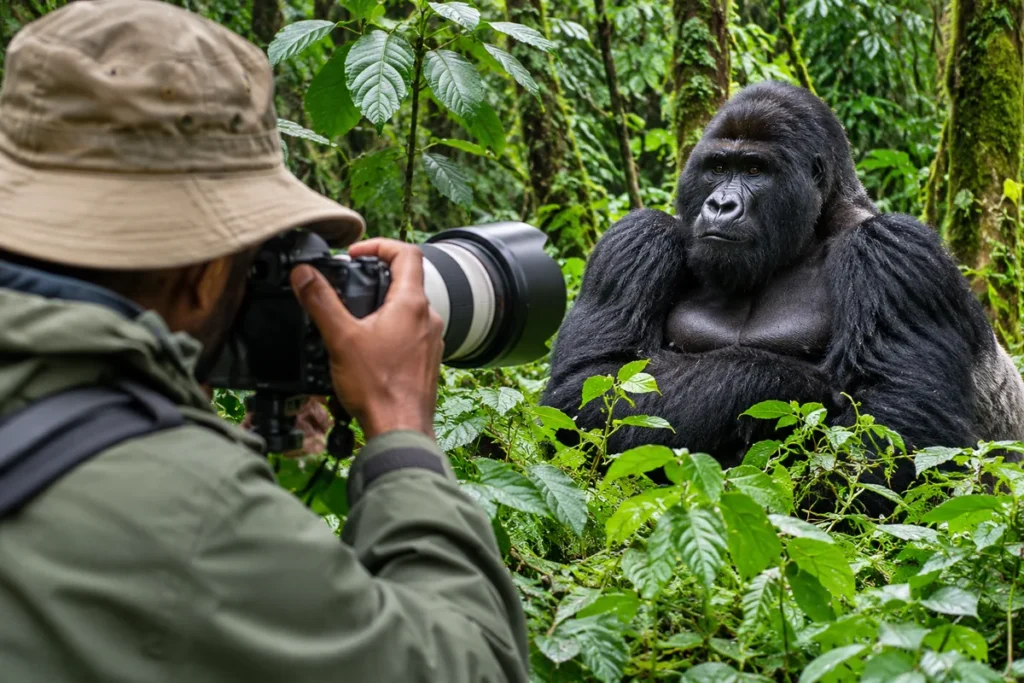
Can You Go Gorilla Trekking With Arthritis in Uganda?
Yes, some people with arthritis can participate in a guided gorilla trek in Uganda, but the diagnosis alone cannot tell you whether the experience is suitable. What matters is how reliably you can walk, balance, climb, descend, and recover when conditions become wet or uneven. Gorilla trekking with arthritis is therefore a planning question, not a simple yes-or-no medical rule.
Uganda offers mountain gorilla encounters in Bwindi Impenetrable National Park and Mgahinga Gorilla National Park. Both involve wild forest environments rather than paved wildlife-viewing platforms. Routes vary with the gorillas’ location, rainfall, vegetation, and the group assigned that morning. A traveler who manages comfortable city walks may still find sustained downhill steps, slippery roots, or awkward footing difficult. Consider the 3-Day Uganda Gorilla Flying Luxury Safari when road travel is a concern.
An arthritis diagnosis can cover very different experiences. One visitor may have mild hand stiffness but excellent walking endurance, while another has unpredictable knee swelling or hip pain after short distances. Consider your actual function on recent hikes rather than relying on the condition’s name. A realistic assessment is especially important because reaching the gorillas is only part of the journey; you must return.
The first step is to discuss the proposed activity with a clinician who knows your condition and current treatment. Describe an unpredictable multi-hour forest walk, possible altitude, limited immediate medical access, and changing weather. Ask about symptoms that should stop participation and how to handle medication or mobility aids. This advice is more useful than a generic certificate declaring someone fit for travel.
Before paying for permits, ask your safari organizer what support may be arranged and what remains uncertain. A porter can carry a daypack and provide practical assistance, but cannot remove steep terrain or guarantee a short route. Explain whether you struggle more with stairs, prolonged standing, downhill walking, or morning stiffness so the conversation focuses on your actual needs. Browse the Uganda Safari Ideas for more itinerary choices.
Gorilla trekking with arthritis can be more manageable when the itinerary includes adequate rest and avoids unnecessary travel fatigue. For example, the 3-Day Uganda Gorilla Flying Luxury Safari reduces some long road travel by using a domestic flight, although the gorilla trek remains physically demanding. Flying is a transport preference, not a medical accommodation or an assurance of easier terrain. Ask PrideMark Safaris about tailoring the travel schedule to your mobility needs.
If a flare makes normal daily walking painful, postponement may be the sensible choice. Missing one trekking date can be disappointing, but forcing a difficult forest walk can create a larger problem far from familiar care. Keep permit terms, travel insurance, and any rescheduling possibilities in mind before departure. A responsible plan allows for the possibility that conditions or symptoms change.
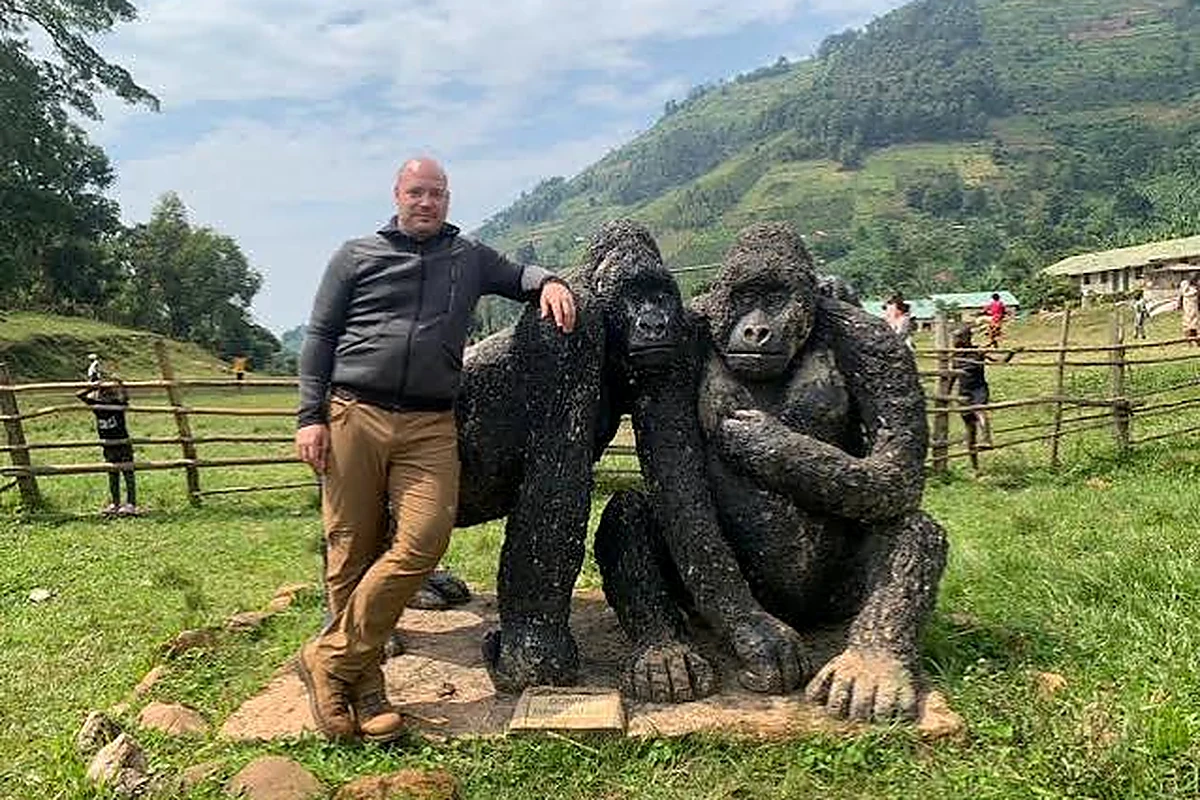
A visitor poses beside two life-sized gorilla statues against a scenic green hillside.
How Arthritis Affects Steep and Uneven Gorilla Trekking Trails
The challenge of gorilla trekking with arthritis is often less about speed than about repeated movements on irregular ground. A muddy slope asks the ankles to stabilize, the knees to control each step, and the hips to manage shifting weight. A narrow trail may require stepping over roots or bending beneath branches. Each movement can become tiring when joints are painful or restricted.
Descending deserves as much attention as climbing. Downhill walking can place substantial demands on the knees, especially when a traveler must brake carefully to avoid slipping. Trekking poles may help some people distribute effort, but only when used correctly and permitted by guides. Practice downhill sections at home rather than assuming that reaching the gorillas means the hardest part is over.
Rain changes trail conditions quickly in mountain forests. Wet leaves can hide roots, exposed soil becomes slippery, and a walking pace that feels comfortable on dry ground may require extra concentration. Choose boots with reliable traction and enough room for any swelling. Test footwear before travel, including on slopes, rather than saving new boots for the morning of the trek. Compare the 5-Day Gorilla & Game Safari Adventure for a mixed wildlife itinerary.
Morning stiffness can complicate an early briefing and departure. Some people feel better after gentle movement, while others need more time before their joints settle. Plan a calm morning with enough time to dress, eat, use the bathroom, and warm up within the limits recommended by your healthcare team. Rushing from a cold lodge room straight onto difficult ground is avoidable.
Fatigue can make good technique deteriorate. When attention drops, people may take hurried steps, grab unstable branches, or compensate awkwardly for a sore joint. A pace that allows controlled foot placement is often safer than trying to keep up through discomfort. Tell your guide early when you need a pause; do not wait until you are exhausted or unsteady.
The Uganda Wildlife Authority explains that gorilla tracking can take several hours and that visitors observe habituated gorillas for a limited period once located. Actual durations and difficulty differ between outings. For arthritis planning, use that uncertainty as the baseline rather than treating a short trek described by a previous traveler as a prediction of your own experience. Ask PrideMark Safaris about tailoring the travel schedule to your mobility needs.
When choosing a package, separate the difficulty of the wildlife activity from the comfort of the surrounding holiday. The 5-Day Gorilla & Game Safari Adventure includes game viewing by vehicle, which can diversify the experience, but it does not eliminate the demanding gorilla trekking day. Review each day of the itinerary and the transfer times before making a decision. Read the official Uganda Wildlife Authority gorilla tracking guidance for the park context.
| Trail feature | Why it matters for arthritis | Planning response |
|---|---|---|
| Steep descent | Can challenge knee control | Practice descents and ask about support |
| Mud and exposed roots | Increases slipping risk | Use tested footwear and slow steps |
| Long, uncertain duration | May increase fatigue | Prepare for variable trekking time |
| Early morning departure | May coincide with stiffness | Allow time for prescribed routine |
Osteoarthritis, Rheumatoid Arthritis, and Other Joint Conditions
Osteoarthritis commonly affects joints such as the knees, hips, hands, and spine, while inflammatory forms of arthritis can involve swelling, fatigue, and systemic symptoms. These broad patterns are not a substitute for individual assessment. Gorilla trekking with arthritis may pose very different challenges depending on whether discomfort is mechanical, inflammatory, intermittent, or accompanied by other health concerns.
For someone with knee osteoarthritis, downhill steps and repeated squatting may be more limiting than level walking. A person with hip stiffness may find high steps or uneven surfaces awkward. Hand arthritis can make gripping a walking stick or tree root uncomfortable. Identify the movement that actually causes difficulty, then test safer alternatives with a physiotherapist before travel.
Inflammatory arthritis may involve periods of increased pain, swelling, warmth, or fatigue. If you use medicines that affect the immune system, ask your treating clinician about travel preparation, infection precautions, and what to do if you become ill. Avoid making independent changes to prescribed treatment to accommodate a safari. Medication planning should be individualized and documented.
Spinal or neck involvement warrants particular attention because slipping, sudden twisting, and carrying weight can aggravate symptoms. A daypack that feels light in an airport may become uncomfortable after hours on a slope. Consider a porter and an appropriately fitted pack, and discuss any neurological symptoms, significant instability, or severe restrictions with your clinician well before booking. See the 4-Day Mgahinga Gorilla and Golden Monkey Safari for a different park option.
Joint replacement history does not automatically rule out travel, but the timing of surgery, rehabilitation progress, and surgeon guidance matter. A person recovering from an operation should not treat a trekking permit as a deadline for healing. Practice walking on similar surfaces only when medically appropriate and make sure your care team understands that the proposed trail may be remote. Browse the Uganda Safari Ideas for more itinerary choices.
Pain levels are useful information, yet function is equally important. Can you descend a staircase without holding both rails? Can you stand on uneven ground while turning to look at wildlife? Can you continue walking after a rest? Honest answers help identify whether additional training, a different itinerary, or postponement is preferable to relying on determination alone.
The Centers for Disease Control and Prevention notes that appropriate physical activity can help people with arthritis improve function and manage symptoms. That does not mean a challenging gorilla trek is therapeutic for everyone. Build capacity through manageable activities and professional guidance, not through a sudden jump from inactivity to strenuous forest walking. The CDC guidance on arthritis and physical activity provides useful background.
Preparing Your Joints and Fitness Before Traveling
Preparation for gorilla trekking with arthritis should begin with ordinary movement you can repeat consistently. Walking on flat ground provides a starting point, but eventually you may need supervised practice on inclines, steps, and uneven surfaces. Increase difficulty gradually and track how you feel during activity and the following day. A single ambitious weekend hike is not a reliable fitness test.
If your clinician agrees, combine aerobic activity with exercises that support balance, strength, and joint range of motion. Stronger muscles can help with control during walking, while balance practice may improve confidence on irregular terrain. The best routine depends on your joints, medications, and existing fitness. A physiotherapist can tailor exercises instead of relying on generic online challenges. Consider the 3-Day Uganda Gorilla Flying Luxury Safari when road travel is a concern.
Practice wearing the boots and socks you intend to use. Check whether swelling changes the fit later in the day and whether the soles grip wet or loose ground. Break in footwear during ordinary walks, not on the safari. Some travelers benefit from professionally recommended braces or orthotics, but equipment should be tested rather than purchased at the last minute.
Training should include realistic recovery. After a longer walk, note whether you can move comfortably that evening and the next morning. Persistent unusual pain, new swelling, or declining mobility is a reason to reduce the workload and seek advice. The goal is sustainable function, not pushing through symptoms to reach an arbitrary distance before departure.
Build a travel schedule that protects sleep and avoids unnecessary pressure. Arriving exhausted after a long transfer may make early-morning stiffness or fatigue harder to manage. If road travel aggravates your joints, discuss the 3-Day Uganda Gorilla Flying Luxury Safari and ask whether additional rest nights can be arranged. A flight may shorten road time, but airstrip transfers still require planning. Browse the Uganda Safari Ideas for more itinerary choices.
Create a written personal plan before leaving home. Include medication names, allergies, important diagnoses, emergency contacts, and advice from your clinician about a flare. Keep essential medicines in hand luggage where appropriate, in original labeled packaging, and confirm airline and destination requirements. This practical preparation helps when luggage is delayed or a travel day changes unexpectedly. Ask PrideMark Safaris about tailoring the travel schedule to your mobility needs.
Finally, practice asking for help. Some visitors hesitate to mention joint limitations because they fear missing the experience. Yet guides and operators can only consider information you share. Explain your walking pace, any balance concerns, and whether you need a porter. Ask what assistance is available and which parts of the route remain beyond anyone’s control. The Mayo Clinic arthritis exercise overview discusses gradual activity and joint protection.
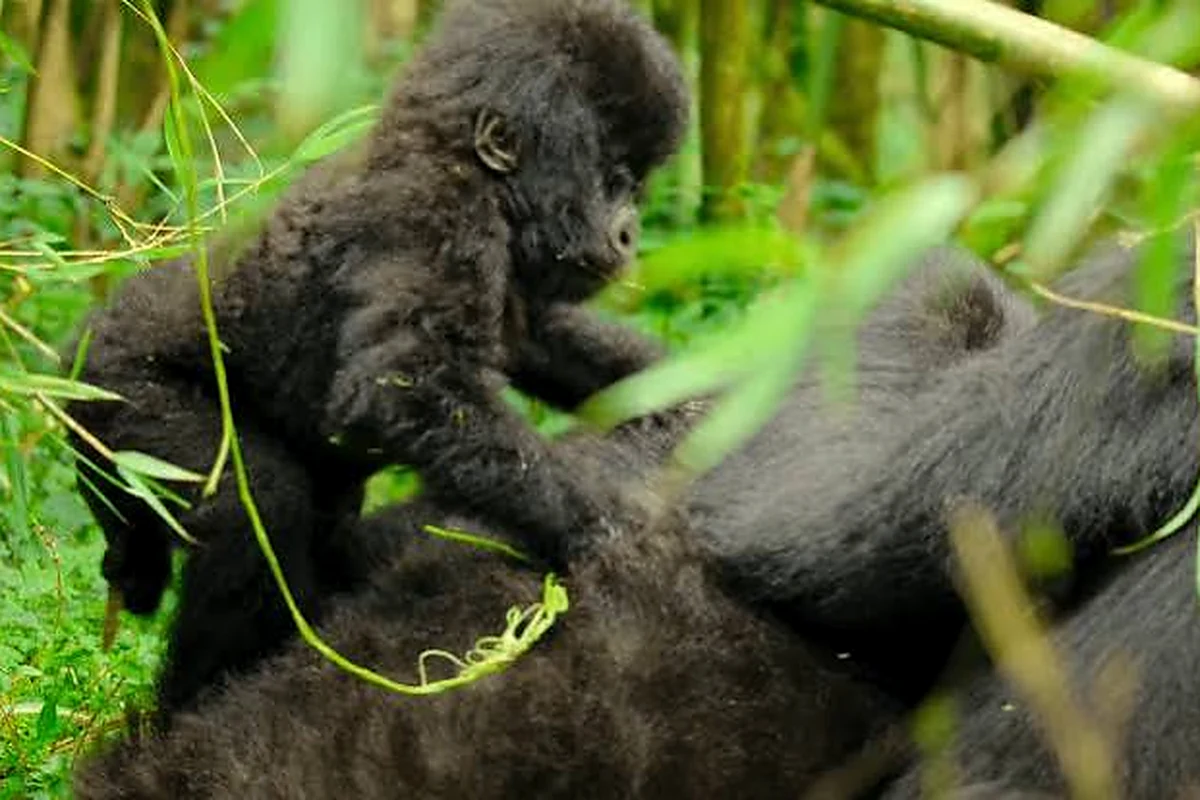
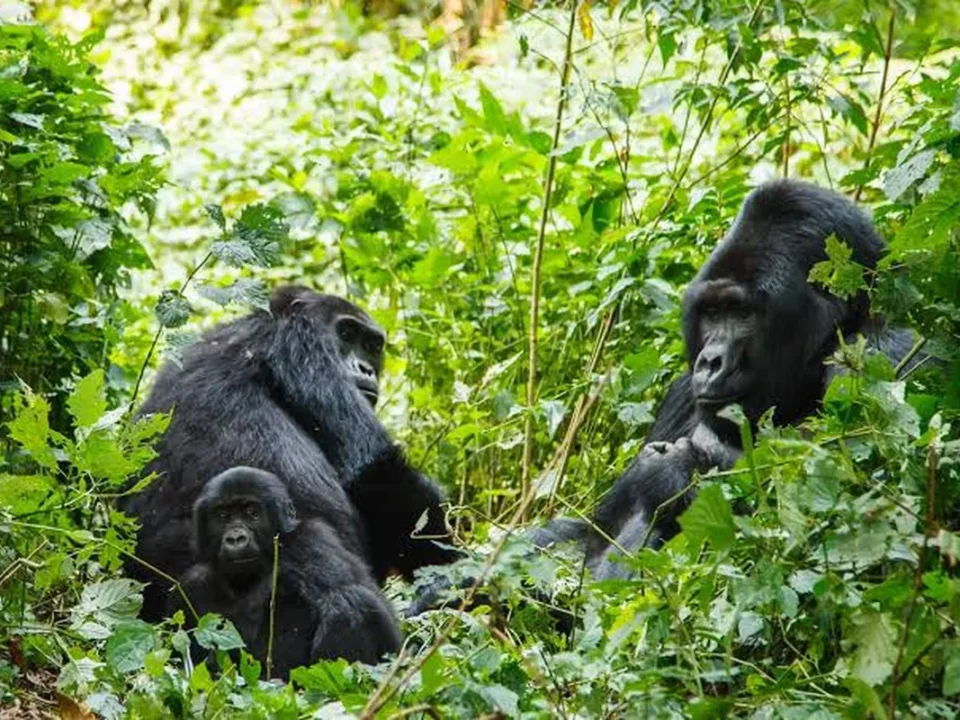
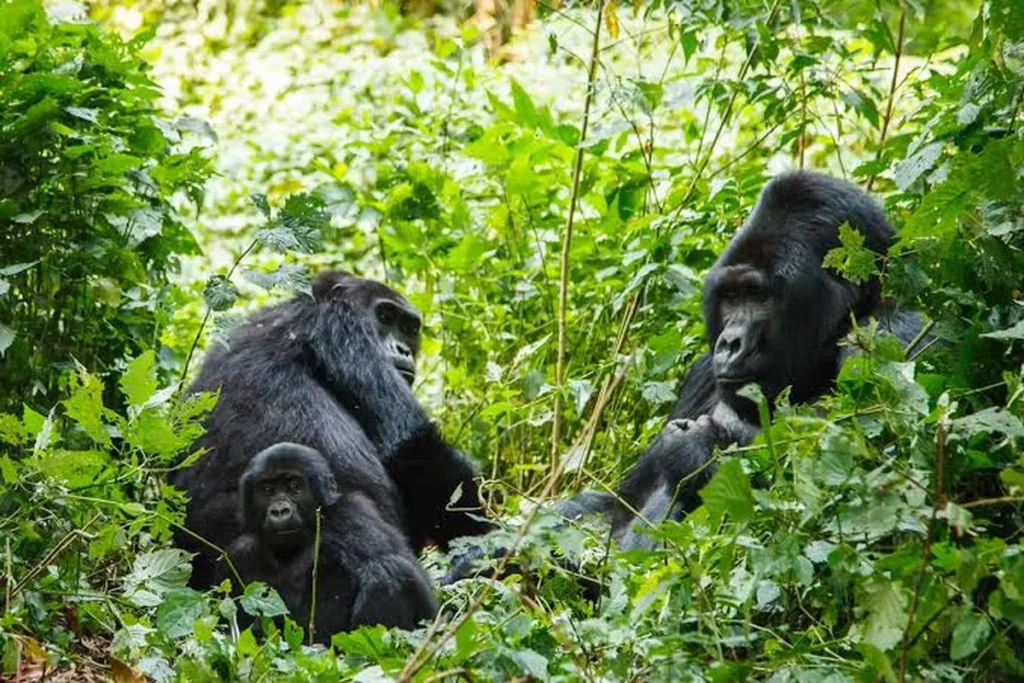
A young mountain gorilla climbs over an adult gorilla surrounded by lush green vegetation.
Choosing Between Bwindi and Mgahinga for Gorilla Trekking
Bwindi and Mgahinga both offer mountain gorilla trekking, but neither should be advertised as universally easier for arthritis. Bwindi has multiple trekking sectors, while Mgahinga occupies a volcanic mountain landscape. Actual difficulty depends on the day’s gorilla location, weather, route, and your own condition. A park name alone cannot predict whether a specific trek will suit you.
Bwindi’s recognized entry sectors include Buhoma, Ruhija, Rushaga, and Nkuringo. Their landscapes and access arrangements differ, but any sector can involve steep or slippery sections. Rather than requesting an allegedly effortless sector, ask about accommodation proximity, transfer times, ranger briefings, and whether your mobility concerns can be communicated to park staff before the trek.
Mgahinga provides a different forest and mountain setting, with opportunities for golden monkey trekking as well. Its terrain can still be demanding, particularly at altitude and after rain. The 4-Day Mgahinga Gorilla and Golden Monkey Safari is worth comparing if you want to explore this park, but adding a second trekking activity should depend on your recovery and functional ability. Compare the 5-Day Gorilla & Game Safari Adventure for a mixed wildlife itinerary.
The gorillas are free-ranging animals, not stationed beside a predictable path. Rangers work with current information, but a family’s position can change. Even if a group appears close during one outing, another day may require more climbing. That is why gorilla trekking with arthritis should be planned around uncertainty, rather than promises of a particular walking duration. See the 4-Day Mgahinga Gorilla and Golden Monkey Safari for a different park option.
Ask how early you must reach the briefing point and whether the lodge has steps, steep paths, or long walks between rooms and dining areas. These smaller movements matter when joints are already sore. An attractive hilltop property may offer beautiful views but involve repeated stair climbing. Confirm practical access details directly instead of assuming that luxury always means easier mobility.
Consider the overall safari rhythm. A 5-Day Gorilla & Game Safari Adventure can add scenic wildlife viewing after the forest experience, yet road transfers and vehicle entry may still require flexibility. A traveler who needs frequent movement breaks should discuss the schedule before booking. Tailoring the itinerary may matter more than choosing the shortest advertised package.
The most useful comparison is personal: how much walking can you manage today, what happens after a difficult day, and how quickly do symptoms settle? Share those answers with your clinician and safari planner. Use the Uganda Wildlife Authority’s official gorilla tracking information for park rules and recognize that staff cannot guarantee a route matched to a medical condition. Check the Uganda Wildlife Authority tracking guidelines for official procedures.
Walking Sticks, Porters, and Practical Trekking Assistance
Using a porter is a practical option for gorilla trekking with arthritis, especially when carrying weight aggravates the back, shoulders, hips, or knees. A porter may carry your daypack and offer a steadying hand on difficult ground. However, the availability and scope of support should be confirmed locally, and assistance does not replace the ability to participate safely in the trek.
A walking stick can provide another point of contact on uneven terrain. Some visitors prefer one stick, while others have experience with trekking poles. Ask the operator about local practice and follow ranger instructions. Practice with your chosen aid beforehand because poor technique can increase strain or create a tripping hazard, particularly on narrow or muddy paths. Consider the 3-Day Uganda Gorilla Flying Luxury Safari when road travel is a concern.
For hand arthritis, grip size and wrist comfort are important. A stick that requires forceful gripping for several hours may trade knee relief for hand pain. Test handles with your usual gloves and ask a physiotherapist whether a different grip or pole technique would be suitable. Never rely on grabbing vines or branches as a guaranteed substitute for stable support.
Some travelers ask about sedan chairs or carried assistance. Such services may be available in certain circumstances, but availability, costs, routes, staffing, and safety must be checked directly with the operator and relevant park authorities. Do not assume that a carrying option is automatically available on every date or suitable for every medical condition.
Clothing can reduce avoidable discomfort. Lightweight rain protection helps when weather changes, gaiters may limit mud entering boots, and gloves can protect hands when appropriate. Carry drinking water and food consistent with your medical needs. The aim is to minimize distractions while preserving mobility, not to load yourself with so much equipment that walking becomes harder. Browse the Uganda Safari Ideas for more itinerary choices.
Before departure, request a clear explanation of porter arrangements, payment, tipping expectations, and where support begins and ends. When comparing the 3-Day Uganda Gorilla Flying Luxury Safari with road-based options, ask for assistance planning across airport transfers, lodge access, and trekking day. A smooth itinerary involves more than the time spent in the forest. Ask PrideMark Safaris about tailoring the travel schedule to your mobility needs.
Keep your expectations grounded. A guide may suggest a safer pace or a rest stop, but wildlife movements and park rules still govern the experience. If you become unable to continue safely, inform the ranger immediately. No equipment, porter, or package can make an unpredictable mountain forest completely accessible.
| Support option | Potential benefit | Important limitation |
|---|---|---|
| Porter | Carries a bag and may assist with footing | Does not guarantee an easy route |
| Walking stick | Can aid balance for some travelers | Must be used correctly |
| Flying safari | Reduces some road transfer time | Does not shorten the forest trek |
| Extra rest night | Allows more recovery time | Does not remove terrain challenges |
Managing Medication, Morning Stiffness, and Joint Discomfort
Medication planning is central to gorilla trekking with arthritis, particularly when you take daily treatments or medicines that require special storage. Consult your prescribing clinician before travel and keep the regimen consistent unless they advise otherwise. Bring enough medicine for the journey plus an appropriate contingency supply, subject to legal and travel requirements.
If you take anti-inflammatory medicines or pain relief, ask about safe dosing, interactions, stomach or kidney concerns, and what to do if dehydration or illness occurs. Do not increase a dose simply because the trail is harder than expected. Pain medicine can change how symptoms feel without fixing an unstable joint or removing the risk of a fall.
People taking immune-modifying treatments should discuss infection prevention, vaccinations, and travel-related illness with their treating team. Some medicines have specific timing or temperature requirements. Ask how to store them during flights, transfers, and lodge stays. Do not assume that a vehicle cooler or hotel refrigerator will maintain the correct conditions without confirmation. Compare the 5-Day Gorilla & Game Safari Adventure for a mixed wildlife itinerary.
Morning preparation can be simple but valuable. Allow time for breakfast, prescribed medicines, bathroom use, and gentle movements your clinician has recommended. Dress in layers because the forest may feel cool at the briefing point and warmer during climbing. A rushed start can turn manageable stiffness into an unnecessarily stressful first hour.
Pacing is not a sign of weakness. Take deliberate steps, keep a stable posture, and tell your guide when a short pause would help. Avoid sitting on unstable logs or slippery slopes just because you need a rest. Ask where you can stop safely, then stand up carefully, especially if prolonged sitting increases your stiffness.
Hydration and food matter for general trekking comfort, but there is no single amount suitable for everyone. Follow advice appropriate to your medical history, climate, and medicines. Carry water in a container you can reach without awkward shoulder movements. If another condition requires fluid or dietary restrictions, your clinician’s individualized instructions take priority. Ask PrideMark Safaris about tailoring the travel schedule to your mobility needs.
After the trek, allow recovery time rather than automatically booking another strenuous activity. The 5-Day Gorilla & Game Safari Adventure offers a mix of experiences, yet you should discuss whether any optional walks or transfers need adjustment. Gentle movement, rest, and monitoring for unusual swelling can be more useful than trying to fill every hour of the itinerary.
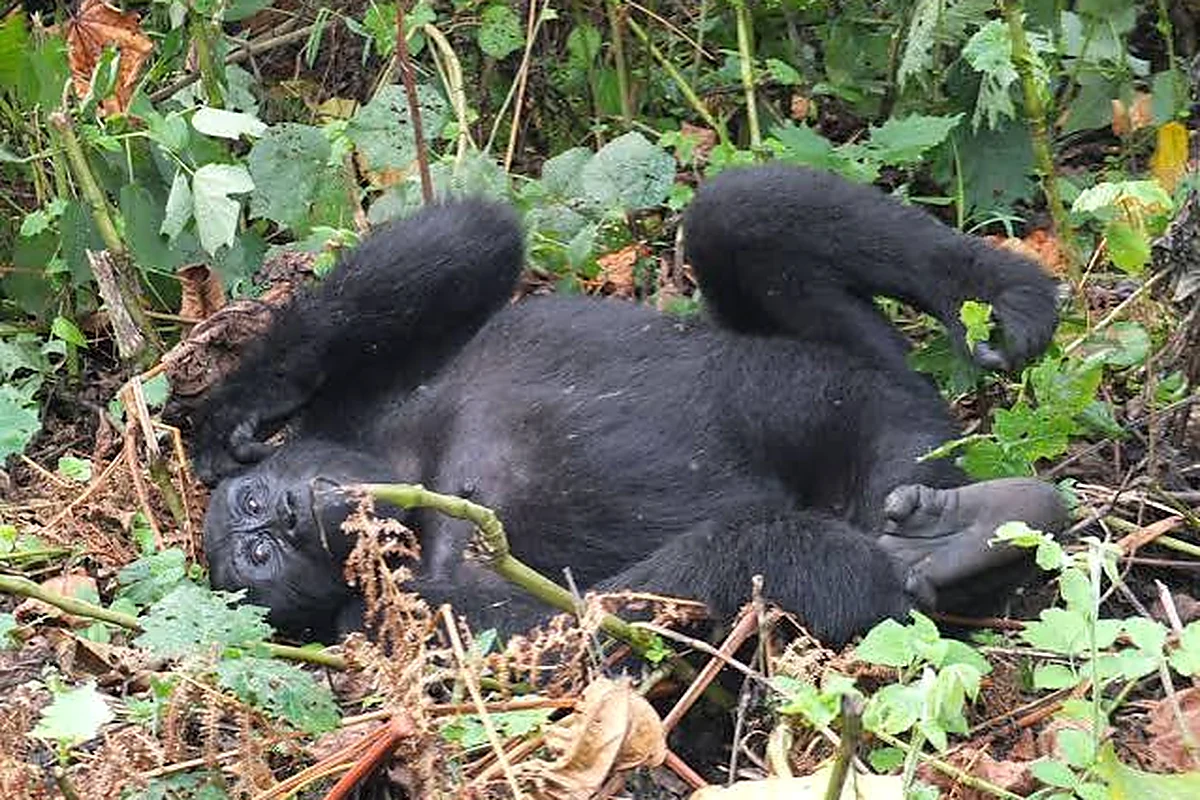
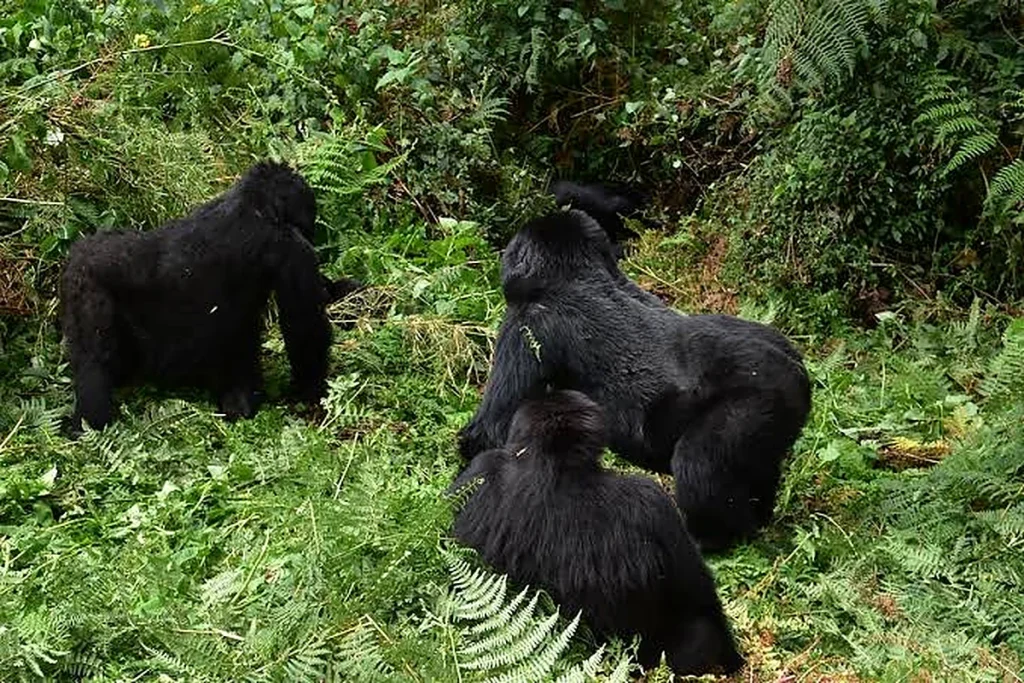
A mountain gorilla lies on its back with its legs raised, surrounded by lush forest vegetation.
When to Rest, Stop Trekking, or Seek Medical Help
Gorilla trekking with arthritis should never require ignoring serious symptoms. New severe joint pain, inability to bear weight, sudden instability, or a fall with possible injury are reasons to stop and tell the ranger immediately. Do not try to conceal symptoms because the group has already walked a long distance or because you are close to the gorillas.
A joint that becomes unusually hot, red, or markedly swollen needs medical assessment, especially when accompanied by fever or feeling unwell. Such symptoms are not automatically an ordinary arthritis flare. Discuss warning signs before traveling and seek professional evaluation promptly when they occur. Remote forest conditions make early communication especially important.
Other urgent symptoms are not necessarily related to arthritis. Chest pain, severe breathlessness, fainting, new weakness, or confusion require immediate attention. Alert your guide and follow emergency instructions. Avoid attempting a difficult descent alone. Your safari operator should explain the practical process for contacting help and reaching medical care before the activity begins.
Know the difference between expected effort and a warning signal. Mild exertional tiredness may settle with rest, whereas sharp pain, rapidly worsening swelling, or repeated loss of balance suggests that continuing may be unsafe. A clinician familiar with your condition can help define personalized limits. Those limits are more valuable than generic advice to simply push through discomfort. See the 4-Day Mgahinga Gorilla and Golden Monkey Safari for a different park option.
Weather can also change the decision. Heavy rain, colder conditions, or a longer-than-expected route may make a previously reasonable plan unsuitable. Rangers control the trek and wildlife encounter, and participants must follow their instructions. It is acceptable to communicate that your capacity has changed, even if you felt well at the morning briefing. Browse the Uganda Safari Ideas for more itinerary choices.
Before booking, review travel insurance wording for trekking, pre-existing conditions, emergency transport, and cancellation. Coverage varies and may have exclusions or disclosure requirements. Keep emergency contacts accessible and ask your operator what support is possible in the relevant park. No safari company can promise immediate hospital-level care in remote forest terrain.
If you decide not to trek, the holiday need not be wasted. A customized Uganda itinerary may emphasize scenic drives, suitable cultural visits, or wildlife viewing from a vehicle, subject to your needs. Explore the Uganda Safari Ideas collection and discuss realistic alternatives rather than treating one missed activity as the end of the trip.
Planning an Arthritis-Aware Uganda Gorilla Safari
The strongest plan for gorilla trekking with arthritis combines medical advice, honest functional assessment, and a flexible itinerary. Start by identifying your limits on stairs, slopes, and uneven ground. Then choose travel dates, lodge arrangements, and transport that reduce avoidable strain. Keep the uncertainty of the actual gorilla route central to every decision.
If long road journeys are particularly uncomfortable, compare the 3-Day Uganda Gorilla Flying Luxury Safari with other options and ask about additional rest nights. A shorter transfer may improve comfort before trekking, but it cannot guarantee that your joints will tolerate the forest. Confirm domestic flight baggage rules, airstrip transfers, and lodge accessibility as part of the same conversation. Consider the 3-Day Uganda Gorilla Flying Luxury Safari when road travel is a concern.
If you want a broader wildlife holiday, the 5-Day Gorilla & Game Safari Adventure pairs gorilla trekking with game drives. This can be attractive for travelers who prefer varied activities, but the published schedule still deserves careful review. Ask about vehicle comfort, breaks, step heights, and whether optional activities can be reduced without disrupting essential bookings. Compare the 5-Day Gorilla & Game Safari Adventure for a mixed wildlife itinerary.
For travelers drawn to Mgahinga, the 4-Day Mgahinga Gorilla and Golden Monkey Safari offers another starting point. Remember that golden monkey trekking is an additional walking activity rather than a guaranteed rest day. Discuss whether it is appropriate to keep both treks, change the order, or substitute a less demanding experience if your symptoms fluctuate. See the 4-Day Mgahinga Gorilla and Golden Monkey Safari for a different park option.
Before paying, request written clarity on what is included, what is optional, and what is subject to park allocation. Gorilla permits, accommodations, transfers, porter arrangements, and cancellation terms deserve separate attention. A well-designed package makes logistics clearer but cannot promise particular gorilla locations, trekking durations, or medical outcomes.
When contacting PrideMark Safaris, explain your condition in practical terms rather than sending only a diagnosis. Say whether you can walk for several hours, use a walking aid, need frequent pauses, or struggle with stairs. Ask about lodge access and the realistic limits of support. That information helps shape a thoughtful quotation without suggesting that the company can provide medical clearance. Ask PrideMark Safaris about tailoring the travel schedule to your mobility needs.
Ultimately, the right safari is one that respects both the excitement of seeing mountain gorillas and the limits of your joints. Use professional medical advice to decide whether to attempt the trek, official park guidance to understand the activity, and experienced trip planning to reduce avoidable fatigue. The goal is an informed, memorable journey rather than an unrealistic promise of effortless trekking. For an itinerary discussion, contact PrideMark Safaris directly.
| Before booking | Question to ask | Who can help |
|---|---|---|
| Health assessment | Can I safely manage an uncertain forest walk? | Your clinician or physiotherapist |
| Park logistics | What are the permit and entry arrangements? | Safari operator and park authority |
| Porter support | What can be arranged and at what cost? | Safari operator |
| Travel cover | Does my policy cover trekking and existing conditions? | Insurer |
| Recovery time | Can we adjust transfers and optional activities? | Safari operator |
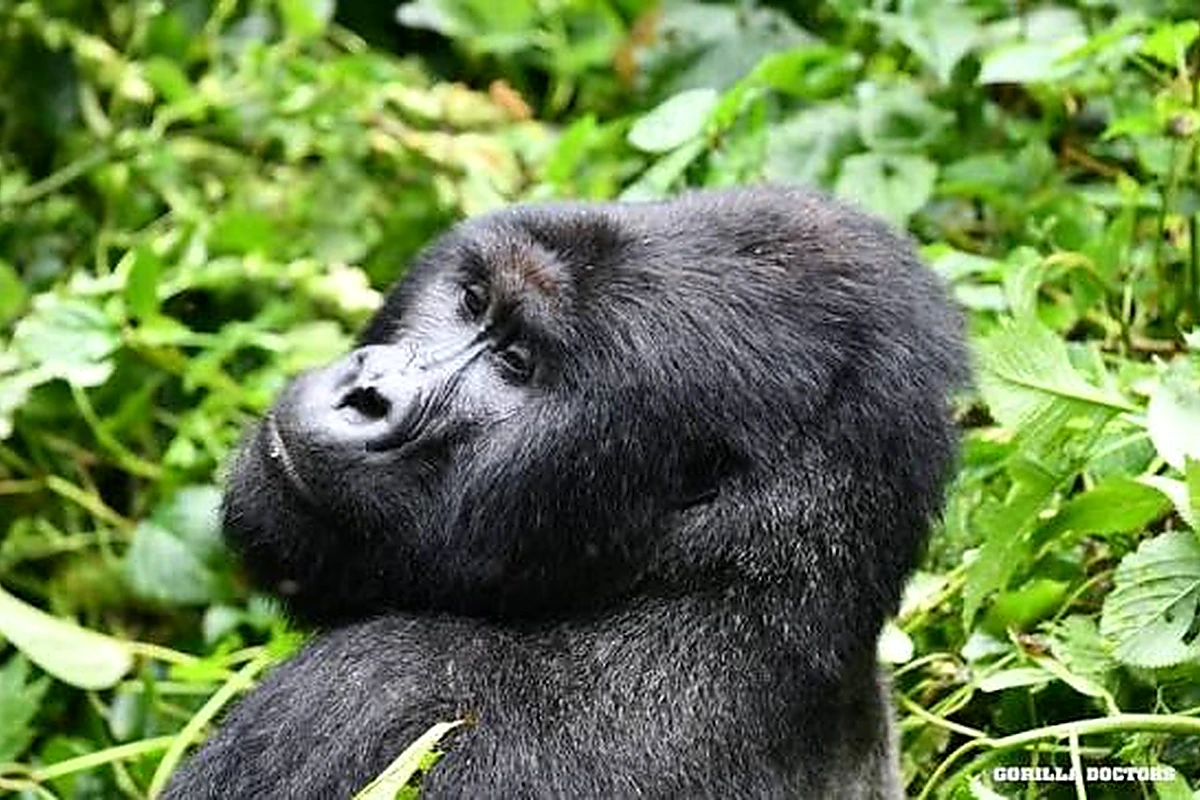
A mountain gorilla looks upward while resting among dense green forest vegetation.
Frequently Asked Questions About Gorilla Trekking With Arthritis
Can I go gorilla trekking with arthritis if I have knee pain?
Possibly, depending on the severity of your knee symptoms, balance, endurance, and ability to descend uneven slopes. Downhill walking may be particularly demanding. Ask your clinician or physiotherapist to assess the proposed activity, practice on suitable terrain beforehand, and discuss porter assistance with your operator. A mild diagnosis does not guarantee an easy trek, and severe or unstable symptoms may make postponement safer.
Is gorilla trekking with arthritis safe for older travelers?
Age alone does not determine suitability. An older traveler with good mobility may manage better than a younger traveler with active joint inflammation. Review your current walking ability, medical conditions, medicines, and recovery after exertion. Gorilla trekking with arthritis should be judged individually, and no operator can guarantee a short or easy route based on age or fitness.
Which is easier for arthritis, Bwindi or Mgahinga?
Neither park is reliably easier. Both involve natural terrain, variable weather, and gorillas that move freely. Bwindi has several trekking sectors, while Mgahinga has a volcanic mountain environment. Ask about logistics and accommodation, but do not assume that a particular park guarantees gentle gradients. Compare the 4-Day Mgahinga Gorilla and Golden Monkey Safari with Bwindi options according to your needs.
Can I hire a porter for a gorilla trek?
Porters may be available to carry your bag and provide practical help on difficult ground. Confirm arrangements, fees, and limitations before your trekking day. A porter can reduce the burden of carrying equipment but cannot remove slippery slopes, guarantee a nearby gorilla family, or replace medical advice. Discuss your mobility limitations honestly so expectations remain realistic.
Will a walking stick help with arthritis on gorilla trails?
A walking stick or trekking pole may improve stability for some people, but the benefit depends on technique, terrain, and which joints are affected. Hand or wrist arthritis can make gripping uncomfortable. Practice before departure and ask a physiotherapist about appropriate equipment. Follow ranger instructions in the forest and never assume that branches provide dependable support.
Can I trek during a rheumatoid arthritis flare?
An active flare with significant swelling, pain, fatigue, or reduced mobility may make a remote forest trek inappropriate. Discuss flare management and the decision to travel with your treating clinician. Do not alter prescribed treatment on your own or rely on pain relief to disguise serious symptoms. Ask about cancellation or rescheduling terms before you purchase permits.
How long does gorilla trekking usually take?
The time varies because gorillas move and forest conditions change. Uganda Wildlife Authority describes treks that can last several hours, with a limited observation period once the gorillas are found. Prepare for an unpredictable day rather than a guaranteed duration. The walk back also counts, particularly when knees and hips become more uncomfortable after prolonged activity.
Can I choose an easy gorilla family to visit?
You can communicate mobility concerns, but gorilla families and routes are assigned under park procedures, and wildlife movements are unpredictable. Do not book on the promise of a particular easy family or short walk. Ask the safari organizer to communicate your needs and follow the ranger’s decisions on the day. Plan as though uneven ground may still be unavoidable.
Should I stop taking arthritis medication before flying to Uganda?
Do not stop, start, or change medication without advice from your prescribing clinician. Some treatments have important dosing, storage, infection, or monitoring considerations. Carry medication information and an appropriate supply, check travel rules, and ask what to do if you become ill. A safari operator can assist with logistics but should not make medication decisions.
Does a luxury flying safari make trekking easier?
A flying itinerary can reduce lengthy road transfers and may leave you less tired before the trek. The 3-Day Uganda Gorilla Flying Luxury Safari is therefore worth considering if sitting for long drives aggravates your joints. However, the actual gorilla trekking route is still natural, variable, and potentially strenuous. Flight arrangements do not guarantee an easy forest walk.
What should I do if joint pain becomes severe during the trek?
Tell your ranger immediately, stop moving if you are unsafe, and follow instructions for assistance. Do not push through severe pain, new inability to bear weight, a fall, or marked swelling. Seek medical assessment when indicated. Before departure, ask your operator about communication and emergency procedures because access to medical facilities is limited in remote forest areas.
How can PrideMark Safaris help plan my trip?
PrideMark Safaris can discuss itinerary choices, transfer preferences, lodging logistics, and requests for porter arrangements while explaining what cannot be guaranteed. Share practical details about your mobility and ask for a tailored quotation. For medical clearance, medication changes, and decisions about whether you should trek, rely on your own qualified healthcare professional rather than a tour operator.
Start Planning Your Uganda Gorilla Safari
Gorilla trekking with arthritis is a possibility for some travelers, but never a promise of a painless or easy hike. Start with individualized medical advice, realistic practice, and an itinerary that allows for changing symptoms. Compare the 3-Day Uganda Gorilla Flying Luxury Safari, 5-Day Gorilla & Game Safari Adventure, and 4-Day Mgahinga Gorilla and Golden Monkey Safari before choosing a route.
To discuss travel logistics, accommodations, transfer preferences, and available assistance, contact PrideMark Safaris. Explain your mobility needs clearly and ask for a tailored proposal. Park authorities and guides make decisions about trekking procedures, while your healthcare professional remains the right person to assess your medical readiness.